Why So Many Ancient Cultures Described the World as Illusion
How Hindu Maya, Plato’s cave, Buddhist impermanence and quantum ideas point to a layered reality where everyday experience masks deeper truth.

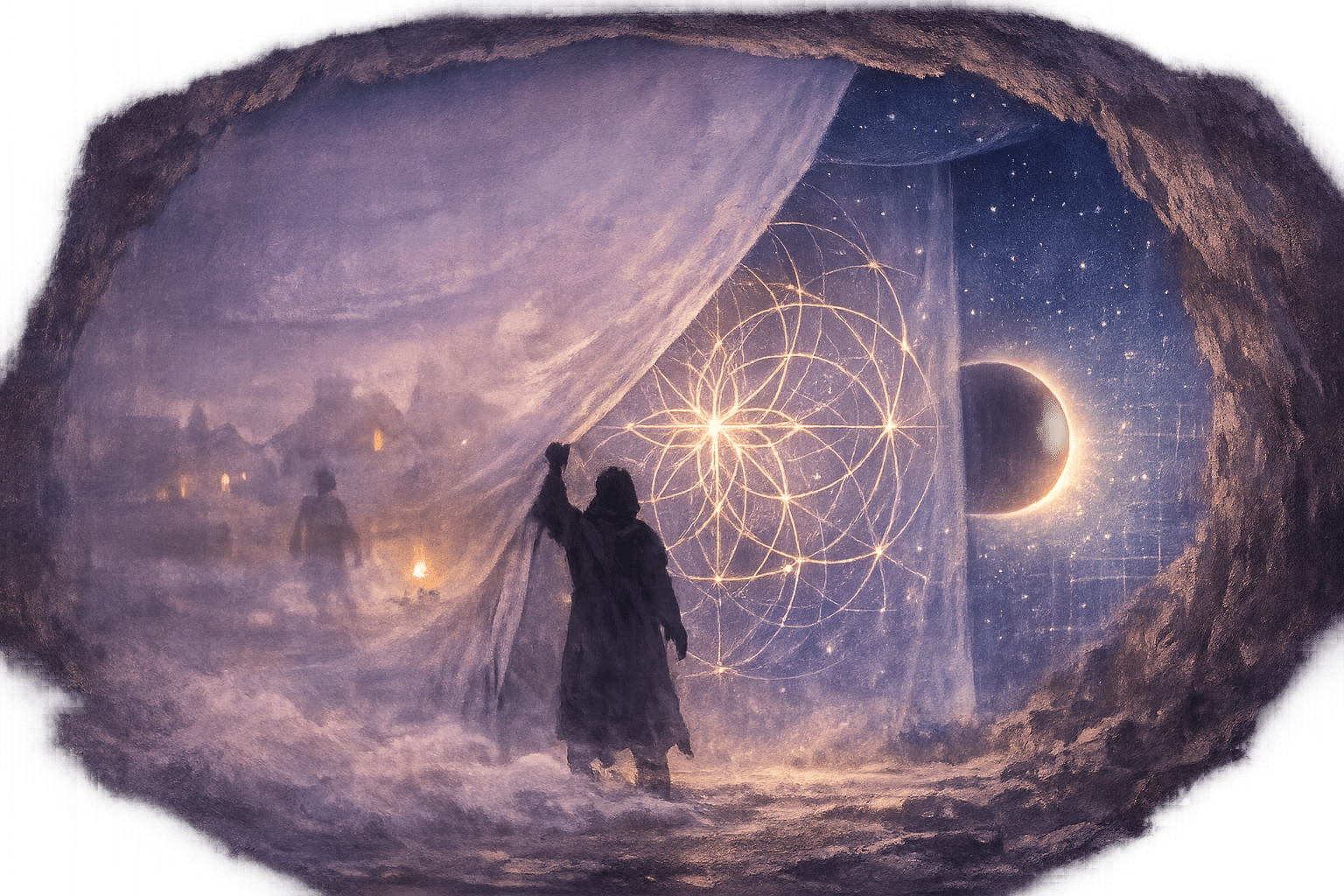
Ancient philosophies often hint at a shared truth: the world we see is not the full picture. Hinduism speaks of Maya, the veil hiding ultimate reality. Plato’s Allegory of the Cave suggests our senses show only shadows of a deeper truth. Buddhism reveals the world’s constant impermanence and the illusion of a fixed self. These traditions, though separated by time and geography, converge on the idea that reality is layered, and what we perceive is but the surface.
Today, modern science echoes these ideas. Quantum physics shows particles exist in undefined states until observed, much like a video game rendering only what’s in view. Simulation theory proposes we could be living in a constructed reality, akin to the ancient notion of a cosmic illusion. Whether through spiritual awakening or scientific theories, the question remains: is this world the true reality, or just one layer of it?
This article explores how ancient teachings and modern theories align, offering paths to see beyond the veil - whether through self-inquiry, meditation, or questioning the layers of existence.
Maya: The Hindu Concept of Illusion
What Maya Means
In Hindu philosophy, Maya is the force that transforms the infinite, unbounded consciousness of Brahman into the material world we perceive. The term comes from the Sanskrit mā, meaning "to measure" or "to form." In ancient texts like the Rig Veda, Maya was seen as a creative power that manifests the universe. By the time of the Upanishads, the idea had shifted, describing Maya as the force that veils ultimate truth, making the singular Brahman appear as the multiplicity of existence.
Hindu thought divides reality into two layers: Paramarthika (absolute reality, the essence of Brahman) and Vyavaharika (the empirical, everyday reality shaped by Maya). Maya is not seen as entirely false but as "relatively real" - a temporary distortion that conceals the ultimate truth until spiritual awakening. Scholar Lynn Foulston explains this duality: "The world is both real and unreal because it exists but is 'not what it appears to be'".
On a personal level, Maya manifests as avidya (ignorance), which leads individuals to identify with their physical and mental selves rather than their eternal soul. This identification fosters attachment to fleeting experiences and reinforces the illusion of separateness from the greater whole. The Bhagavad Gita expresses this idea with clarity:
Deluded by the ego, man thinks, 'I am the doer'.
This misunderstanding not only binds individuals to the transient but also serves as the starting point for spiritual liberation. Hindu traditions offer various paths to transcend this illusion.
How Hindus Transcend Maya
Recognizing the nature of Maya naturally raises the question: how can one move beyond its veil? Hinduism offers several approaches to help seekers realize their unity with Brahman.
- Jnana Yoga, the path of knowledge, focuses on self-inquiry. Practitioners ask, "Who am I?" to cultivate discrimination (viveka) and detachment (vairagya), essential tools for seeing beyond Maya.
- Bhakti Yoga dissolves the illusion of separateness through devotion. By directing love and surrender toward the Divine, individuals transcend Maya. As poet-saint Mirabai expressed:
Maya has no hold on one whose heart belongs to Krishna.
- Karma Yoga emphasizes selfless action. By performing duties without attachment to results, practitioners purify their hearts and weaken Maya's grip.
A Guru, or spiritual teacher - whose name literally means "remover of darkness" - is often essential in guiding seekers. Adi Shankaracharya, a revered philosopher, emphasized this role:
Only through the knowledge imparted by the guru can one cross this ocean of Maya.
Additional practices like meditation, cultivating sattva (purity), and sustained spiritual effort help dispel Maya, allowing the eternal truth to emerge. Through these paths, the seeker moves closer to the realization of Brahman and the dissolution of illusion.
Plato's Allegory of the Cave
The Cave and the Shadows
In 380 B.C., the Greek philosopher Plato shared one of the most enduring metaphors for understanding illusion in his work, The Republic. He described prisoners who had been chained inside a dark cavern since childhood, unable to move their heads and forced to stare at a wall directly in front of them. Behind them, a fire burned, and between the fire and the prisoners, puppeteers carried objects that cast shadows on the wall. For the prisoners, these shadows were their entire reality - they had no knowledge of the objects or the fire that created them.
Plato used this vivid image to explain how the "visible world" that we perceive through our senses is merely a distorted reflection of a deeper, truer reality. As Socrates explains in the dialogue:
To them, I said, the truth would be literally nothing but the shadows of the images.
The chains represent the limitations of human perception and the influence of societal conditioning, while the cave itself symbolizes ignorance and the material world. This imagery aligns with the concept of Maya, the idea that the physical world conceals deeper truths. Plato's allegory sets the stage for exploring the challenging path from ignorance to enlightenment.
The Journey Out of the Cave
Plato didn't just describe the illusion - he also mapped out the process of awakening. When a prisoner is freed and forced to turn toward the fire, the sudden brightness is overwhelming, both physically and mentally. The climb out of the cave symbolizes the soul's journey from ignorance to knowledge, a process that is neither easy nor immediate. This transformation echoes ancient wisdom about breaking through the illusions of the material world.
Once outside the cave, the freed prisoner encounters the sun, which represents the "Form of the Good" - the ultimate source of truth, understanding, and the foundation of all that is right and beautiful. Socrates explains this symbolism:
The prison-house is the world of sight, the light of the fire is the sun, and... the soul's ascent from ignorance to intellectual clarity.
The prisoner’s adjustment to the light is gradual. At first, they can only perceive reflections in water, then objects themselves, and eventually, they come to understand the brilliance of the sun. For Plato, this progression mirrors the role of education: awakening the soul to its inner light and its connection to truth. The allegory not only highlights the limits of perception but also underscores humanity's timeless pursuit of a deeper and more enduring reality.
The story ends with a sobering twist: when the enlightened individual returns to the cave to help others, the prisoners often respond with hostility or fear. Their eyes, accustomed to the darkness, perceive the attempt to free them as a threat. This resistance mirrors the struggles faced by spiritual teachers and thinkers throughout history. Plato’s allegory captures the universal challenge of breaking through illusion - a theme that continues to resonate, even in modern discussions like simulation theory.
The Ancient Secrets To Escape The Simulation
Buddhist Views on Impermanence and Self
Much like Maya's veil or Plato's shadows, Buddhism invites us to question our perceptions, revealing the transient nature of reality and the illusion of a fixed self.
Anicca: The Truth of Transience
Anicca, or impermanence, underscores that all conditioned things are fleeting, arising and dissolving as circumstances shift. It is one of the three core characteristics of existence in Buddhism, known collectively as the trilakshana.
This principle applies universally. Your body, thoughts, emotions - everything you encounter - is in constant motion. These phenomena exist due to dependent origination, meaning they arise from interconnected causes and conditions. As these conditions evolve, the phenomena inevitably transform or fade away.
Buddhism identifies our tendency to see the world and ourselves as stable as a fundamental misperception. Rupert Gethin, a scholar of Buddhist studies, explains:
As long as there is attachment to things that are unstable, unreliable, changing and impermanent, there will be suffering – when they change, when they cease to be what we want them to be.
Recognizing anicca is not just an intellectual exercise; it is a practice. Through meditation, practitioners observe the arising and passing of sensations and thoughts, directly experiencing this constant flux.
Interestingly, anicca contrasts sharply with Nibbana (Nirvana), which is described as nicca - unchanging, free from decay or death. This distinction highlights that while all conditioned phenomena are impermanent, there exists a state beyond such conditions.
This understanding naturally leads to a profound question: If everything is impermanent, what does that say about the self?
Sunyata: The Illusion of a Fixed Self
Sunyata, or emptiness, expands on anicca by showing that all phenomena, including the self, lack a solid, independent, and permanent essence. This does not deny existence but reframes it - everything exists as interdependent, ever-changing processes rather than as isolated entities.
The self, in Buddhist thought, is a collection of five skandhas - form, sensations, perceptions, mental formations, and consciousness - all of which are in perpetual motion. As Lion’s Roar explains:
Emptiness means that all things lack - are empty of - inherent or independent existence. Neither we, other beings, nor any phenomenon in the universe has a permanent, separate, and independent core, soul, or identity.
Believing in a fixed self is seen as a form of ignorance. This misconception leads to attachment and suffering, as the mind clings to the illusion of stability where only change exists. Early Buddhist texts liken this cognitive error to a magical illusion (māyā), which tricks us into thinking that the same "self" persists over time, when in reality, the mind is continually shifting.
Meditating on emptiness has practical benefits too. Studies suggest it can reduce negative emotions by 24%. This is because the "self" we often strive to protect is not a fixed entity but a construct dependent on a dynamic interplay of body and mind. Letting go of this illusion eases the suffering tied to defending something that was never solid to begin with.
Common Patterns Across Ancient Traditions
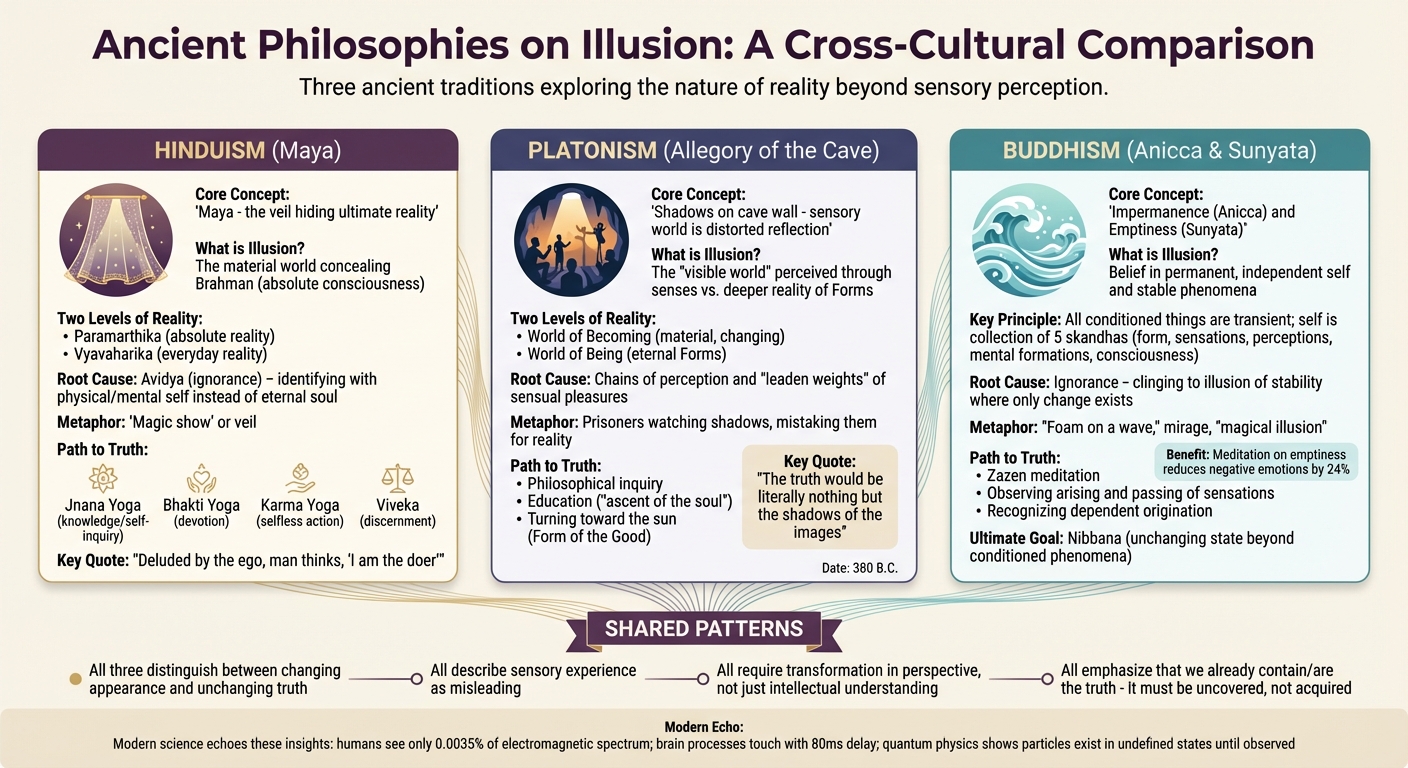
Ancient Philosophies on Illusion: Hindu Maya, Plato's Cave, and Buddhist Impermanence Compared
Throughout history, many spiritual and philosophical traditions have converged on a profound idea: our senses distort the deeper, unchanging essence of reality. Despite their origins in vastly different times and cultures, teachings from Hinduism, Platonism, and Buddhism share this striking insight. Whether it's Maya's "magic show", Plato's shadows on the cave wall, or Buddhism's depiction of sensory experience as a "magical illusion", these traditions remind us that what we perceive is far from the ultimate truth .
This shared perspective goes beyond poetic metaphor. Each tradition draws a clear line between a fleeting, ever-changing world and a stable, eternal truth. In Hinduism, this is seen in the contrast between Prakṛti (the material world) and Brahman (the Absolute). Plato similarly distinguishes the "world of becoming" from the "world of being", where true Forms exist . They also offer parallel explanations for why we remain trapped in illusion: Hinduism attributes this to Avidya (ignorance), while Plato blames the "leaden weights" of sensual pleasures that tether the soul to the shadows.
How Perception Creates Illusion
These traditions use vivid imagery to illustrate how our senses mislead us. Hindu analogies and Buddhist teachings often liken sensory experiences to fleeting illusions. In Buddhism, sensory cognition is compared to "foam on a wave" or a mirage - something that appears solid but is ultimately hollow and insubstantial.
Modern science echoes these ancient observations. For instance, human eyes detect just 0.0035% of the electromagnetic spectrum, and our hearing is limited to a range of 20 Hz to 20,000 Hz. Even our sense of touch lags behind reality, as the brain processes touch with an 80-millisecond delay. In other words, we are always interacting with the past. Neuroscientist Anil Seth captures this idea succinctly:
We're all hallucinating all the time - when we agree about our hallucinations, we call it reality.
These insights, ancient and modern, set the stage for understanding how we might break free from these illusions.
Breaking Through Illusion
To move beyond illusion, each tradition offers a path to uncover the deeper truth. This shift requires more than intellectual understanding - it demands a transformation in perspective. Plato describes this as the "ascent" of the soul, a journey from shadows into light. Hinduism speaks of "lifting the veil" to realize that one is already united with the Absolute. Swami Vivekananda puts it beautifully:
The Vedas cannot show you Brahman, you are That already. They can only help to take away the veil that hides truth from our eyes.
While the methods vary, the themes remain consistent. Hinduism emphasizes Jnana Yoga (the path of knowledge) and Viveka (discernment) to distinguish the eternal from the transient. Plato advocates philosophical inquiry and education as a "rough ascent" to overcome sensory deception. Buddhism, on the other hand, prescribes practices like Zazen meditation to observe the mind's construction of experience and to see through the illusions of the senses.
Breaking through these illusions reveals the timeless truth hidden behind the ever-changing appearances of the world. These ancient strategies not only illuminate the human quest for understanding but also provide a foundation for modern explorations into simulation theory, reimagining this age-old pursuit in a contemporary context.
Simulation Theory and Ancient Illusion Concepts
The ancient belief that reality is an illusion aligns intriguingly with modern perspectives. In 2003, philosopher Nick Bostrom introduced the idea that an advanced civilization could create virtual worlds so realistic that they would be indistinguishable from physical reality. He proposed that we might already be living within such a simulation. This hypothesis echoes the Hindu concept of Maya, providing a digital lens to explore how reality might be constructed rather than existing as an inherent truth.
The similarities go beyond surface-level comparisons. Hindu philosophy differentiates between Paramarthika (absolute reality) and Vyavaharika (everyday reality), a distinction that parallels simulation theory's division between base reality and its simulated layers. Even the term "avatar", now used for digital personas, originates from Sanskrit, where it referred to divine incarnations. Ancient sages described the soul as a "player" who temporarily wears the body like a garment, a notion that resonates with simulation theory's depiction of consciousness as external to the program yet controlling a character within it. These timeless ideas provide a foundation for examining today’s technological advancements.
Simulation Theory as Digital Maya
Columbia University astronomer David Kipping has calculated the odds of us living in a simulation to be approximately 50/50. Ancient texts often describe the universe as being created through divine commands, a perspective that aligns with simulation theory's proposal that reality is constructed through algorithmic code. Interestingly, the Sanskrit root of Maya (mā) translates to "to measure, to form, or to build". This concept of shaping reality mirrors the modern process of coding simulations.
In August 2025, Google unveiled Genie 3, an AI system capable of generating highly realistic, interactive virtual worlds from minimal input, demonstrating that creating vast and convincing simulations is no longer a distant dream. As Nick Bostrom observed:
If technology continues to improve, humans will be able to build virtual worlds indistinguishable from physical reality... This suggests it's possible that a more advanced civilization has already reached that point – and that we are inside one of their simulations.
Quantum Physics and the Nature of Reality
At the quantum level, particles remain in an indeterminate state until observed - much like the way a video game renders its environment only when a player turns their attention to it. This behavior supports the ancient notion that perception offers only a provisional interface to reality. It also aligns with Buddhist teachings, which view cognition as a transient, insubstantial phenomenon. These ideas challenge the assumption that the physical world exists independently of observation and suggest a layered structure to reality.
Both quantum physics and ancient philosophies propose that what we experience is a constructed interface rather than the true essence of reality. Whether labeled as Maya, shadows on a cave wall, or a digital simulation, the message is consistent: we are engaging with a temporary reality that conceals a deeper, underlying truth.
Conclusion
From the Hindu idea of Maya to Plato's allegory of the cave, civilizations throughout history have pointed to a shared understanding: what we perceive is only a fragment of reality. These philosophies suggest that our senses, ego, and societal influences weave an illusion, masking the deeper layers of existence. Whether described as divine deception, fleeting aggregates, or shadows cast by firelight, the message remains the same - what we engage with is a construct, not the essence.
This ancient wisdom resonates with modern theories like simulation hypothesis. For example, Columbia University astronomer David Kipping's calculation that we have roughly a 50/50 chance of living in a simulation reframes these age-old insights for a digital era. The Sanskrit root of Maya (mā), meaning "to measure, to form, to build", feels particularly relevant when compared to how code shapes virtual realities today.
These teachings also offer practical guidance for navigating modern life. Consider how media narratives, social media algorithms, and cultural feedback loops act as the "shadows" of our time. By practicing Viveka - the discernment between the transient and the enduring - we can begin to see beyond these projections. Whether you interpret life as a divine play, a journey out of the cave, or an intricate simulation, the goal remains the same: to look beyond appearances. Ramakrishna Paramahamsa encapsulated this beautifully:
Maya is like the fog. It hides the sun, but it cannot destroy it. When the fog clears, the sun is seen to have always been there.
Ultimately, these perspectives remind us that beneath the surface of our everyday experiences lies a truth that is timeless and unchanging.
FAQs
Why do ancient philosophies like Hinduism, Buddhism, and Platonism describe reality as an illusion?
Ancient philosophies like Hinduism, Buddhism, and Platonism often explore the idea of reality as an illusion, offering insights into the gap between what we perceive and the deeper truths that underlie existence. In Hinduism, the concept of Maya represents the cosmic illusion that makes the material world seem real, obscuring the ultimate reality of Brahman - the eternal, unchanging essence of the universe. Maya isn’t merely about deception; it’s a force that shapes perception, causing us to confuse the temporary with the eternal.
Buddhism approaches illusion through the lens of impermanence and the suffering that arises from clinging to fleeting experiences. Enlightenment, in this context, is about piercing through these illusions to grasp the interconnected nature of all things. Similarly, Plato’s Allegory of the Cave uses the image of prisoners mistaking shadows on a wall for reality, symbolizing how human perception can be both limited and misleading. True understanding, Plato suggests, comes from breaking free of these constraints and seeking deeper truths. Across these traditions, the journey beyond illusion is seen as essential for spiritual and philosophical awakening.
What scientific theories suggest that reality could be an illusion?
Several contemporary scientific theories challenge the idea that reality is as solid and straightforward as it appears. The simulation hypothesis, for instance, entertains the possibility that our universe is a sophisticated computer simulation, crafted by an advanced intelligence. Meanwhile, quantum mechanics unveils a world where particles remain in uncertain states until observed, hinting that the act of observation itself plays a role in shaping reality. Another intriguing concept, the holographic principle, suggests that our three-dimensional reality might actually arise from information encoded on a two-dimensional surface.
Interestingly, these modern ideas resonate with age-old philosophical perspectives. The Hindu concept of Maya describes the material world as an illusion, while Plato's Allegory of the Cave illustrates how our perceptions may only capture shadows of a deeper truth. Though science and spirituality take different paths, both offer compelling glimpses into the mysterious nature of existence.
How can I start to understand and move beyond the illusions described in ancient teachings?
To begin unraveling the veils of illusion described in ancient teachings, the first step is to nurture self-awareness and question the nature of your perceptions. Concepts like the Hindu idea of Maya or Plato's Allegory of the Cave suggest that what we often accept as reality is shaped by limited understanding or superficial appearances. Recognizing this calls for curiosity and a genuine willingness to look beyond the obvious.
You can take practical steps by engaging in meditation, quiet reflection, or spiritual practices that help still the mind and reveal what lies beneath the surface. Exploring philosophical ideas and studying ancient wisdom can also offer insights that deepen your understanding. This path often requires the courage to face uncomfortable truths, release rigid beliefs, and allow for a broader perspective on existence. With patience and an open heart, the deeper layers of reality begin to reveal themselves, one step at a time.