The Mandela Effect: Faulty Memory or Evidence of Glitch Correction?
Thousands of people sometimes remember the same event or image in exactly the same wrong way. Memory science explains much of it. The remaining question is why some errors are so strangely consistent.


Most of us have had the experience of being certain about something and then discovering we were wrong. A name was spelled differently. A line from a film was never actually said that way. A logo did not contain the detail you can picture perfectly clearly.
Usually, that is just annoying.
The Mandela Effect becomes more interesting when large numbers of people remember the same detail incorrectly. The phenomenon is real in the straightforward sense that shared false memories do occur. The harder question is why so many people sometimes arrive at the same wrong version, and whether memory science fully accounts for it.
The term itself came from Fiona Broome, who wrote about remembering Nelson Mandela dying in prison during the 1980s. Other people told her they remembered something similar. The documented history is clear: Mandela was released from prison in 1990, became South Africa's president in 1994 and died in 2013.
That gap between memory and record gave the phenomenon its name.
Since then, the Mandela Effect has grown into a large catalogue of disputed spellings, logos, quotations, film lines and cultural details. Some examples collapse quickly once you examine them. Others are more difficult to shake because the alternative memory is both widespread and remarkably specific.
Why memory feels more reliable than it is
Human memory does not operate like a recording device. We do not store complete copies of events and retrieve them later. Memory is reconstructive.
When you recall something, the brain rebuilds it from fragments. It uses sensory information, meaning, context, expectation, emotion and later knowledge. That reconstruction can be accurate, but it can also change.
Decades of research into false memory have shown how easily later information can alter what people think they originally saw or experienced. Elizabeth Loftus's work demonstrated this repeatedly. Small changes in wording, suggestion or later information can produce confident memories of details that were never present.
This matters because confidence and accuracy are not the same thing. A false memory can feel vivid, detailed and completely certain.
That explains why the Mandela Effect can feel so unsettling. People are not usually saying, "I have a vague sense that this might have been different." They often feel they can see the old version in their mind.
Memory can produce exactly that level of conviction.
Why do people make the same mistake?
The shared nature of the Mandela Effect is where the question gets more interesting.
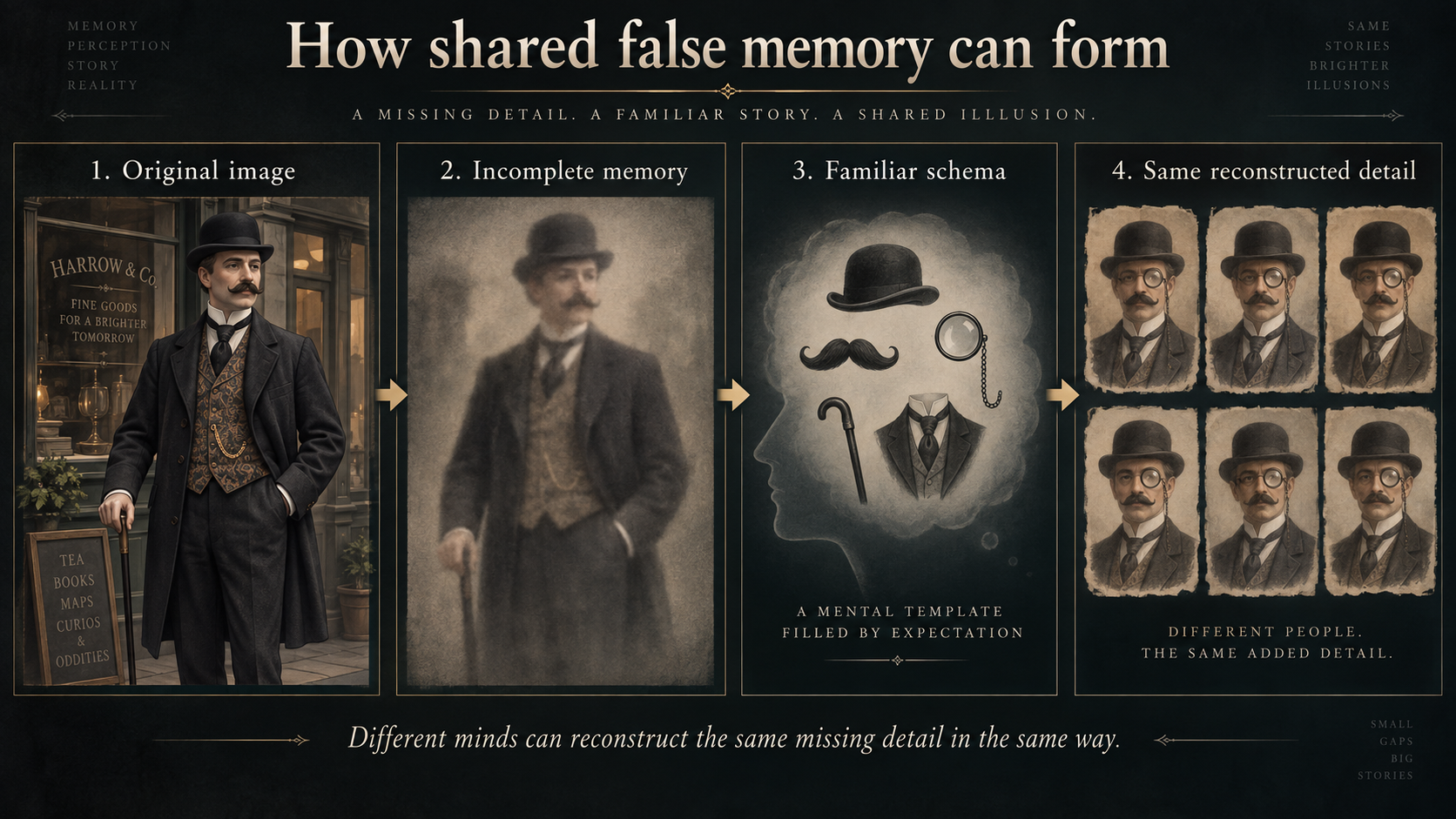
If memory errors were completely random, we might expect everyone to misremember things differently. In reality, people share the same cultural assumptions, language patterns and visual expectations. Our brains also use similar shortcuts when filling gaps.
That creates predictable errors.
The Monopoly Man is a good example. Many people remember him wearing a monocle, even though he does not. The mistake makes intuitive sense because the character fits an old visual stereotype of a wealthy gentleman, complete with top hat, cane and formal dress. A monocle belongs naturally to that mental category.
The same process can affect words. An unusual spelling may drift in memory towards a more familiar one. A film quotation can gradually become more concise or dramatic until the misquotation feels more authentic than the original.
Culture then strengthens the error. Parodies repeat it. Friends repeat it. Television references it. Memes circulate it. Eventually people may remember the altered version while forgetting where they encountered it.
Psychologists refer to this kind of problem as source misattribution. You remember the information but lose track of its origin.
For many Mandela Effects, that provides a strong explanation.
The Visual Mandela Effect
The phenomenon became more interesting when researchers tested it directly.
In 2022, Deepasri Prasad and Wilma Bainbridge published a study on what they called the Visual Mandela Effect. Participants were shown familiar cultural images alongside altered versions and asked which they remembered.
For certain images, people repeatedly chose the same incorrect version.
That is important because the result was not simply poor memory. The mistakes showed a pattern. Different people converged on the same false detail.
The researchers explored several possible explanations, including where people looked when viewing the images and whether they might have been exposed to altered versions online. Those factors did not fully account for what they found.
In another part of the research, people were asked to draw familiar images from memory. Some of the same false details appeared spontaneously.
The study did not show that reality had changed. It showed something more modest, but still intriguing: some images seem particularly likely to generate the same false memory across different people.
That gives us a much better question than the usual argument over whether somebody "remembered wrong".
Why are certain false versions so stable?
Pattern, expectation and mental compression
One possibility is that the brain stores meaning more efficiently than detail.
You do not need a perfect internal copy of every object you encounter. You need enough information to recognise it, categorise it and use it.
That means memory often compresses.
A familiar image becomes a set of features. A character becomes moustache, hat, cane, wealthy man. The precise absence of a monocle may simply not be stored because it is not important.
Later, when the image is reconstructed, the brain fills in what fits.
Language works in similar ways. We remember the sense of a sentence better than its exact wording. Famous film lines often become shorter, clearer or easier to quote over time.
This helps explain why false memories can be shared. People do not need to influence each other directly if the same material encourages the same reconstruction.
The oddity remains in the details. Some errors appear arbitrary enough that simple expectation feels less satisfying. That does not make them paranormal, but it does make them worth examining more carefully.
Anchor memories
Some Mandela Effects are difficult for people to dismiss because the disputed detail connects to another memory.
Someone remembers asking how a particular word was pronounced because of the spelling they now discover was never there. Someone remembers learning what an object was because it appeared in a logo that supposedly never contained it. Someone remembers a family conversation about a line from a film that the film does not contain.
These are often called anchor memories.
They feel persuasive because they contain context. The person is not only remembering the detail. They are remembering another event that appears to depend on that detail being correct.
Memory research gives us reason to be cautious here too. Reconstructive memory can alter surrounding context as well as isolated details. Once two ideas become linked, a coherent autobiographical memory can form around them.
That does not mean every anchor memory is meaningless. It means that vivid context cannot settle the question on its own.
The problem of residue
Mandela Effect communities often look for what they call residue: old material that appears to preserve the remembered version.
This might be a newspaper using an alternative spelling, a cartoon reproducing a disputed logo, old merchandise, a quotation in a book or a parody that appears to depend on the alternate version.
Some of these examples are genuinely interesting, but they need careful handling.
A newspaper can make an error. A cartoonist can work from memory. A parody may repeat the same culturally shared mistake. An unofficial product may copy a popular misconception rather than an original design.
In those cases, residue can show how a false version spread rather than prove that another version once existed.
The strongest residue would need to be original, reliably dated and clearly authenticated. It would also need to be difficult to explain as a reproduction, error or variation.
This raises another problem for the idea that reality has been rewritten. If every official record changed, why would one physical object escape?
Any theory involving altered reality has to explain both the change and the survival of evidence.
Could the Mandela Effect be a correction in the system?
The stranger interpretation begins with a different assumption: reality might be informational.
Imagine that some aspect of the underlying system changes. A detail is corrected or a state is updated. Every record within the system now reflects the new version, while some human memories retain information generated before the change.
From inside that system, those people would appear simply to be wrong.
The analogy is easy to grasp because software behaves like this all the time. A website updates while an older version remains in a cache. Different devices can briefly display different states.
Applied to reality, the idea becomes much more demanding. There is no evidence that Mandela Effects are produced this way.
But as a thought experiment, it creates an interesting problem: if reality could be altered, what evidence could survive the alteration?
This connects directly to Can We Prove We're in a Simulation?. A simulation theory that explains every missing piece of evidence by saying the evidence was rewritten becomes very difficult to test.
That does not make it false.
It makes it weak as an explanation unless it can generate predictions that differ from ordinary false memory.
Would a simulation contain glitches?
Simulation theory is often invoked whenever reality appears inconsistent.
The logic is usually straightforward: software contains bugs, so a simulated universe might contain bugs too.
That is possible in principle, but it does not follow that apparent anomalies are evidence of software errors.
Nick Bostrom's simulation argument is often misunderstood on this point. His argument concerns the probability that sufficiently advanced civilisations might run ancestor simulations. It does not claim that déjà vu, false memories or strange coincidences demonstrate that we live inside one.
Even if reality were simulated, ordinary explanations would still apply. A simulated human brain could still forget, distort and reconstruct memories.
The Mandela Effect becomes relevant to simulation theory only if we can show something beyond normal cognitive error.
A particularly interesting version of the hypothesis would require memory to sit partly outside whatever gets updated. That would mean consciousness somehow retains information that the physical system no longer contains.
That is a much bigger claim than saying a logo changed.
It would also raise deep questions about where consciousness actually resides.
Parallel timelines and alternate histories
Another popular explanation is that Mandela Effects result from shifts between timelines.
Under this idea, both versions may have existed. People who remember the alternative version retain memories from another branch of history.
This sits naturally beside the questions explored in Timeline Jumping 101, but it should not be confused with the Many-Worlds Interpretation of quantum mechanics.
Many-Worlds concerns the branching of quantum outcomes. It does not provide an established mechanism for people moving between large-scale histories while keeping memories from another branch.
The gap matters.
The existence of multiple possible histories would not automatically mean consciousness could cross between them. A theory needs to explain how the movement happens, why only certain memories persist and why the physical record does not.
At present, we do not have that mechanism.
The idea remains philosophically interesting because it exposes the central difficulty of the Mandela Effect. If someone really had moved between two almost identical histories, their experience might look exactly like a false memory.
How could we tell the difference?
This is the hardest part.
Imagine that tomorrow you discover that something you have known for decades is wrong. Every archive, photograph and official record supports the new version. Everyone around you says it has always been that way.
Only your memory disagrees.
What could prove that reality changed rather than your memory?
One strange recollection would tell us very little. A large group remembering the same thing becomes more interesting, but still does not settle the question because people can share cognitive tendencies and cultural influences.
Evidence becomes stronger when the remembered version contains details that ordinary reconstruction should not easily generate.
A familiar stereotype appearing in memory is easy to explain. A completely arbitrary shared detail would be more interesting. Several linked arbitrary details reproduced independently would be more interesting again.
A timestamped physical record that could not be reconciled with the accepted history would raise the stakes considerably.
So far, Mandela Effect cases have not reached that level.
That does not remove the mystery. It defines what stronger evidence would need to look like.
How to investigate one properly
If you encounter a Mandela Effect yourself, capture your memory before you contaminate it.
- Write down exactly what you remember before searching. Include spelling, colours, shapes, wording and context.
- Record your confidence level. Do this before seeing the accepted version.
- Ask other people independently. Avoid telling them what you remember first.
- Avoid forced choices. Asking whether something was A or B introduces both versions.
- Look for primary sources. Use original recordings, official archives, first editions or contemporary photographs where possible.
- Check for similar sources of confusion. Brands, parodies, quotations and characters often overlap in memory.
- Examine residue carefully. Work out who produced it, when and from what source.
- Keep track of correct memories too. A record containing only strange hits is misleading.
- Note whether you encountered the alternate version online first. Once exposed, your own memory becomes harder to evaluate.
- Allow uncertainty. Sometimes the cleanest conclusion is simply that you remember something differently and do not know why.
The same discipline helps with synchronicities and apparent glitches in the matrix.
The aim is not to explain an experience away. It is to preserve it well enough to examine.
What the Mandela Effect may really be showing us
The strongest current explanation for the Mandela Effect is reconstructive memory.
We already know memory can be changed by expectation, suggestion and later information. We also know that people can produce the same false memory independently, particularly when an image or idea invites a particular reconstruction.
That explains a great deal.
It also reveals something deeper about how we experience reality.
We do not encounter the world as a perfect stream of raw information. The brain builds an internal model from incomplete sensory input, stored knowledge and prediction. Most of the time that model is good enough that we never notice the gap.
The Mandela Effect makes the gap visible.
A large group of people can experience an internal version of reality that differs from the physical record, yet feels completely authentic.
That alone is extraordinary.
The metaphysical possibilities begin beyond that point. If consciousness can sometimes retain information from a changed system, another timeline or some deeper informational layer of reality, the Mandela Effect would be one possible place to look.
We do not currently have evidence strong enough to make that claim.
But the phenomenon gives us a useful question.
If reality changed while your memory remained intact, what would the experience feel like?
Probably very much like being told that something you remember perfectly had never been true.
Related reading
If the Mandela Effect has left you questioning how fixed reality really is, continue here:
- Glitches in the Matrix: Cognitive Errors or Cracks in Reality?
- The Frequency Illusion: Once You Notice It, It’s Everywhere
- Timeline Jumping 101: Can You Shift Into a Different Reality?
- Can We Prove We’re in a Simulation? What Evidence Would Actually Count?
- Simulation Theory 101: Are We Living in a Simulated Reality?
- Déjà Vu and the Illusion of Time: Memory Glitch or Glimpse Beyond the Present?