Gnosticism: The Divine Spark, the Demiurge and the Search for Hidden Knowledge
Gnosticism turns the familiar story of creation inside out. Explore the Demiurge, Sophia, the divine spark and the ancient idea that liberation begins by remembering who you really are.

Gnosticism begins with a disturbing possibility: what if the world we experience is not the highest level of reality?
Across a group of religious and philosophical traditions that flourished in the early centuries of the Common Era, we find stories in which human beings have forgotten their origin, the visible cosmos is separated from a higher divine reality, and salvation comes through gnosis, a form of transformative knowledge.
That sounds remarkably modern. It is one reason Gnosticism now appears so often alongside simulation theory, consciousness research and ideas about awakening from an artificial or incomplete world.
But the historical tradition is stranger, richer and much less tidy than the internet version.
There was no single Gnostic church, no universally accepted Gnostic creed and no ancient manual containing “the hidden teachings of Gnosticism”. The label covers different texts and movements that sometimes shared themes but could disagree substantially about God, creation, Jesus, the human soul and the route to liberation.
So before exploring the Demiurge, Sophia, the Archons and the divine spark, we need to begin with the most important point.
What is Gnosticism?
The word gnosis comes from Greek and means knowledge, but in this context it means more than simply knowing information.
Gnosis is knowledge through recognition or direct insight. It is the difference between being told something and experiencing it as true at the deepest level.
Many traditions now described as Gnostic placed this kind of knowing at the centre of spiritual life. Human beings were not simply in need of correct doctrine or moral instruction. They were in a state of forgetfulness.
They had forgotten where they came from.
Salvation therefore involved awakening to a truth about the self, the cosmos and the divine reality beyond ordinary appearances.
That broad idea connects many of the texts we now associate with Gnosticism, but historians increasingly caution against treating them as a single religious system. Some scholars use Gnosticism as a convenient umbrella term, while others prefer to identify specific movements such as Sethian or Valentinian Christianity.
That caution matters because the differences are real.
Some texts portray the material cosmos as a deeply flawed prison. Others offer more subtle accounts in which the problem lies primarily in ignorance, separation or distorted perception rather than matter itself.
The discovery that changed everything
For centuries, much of what scholars knew about Gnostic groups came from their opponents.
Christian writers such as Irenaeus, Tertullian and Hippolytus described teachings they regarded as heretical and attempted to refute them. Those accounts preserved important information, but they were written by people actively arguing against the traditions they described.
Then, in 1945, a collection of ancient books was discovered near Nag Hammadi in Upper Egypt.
The thirteen papyrus codices contained more than fifty texts, including works such as the Gospel of Thomas, Gospel of Philip, Gospel of Truth and Secret Book of John. For the first time, scholars had access to a substantial body of texts associated with forms of early Christianity and spirituality that had largely disappeared from the historical record.
Not everything in the Nag Hammadi collection is Gnostic, and not every Gnostic text was found there.
But the discovery transformed the subject.
Instead of seeing these traditions almost entirely through the accusations of their critics, we could hear some of their own voices.
And the world those voices describe is extraordinary.
The highest God: beyond the creator
One of the most radical ideas appearing in several Gnostic systems is the distinction between the ultimate divine source and the being responsible for creating the visible cosmos.
In many forms of Christianity, Judaism and Islam, the creator of the universe is also the supreme God.
Some Gnostic myths break that identity apart.
Beyond the material universe lies an ultimate divine reality that cannot easily be described. Different texts use different language for this highest principle, including the Invisible Spirit, the Father, the One or, in later terminology, the Monad.
This source is not simply a powerful being somewhere above the universe. It is beyond ordinary categories of existence.
Everything else proceeds from it.
That immediately changes the creation story.
The physical universe may have a creator, but that creator is not necessarily the highest God.
The Pleroma and the Aeons
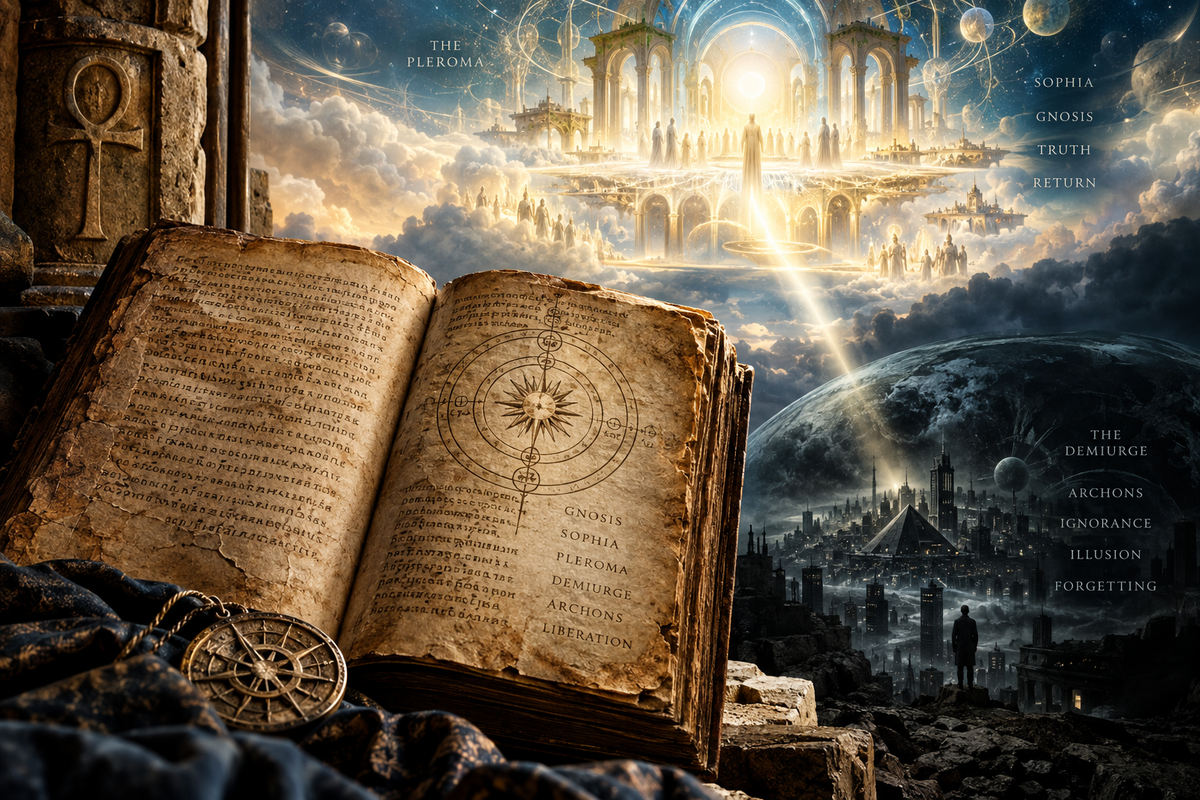
Several Gnostic cosmologies describe divine reality as a Pleroma, a Greek word meaning fullness.
The Pleroma is populated by divine emanations sometimes called Aeons. These are not gods in the straightforward polytheistic sense. They can be understood as expressions or aspects of divine reality, often appearing in paired or structured relationships.
Different texts give different names and arrangements, which is another reason it is dangerous to talk about one universal Gnostic cosmology.
Among the most important figures is Sophia, whose name means Wisdom.
Her story becomes the turning point between the divine fullness and the lower world.
Sophia and the fracture in creation
Sophia is one of the most compelling figures in Gnostic mythology.
In the Secret Book of John, a version of the story describes Sophia attempting to bring something forth without the full harmony of the divine order. The result is a being outside the proper structure of the Pleroma.
That being becomes associated with Yaldabaoth, the chief ruler of the lower cosmos.
Later spiritual retellings sometimes simplify this into a story of Sophia “falling” and accidentally creating an evil god. The ancient myths are more complicated, and different texts treat her role differently.
But the essential pattern is striking.
Something becomes separated from the fullness.
A lower reality emerges in conditions of ignorance.
And the intelligence governing that reality does not fully understand the divine reality above it.
This is where the figure of the Demiurge enters the story.
Who is the Demiurge?
The word Demiurge originally meant a craftsman or maker.
Plato had used the term centuries earlier for the benevolent divine craftsman who orders the cosmos. Gnostic traditions radically transformed the idea.
In several Gnostic myths, the Demiurge is the creator or ruler of the lower material world, but he is not the ultimate source of existence.
Sometimes he is called Yaldabaoth. Other names include Saklas and Samael in particular texts and traditions.
He is frequently portrayed as ignorant rather than simply satanic.
The Demiurge believes himself to be the highest power because he cannot perceive what exists beyond him.
That makes the myth philosophically interesting.
The problem is not merely that the ruler of the world is cruel.
It is that a limited intelligence mistakes its own level of reality for the whole of reality.
For modern readers interested in simulation theory, the comparison is hard to miss. A local creator or administrator controls a constructed environment while remaining separate from, and perhaps ignorant of, the deeper reality from which the system ultimately originates.
That analogy is explored more fully in Simulation Theory and the Demiurge.
But it is important to keep the direction of influence clear. Ancient Gnostic writers were not describing computer code or virtual reality.
Simulation language is a modern metaphor for an older metaphysical problem.
The Archons: rulers of the lower world
The Demiurge is often accompanied by Archons, a word meaning rulers or authorities.
In Gnostic myths, these powers are associated with the organisation and control of the lower cosmos. Depending on the text, they may be connected with planetary spheres, fate, psychological limitation or the forces that keep human beings trapped in ignorance.
Modern spiritual culture has expanded the Archons into everything from literal parasitic entities to extraterrestrial controllers.
Those ideas go far beyond the ancient evidence.
Historically, the Archons belong to complex mythological systems that express a fundamental Gnostic concern: the structures governing ordinary existence may not lead us towards spiritual freedom.
Whether understood literally, cosmologically or symbolically, they represent powers that reinforce forgetfulness.
The human problem is forgetting
This is where Gnosticism becomes much more than a strange creation myth.
Many Gnostic traditions suggest that something within the human being does not fully belong to the lower order.
Humanity contains, or has access to, something originating from the higher divine reality.
This is often described today as the divine spark.
The exact language varies between traditions, but the idea is powerful: beneath ordinary identity lies something connected to a reality beyond the world of ignorance.
The human problem is therefore not simply sin in the conventional sense.
It is misidentification.
We believe ourselves to be only what the lower world tells us we are.
We mistake the temporary identity for the whole self.
We forget our origin.
Gnosis reverses that forgetting.
Gnosis as awakening
The Gospel of Truth, a text associated with Valentinian Christianity, uses the language of sleep and awakening to describe this transformation.
Ignorance is compared with a disturbing dream. While the dream continues, its fears and situations feel completely real. Once the dreamer wakes, the apparent world of the dream loses its authority.
Knowledge of the divine is described as a kind of dawn.
This metaphor captures the Gnostic idea beautifully.
Awakening does not necessarily mean discovering a new piece of information about the universe. It means recognising that the framework within which you understood yourself was incomplete.
This is also why Gnostic interpretations of dreams can be so interesting. Dreaming becomes both an experience in its own right and a metaphor for ordinary consciousness.
Jesus in Gnostic Christianity
Many texts associated with Gnosticism are explicitly Christian.
But the role of Jesus can look very different from later orthodox Christianity.
In several texts, Jesus appears primarily as a revealer.
He comes to disclose hidden knowledge about the divine world, the origin of humanity and the route back to the higher reality.
This does not mean all Gnostic Christians rejected the crucifixion, resurrection or the importance of Christ. Different groups interpreted those themes in radically different ways.
Valentinian Christians, for example, could participate in forms of Christianity that outwardly resembled other Christian communities while interpreting scripture and salvation through a much more elaborate cosmological framework.
The relationship between Jesus, secret teaching and early Christian diversity deserves its own treatment, which is why The Hidden Teachings of Christ sits within this Gnosticism strand.
The Gospel of Thomas and knowing yourself
The Gospel of Thomas is one of the most famous texts discovered at Nag Hammadi.
It contains 114 sayings attributed to Jesus rather than a narrative of his life and death. Several sayings emphasise seeking, self-knowledge and discovering the kingdom in a way that feels immediately compatible with the language of gnosis.
One of its best-known themes is that the kingdom is not simply somewhere else to be reached later. It is described as being both within and outside.
Yet the Gospel of Thomas is a good example of why labels require care.
It is frequently called a “Gnostic Gospel” in popular writing, but scholars disagree over whether it should properly be classified as Gnostic at all.
It is better to read the text on its own terms and then ask where its emphasis on knowledge, hidden sayings and self-recognition overlaps with wider Gnostic themes.
We explore that question separately in The Gospel of Thomas.
Sethian and Valentinian traditions
Two of the most important groupings discussed by scholars are Sethian and Valentinian traditions.
Sethian texts often contain elaborate cosmologies involving the Invisible Spirit, Barbelo, divine Aeons, Sophia, the Demiurge and the figure of Seth. The Secret Book of John is one of the most important surviving examples for understanding this mythological world.
Valentinian Christianity developed around the teachings associated with Valentinus, an influential second-century Christian teacher.
Valentinian systems could be extraordinarily sophisticated. Their accounts of creation, error, redemption and divine fullness differ from the simpler popular idea that Gnostics simply hated matter and wanted to escape the world.
That distinction matters.
If Gnosticism is reduced to “matter bad, spirit good”, much of its philosophical richness disappears.
Did Gnostics believe the world was evil?
Sometimes, but that formulation is too simple.
Some Gnostic texts are deeply suspicious of the material cosmos and portray the powers governing it as hostile or imprisoning.
Other traditions are less straightforward.
The problem may lie not in matter itself but in ignorance, fragmentation, domination or mistaking the lower reality for the ultimate one.
This is particularly important when discussing Valentinian traditions, where creation can be understood as flawed and incomplete without being treated as absolutely evil.
It is safer to say that many Gnostic systems relativise the material world.
The visible cosmos is not the highest reality.
Its powers are not ultimate.
And human identity cannot be fully explained by our position within it.
Was Gnosticism anti-body?
Again, not in one simple way.
Ancient critics accused some groups of extreme asceticism and others of sexual or moral licence, often using those accusations to portray opponents as dangerous.
The surviving texts do not support one universal Gnostic attitude towards the body.
Some traditions encouraged strict discipline. Others used ritual, baptism, anointing, sacred meals or symbolic forms of union. Different communities appear to have practised their spirituality differently.
The modern tendency to imagine every Gnostic as a solitary mystic meditating on hidden light is largely a projection.
They were religious communities, not just metaphysical philosophers.
Ritual, initiation and direct experience
Gnosis may have been understood as direct knowledge, but that does not mean it arrived without practice or community.
Evidence from Gnostic and related texts points to rituals including baptism, anointing, prayer, Eucharistic meals and forms of initiation. Some writings also describe visionary ascents, encounters with divine beings or movement through heavenly realms.
But there is no single surviving “Gnostic initiation system”.
Modern Gnostic churches, occult groups and esoteric teachers have developed practices inspired by ancient texts, sometimes combining them with ceremonial magic, meditation, astrology or other traditions.
Those practices can be meaningful in their own right, but they should not automatically be projected backwards into antiquity.
The distinction between ancient evidence and modern reconstruction is especially important in discussions of Gnostic initiation and the divine spark.
Why did Gnosticism disappear?
The familiar story says that the early Church discovered the Gnostics, declared them heretics and destroyed their books.
There is truth inside that story, but the history is more complicated.
Early Christianity was remarkably diverse. Different communities competed over scripture, authority, theology and the meaning of Jesus.
Writers such as Irenaeus attacked groups they regarded as false teachers, helping define the boundaries of what later became orthodox Christianity. Over time, some theological positions gained institutional authority while others declined, fragmented or disappeared.
Texts were lost for many reasons, including changes in religious power, manuscript copying practices and deliberate opposition to teachings judged heretical.
The Nag Hammadi codices survived because someone preserved and buried them.
We do not know with certainty why that particular collection was hidden.
So it is reasonable to describe Gnostic movements as marginalised and condemned by developing Christian orthodoxy. It is much harder to support the dramatic modern claim that a single unified Church deliberately erased one secret version of Christianity because it contained the truth.
History rarely arranges itself that neatly.
Was Gnosticism a secret teaching?
Some Gnostic texts clearly value hidden, revealed or advanced knowledge.
The Gospel of Thomas opens by describing hidden sayings. Revelation dialogues often present Jesus privately explaining mysteries to a disciple after the resurrection. Other traditions distinguish between people capable of different levels of understanding.
That does not necessarily mean there was one secret doctrine hidden from ordinary humanity.
Secrecy was common across many religious and philosophical traditions of the ancient Mediterranean. Initiation, restricted teaching and graded knowledge were not unique to Gnosticism.
The more interesting point is that many Gnostic texts assume reality has layers.
The surface account is not the whole account.
Scripture may contain deeper meanings.
The visible world may conceal its origin.
And the ordinary self may conceal a deeper identity.
Gnosticism and the idea of illusion
This is one reason Gnosticism belongs so naturally within Sacred Illusion.
Its central questions are not identical to Hindu ideas of maya, Plato's cave or modern simulation theory. Those traditions emerged in different historical worlds and should not be collapsed into one ancient universal teaching.
Yet they share a recurring philosophical problem.
What if appearances are not the deepest reality?
Gnostic myths answer that question through divine emanation, cosmic error, ignorance and awakening.
The lower world appears complete only because we have forgotten what lies beyond it.
The spiritual journey is therefore an act of remembering.
Gnosticism and simulation theory
The resemblance to simulation theory is striking enough to deserve serious attention.
A Gnostic cosmos can contain a higher reality, a lower constructed order, an inferior creator, controlling powers operating inside the system and human beings who carry something originating beyond it.
A simulation narrative can contain almost exactly the same structure.
But structural resemblance is not historical evidence.
The Gnostics did not predict computers, artificial intelligence or digital universes.
What they did develop was an ancient language for a question that remains surprisingly modern: how would beings trapped inside a limited reality discover that the system around them was not ultimate?
That is why the Demiurge continues to fascinate people interested in simulation theory.
The connection works best as philosophy, not proof.
Is the Demiurge the God of the Bible?
Some ancient Gnostic groups did reinterpret the creator in Genesis in ways that brought the biblical creator into the role of the lower cosmic ruler.
This could involve reading familiar biblical episodes against their conventional meaning.
The serpent in Eden, for example, could appear differently if knowledge is understood as liberation rather than disobedience. We explore that reversal in Was Eden the First Simulation?.
But it is misleading to say simply that “Gnostics believed the biblical God was evil”.
Different traditions offered different readings.
And even where the creator was criticised, the problem might be ignorance, arrogance or limitation rather than absolute evil.
What does the divine spark mean today?
The idea of the divine spark may be the most enduring part of Gnostic spirituality.
You do not have to accept ancient cosmology literally to understand its appeal.
Most people know the experience of becoming completely identified with roles, status, fear, work, possessions, social expectations or the stories other people tell about us.
Gnostic language asks whether any of those identities are the deepest thing we are.
The traditional answer is no.
Something in us belongs to a greater reality.
For an ancient Gnostic, that claim could be cosmological and literal.
For a modern reader, it might also function psychologically or symbolically: the possibility that consciousness cannot be reduced to the roles through which the world defines us.
The interpretations differ, but the invitation is similar.
Know yourself more deeply.
Gnosticism is not positive thinking
Modern spirituality sometimes absorbs Gnostic language into a general message about awakening, vibration and creating your reality.
That can obscure how challenging the ancient material actually is.
Gnostic texts are often concerned with ignorance, suffering, cosmic limitation, death and the difficulty of recognising truth within a confusing world.
They do not simply tell us to think differently so that reality gives us what we want.
Gnosis demands a deeper change in identity.
It asks what remains when inherited assumptions about God, reality and the self are questioned.
That is a much more radical proposition.
What can we actually know?
Historically, we can say that diverse movements and texts in the early centuries of the Common Era developed religious ideas centred on revelation, knowledge, divine origins and complex cosmologies.
We can read many of those texts directly because collections such as the Nag Hammadi library survived.
We can identify recurring figures and themes including Sophia, the Demiurge, divine fullness, cosmic rulers and awakening from ignorance.
What we cannot honestly do is reconstruct one perfectly coherent Gnostic religion and announce that this is exactly what “the Gnostics believed”.
The evidence does not support that simplicity.
Nor can we establish that their cosmology is a literal description of how the universe works.
The Demiurge, Archons and Pleroma belong to religious and philosophical systems, not established scientific cosmology.
That does not make them uninteresting.
Myths can preserve questions long after their original worldview has changed.
And the question Gnosticism asks remains difficult to dismiss:
What if the greatest obstacle to understanding reality is not lack of information, but forgetting what we are?
Why Gnosticism still matters
Gnosticism survives because it refuses to take appearances at face value.
It questions whether authority necessarily possesses truth. It distinguishes the creator of a system from the deepest source of reality. It treats self-knowledge as potentially transformative and imagines human beings as carrying something that exceeds the world in which they find themselves.
Those ideas can become dangerous if they turn into certainty that everyone else is asleep, controlled or spiritually inferior.
But approached carefully, they can also provide a powerful language for examining consciousness, identity and the structures we mistake for reality.
Perhaps that is why these ancient texts feel unexpectedly contemporary.
They do not merely ask whether the world is real.
They ask whether we are awake enough to recognise what kind of reality we are in.
Explore more
Continue with Simulation Theory and the Demiurge for the strongest modern parallel between Gnostic cosmology and simulated reality.
Explore How Gnostics Interpret Dreams for the ancient language of sleep, awakening and later Gnostic dream practice.
Read The Gospel of Thomas and The Hidden Teachings of Christ as those pages are developed into deeper studies of early Christian texts and traditions.
Or return to Ancient Wisdom to explore the wider traditions Sacred Illusion places alongside Gnosticism.