Why So Many Ancient Traditions Said Reality Is Not What It Seems
From Hindu Maya and Plato’s Cave to Buddhist emptiness and Gnostic cosmology, ancient traditions repeatedly warned that reality is not necessarily what it appears to be. But they did not all mean the same thing.

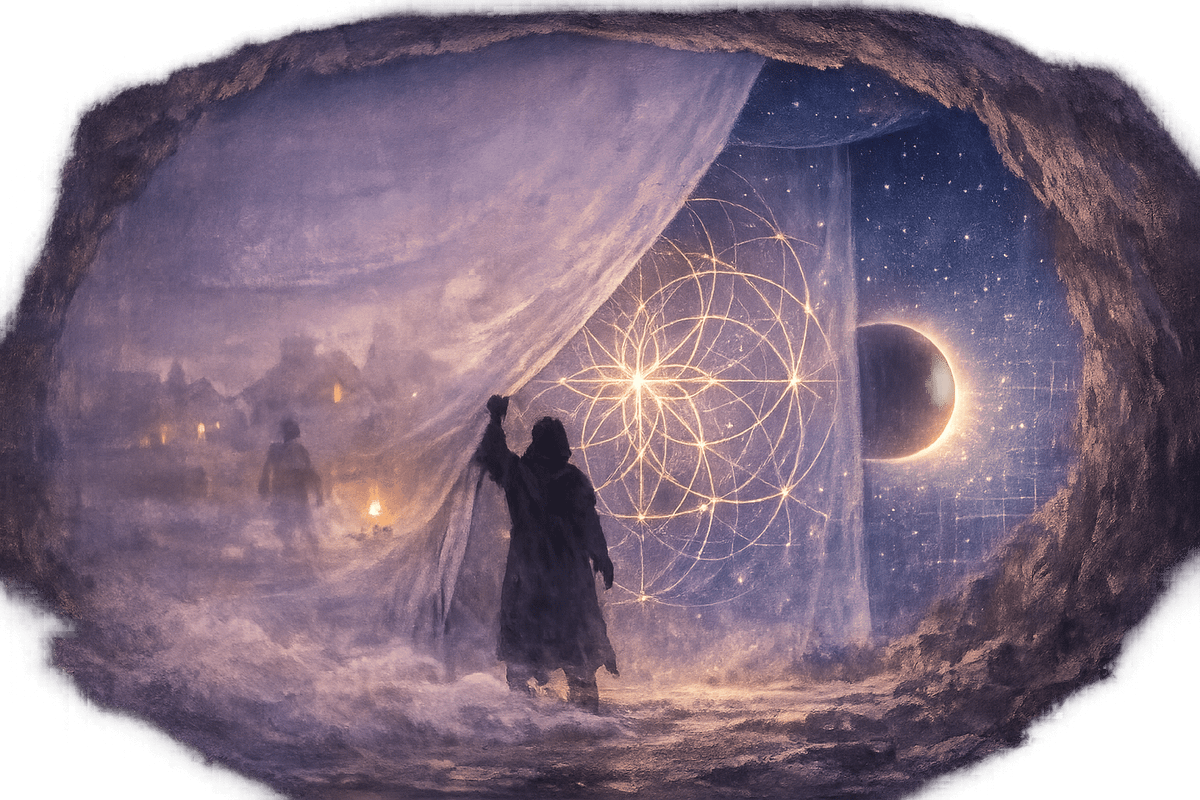
Across cultures separated by thousands of miles and hundreds of years, a peculiar idea keeps appearing: the reality we experience may not be reality as it ultimately is.
Indian philosophers wrote about maya and ignorance. Plato imagined prisoners mistaking shadows for the world. Buddhist traditions questioned both the apparent solidity of the self and the permanence of everything around us. Gnostic Christians told stories of humanity living within a lower cosmos while forgetting a greater reality beyond it.
Put those ideas side by side and it is tempting to conclude that the ancients all discovered the same secret. Perhaps they knew the world was an illusion. Perhaps they somehow anticipated simulation theory. Perhaps mystics thousands of years ago discovered something modern physics is only now beginning to confirm.
It makes a wonderful story, but it is too simple. These traditions really did question appearances, sometimes radically, but they meant very different things by that question. Understanding those differences makes the comparison far more interesting.
Did ancient people really think reality was an illusion?
Some did, depending on what we mean by illusion. The English word can easily mislead us because it can mean that something is completely unreal, like a hallucination, but it can also mean that something real is being perceived incorrectly or incompletely.
Most of the traditions discussed here were not simply saying that nothing exists. They were proposing something closer to this: the way things appear to ordinary consciousness is not necessarily the whole truth about them.
That distinction matters.
Maya: is the Hindu world an illusion?
Maya is probably the most famous ancient concept associated with an illusory world, but saying simply that “Hinduism teaches that reality is an illusion” hides centuries of philosophical disagreement.
There is no single Hindu philosophy. Different Indian traditions developed very different accounts of consciousness, matter, the self and ultimate reality. The interpretation most closely associated with the idea of the world as illusion is Advaita Vedanta, particularly the tradition associated with the philosopher Shankara.
Advaita means non-dualism. At the heart of the tradition is the claim that ultimate reality is Brahman, and that the deepest self, Atman, is not ultimately separate from Brahman.
Ordinary experience seems to tell us something very different. We appear to be separate individuals living among countless separate objects in a changing world. Advaita asks whether that apparent multiplicity represents reality at its deepest level.
What does Maya actually mean?
Maya is often translated simply as illusion, but the concept is subtler than saying the universe is imaginary.
One traditional analogy is a rope seen in poor light. Someone mistakes the rope for a snake. The fear is real and the perception has consequences, but the observer has misunderstood what is actually present.
The snake does not need to be destroyed. It needs to be correctly seen.
Advaita uses this kind of example to describe the way ignorance, avidya, shapes ordinary experience. The world of everyday distinctions functions perfectly well at its own level. We still eat, work, suffer, love and avoid walking into traffic.
According to Advaita, however, we misunderstand that world when we treat separation and multiplicity as ultimate. The illusion lies partly in mistaking the appearance for the deepest reality.
That is much more sophisticated than simply saying the world is fake.
Other Hindu traditions also rejected Shankara’s particular account, with some treating the world as a real manifestation or expression of Brahman rather than something properly described as illusory. So when someone says “the ancient Hindus knew reality was an illusion”, they have compressed a very diverse philosophical civilisation into one school.
Plato’s Cave: shadows mistaken for reality
Several centuries before the development of classical Advaita Vedanta, Plato used one of the most famous images in Western philosophy.
In Book VII of The Republic, Socrates asks us to imagine human beings imprisoned inside a cave. They have been chained in position since childhood and can look only towards a wall. Behind them burns a fire, and between the fire and the prisoners, objects are carried past, throwing shadows onto the wall.
The prisoners have never experienced anything else, so naturally they assume the shadows are reality.
One prisoner is eventually released. At first, turning towards the fire hurts his eyes. The objects casting the shadows confuse him. If he is dragged outside the cave, sunlight overwhelms him. Gradually, though, he becomes capable of seeing first reflections, then objects, and eventually the sun itself.
What he previously called reality is revealed as only one level of a much larger world.
Plato was not describing a computer simulation. The Cave belongs within his philosophy of knowledge, education and the Forms, and it is also a political allegory about what happens when somebody who has seen beyond accepted appearances returns to people who still take the shadows as complete.
Yet the modern simulation comparison is obvious because the philosophical problem is similar. How could we recognise that our ordinary model of reality was incomplete if it was the only model we had ever known?
Buddhism: is everything an illusion?
Buddhism is frequently placed in the same category with another simplified statement: “Buddhists believe reality is an illusion.”
Again, the actual teaching is more interesting.
Early Buddhist thought places enormous emphasis on impermanence, or anicca. Everything produced through causes and conditions changes. Bodies change, feelings change, thoughts change, relationships change, possessions change and identities change.
The problem is not necessarily that these things do not exist. The problem arises when we relate to changing things as though they were permanent.
Buddhism then pushes the argument somewhere particularly uncomfortable by questioning the apparently continuous self who experiences all of this. The teaching of anatta or anatman, usually translated as not-self, challenges the idea that somewhere inside experience there is a fixed and permanent essence corresponding neatly to our everyday sense of “me”.
Instead, human experience can be analysed as changing processes involving bodily form, sensation, perception, mental activity and consciousness. Practical continuity remains, but continuity does not necessarily prove the existence of an unchanging inner entity.
What feels solid may actually be process.
Emptiness does not mean nothing exists
Later Mahayana Buddhist philosophy develops another easily misunderstood concept: emptiness, or shunyata.
Popular summaries sometimes interpret emptiness as saying that nothing is real. That misses the point. To say that things are empty is generally to say that they lack independent, permanent self-existence.
Everything arises through conditions and relationships. A tree depends on soil, water, sunlight, biology and an enormous network of causes. A person depends on parents, food, culture, language, memory, relationships and countless physical processes.
Take away every relationship and condition through which something exists and it becomes difficult to locate the independent essence we initially assumed it possessed.
The illusion is therefore not necessarily the world itself. It is the way the mind turns changing, dependent processes into apparently permanent and self-contained things.
Plato and Buddhism are not saying the same thing
This is where comparisons become dangerous.
Plato looks beyond changing appearances towards realities that are more stable and ultimately more knowable. Buddhist traditions frequently challenge the very urge to locate permanent essence in the first place.
Those positions are not interchangeable.
One tradition seeks beyond change towards something more enduring, while another can warn that our desire for enduring independent existence is itself part of the problem.
They do, however, meet at one fascinating point: ordinary perception can mislead us about the nature of reality.
From there, they travel in very different directions.
Gnosticism: what if the cosmos itself is incomplete?
Gnostic traditions introduce another variation.
Several ancient texts associated with Gnosticism distinguish between a higher divine reality and the lower cosmos inhabited by human beings. In works such as the Secret Book of John, the visible world is connected with an inferior creator, commonly called the Demiurge, who does not fully understand the divine reality above him.
Human beings, however, contain or participate in something originating beyond that lower order.
The central problem is therefore ignorance. We have forgotten where we come from. Salvation involves gnosis, a transformative knowledge or recognition of deeper reality and our relationship to it.
This comes closer than Plato or Buddhism to the modern idea of inhabitants trapped within a limited world maintained by a lesser intelligence, which is one reason Gnosticism has become so attractive to people interested in simulation theory.
But the analogy is modern. Ancient Gnostic writers were constructing religious cosmologies, not describing servers running a digital universe.
For the full tradition, see Gnosticism: The Divine Spark, the Demiurge and the Search for Hidden Knowledge.
The recurring pattern is ignorance
Once we stop insisting that all these traditions taught the same doctrine, another pattern becomes clearer.
Again and again, the problem is not simply reality itself. It is our understanding of reality.
Advaita speaks of ignorance obscuring recognition of non-duality. Plato’s prisoners do not realise they are watching shadows. Buddhist traditions challenge the habits through which impermanent and dependent processes appear permanent and self-contained. Gnostic texts describe humanity as ignorant of its divine origin.
The metaphysics differ enormously, but the diagnosis has a family resemblance.
Human beings seem to have a tendency to mistake their normal way of seeing for the way things ultimately are.
Why would so many traditions reach that conclusion?
One answer may be surprisingly straightforward: ordinary human perception really is limited.
We do not encounter the world without mediation. Our nervous system selects, processes and organises sensory information. Attention determines what enters awareness. Memory reconstructs rather than perfectly records. Expectations affect interpretation.
We therefore experience a usable representation of our environment rather than every physical property of everything around us.
That fact does not prove Advaita, Platonism, Buddhism or Gnosticism, but it helps explain why philosophers examining consciousness might begin to distrust the assumption that appearance equals reality.
Even without modern neuroscience, introspection reveals that experience is unstable. Thoughts arise without being deliberately chosen. Attention jumps. Dreams create convincing worlds. Memory changes. The sense of self shifts across situations and across a lifetime.
You do not need quantum mechanics to notice that consciousness is peculiar.
Dreams: humanity’s nightly demonstration
Dreams may be one of the oldest reasons humans learned to question reality.
During a vivid dream, another world temporarily becomes convincing. There are landscapes, people, danger, emotion and sometimes even an apparently coherent history explaining how you arrived there.
Then you wake.
A reality that seemed externally present is suddenly understood to have been generated under very different conditions.
That does not prove waking life is another dream, but it gives philosophers a powerful problem. If consciousness can become completely absorbed in a world that later turns out not to exist in the way we assumed, how certain can we be that waking perception gives direct access to ultimate reality?
Versions of that question appear repeatedly in philosophy and spirituality.
We explore the modern consciousness angle in What Dreams Might Reveal About the Source Code of Reality.
Zhuangzi and the butterfly
An especially beautiful version appears in the Chinese philosophical tradition associated with Zhuangzi.
In the famous story, Zhuang Zhou dreams that he is a butterfly. While dreaming, he is simply the butterfly. After waking, he wonders whether he is Zhuang Zhou who dreamed of being a butterfly, or a butterfly now dreaming of being Zhuang Zhou.
The passage is playful and deliberately difficult to reduce to one metaphysical doctrine. It does not simply announce that physical reality is false.
Instead, it unsettles confidence about identity, perspective and the categories through which we organise experience.
Who is the dreamer? Which perspective gets to call itself reality?
More than two thousand years later, the question still works.
Is modern science saying the same thing?
There are genuine modern reasons to question naive assumptions about reality.
Neuroscience shows that perception depends upon active processing in the brain. Physics has revealed a universe whose underlying behaviour is radically unlike everyday intuition. Philosophy of mind still struggles with the relationship between physical processes and subjective experience.
Simulation theory adds another possibility: perhaps conscious beings could inhabit a constructed world while experiencing it as ordinary reality.
Those are legitimate modern questions.
They do not, however, retrospectively prove ancient metaphysics.
Quantum physics does not prove Maya
This deserves saying plainly because it appears so often in spiritual writing.
Quantum mechanics does not demonstrate that human consciousness creates everyday physical reality simply by observing it. The measurement problem in quantum mechanics is real and philosophically difficult, but observation in physics does not straightforwardly mean a conscious human looking at something.
Nor does quantum uncertainty prove that reality exists only when somebody notices it.
Likewise, the holographic principle is an idea in theoretical physics about relationships between descriptions of physical systems. It is not evidence that the visible world is literally a projection in the spiritual sense.
Ancient philosophy and modern physics can provoke similar questions.
That is not the same thing as saying they discovered the same answer.
Science makes the ancient question more interesting
Removing false quantum claims does not make this subject less mysterious. It actually makes the question better.
Modern cognitive science gives us strong reasons to distinguish the world itself from our experience of the world.
Colour is a useful example. The physical world contains electromagnetic radiation at different wavelengths, while the conscious experience of red is something a visual system produces in response to particular conditions.
That does not mean the red apple is imaginary. It means the world as experienced includes properties generated through an interaction between external reality and a perceiving organism.
Our conscious world is not a photograph. It is an interpretation.
Ancient thinkers did not know the neuroscience behind perception, but many recognised the philosophical problem.
Illusion or construction?
Perhaps construction is sometimes a better modern word than illusion.
An illusion suggests that nothing is there. Construction suggests that experience emerges through a relationship between reality and the system perceiving it.
Consider a map. A map is not false because it leaves out almost everything about the territory. Its usefulness depends precisely on leaving things out.
A road map, geological map and political map can all represent the same place differently because each selects different information.
Human perception may work in a comparable way. We encounter the aspects of reality our perceptual and cognitive systems are equipped to represent.
The unanswered question is how closely that representation corresponds to reality in itself.
This is where simulation theory enters
Simulation theory turns the old philosophical problem into a technological one.
If sufficiently advanced beings could construct a virtual environment containing conscious inhabitants, those inhabitants would experience the internal rules of their world as physics. They could build instruments, discover laws, develop mathematics and argue about metaphysics.
Everything they observed would still be real within their level of reality.
The simulation hypothesis then asks whether we could occupy an equivalent position.
That is not what Plato, Shankara or the Gnostic writers believed, but the structure of the question is familiar: what appears complete from inside a system may look partial from outside it.
Start with Simulation Theory 101 if you want to explore that modern version separately.
Four traditions, four different problems
It is useful to put the distinctions plainly.
In Advaita Vedanta, we experience multiplicity and separation, while ultimate reality is understood as non-dual Brahman. Ignorance prevents recognition of our deepest nature.
In Platonism, sensory appearances do not provide the highest kind of knowledge. Philosophical understanding moves beyond appearances towards intelligible reality.
In Buddhist traditions, we mistakenly treat changing and dependent processes as permanent and independently existing, including the self.
In Gnostic traditions, humanity inhabits a lower cosmic order while remaining ignorant of a higher divine reality and, in some systems, its own divine origin.
These are not four ancient versions of simulation theory.
They are four different ways of destabilising ordinary certainty.
What they genuinely share
Despite those differences, several recurring themes are real.
Immediate experience is not assumed to reveal the deepest nature of things. The problem is often not simply lack of information, but the way our ordinary perception and identity maintain misunderstanding.
These traditions also tend to insist that transformation requires more than abstract theory. Philosophy, meditation, contemplation, ethical practice, initiation or gnosis change the person who is looking, not merely the collection of ideas they possess.
The ordinary self is repeatedly questioned too. Whether through Atman, Buddhist not-self, Platonic soul or Gnostic divine origins, many ancient traditions refuse to treat everyday personality as the final answer to who we are.
And across them appears some version of the possibility of awakening. The metaphors vary, but sight, remembrance, liberation and recognition recur again and again.
Does recurrence mean they discovered the same truth?
Possibly, but it is not the only explanation.
Human beings across cultures possess broadly similar brains and encounter many of the same existential problems. We dream, misperceive, change, lose people, experience memory failure, undergo altered states and repeatedly discover that the world behaves differently from what we expected.
Different cultures might therefore develop similar metaphors because they are examining shared features of human consciousness.
Another possibility is that they are independently approaching aspects of reality that genuinely are deeper than ordinary perception.
Those explanations are not easy to distinguish.
This is where historical evidence ends and metaphysical interpretation begins.
Maybe “illusion” is the wrong question
Asking whether the world is real or illusion may force a binary choice that these traditions themselves often complicate.
A rainbow is real. It can be photographed, measured and experienced by multiple observers.
But it is not a coloured object hanging in one fixed position in the sky. Its appearance depends on light, water droplets, geometry and the position of an observer.
Calling the rainbow unreal would be wrong.
Calling our first impression of what it is complete would also be wrong.
Perhaps reality contains more things like that than we realise: real, but relational; present, but not quite what they seem.
The ancient warning
There is something humbling about finding versions of this question across such different philosophical worlds.
Human beings have repeatedly suspected that certainty comes too easily to the mind. We see a world and assume that is simply what reality looks like. We experience a self and assume that is exactly what we are. We inherit an explanation and forget that it is an explanation at all.
Ancient traditions repeatedly interrupt that confidence by asking us to look again, question appearances and examine the observer as carefully as the observed.
That does not prove the world is an illusion.
It may reveal something more useful: the world we experience is real enough to live in, but our interpretation of it may never be the whole story.
Perhaps that is why the question keeps returning.