The Celtic Calendar: Rituals, Traditions and the Turning of the Year
From Samhain fires and Brigid’s crosses to Beltane May bushes and Lughnasadh harvest gatherings, explore the old Gaelic seasonal year and the modern Wheel that grew around it.

There is something deeply satisfying about dividing the year by what the land is doing rather than by the number printed at the top of a calendar.
The first shoots appear. Light changes. Animals return to pasture. Hawthorn flowers. Crops ripen. Leaves fall. Darkness comes back.
Long before January became the universal moment for deciding that life should begin again, communities across Ireland and the wider Gaelic world were marking these changes through seasonal festivals.
Four in particular stand out:
Samhain. Imbolc. Bealtaine. Lúnasa.
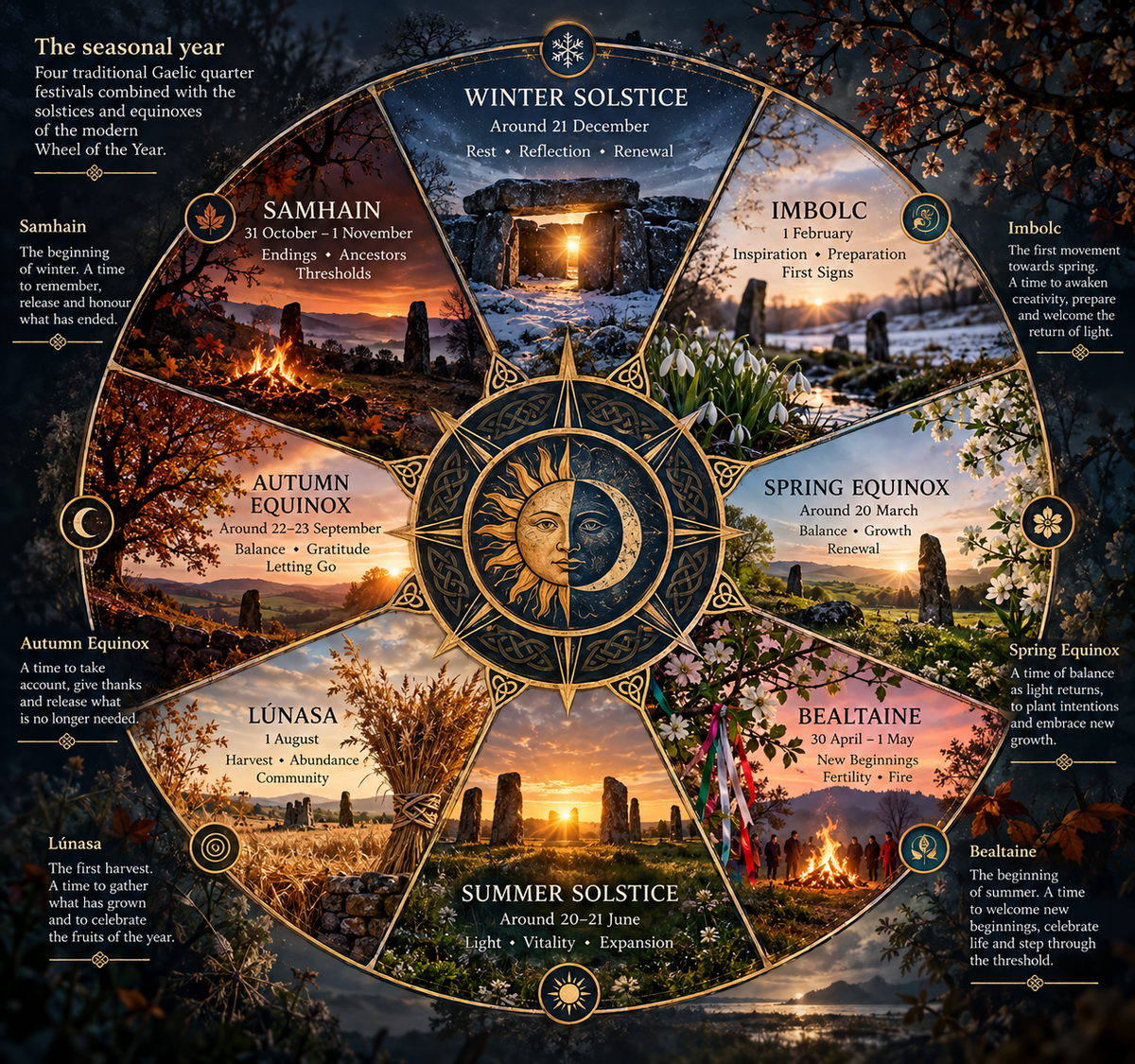
They divided the traditional year into meaningful thresholds: the beginning of winter, the first movement towards spring, the opening of summer and the arrival of harvest.
Around them grew fires, feasts, flowers, protective charms, visits to holy places, divination, courtship, cattle rituals and customs concerned with one fundamental question:
How do we cross safely from one season of life into another?
Today these four festivals are commonly combined with the solstices and equinoxes into the eight-point Wheel of the Year used in modern Paganism.
It is a beautiful system.
It is just not quite as ancient as it is sometimes presented.
That distinction does not diminish it. In some ways, it makes the calendar more interesting.
There was no single Celtic calendar
The phrase Celtic calendar makes it sound as though people from Ireland to Gaul followed one agreed ritual year.
They did not.
"Celtic" describes a large family of related cultures and languages spread across different places and periods. Evidence for their religious life is uneven, and much of what survives about Gaelic seasonal customs comes from medieval literature and later folklore rather than contemporary accounts written by pre-Christian practitioners.
There is an actual ancient Celtic calendar: the Coligny Calendar, discovered in France in 1897. It is written in Gaulish on bronze and dates from the Roman period. Its sophisticated lunisolar system shows that time could be reckoned through both lunar and solar cycles. It does not, however, give us the neat eight-spoked Wheel of the Year familiar from modern Pagan books.
The eight-festival Wheel as a single system is largely a twentieth-century development. Historian Ronald Hutton has traced how modern Pagan traditions brought together four old Gaelic seasonal festivals with the solstices and equinoxes during the development of Wicca and modern Druidry.
So when a modern diagram labels Imbolc, Ostara, Beltane, Litha, Lughnasadh, Mabon, Samhain and Yule as the ancient Celtic year, several different historical traditions have actually been woven together.
There is nothing inherently wrong with that.
Traditions have always borrowed, adapted and accumulated.
We simply understand them better when we know which pieces came from where.
The older Gaelic year
The strongest historical spine is the four Gaelic quarter days:
Imbolc – around 1 February
Beginning of spring.
Bealtaine – around 1 May
Beginning of summer.
Lúnasa – around 1 August
Beginning of the harvest season.
Samhain – around 1 November
Beginning of winter.
The National Museum of Ireland describes these as traditional quarter days marking transitions between seasons. Irish festival observance often began on the evening before the calendar date, when a threshold was thought to be particularly significant.
Folklore records also preserve a striking division of the year into two great halves:
Samhain to Bealtaine.
Bealtaine to Samhain.
Winter and summer.
Dark and light.
Indoor and outdoor.
The cattle brought in, then driven out again.
That rhythm feels much closer to the practical realities of an agricultural society than our modern insistence that spring starts precisely at an equinox.
And between those older quarter days we can place the astronomical turning points that modern practitioners also observe.
What emerges is not necessarily the ancient Celtic calendar.
It is something more useful:
a map of the seasonal year that contains both genuine historical tradition and a living modern practice.
Imbolc: the first movement of spring
Around 1 February
Imbolc arrives when winter has not actually finished.
That may be the most important thing about it.
This is not spring in the modern sense of blossom, warmth and long afternoons. In Ireland and Britain, early February can be wet, dark and brutally cold.
But something has changed.
The days are noticeably longer.
Animals begin producing young.
The land is preparing before it looks transformed.
Imbolc became closely intertwined with the feast of St Brigid, and separating a supposedly pure pre-Christian festival from later Christian tradition is not always possible or particularly helpful. Irish folklore shows centuries of blending between Brigid the saint, older seasonal meanings and customs concerned with fertility, protection, fire, water and the return of life.
Traditional customs included making St Brigid's crosses from rushes, leaving a Brat Bríde, a piece of cloth or ribbon, outside overnight to receive Brigid's blessing, visiting holy wells and asking for protection over home, animals and crops.
The mood of Imbolc is not dramatic rebirth.
It is evidence that rebirth has begun.
A modern Imbolc ritual
You do not need to recreate a ceremony whose historical details you cannot know.
Instead:
Clean one neglected part of the house.
Light a candle.
Write down what has begun to move in your life even though nobody else could see it yet.
If there is something you want to grow during the year, name the first physical action required.
Then do it within the next twenty-four hours.
Imbolc is a good festival for beginnings that are still too small to announce.
The spring equinox: the balance point
Around 20 March
The spring equinox is an astronomical event: day and night are approximately balanced as the Sun crosses the celestial equator.
It is now one of the eight points of the modern Wheel of the Year.
What we should not do is confidently describe a festival called Ostara as a universally observed ancient Celtic feast. The evidence simply does not support that.
The equinox nevertheless makes an intuitive seasonal marker.
By late March, the tentative signs noticed at Imbolc have become harder to miss.
Light has returned.
Plants are growing.
Bird activity increases.
The world is visibly moving.
A modern equinox ritual
Use the equinox for balance rather than perfection.
Divide a page in two.
On one side write:
What is taking too much from me?
On the other:
What needs more of me?
Choose one adjustment from each side.
Not eight goals.
Not a complete life overhaul.
Two adjustments.
The astronomical moment of balance lasts almost no time at all.
Perhaps that is the point.
Balance is something we continually make rather than somewhere we permanently arrive.
Bealtaine: crossing into summer
30 April into 1 May
Bealtaine is the point on the calendar I find hardest to treat as merely historical.
Partly because its surviving traditions are unusually rich.
Partly because May has repeatedly behaved like a threshold in my own life.
New jobs. House moves. Marriage. Fresh starts. Moments when one version of life seems to close and another suddenly becomes possible.
I don't take that as proof that Bealtaine causes events.
Correlation is not magic simply because it happens to us personally.
But after enough repetitions, you notice.
And there is something about Bealtaine that makes noticing beginnings feel entirely appropriate.
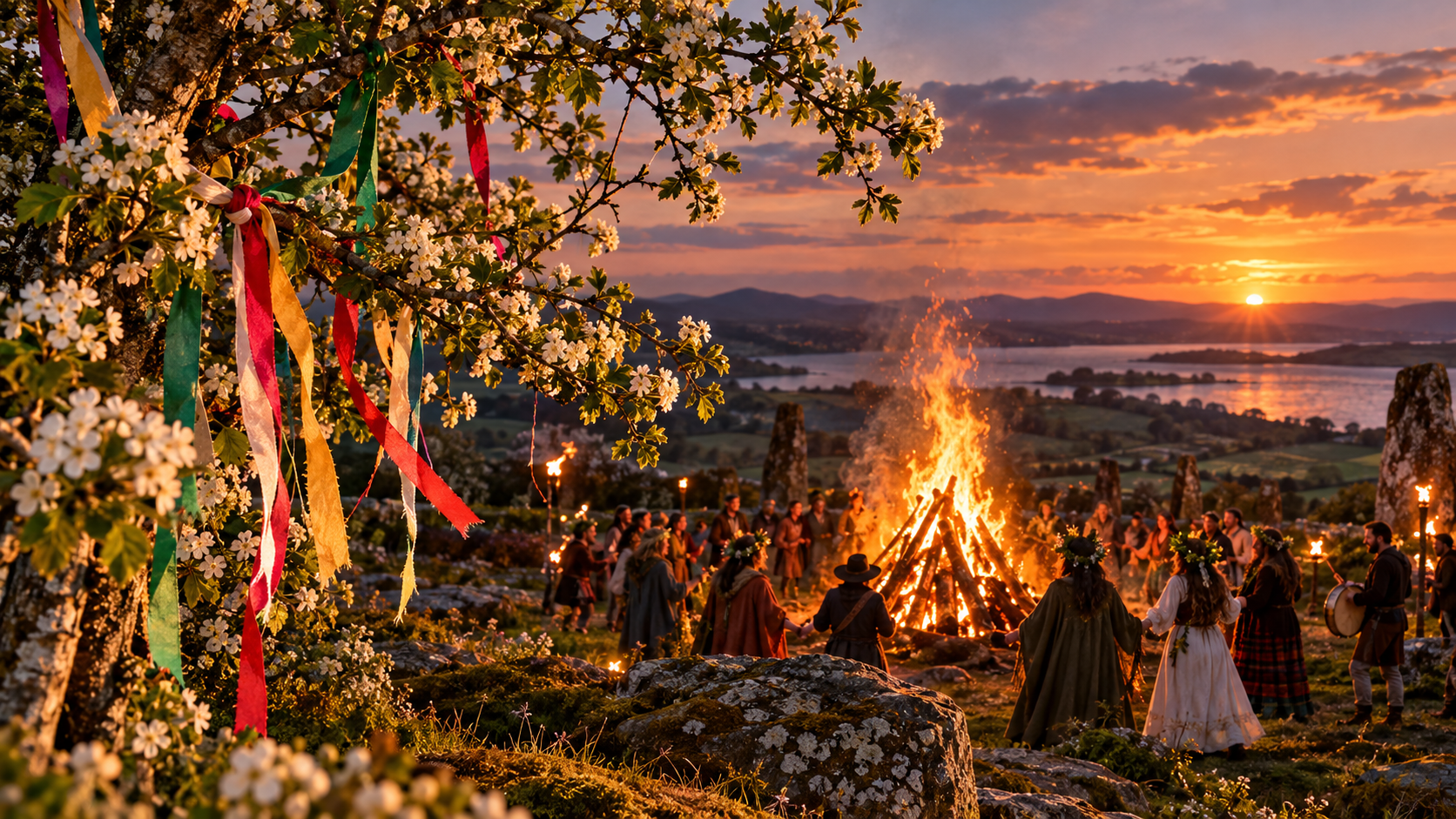
Traditional Irish sources describe Bealtaine as the beginning of summer. Folklore gathered in the twentieth century preserves May bushes decorated with ribbons, flowers and coloured eggshells; flowers around doors and houses; May morning dew; bonfires; dancing; and protective customs surrounding cattle, milk and the home.
Fire is particularly important.
The Irish expression idir dhá thine Bhealtaine, "between the two fires of Bealtaine", survives from the tradition of passing cattle between or through the remains of May fires for protection and good health.
The May Bush could be hawthorn or another flowering branch, decorated and set outside the home or in a communal place. In some areas people rose early to wash their faces in May morning dew. Flowers could be placed at entrances to welcome summer and protect the household.
These customs contain celebration, but also caution.
Traditional May was a liminal time.
Summer was opening, animals were moving back onto pasture, fertility mattered, food production mattered and the boundary between one seasonal order and another had shifted.
A threshold is exciting because something becomes possible.
It is also unstable because the old arrangement no longer applies.
That may be why Bealtaine still feels so psychologically recognisable.
Why Bealtaine feels like a festival of beginnings
There are moments when change happens because we have carefully planned it.
And there are moments when several things move at once.
A new house.
A new relationship.
A wedding.
A job.
A decision that had been sitting unresolved suddenly becoming obvious.
Looking backwards across my own life, an unusual number of those transitions have clustered around late April and May.
Perhaps that is chance.
Perhaps we are more receptive to change when winter has properly released its grip and the environment itself is signalling expansion.
Perhaps the cultural symbolism of May gives us permission to act.
Or perhaps there is something about seasonal thresholds that we have not completely measured.
Sacred Illusion does not need to decide between those possibilities.
The experience remains interesting either way.
Bealtaine gives us a useful question:
What is trying to begin?
Not what should I manifest?
Not what should the universe give me?
What, in practical terms, already appears to be opening?
That is a more demanding question because it asks us to participate.
A Bealtaine ritual for a new beginning
Do this on the evening of 30 April or on May morning.
Bring something living or freshly growing into the house: flowers, blossom or a small branch gathered responsibly.
Light a candle or, if practical and safe, a small outdoor fire.
Write down two things:
What I am leaving behind.
What I am stepping into.
Make the second statement concrete.
Not abundance.
Perhaps:
I am applying for the job.
I am putting the house on the market.
I am saying yes.
I am ending something that has already ended.
I am beginning the work.
If you want to borrow from documented May tradition, decorate a small branch with ribbons representing what you want to welcome into the next half of the year.
Then take one actual step.
Bealtaine does not need to become a wish-making exercise.
Its older symbolism is stronger than that.
The gate is open.
Walk through it.
The summer solstice: the height of light
Around 20–21 June
By the summer solstice, the movement begun at Imbolc has reached its opposite extreme from winter.
This is the longest day.
Modern Pagan calendars often call the festival Litha, although that should not be confused with a securely documented pan-Celtic festival of that name.
Solar observance itself is much older than Celtic culture.
Across prehistoric Britain and Ireland, monuments demonstrate close attention to the movements of the Sun. That does not mean every alignment belonged to one continuous religion. It does tell us that seasonal light mattered profoundly to people living here thousands of years ago.
The most famous Irish example is actually aligned to the opposite point of the year: at Newgrange, built around 3200 BCE, the rising winter-solstice Sun penetrates the passage and illuminates the chamber. Newgrange predates the cultures we normally call Celtic by millennia, which is an important reminder not to collapse all prehistoric traditions into one category.
A modern summer-solstice ritual
Do something almost embarrassingly simple.
Stay outside until the light begins to fade.
Before sunset, write down:
What has grown since February?
Include what worked.
Include what didn't.
Include something you did not appreciate while it was happening.
The solstice is a useful corrective to constant striving.
Sometimes the appropriate response to reaching the height of something is not to ask immediately what comes next.
It is to notice that you arrived.
Lúnasa: the first harvest
Around 1 August
Lúnasa or Lughnasadh marks the beginning of the harvest season.
The National Museum of Ireland records gatherings on mountains and at lakes, harvest fairs, pilgrimages and customs associated with the cutting of crops. Harvest knots made from straw could be exchanged as tokens of love and courtship. The final sheaf of a harvest carried its own ceremony in some areas.
Lúnasa therefore occupies a different emotional territory from Bealtaine.
May asks what might begin.
August asks:
What actually grew?
A harvest is evidence.
You planted something, deliberately or otherwise, and now you discover what the season produced.
Some things flourished.
Some failed.
Some became entirely different from what you expected.
A modern Lúnasa ritual
Make a harvest inventory.
Write down three things the year has produced so far.
They can be tangible:
a completed project, money earned, a move, a qualification.
Or less visible:
a boundary established, confidence regained, a relationship repaired, something finally understood.
Then ask:
What needs harvesting now rather than endlessly growing?
Finishing is also a seasonal skill.
The autumn equinox: taking account
Around 22–23 September
The autumn equinox gives us another approximate balance of light and darkness.
In modern Pagan practice it is often called Mabon.
That name is modern in this particular festival context and should not be presented as the name of an ancient Celtic autumn-equinoctial celebration.
Again, historical precision does not make the date useless.
By September the consequences of the year's choices are increasingly visible.
The energetic expansion of spring and summer begins to contract.
The natural question is no longer simply what can be created.
It is what should be kept.
A modern autumn-equinox ritual
Look at your commitments.
Work.
Possessions.
Relationships.
Projects.
Habits.
Ask of each:
Does this deserve to come with me into winter?
Choose one thing to stop.
That may be a more seasonally appropriate ritual than acquiring another set of crystals.
Samhain: the threshold into darkness
31 October into 1 November
Samhain marks the beginning of winter in the traditional Irish seasonal year.
Like the other quarter days, much of its celebration took place on the eve.
Later Halloween traditions layered Christian observance onto much older seasonal concerns. Irish folklore records feasting, nuts and fruit, divination games, disguises and beliefs that the dead or other spirits might be especially close at this time. Protective crosses and other measures could be used around the household.
It is easy to turn Samhain into generic Gothic imagery.
Its deeper seasonal logic is simpler.
The productive year is over.
Animals and people move towards winter.
The evenings close.
What has died becomes difficult to ignore.
That gives Samhain its continuing force.
Every life accumulates things that are technically over but have not yet been acknowledged.
A modern Samhain ritual
Make two lists.
What ended this year?
What am I still carrying as though it hasn't ended?
You do not have to burn the list.
You do not have to perform a complex ceremony.
Read it.
Acknowledge it.
If someone has died whom you want to remember, place their photograph or an object associated with them somewhere visible and spend time telling their story.
Ancestor practice does not require believing that the dead have literally entered the room.
Remembering is already a way of making them present.
The winter solstice: the return begins in darkness
Around 21 December
The winter solstice is the shortest day and longest night of the year.
Then, almost imperceptibly, the direction changes.
That makes midwinter one of the most powerful seasonal metaphors available to us.
The light does not return because winter has finished.
It returns while winter is still happening.
Newgrange embodies that idea with extraordinary precision. Around the winter solstice, sunrise enters through the monument's roof box and travels down its passage into the chamber. The structure was created more than five thousand years ago.
Whatever its full meaning was to the people who built it, the engineering required careful attention to the solar year.
That fact is mysterious enough.
A modern winter-solstice ritual
Get up before sunrise.
Turn the lights off.
Sit in the dark for ten minutes.
Do not manifest anything.
Do not optimise anything.
When the sky begins to change, light one candle.
Then write down one thing you want to carry through the next year.
Not twenty goals.
One.
The darkest point of the year does not demand a complete plan.
Only enough light for the next step.
The whole year as a ritual
Once you strip away some of the modern certainty around the "ancient Celtic Wheel", something more interesting remains.
These festivals are not eight versions of the same celebration.
They ask different things of us.
Imbolc: What is beginning beneath the surface?
Spring equinox: What needs rebalancing?
Bealtaine: What am I ready to begin?
Summer solstice: What has reached its height?
Lúnasa: What has actually borne fruit?
Autumn equinox: What should I keep?
Samhain: What has ended?
Winter solstice: What remains alive in the darkness?
That sequence works even if you never call yourself Pagan.
You do not need to believe that the calendar contains supernatural power.
Living seasonally changes what you notice.
That alone changes behaviour.
A ritual creates a deliberate interruption in ordinary time. It makes us pay attention to something we might otherwise pass straight through.
Perhaps our ancestors needed seasonal festivals because survival depended directly on noticing the land.
Most of us are no longer dependent on recognising the exact moment cattle should move or crops must be harvested.
But we have not stopped living in cycles.
Jobs begin and end.
Children grow.
Relationships change.
Homes change.
Bodies change.
Ambitions ripen and sometimes fail.
There are seasons when we should push.
There are seasons when we should finish.
There are seasons when something is gone and pretending otherwise only makes winter harder.
That may be the most useful inheritance of the old calendar.
Not a rigid set of ancient instructions.
A way of noticing where we are.
And then Bealtaine comes round again
Perhaps this is why I remain particularly fond of Bealtaine. I can look back through my own life and find May turning up around moments when the scenery changed.
New jobs. New homes. Marriage. Beginnings that only looked inevitable once I was already standing inside them. I cannot tell you that the calendar caused any of those things. I can tell you that I notice the pattern.
And each year, when April begins tipping into May, I find myself wondering what is moving this time. That is not prophecy.
It is attention. Sometimes attention is enough to notice the gate before you walk past it. And if Bealtaine has anything useful to teach us now, perhaps it is simply this: when life opens, recognise it. Then move.