How Gnostics Interpret Dreams
Ancient Gnostic texts often use dreaming as a metaphor for ignorance and awakening as a symbol of gnosis. Later Gnostic traditions developed that idea into a much fuller practice of dream exploration.

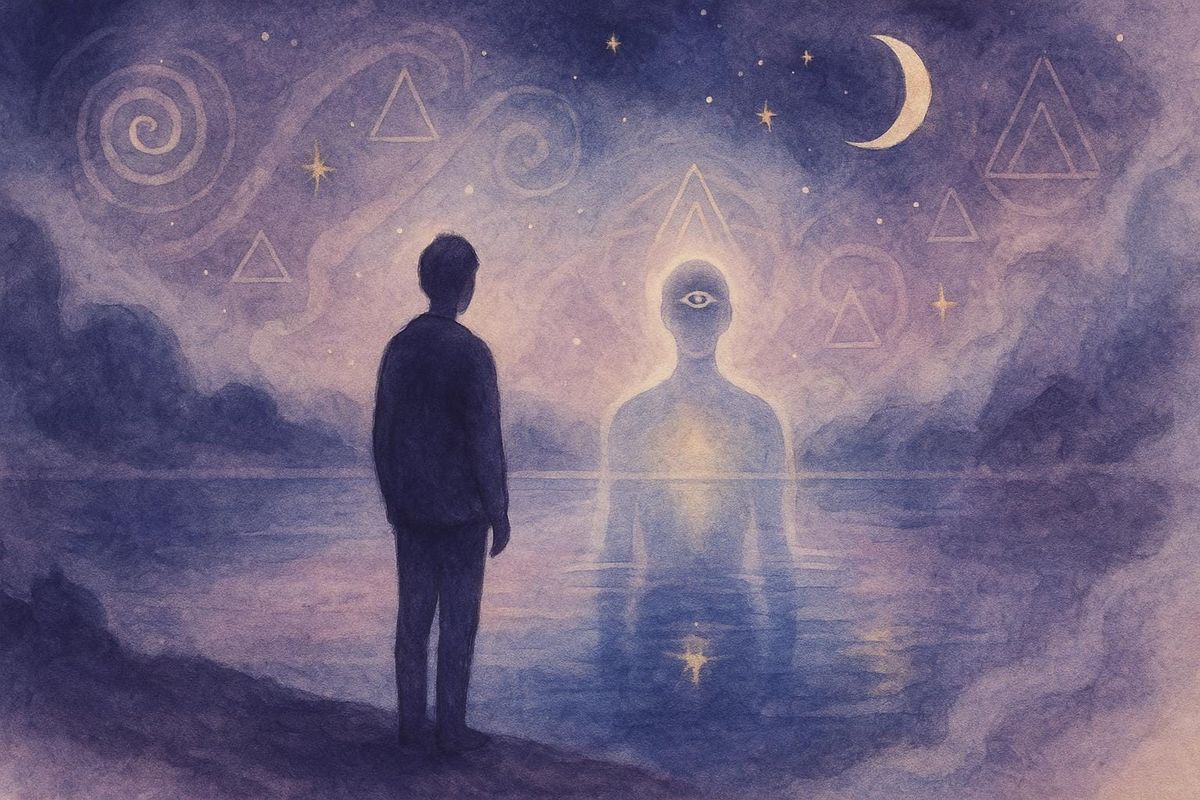
Dreams fit naturally into the Gnostic view of reality. If ordinary human life involves forgetting who we really are, becoming absorbed in the material world and mistaking appearances for ultimate reality, then dreaming offers an obvious metaphor: we can become completely immersed in an experience without recognising its true nature.
Ancient Gnostic texts do not leave us a single system for decoding dream symbols, however. What they do contain is a powerful language of sleep, dreaming, revelation and awakening. Later esoteric and modern Gnostic traditions developed those ideas much further, turning dreams into an active practice of self-observation and spiritual exploration.
Understanding the difference makes the tradition more interesting rather than less.
Dreaming and awakening in ancient Gnostic thought
One of the clearest examples appears in the Gospel of Truth, a text associated with Valentinian Christianity.
It compares human ignorance with being trapped inside disturbing dreams. A sleeping person may flee imagined danger, fall from heights or become caught in terrifying situations that seem completely real until they wake. The text uses this image to describe spiritual ignorance: people become absorbed in fear, confusion and illusion because they do not recognise their divine origin.
Gnosis is therefore compared with waking up.
This theme appears elsewhere in the Nag Hammadi writings too. Sleep can represent forgetfulness, entanglement and unconscious participation in the material condition, while awakening represents recognition of a deeper spiritual reality.
That distinction is central to Gnostic spirituality. The important question is not simply what you dreamed last night, but whether waking life itself contains forms of sleep from which consciousness might awaken.
Dreams as a metaphor for the material world
Many Gnostic systems described the visible world as incomplete, distorted or removed from the ultimate divine reality.
Different groups explained this in different ways, but the recurring idea was that human beings contain something connected to a higher source while living within conditions that obscure that knowledge.
Dreaming becomes an unusually effective metaphor for this situation.
While dreaming, you normally accept the dream world without question. Its people, places and rules seem real until another level of awareness appears. Only after waking do you realise how completely consciousness had accepted the temporary reality.
For a Gnostic reader, that creates an obvious spiritual question: what assumptions about waking reality would look equally strange if consciousness could see from a wider perspective?
This is one reason Gnostic ideas sit so comfortably beside modern discussions of simulation theory. The comparison is not exact, but both ask whether the world as experienced is the deepest level of reality.
Vision and revelation mattered too
Ancient Gnostic literature was not concerned only with philosophical argument.
Some important texts take the form of revelations and visions. In the Secret Book of John, for example, John enters a state of grief and questioning before receiving an extraordinary revelation concerning creation, divine reality and the human condition.
Whether such accounts describe literal visionary experiences, literary devices or some combination of the two is difficult to establish historically.
What matters is that direct experience held enormous importance.
Gnosis was not simply learning the correct doctrine. It involved knowing in a deeper sense, through revelation, recognition or transformative insight.
Dreams and visions therefore occupy useful territory because they challenge the assumption that ordinary waking perception is the only state in which meaningful experience can occur.
Did ancient Gnostics interpret dream symbols?
This is where we need to be careful.
There is no surviving ancient Gnostic manual telling us that a snake means one thing, a doorway means another and the number seven always carries a particular message.
Symbolism was certainly important throughout Gnostic literature. Texts are filled with complex images of light, darkness, rulers, heavens, emanations, divine figures and journeys of the soul. But treating this as a formal system of dream interpretation goes beyond what the surviving evidence supports.
Much of what is now described online as Gnostic dream interpretation comes from later occult, esoteric and modern Gnostic traditions rather than directly from the Nag Hammadi texts.
That does not make those practices invalid as spiritual traditions. It simply means we should identify where they come from.
The influence of modern Gnostic dreamwork
One of the most influential modern sources is Samael Aun Weor, whose twentieth-century esoteric teachings combined elements of Gnosticism with occultism, mysticism, meditation, astral travel and dream practice.
His approach treats dreams as symbolic experiences that can contain psychological material as well as spiritual instruction.
Rather than relying on a fixed dream dictionary, the practitioner is encouraged to examine symbols through analogy, correspondence, personal context and intuition. Numbers and recurring images may also be given symbolic importance.
This is the source of many practices now presented simply as “Gnostic dreamwork”.
It is better understood as a modern Gnostic-esoteric system inspired by older ideas of awakening and gnosis.
Dreams as mirrors of the inner world
One useful part of this later approach is the insistence that not every dream should be treated as a message from a higher realm.
Dreams can contain ordinary memory, emotion, fear, desire and unfinished psychological material. Modern psychology would make much the same basic observation, even if it explained the process differently.
A dream about being chased may reflect anxiety rather than prophecy. A recurring person may represent unresolved emotional material rather than an independent spiritual visitor.
The spiritual interpretation begins when a dream seems to carry unusual coherence, symbolic intensity or insight.
Even then, discernment matters.
A powerful dream may be meaningful without being literally predictive or externally transmitted.
Symbolism without a dream dictionary
The strongest way to approach dream symbolism is therefore contextually.
Suppose you repeatedly dream about a locked door. A general symbolic reading might associate doors with thresholds, opportunities or hidden knowledge. But the meaning will also depend on your own history, what is happening around the door and how you feel in the dream.
The same symbol may mean very different things to different people.
This actually fits the Gnostic emphasis on gnosis better than rigid interpretation does. The aim is not to memorise an external codebook but to understand what the experience reveals when examined carefully.
Symbols can be treated as invitations to inquiry rather than instructions.
Lucid dreaming and Gnostic practice
Modern Gnostic traditions have also incorporated lucid dreaming, in which you become aware that you are dreaming while the dream continues.
Practices such as daytime reality checks, self-observation and maintaining awareness while falling asleep are used to increase the likelihood of recognising the dream state.
Lucid dreaming itself is scientifically established. What remains a matter of spiritual interpretation is what someone is interacting with once lucidity occurs.
A psychological model treats the environment as a dream generated by the sleeping brain. Some esoteric traditions interpret certain lucid or out-of-body states as access to subtler levels of reality.
The experience alone does not settle that question.
For a modern Gnostic practitioner, however, lucidity has symbolic value regardless: becoming conscious inside a dream mirrors the larger spiritual task of becoming conscious inside ordinary life.
The deeper Gnostic question
This may be the most useful way to understand Gnostic dreamwork.
The point is not simply to collect unusual dreams or become skilled at decoding symbols. It is to notice how easily consciousness becomes absorbed in a reality without questioning it.
We do this while sleeping, but Gnostic thought suggests that we may also do it while awake.
We identify completely with roles, fears, possessions, social expectations and inherited ideas about who we are. They become so familiar that they feel like reality itself.
Dreaming provides a nightly demonstration of how convincing an immersive world can be.
The Gnostic response is to cultivate awareness.
A simple Gnostic-inspired dream practice
You do not need to adopt every later occult teaching to explore dreams through this lens. Keep a record beside the bed and write down dreams before the memory fades. Pay particular attention to recurring situations, emotionally charged symbols and moments when you become aware that something about the dream is not what it seems.
Instead of immediately asking what a symbol “means”, consider what the dream is asking you to notice. You can also compare the dream with waking patterns: where are you acting automatically, what are you refusing to see, and what feels more important than its literal appearance would suggest?
That keeps the practice grounded while leaving room for spiritual meaning.
Are dreams messages from a higher reality?
Ancient Gnostic texts do not give us enough evidence to answer that with a simple yes.
They do give us a worldview in which ordinary perception is incomplete, direct revelation is possible and awakening requires seeing beyond appearances. Later Gnostic and esoteric traditions took those ideas and developed much more explicit systems of dream practice.
Modern neuroscience gives us compelling explanations for how dreams are generated and how memory, emotion and perception shape them. That does not determine in advance whether every unusual dream can be reduced to those mechanisms.
The most interesting Gnostic approach is therefore not blind belief in every dream.
It is discernment.
A dream may be psychological noise, symbolic insight, spiritual experience or some mixture of all three. The work lies in learning not simply to dream, but to become more aware of the mind that is doing the dreaming.
And that leads back to the oldest Gnostic metaphor of all: perhaps awakening is not only something we do each morning.