The Hidden Teachings of Christ: What the Gnostic Gospels Really Say
Some early Christian texts describe Jesus revealing teachings that do not appear in the New Testament. What do the so-called Gnostic gospels actually say, and were they really suppressed?

Did Jesus teach things that never made it into the New Testament?
It sounds like the beginning of a conspiracy theory, but the historical question is legitimate. Early Christianity produced far more writing about Jesus than the four gospels that eventually became canonical. Some texts describe private conversations between Jesus and particular disciples. Others present teachings about self-knowledge, the origins of the cosmos, the divine within humanity and realities hidden behind the visible world.
Several were lost for centuries.
When ancient manuscripts containing some of these works resurfaced, particularly with the discovery of the Nag Hammadi codices in Egypt in 1945, they opened a remarkable window onto forms of early Christianity that had largely disappeared.
They also generated a much more sensational story: that the institutional Church deliberately removed Jesus's real teachings, suppressed a mystical Christianity based on personal awakening and replaced it with religion, hierarchy and obedience.
The evidence does not support such a simple story.
But neither does it support the idea that early Christianity was always the uniform religion later generations inherited.
The truth is far more interesting.
Did Jesus teach his disciples privately?
Even the canonical gospels contain the idea that Jesus sometimes taught different audiences in different ways.
In the Gospel of Mark, Jesus explains parables privately to his followers after speaking publicly to the crowd. Similar scenes occur in Matthew and Luke. The disciples are occasionally presented as receiving explanations that other listeners do not.
That does not prove the existence of a separate secret religion.
It does show that the idea of private instruction from Jesus was not inherently alien to early Christianity.
As Christian communities developed during the first and second centuries, some writers pushed that idea much further.
Texts appeared in which the risen Jesus revealed elaborate teachings to individual disciples. John, Thomas, Mary, James and others could become recipients of knowledge unavailable to ordinary observers of Jesus's public ministry.
These texts did not all teach the same thing.
But collectively they reveal an early Christian world much more diverse than the neat categories of later orthodoxy can make it appear.
The books that did not become the New Testament
The New Testament did not arrive as a complete book at the beginning of Christianity.
Individual gospels, letters, apocalypses, acts and teachings circulated between different Christian communities. Some texts became widely accepted. Others were valued only by particular groups. Some were disputed, rejected or eventually forgotten.
By the late second century, figures such as Irenaeus of Lyons were arguing forcefully that certain teachings represented false versions of Christianity.
Irenaeus wrote his major work commonly known as Against Heresies around 180 CE. His opponents included Christians associated with Valentinian and other forms of theology that gave a central role to gnosis, knowledge of divine reality.
This matters because the boundary between what later became "orthodox Christianity" and what later became labelled "heresy" was still being fought over.
It would be wrong to imagine an original unified Church suddenly confronted by one organised underground Gnostic movement.
There were multiple Christian communities interpreting Jesus, scripture, creation and salvation in different ways.
What changed at Nag Hammadi?
Until the twentieth century, many alternative early Christian groups were known largely through the writers who attacked them.
Then a collection of ancient codices was discovered near Nag Hammadi in Upper Egypt.
The manuscripts themselves were copied in Coptic in late antiquity, but many of the works they preserve were composed considerably earlier, probably first in Greek.
Among them were texts with extraordinary titles:
The Gospel of Thomas.
The Gospel of Philip.
The Gospel of Truth.
The Secret Book of John.
The Dialogue of the Saviour.
The Thunder, Perfect Mind.
Not all of the Nag Hammadi writings are Christian, and scholars increasingly resist treating every text in the collection as simply "Gnostic".
But their discovery radically expanded the evidence.
Suddenly, instead of hearing only accusations about supposedly heretical Christians, historians could read many of the texts associated with alternative Christian traditions themselves.
And in some of them, Jesus sounds very different.
The Gospel of Thomas: the kingdom already here
Perhaps the most famous is the Gospel of Thomas.
Thomas does not tell the story of Jesus's birth, crucifixion or resurrection. It is a collection of 114 sayings attributed to Jesus.
Some closely resemble sayings in Matthew, Mark and Luke.
Others do not.
Its opening presents the sayings as hidden words spoken by the living Jesus, promising that whoever discovers their interpretation will escape death.
Throughout the text, the emphasis falls repeatedly on seeking, discovering and seeing differently.
The kingdom is not presented simply as a future realm that arrives at the end of history. It can be described as already present, although people fail to recognise it.
Self-knowledge also matters. Several sayings connect knowing oneself with understanding one's deeper origin.
It is easy to see why modern readers interpret Thomas as teaching an inward, mystical Christianity.
But there are two important cautions.
First, scholars continue to debate when different sayings within Thomas originated and how the collection relates to the canonical gospels.
Second, calling Thomas straightforwardly a "Gnostic gospel" is itself controversial. It lacks much of the elaborate mythology associated with texts such as the Secret Book of John.
Thomas belongs in the wider conversation about early Christian diversity, but it should be allowed to speak for itself.
We explore it in depth in The Gospel of Thomas: The Jesus Who Spoke in Code.
The Secret Book of John: Jesus explains the hidden cosmos
If Thomas feels mysterious, the Secret Book of John, also called the Apocryphon of John, goes much further.
It survives in four ancient Coptic copies, three among the Nag Hammadi codices and another in the Berlin Codex. Scholars generally regard it as one of the most important surviving works for understanding the mythological traditions commonly called Gnostic.
Its setting is striking.
After the crucifixion, the disciple John is troubled and questioning. Jesus appears to him and begins revealing the true structure of reality.
What follows is not simply additional moral teaching.
It is an alternative cosmology.
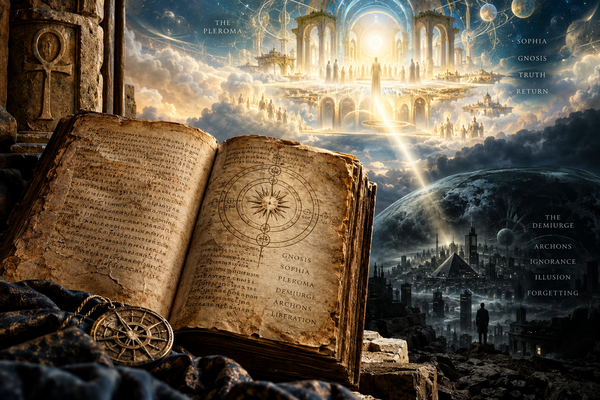
Jesus describes an unknowable supreme divine source, realms of divine fullness, Sophia, the emergence of an ignorant lower creator and the creation of the human world.
That lower creator is associated with Yaldabaoth, the figure commonly called the Demiurge in modern discussions of Gnosticism.
Human beings, however, contain something that ultimately derives from the higher divine reality.
Salvation becomes a form of awakening from ignorance and recovering knowledge of that origin.
This is one of the clearest examples of what a "secret teaching of Jesus" actually looks like in an ancient source.
The historical question is not whether Jesus of Nazareth literally delivered the discourse recorded in the text. Historians cannot establish that.
What the text proves is that at least some early Christians imagined the risen Christ as a revealer of a radically different account of creation from the one that later became orthodox.
For the wider cosmology behind this, start with Gnosticism: The Divine Spark, the Demiurge and the Search for Hidden Knowledge.
A different creation story
This hidden-cosmology tradition changes the meaning of familiar biblical stories.
In ordinary Christian readings, the creator of Genesis is the supreme God, humanity falls through disobedience and salvation repairs that relationship.
Some Gnostic readings turn the structure around.
The creator of the visible world may be a lower being ignorant of the divine reality above him. Humanity's problem is not simply disobedience but ignorance of its true origin.
Knowledge then becomes potentially liberating.
That can even alter the symbolic meaning of Eden.
The command not to eat from the tree of knowledge looks very different if the authority issuing the command is not the highest divine power.
That does not mean every Gnostic text celebrates the serpent or tells the same version of Genesis. The traditions are far too diverse for that.
But the reversal is real enough to explain why Gnostic readings still feel subversive.
We explore that particular inversion in Was Eden the First Simulation?.
The Gospel of Mary: who gets to speak for Jesus?
Another extraordinary early Christian text is the Gospel of Mary.
It was not discovered at Nag Hammadi. The most substantial surviving copy belongs to the Berlin Codex, with additional Greek fragments surviving separately.
The manuscript is incomplete, so both the beginning and several pages from the middle are missing.
What survives begins after a teaching from the Saviour. The disciples are frightened and uncertain. Mary encourages them.
Peter then asks Mary to share teachings the Saviour gave to her.
She describes a revelation involving the ascent of the soul and its encounter with hostile powers.
Then conflict breaks out.
Andrew questions whether the Saviour really taught these ideas. Peter questions whether Jesus would have spoken privately to a woman rather than openly to the male disciples.
Levi defends Mary and criticises Peter.
The scene matters enormously because the argument is not simply about theology.
It is about authority.
Who has the right to interpret Jesus?
Who receives revelation?
Does apostolic authority rest on institutional status, personal closeness to Jesus or spiritual understanding?
The Gospel of Mary gives Mary an authoritative role in that debate.
That does not prove modern claims that Mary Magdalene secretly led the entire early Church or that every later Christian institution deliberately erased her.
It does prove that at least one early Christian text remembered a serious conflict in which a woman identified as Mary possesses spiritual insight that some male disciples resist.
That is historically fascinating without needing embellishment.
The Gospel of Philip and Mary Magdalene
The Gospel of Philip has become famous partly because of its references to Mary Magdalene and the much-discussed language of companionship, kissing and the "bridal chamber".
Popular culture has often turned those passages into evidence that Jesus and Mary Magdalene were secretly married.
The situation is more complicated.
The Gospel of Philip is a later Christian text strongly associated with Valentinian thought. It is particularly interested in ritual, symbolism, sacraments, union and spiritual transformation.
Its bridal imagery belongs within that theological world.
Scholars disagree about exactly how some passages concerning Jesus and Mary should be interpreted, and one scholarly argument has even proposed that the text imagines them as married. That is very different from possessing historical evidence that the first-century Jesus actually married Mary Magdalene.
The text tells us a great deal about the Christians who produced and used it.
It tells us much less securely about the private life of the historical Jesus.
That distinction is one we will keep throughout Sacred Illusion: an ancient claim is evidence that the claim existed, not automatic proof that the event happened.
Was salvation about believing, or knowing?
This may be the biggest philosophical difference between many Gnostic texts and the Christianity most people encounter today.
Modern summaries sometimes say orthodox Christianity teaches "faith" while Gnosticism teaches "knowledge".
That is too crude. Knowledge, faith, revelation and spiritual understanding appear across many early Christian traditions.
But there is a distinctive emphasis in texts associated with gnosis.
The human problem is often described as ignorance.
We do not understand what reality is.
We do not know where we came from.
Most importantly, we do not know what we truly are.
Christ therefore appears not simply as the sacrifice that repairs sin, but as the revealer who wakes humanity from a mistaken understanding of itself.
The imagery is remarkably powerful.
Sleep and awakening.
Forgetfulness and remembrance.
Blindness and sight.
Ignorance and gnosis.
Those themes help explain why Gnostic texts resonate so strongly with modern people interested in consciousness and the nature of reality.
Is "Christ Consciousness" an ancient Gnostic teaching?
This is where modern spirituality and ancient history need separating.
The phrase Christ Consciousness is widely used today to describe an awakened state in which a person recognises divine unity, love or the sacred presence within.
That can be a meaningful modern spiritual idea.
But it is not a standard term taken from the ancient Gnostic texts.
Likewise, claims that Jesus originally taught manifestation, energy frequencies, quantum consciousness or techniques for deliberately altering reality generally belong to modern metaphysical systems.
That does not make those ideas illegitimate subjects for spiritual exploration.
It simply means we should not put modern language into ancient mouths without evidence.
There is enough strangeness in the actual texts.
We don't need to manufacture more.
Resurrection: event, symbol or spiritual transformation?
Some early Christian traditions also disagreed about resurrection.
The surviving evidence does not support the sweeping claim that "the Gnostics believed the resurrection was symbolic and orthodox Christians believed it was physical".
Different texts offer different understandings.
Some emphasise spiritual transformation and knowledge. Some interpret resurrection as something experienced in the present rather than only after bodily death. Some have more complicated views of incarnation and embodiment than the stereotype of Gnostics simply rejecting the physical world.
The diversity matters because many older descriptions of Gnosticism were shaped by the accusations of its opponents.
Direct sources sometimes reveal something subtler.
The early Christian argument was not simply between literalists and mystics.
It concerned what salvation means, what kind of being Jesus was and what exactly happens to a human person who encounters the divine.
Did the Church suppress these texts?
There is a tempting story here.
The Church gained power, selected the four gospels that supported its theology, banned all competing texts and buried the secret teachings of Jesus for nearly two thousand years.
Reality is less cinematic.
Some Christian leaders certainly condemned writings and teachings they considered heretical. Irenaeus vigorously attacked competing Christian groups in the second century. Later church authorities increasingly defined acceptable doctrine and scripture.
Books not copied by later communities disappeared. Some works almost certainly vanished because the communities preserving them declined or were marginalised.
Religious power matters.
But the formation of the New Testament was a long process involving usage, theological disputes, perceived apostolic authority and the circulation of particular texts across different churches.
There was no single meeting at which an emperor or pope simply removed "the Gnostic gospels" from an already completed Bible.
Nor do we know why the Nag Hammadi codices themselves were hidden.
The discovery preserves lost alternatives.
It does not, by itself, prove a conspiracy.
Did the Council of Nicaea choose the Bible?
No.
This is one of the most persistent myths surrounding hidden Christianity.
The Council of Nicaea in 325 CE addressed disputes centred largely on the relationship between the Father and Son, particularly the controversy associated with Arius.
It did not meet to decide which gospels belonged in the New Testament.
Discussion about authoritative Christian writings had been developing long before Nicaea and continued afterwards.
The history of the canon is complicated enough without adding an event that did not happen.
What about the Cathars, Templars and Rosicrucians?
Modern esoteric history often draws a continuous line from ancient Gnostics through medieval Cathars, Knights Templar, Renaissance occultists, Rosicrucians and later secret societies.
It makes for a magnificent story.
Historically, the chain is extremely difficult to demonstrate.
The Cathars held forms of medieval Christian dualism that invite comparison with some ancient Gnostic traditions, but direct institutional transmission from the Nag Hammadi-type movements of late antiquity has not been established.
The Knights Templar accumulated legends about secret knowledge largely after their suppression. Evidence that they secretly preserved Gnostic teachings of Jesus is lacking.
Rosicrucianism emerged in a completely different early modern European context.
Ideas can reappear without travelling through one hidden organisation for fifteen centuries.
Sometimes later seekers rediscover the same questions.
That possibility is interesting in its own right.
So were there hidden teachings of Christ?
There are really three different questions.
Did the historical Jesus privately teach his closest followers things that were never written into the canonical gospels?
It is entirely possible, and the canonical gospels themselves depict private teaching. But we cannot reconstruct a lost secret curriculum with confidence.
Did early Christians produce texts in which Jesus reveals teachings absent from the New Testament?
Absolutely.
The Gospel of Thomas, Secret Book of John, Gospel of Mary, Gospel of Philip and many other writings preserve alternative traditions, interpretations and revelations attributed to Jesus.
Do those texts preserve the original, suppressed message of the historical Jesus?
That is a much harder claim.
Most surviving alternative texts were written or developed decades, sometimes considerably longer, after Jesus's lifetime. They tell us extraordinarily important things about early Christianity.
Whether a particular teaching goes back to Jesus himself has to be investigated text by text.
There is no responsible historical shortcut from "this ancient manuscript says Jesus taught X" to "Jesus definitely taught X".
Why these texts still matter
We do not need them to overthrow the New Testament for them to change our understanding of Christianity.
They show that questions about Jesus were open much earlier than later history sometimes suggests.
Was salvation rescue from sin, liberation from ignorance, transformation of consciousness or some combination of these?
Was divine authority located primarily in scripture, bishops, apostolic succession, revelation or direct spiritual knowledge?
Was the material world fundamentally good, damaged, incomplete or governed by powers beneath the highest God?
Could women receive and transmit authoritative revelation?
Was the kingdom something arriving in the future, or something already present but unseen?
Early Christians did not always answer those questions in the same way.
That diversity is part of Christian history.
The most radical teaching may be the question itself
The fascination of these texts is not that they finally reveal the password Jesus secretly gave to an enlightened few.
It is that they reveal people arguing, remarkably early, about what his message meant.
Some believed Christ came to defeat death. Some emphasised forgiveness and resurrection. Others described him as a revealer who came to wake people from ignorance about their divine origin.
Sometimes those ideas overlapped.
Sometimes they collided.
The traditions that eventually became orthodox Christianity survived and grew into global institutions. Many alternatives disappeared, leaving only quotations from their opponents, fragments in the desert or manuscripts buried for centuries.
Finding those lost voices does not prove that they were right.
But it restores something history had almost lost: the fact that Christianity once contained a far wider argument about reality, consciousness and the meaning of Christ than most of us were taught to imagine.
And perhaps that is the genuinely hidden teaching worth recovering.
Not a single secret doctrine.
A much bigger set of questions.