Glitches in the Matrix: Cognitive Errors or Cracks in Reality?
Some glitches have remarkably good psychological explanations. Others are harder to dismiss. How can we tell a cognitive error from something genuinely strange happening in reality?


A set of keys disappears from the table, you search the room repeatedly, and later they are sitting in the exact place you first looked. You hear somebody say a sentence you could swear they said ten seconds earlier. A stranger appears in two places too quickly for the journey between them to make sense, or a sequence of coincidences becomes so specific that chance begins to feel like an inadequate description.
Experiences like these are often called glitches in the Matrix: brief moments when reality seems to behave differently from the way we expect it to.
There is an obvious difficulty with the idea. Human perception and memory are far less reliable than they feel from the inside. We miss large changes happening directly in front of us, remember things that did not happen exactly as remembered, mistake familiarity for recollection and find meaningful patterns in coincidence.
That gives us good explanations for a great many apparent glitches.
It does not automatically explain every strange experience anyone has ever had.
The interesting question is therefore not whether cognitive errors exist. They clearly do. It is whether every apparent anomaly can reasonably be reduced to one, and what kind of evidence we would need before considering the possibility that something unusual happened outside the observer rather than inside them.
What is a glitch in the Matrix?
The phrase comes from The Matrix, where déjà vu signals that the simulated environment has been altered. It has since become shorthand for experiences that appear to violate the expected continuity of reality.
Online accounts include objects apparently vanishing and returning, people or vehicles seeming to repeat, clocks behaving strangely, conversations apparently restarting, buildings remembered differently, sudden shifts in surroundings, impossible coincidences and short periods in which time seems to have been lost or repeated.
These experiences should not all be treated as the same phenomenon.
Seeing an object disappear from where you remember leaving it is primarily a memory and perception problem unless there is additional evidence. Two people independently witnessing the same highly specific anomaly is a different kind of claim. An anomaly captured simultaneously by independent instruments would be different again.
Before asking whether reality glitched, we need to understand how easily experience can glitch.
We do not experience the world directly
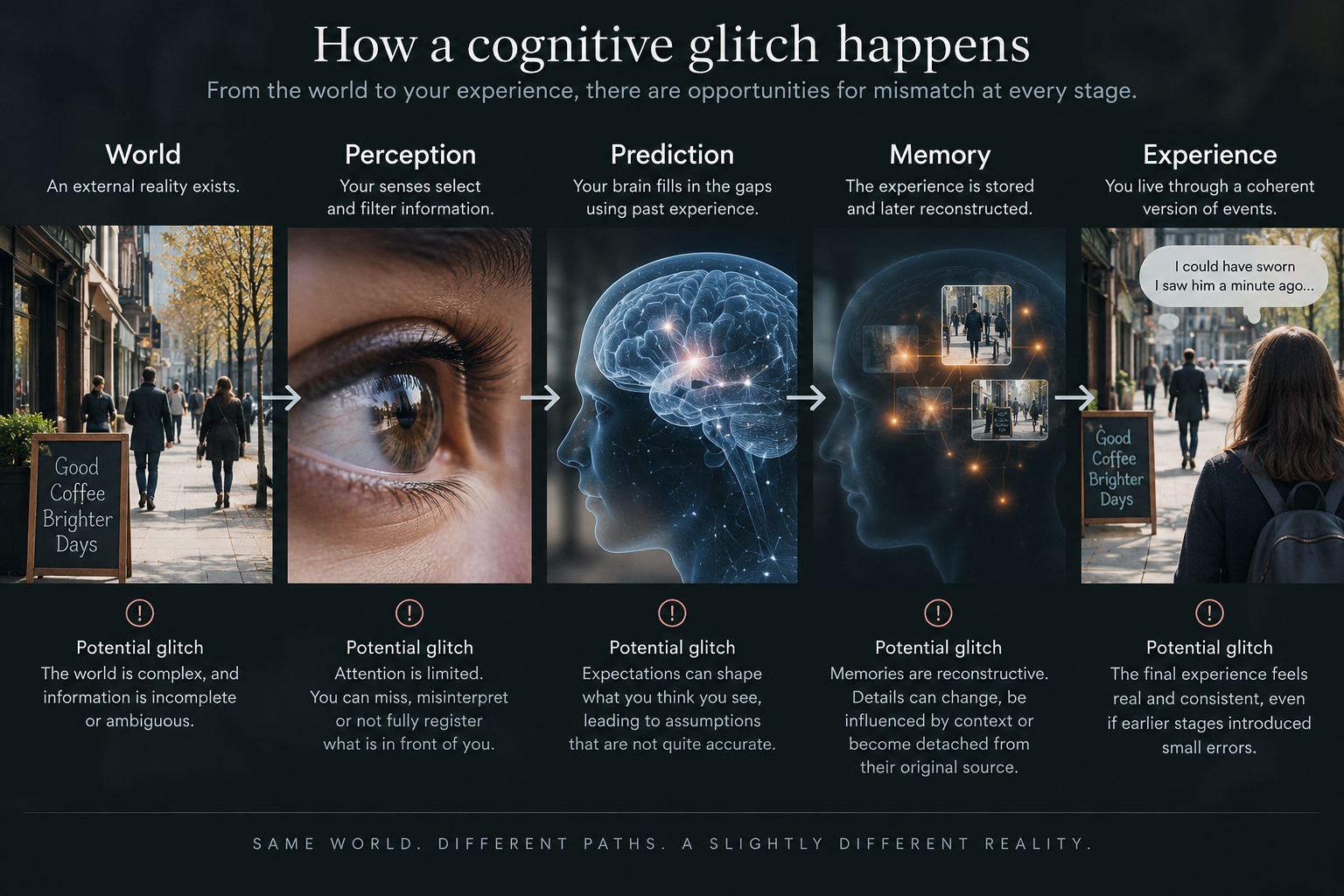
It feels as though we simply look out at reality and see what is there. Perception is considerably more active than that.
The brain combines incoming sensory information with attention, memory, context and expectation to produce a usable representation of the environment. Modern research into predictive processing describes perception as partly inferential: the nervous system uses previous information and expectations to help interpret incomplete or ambiguous sensory input.
Most of the time this is enormously useful. We can recognise a familiar room in poor light, anticipate where a moving object will travel and understand a partially obscured word without consciously calculating how we did it.
It also means that experience is not a flawless recording of external reality.
Sometimes the model and the world fail to line up.
You can miss something while looking directly at it
One of the clearest demonstrations comes from change blindness. Under the right conditions, people can fail to notice surprisingly large alterations in a visual scene.
Objects can change position, disappear or be replaced without the observer immediately becoming aware of it. The phenomenon does not mean we see nothing accurately. It shows that our conscious visual experience contains less continuously monitored detail than it seems to.
This offers a straightforward explanation for some domestic "glitches". You search a surface for an object and genuinely feel that you examined the whole area, but your attention never properly registered the object that was sitting there.
When you see it later, the experience can be astonishing because your memory says you already checked.
Both things can be true: you looked at the table, and you failed to consciously see what was on it.
Memory creates another layer of uncertainty
Memory feels like retrieval, but it is partly reconstruction.
We retain information about events and later rebuild an account using stored details, expectations and context. We are also capable of remembering information while becoming confused about where that information came from.
Psychologists call this source monitoring.
You might remember an image accurately but forget whether you saw it, dreamed it, imagined it or heard somebody describe it. Usually these errors are trivial. In stranger circumstances they can produce the conviction that something has happened twice or that you somehow knew about an event before experiencing it.
This becomes particularly relevant when we investigate anomalies after the event. Each retelling can subtly consolidate one interpretation of what happened.
A memory can remain completely sincere while changing.
That is why an account written immediately after an experience carries more evidential weight than one reconstructed months later.
Pattern recognition can make coincidence feel designed
Humans are exceptional pattern detectors. We look for relationships between events because doing so helps us learn, predict and survive.
Sometimes we identify relationships that are not actually there. Apophenia is the broad term often used for perceiving meaningful connections in unrelated or random information, while pareidolia describes familiar forms such as faces appearing in clouds, buildings or patterns of light.
These tendencies make some apparent glitches easy to manufacture accidentally.
Notice the number 11:11 once and it becomes more salient. You begin catching it on clocks more frequently, which makes the pattern feel as though it is increasing. Learn a new word and suddenly it seems to appear everywhere.
But identifying a cognitive mechanism does not necessarily make every pattern meaningless.
The more useful question is whether the pattern contains information that could not reasonably be produced by attention, probability or retrospective interpretation.
That is also where synchronicity becomes more interesting than simple repetition.
Déjà vu is an excellent example
Déjà vu can feel exactly like a failure in reality. A new moment arrives already carrying the sense that it has happened before.
Research into memory and familiarity provides good reasons why that can occur. Familiarity can be triggered without successful recollection of its source, and an unfamiliar environment can resemble the spatial structure of something previously experienced without the earlier scene becoming consciously available.
We explored that in Déjà Vu and the Illusion of Time.
Déjà vu therefore demonstrates something important about glitch experiences. A phenomenon can feel profound, external and temporal while having a plausible mechanism inside the mind.
But that does not mean the correct method is to dismiss anything that resembles déjà vu. It means we need evidence capable of distinguishing the two possibilities.
What about disappearing objects?
The disappearing-object story is one of the most common forms of reported glitch.
An object is placed somewhere. Several people search for it. Later it appears somewhere that was supposedly checked repeatedly, sometimes in an obvious position.
There are many ordinary possibilities: somebody moved it and forgot, another person returned it, the object was overlooked, the remembered location was wrong, or the search itself created a misleadingly strong memory that the exact spot had been examined.
Those explanations cover an enormous number of cases.
The interesting cases would contain additional constraints. Perhaps several people independently remember the object's location, nobody else had access to it, the area was photographed while the item was apparently missing, and it later appears within the photographed area without an ordinary route by which it could have been returned.
At that point we still have not proved reality changed.
We have simply made the ordinary explanations harder.
That is how investigation should work.
Time glitches are harder to assess
People sometimes report moments when time seems to stop, repeat, accelerate or disappear.
Subjective time is highly flexible. Attention, emotion, fatigue, sleep disruption, novelty and altered states can all change the way duration feels. We can become absorbed in something and lose awareness of an hour, while a frightening few seconds can seem considerably longer.
There are also ordinary gaps in attention and memory. Arriving somewhere without clearly remembering parts of a familiar journey can feel disconcerting even though the behaviour occurred normally.
More unusual accounts involve apparent discrepancies between subjective experience and clocks, devices or other people.
Here again, independent information changes the quality of the claim. Feeling that ten minutes vanished is primarily a subjective experience. Finding that several independent clocks recorded something inconsistent would create a different problem.
The further an anomaly moves outside one person's perception, the more interesting it becomes.
Shared glitches deserve a different category
Suppose two people witness the same strange event.
That does not automatically prove the event was paranormal. People influence one another's attention and interpretation, and memories can converge through conversation after an ambiguous event.
But genuinely independent agreement is stronger than a solitary recollection.
The best shared cases would involve people recording what they saw separately before discussing it. If several accounts independently contain the same unusual details, we have reduced some of the problems created by suggestion and retrospective reconstruction.
Again, there is an evidence ladder.
"I experienced something strange" is valuable as personal testimony.
"We both independently described the same strange thing" is stronger.
"The event also produced a physical record" is stronger again.
"A similar anomaly can be reproduced under controlled conditions" would move us into an entirely different territory.
Physical records change the conversation
Smartphones, doorbell cameras, vehicle cameras, digital timestamps and environmental sensors mean that unusual events are increasingly capable of leaving records.
This creates an interesting test for the modern era.
If physical reality regularly produces obvious macroscopic glitches, we might expect some of them eventually to appear across several independent recording systems.
A single strange photograph proves very little because cameras introduce their own artefacts. Compression, rolling shutters, reflections, dropped frames, stitching errors and software processing can create spectacularly odd images.
But imagine something more rigorous: several independent cameras record the same impossible event from different positions while witnesses describe it consistently and the original files survive technical examination.
That would be much harder to dismiss as a perceptual error.
It still would not immediately prove that reality is simulated.
But it would establish that something external requires explanation.
Not every unexplained event is evidence of a simulation
There is a temptation to turn the argument into two choices: either the brain made a mistake or we live inside a computer.
Reality gives us far more options.
An unexplained event could eventually turn out to involve unusual physics, environmental effects, misunderstood technology, deliberate deception, an unknown feature of consciousness, statistical coincidence or a mechanism we have not considered.
"Simulation glitch" is therefore an interpretation, not a diagnosis.
The simulation hypothesis becomes relevant because it provides one model in which experienced reality could emerge from a deeper informational system. If that system were imperfect, modified or subject to constraints, anomalies are conceivable.
However, Nick Bostrom's simulation argument does not predict that spoons should duplicate, cats should respawn or street scenes should visibly reset. Those ideas come largely from technological metaphor and popular culture rather than from the philosophical argument itself.
If our universe were simulated at an extraordinarily sophisticated level, its underlying errors might look nothing like bugs in a computer game.
What would a genuine simulation glitch look like?
This is where the subject becomes much more interesting.
A useful anomaly would need to tell us something about the system producing it.
Repeated boundary conditions would be interesting. So would consistent limits in physical behaviour, unexplained discretisation, reproducible information anomalies or interventions that appeared to come from outside the physical rules available within the system.
We looked at those possibilities more closely in Can We Prove We're in a Simulation?.
By comparison, an object moving inexplicably once is weak evidence for simulation theory because almost any worldview can accommodate an unexplained object.
A pattern becomes scientifically useful when it discriminates between explanations.
If the same anomaly repeatedly occurs under defined conditions, investigators can begin asking what kind of underlying mechanism would produce it.
Quantum physics does not solve the problem
Glitch discussions often turn rapidly towards quantum mechanics.
Quantum physics genuinely challenges many assumptions derived from everyday experience. At very small scales, physical systems do not behave like familiar solid objects, and quantum theory raises profound questions about measurement, probability and the nature of physical states.
It does not follow that quantum mechanics explains missing jewellery, timeline shifts or synchronicities.
Nor does the role of measurement in quantum theory establish that human intention freely rewrites macroscopic reality.
There may eventually prove to be important connections between consciousness, information and fundamental physics. Those questions remain open enough to be fascinating.
We do not need to misrepresent quantum mechanics to explore them.
Could consciousness itself be part of the anomaly?
There is another possibility that sits between "brain error" and "broken universe".
What if consciousness participates in reality more deeply than our current models recognise?
Idealist philosophies place consciousness closer to the foundation of existence rather than treating it simply as something generated by matter. Some spiritual traditions similarly understand physical reality as one level of a larger field of mind or awareness.
Within those models, a strange event might not represent a software bug at all. It could arise from the relationship between consciousness and the world being experienced.
This is where synchronicity, manifestation, altered states and reality glitches begin to overlap.
Perhaps attention changes what we notice.
Perhaps belief changes behaviour and therefore outcomes.
Perhaps unconscious processes recognise patterns before conscious thought does.
Or perhaps consciousness occasionally interacts with reality in ways we have not yet learned to measure.
The first three already occur. The fourth remains speculative.
Sacred Illusion is interested in the gap between them.
Synchronicity is not quite the same as a glitch
A glitch appears to violate continuity. A synchronicity preserves ordinary physical rules but creates an unusual relationship between events.
You think about somebody you have not spoken to in fifteen years and they contact you that afternoon. You encounter the same unusual symbol repeatedly while making a major decision. A sequence of independently improbable events seems to organise itself around the same subject.
Nothing physically impossible needs to happen.
The strangeness lies in the pattern.
Coincidence and selective attention explain many such experiences. But very specific chains of coincidence can still produce the impression that meaning exists not only inside the observer but in the relationship between mind and event.
Carl Jung's concept of synchronicity was developed precisely to describe meaningful coincidence without an obvious causal relationship.
Whether synchronicity reveals a deeper organising principle or the extraordinary pattern-making ability of consciousness remains unresolved.
Calling either answer obvious would get ahead of the evidence.
The Mandela Effect raises a related question
Collective memory errors create another category of apparent reality shift.
Groups of people sometimes remember names, logos, quotations or public events differently from the historical record. The Mandela Effect has become popular partly because shared false memories feel harder to dismiss than individual ones.
Yet people do not form memories independently of culture. We encounter the same misquotations, visual conventions, assumptions and repeated versions of stories, so large groups can develop the same incorrect memory without requiring history itself to have changed.
That gives us a credible conventional explanation for many examples.
Harder evidence for an altered timeline would require more than lots of people remembering the same thing. We would need reliable records produced before the supposed change that conflict in ways ordinary editing, reproduction or error cannot explain.
That is a much higher bar.
It is also a far more interesting one.
The best question is not "Do I believe this?"
Glitch stories often become arguments between believers and sceptics far too quickly.
A better approach is investigative.
What exactly happened?
Which parts were perceived directly?
Which parts are remembered afterwards?
Was anything recorded at the time?
Did another person witness it independently?
Could attention, memory, expectation or probability account for it?
If those explanations fail, what evidence remains?
This approach does not drain the mystery out of anomalous experience. It protects the genuinely strange cases from being buried beneath thousands of ordinary mistakes.
A simple evidence ladder for reality glitches
Personal experience is the starting point, not the end of the investigation.
A subjective anomaly is something only you experienced. It may be powerful and personally significant, but there are many possible cognitive explanations.
A contemporaneously recorded anomaly is more useful because details were written, photographed or recorded before memory could substantially reshape them.
An independently witnessed anomaly adds another observer, especially if accounts were collected separately.
A multi-record anomaly is supported by physical evidence from more than one independent source, such as separate cameras, instruments or timestamps.
A repeatable anomaly is the strongest category because the conditions can be recreated and the effect examined deliberately.
Very few online glitch stories get beyond the first or second level.
That does not make them worthless.
It tells us how much we can reasonably conclude from them.
How to investigate a glitch when one happens
If you experience something genuinely strange, record it as soon as possible. Describe what happened before deciding what it means, including the time, location, people present and sequence of events.
Keep observation and interpretation separate. "The clock showed 14:12, then appeared to show 14:10 three minutes later" is an observation. "Time reversed" is an interpretation.
Ask witnesses to write their own account before comparing stories. Preserve original photographs or video rather than edited copies, and check ordinary explanations properly rather than treating them as an insult to the experience.
Also record the misses. If you are tracking impossible coincidences or predictions, note occasions when nothing happened as well as the striking hits. Otherwise it becomes very easy to build an extraordinary pattern from selected events.
The aim is not to talk yourself out of what happened.
It is to discover what kind of event you actually have.
When an experience is probably cognitive
An experience becomes easier to explain conventionally when it happens during exhaustion, severe stress, the transition into or out of sleep, intoxication or other states known to affect perception and memory.
The same applies when an anomaly depends entirely on remembering where an object was, whether something looked different yesterday or whether an event happened in exactly the same way previously.
That does not mean the experience was imaginary. The experience itself was real.
It means the available evidence points more strongly towards the processing of reality than towards reality physically changing.
Persistent new hallucinations, unexplained loss of awareness, major memory gaps or other concerning neurological symptoms deserve medical attention rather than being interpreted solely as metaphysical phenomena.
Curiosity and basic health sense can comfortably coexist.
When I would keep investigating
A glitch becomes more difficult to put aside when it contains information the observer could not reasonably have known, several independent people report the same precise anomaly, or the event leaves consistent external evidence.
Repeated events under similar conditions are more interesting again.
The ideal case would combine all of these: an unusual event predicted or documented in advance, witnessed independently, captured by multiple instruments and repeated under conditions that allow alternative explanations to be tested.
We do not currently have accepted evidence of that standard demonstrating that reality itself occasionally glitches.
But that is the kind of case worth looking for.
Could reality be stranger without being broken?
There is another assumption hidden inside the word "glitch": that something has gone wrong.
Perhaps some apparently impossible experiences are not errors at all.
A two-dimensional creature encountering a three-dimensional object might interpret its changing cross-section as impossible behaviour because it could not perceive the dimension required to explain it. In the same way, a reality containing structures beyond our ordinary perception could occasionally produce events that appear inconsistent only because our model is incomplete.
That could involve dimensions, time, consciousness, information or something we have not yet conceptualised.
This is speculative, but it is a more sophisticated possibility than imagining the universe briefly freezing because somebody forgot to update the software.
An anomaly could reveal not a broken reality, but a larger one.
So are glitches in the Matrix just cognitive errors?
Many probably are.
Human attention is selective, memory is reconstructive, expectations shape perception and coincidence becomes more impressive once we start looking for it. These mechanisms can produce experiences that feel far stranger than the underlying event.
That should make us more careful, not less curious.
The existence of perceptual and memory errors does not establish that every anomalous experience originates inside the observer. It simply gives us a set of explanations that should be tested before reaching for more extraordinary ones.
The cases worth pursuing are those that survive that process.
If an event remains strange after checking memory, perception, probability, technology and independent records, "we don't know" becomes a perfectly legitimate answer. It may remain unexplained because information is missing, or it may eventually point towards something our current model of reality does not contain.
Sacred Illusion is interested in that remaining territory.
Not every glitch is a crack in reality.
But we should not decide in advance that reality cannot crack.
Frequently asked questions
What is a glitch in the Matrix?
A glitch in the Matrix is a popular term for an experience that appears to violate the expected continuity of reality. Common reports include repeated events, disappearing objects, time anomalies, unusual coincidences and scenes that seem to change unexpectedly.
Are glitches in the Matrix real?
The experiences are real in the sense that people genuinely report them. Many can plausibly be explained through attention, perception, memory, coincidence or technology. There is currently no established scientific evidence showing that everyday "glitches" are failures in a simulated reality.
Why do objects sometimes seem to disappear and reappear?
Attention and memory offer several explanations. An object can be overlooked even while someone believes they searched the relevant location, or its original position may be remembered incorrectly. Cases with independent records showing an object genuinely absent and later present would be considerably more unusual.
Can the brain create reality glitches?
The brain can certainly create experiences that resemble them. Change blindness, source-memory errors, false familiarity, prediction and pattern detection can all make an ordinary event feel inconsistent with what we believe should have happened.
Are glitches evidence that reality is a simulation?
Not by themselves. Simulation theory does not specifically predict disappearing objects, repeated strangers or déjà vu. Evidence for a simulated universe would be stronger if an anomaly revealed a consistent and testable property of the underlying system.
Is déjà vu a glitch in the Matrix?
Déjà vu is often described that way culturally, but psychology and neuroscience provide plausible explanations involving familiarity and memory. We explore the wider possibilities in Déjà Vu and the Illusion of Time.
Can synchronicities be reality glitches?
Synchronicity is slightly different because nothing necessarily violates physical continuity. The anomaly lies in the apparently meaningful relationship between events rather than an obvious break in reality.
What would count as strong evidence of a genuine reality anomaly?
Independent witnesses, contemporaneous documentation, multiple physical records and repeatability would all strengthen a case. The strongest anomaly would remain measurable after ordinary psychological, technological and environmental explanations had been tested.
Continue exploring
Can We Prove We're in a Simulation?
What would actual evidence of an underlying system have to look like?
Déjà Vu and the Illusion of Time
Why can a completely new moment feel as though it has already happened?
What Dreams Might Reveal About the Source Code
Dreaming shows how convincingly consciousness can inhabit a reality generated under very different conditions.
Simulation Theory 101
Start with the philosophical argument, then explore what a simulated reality could mean for consciousness and human experience.