Déjà Vu and the Illusion of Time: Memory Glitch or Glimpse Beyond the Present?
Déjà vu feels like a memory of something that has never happened. Is it a quirk of recognition, a glimpse of another timeline or a clue that time is stranger than it appears?

You walk into a room you have never visited and suddenly know it.
Not because it resembles somewhere familiar in an obvious way. The whole moment seems known: the light, the angle of the furniture, the conversation unfolding beside you, perhaps even the peculiar certainty that you already know what is about to happen.
Then it disappears.
Déjà vu is difficult to describe precisely because the experience contains a contradiction. Something feels deeply familiar at the same time as another part of your mind knows that it should not.
Neuroscience has some good ideas about why this happens. Memory systems can generate familiarity without retrieving the memory that should accompany it, creating the unsettling impression of recognising the present from an undefined past.
That may explain a great deal.
But déjà vu has fascinated people for so long because it does not feel like an ordinary memory error. It feels temporal, as though for a few seconds the normal relationship between past, present and future has become unreliable.
That leaves a more adventurous question open: what if some experiences of déjà vu tell us something about time itself?
What is déjà vu?
The French phrase déjà vu means "already seen", although the phenomenon usually involves more than vision. It is the sudden feeling that a present situation has been experienced before despite knowing that it is actually new.
Researchers often describe it as familiarity without recollection.
Normally, those two processes work together. You recognise a person as familiar and then remember where you know them from. You enter a building and recognise it because you have been there before.
During déjà vu, familiarity arrives but the corresponding memory does not.
That creates the strange internal conflict at the centre of the experience. One part of the mind is saying, "I know this", while another is saying, "You cannot possibly know this."
That disagreement may be exactly why déjà vu feels so uncanny.
The brain has separate systems for familiarity and recollection
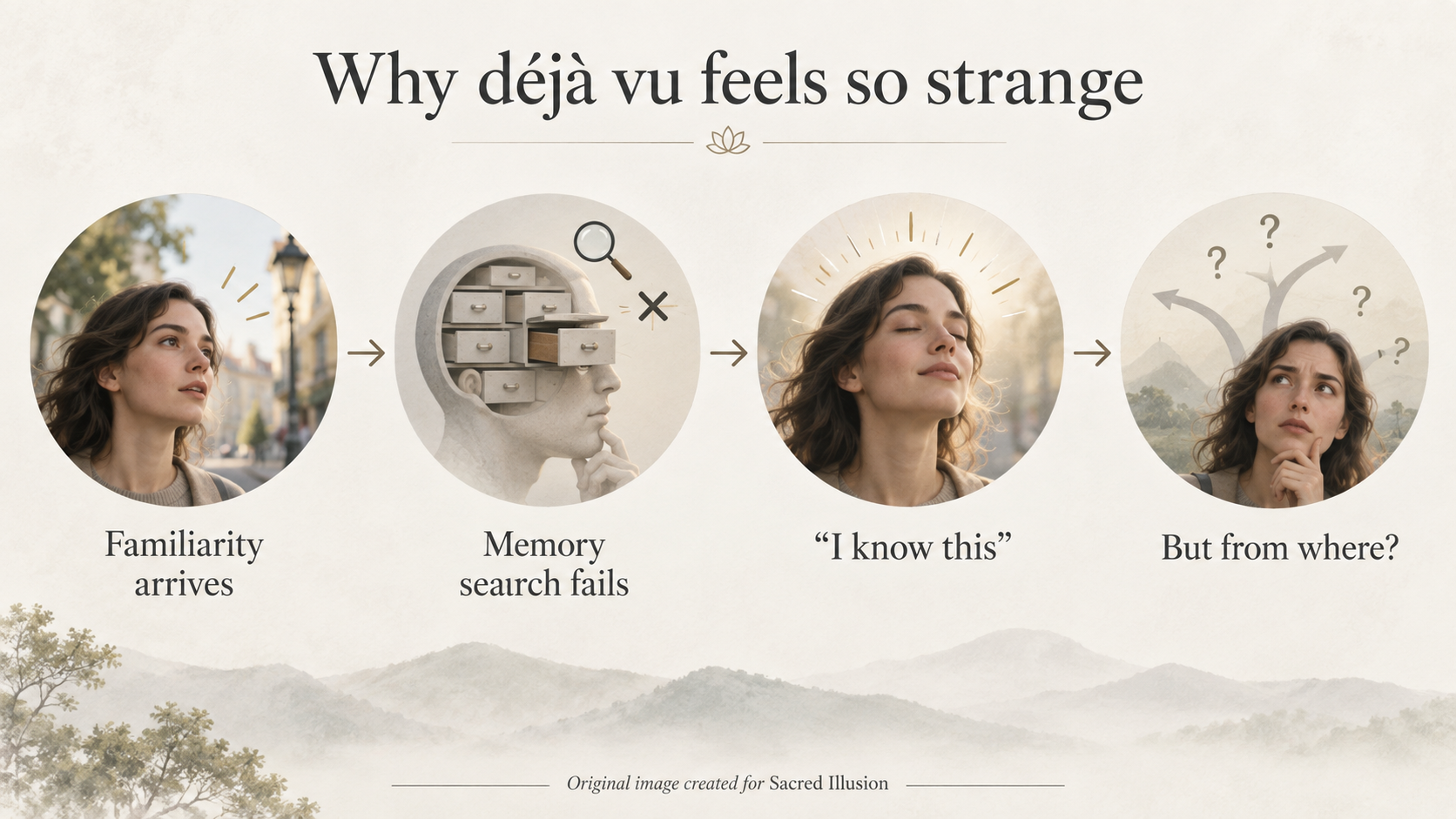
Research into recognition memory suggests that the sense of familiarity and the retrieval of a detailed memory are related but separable processes.
You have probably experienced this outside déjà vu. Someone's face looks familiar but you cannot remember their name or where you met. A place feels known even though you cannot identify the previous visit.
Déjà vu may be an unusually intense version of that mismatch.
Neurological research has linked the experience particularly strongly with structures in and around the medial temporal lobe, which are involved in memory and recognition. Studies of people with temporal-lobe epilepsy have also found associations between déjà vu and systems involved in assessing familiarity.
This gives us a plausible mechanism without reducing the phenomenon to "your brain simply went wrong". It tells us something more interesting: our sense that the present is new is itself actively constructed by memory systems.
Usually we never notice that process.
Déjà vu exposes it.
When a new place resembles an old one
Psychologist Anne Cleary and colleagues have spent years investigating whether an unfamiliar situation can produce déjà vu because its structure resembles something previously experienced.
Imagine walking through the lobby of a hotel you have never visited. The exact furniture, colours and people are new, but the spatial arrangement happens to resemble another place stored in memory.
You do not consciously retrieve the earlier scene.
Your brain nevertheless detects the similarity.
The result may be familiarity without an identifiable source, producing the feeling that the current experience has somehow happened before.
Cleary's laboratory has also examined the feeling of knowing what will happen next that sometimes accompanies déjà vu. Participants can feel unusually confident that the next event is predictable even when their actual ability to predict it does not improve.
That is a strong psychological explanation.
It is also interesting that the experience of time becomes distorted by a problem in memory.
Why déjà vu feels like a problem with time
Memory normally points backwards.
A present event triggers something from the past, allowing us to recognise what we are experiencing now.
Déjà vu scrambles that order.
The current moment seems to arrive already carrying the emotional signature of a memory. Instead of "this reminds me of something", the experience becomes "this has already happened".
For a few seconds, past and present seem to occupy the same space.
That is why déjà vu invites metaphysical interpretations so easily. The experience itself feels as though linear time has briefly failed.
Neuroscience may explain why the feeling occurs.
The deeper philosophical question is whether our ordinary sense of time is as straightforward as we assume in the first place.
Is time really a straight line?
Everyday life encourages us to imagine time moving in one direction.
The past has happened. The present is happening. The future does not exist yet.
Physics and philosophy make the picture considerably more complicated.
Einstein's relativity removed the idea of one universal present shared by the entire universe. Whether two distant events are simultaneous depends on the observer's frame of reference.
Some philosophers and physicists interpret relativity through an idea often called the block universe or eternalism. In this view, past, present and future are all parts of a four-dimensional spacetime rather than reality being continually created at one moving moment.
That does not mean déjà vu gives us access to the future.
It does mean that our intuitive experience of time flowing from past to future may not describe reality at its deepest level.
What if past and future already exist?
The block-universe idea produces a strange possibility.
If every moment occupies its own place within spacetime, your childhood, this moment and events forty years from now may all belong to the same larger structure.
Consciousness nevertheless experiences them sequentially.
Why?
Perhaps the sensation of time passing emerges from memory, attention and the way minds process change rather than from an objective cosmic present moving forward.
Philosophers disagree about this, and eternalism is not the only serious theory of time. But it gives metaphysical interpretations of déjà vu an intriguing backdrop.
If consciousness normally experiences only one moment at a time, could there ever be occasions when information from another point in that structure becomes accessible?
Physics does not currently show that this happens.
Déjà vu makes the possibility compelling to imagine.
Could déjà vu be a memory from the future?
Some experiences of déjà vu contain a second sensation: not only that the present has happened before, but that the next few seconds are already known.
You may feel that someone is about to say a particular sentence or that you know what lies around a corner.
Laboratory research suggests that the subjective feeling of prediction can arise without genuine predictive accuracy.
That explains why many experiences may feel precognitive when they are not.
The harder cases are personal ones in which somebody believes they did know what happened next, particularly when several specific details seem to follow the anticipated sequence.
Those accounts are difficult to evaluate retrospectively because memory itself is flexible. A sensible way to investigate them is to record the prediction immediately, before seeing what happens.
If déjà vu ever does contain genuine information about the immediate future, that would be far more interesting than the familiarity sensation itself.
Déjà rêvé: when the moment feels dreamed rather than lived
There is a related experience known as déjà rêvé, literally "already dreamed".
Instead of feeling simply that the present has happened before, the person has the impression that the current situation appeared previously in a dream.
Sometimes a specific dream is remembered.
Other times there is only the powerful sense that the scene belongs to a dream whose details cannot quite be retrieved.
This becomes especially interesting for people who keep dream journals.
If an apparently predictive dream has been written down before the later event, we have something more useful than retrospective familiarity. We can compare the original account with what actually happened.
Most correspondences may turn out to be broad or coincidental.
Occasionally they may be far more precise.
We explored this territory in What Dreams Might Reveal About the Source Code.
Could déjà vu come from another timeline?
Timeline theories offer a different explanation. Suppose reality contains multiple possible histories. In one version of events, you made one choice. In another, you chose differently. Perhaps many versions of you continue along slightly different trajectories.
Could déjà vu occur when two sufficiently similar timelines briefly resonate?
The idea appears frequently in contemporary metaphysical writing. A scene feels familiar because another version of you has already experienced something almost identical.
Quantum physics does not currently provide a mechanism for memories leaking between branches of the Many-Worlds interpretation.
So this is a metaphysical extension rather than established quantum theory.
But if you already entertain the possibility that consciousness is not completely confined to one physical trajectory, déjà vu becomes one of the obvious experiences to investigate.
The key question would be whether the feeling ever contains information rather than familiarity alone.
Could you be remembering a past life?
Reincarnation traditions offer another interpretation. Perhaps the familiarity belongs not to another timeline but another life.
A landscape, building, face or event could provoke the strange certainty of recognition because consciousness has encountered something similar before birth.
A single episode of déjà vu cannot establish reincarnation. Familiarity can arise for many reasons, and memories are exceptionally easy to reinterpret after the event.
Yet past-life traditions describe a broader category of experience that can include unusually strong recognition of places, people or cultures apparently unfamiliar in the current life.
The more specific and verifiable the information, the more interesting the case becomes. A vague feeling that an old church seems familiar tells us very little. Knowing an unusual feature of a place before seeing it would be another category altogether.
Déjà vu as a simulation glitch
Then there is the interpretation made famous by The Matrix. Something repeats because the system has changed.
In simulation theory, déjà vu can be imagined as a moment when information is duplicated, reality is updated or consciousness somehow detects the underlying architecture of the simulated world.
There is currently no evidence showing that ordinary déjà vu is a computational glitch.
Our understanding of recognition memory already provides a plausible internal explanation.
But the simulation interpretation becomes more interesting if an episode contains something the memory explanation does not easily address, such as independently verified information, repeated external anomalies or simultaneous unusual experience shared by several people.
A feeling of familiarity by itself is weak evidence.
A reproducible anomaly would be something different.
That is the approach we take in Can We Prove We're in a Simulation?: ask what observation would actually distinguish a simulation explanation from an ordinary one.
What about time loops?
Another interpretation treats déjà vu as evidence that an event has literally repeated. Perhaps reality cycles through similar sequences. Perhaps consciousness is reliving the same period without retaining ordinary memory of earlier passes.
Stories about time loops usually belong to fiction, but cyclic models of time have appeared in philosophy, cosmology and religion in many different forms.
A repeated universe would not automatically produce personal memories from an earlier cycle. Nor would déjà vu prove that repetition had occurred.
Yet the idea captures something emotionally accurate about the experience.
For a moment, the present does not feel new. It feels returned.
Synchronicity and déjà vu
Déjà vu can become especially striking when it appears inside a period of intense synchronicity.
You are already noticing repeated themes, unexpected meetings or meaningful coincidences, and then a situation arrives with the strong sensation that you have encountered it before.
That combination can feel less like a memory error and more like navigation.
Some spiritual practitioners interpret it as confirmation that they are moving along the correct path, almost as though consciousness recognises a point in the journey before the rational mind does.
That may simply reflect heightened attention during emotionally significant periods. It could also be a useful symbolic interpretation even without assuming a supernatural mechanism.
The more adventurous possibility is that synchronicity and déjà vu sometimes arise from the same deeper relationship between consciousness and events.
We do not currently know whether such a relationship exists.
Does déjà vu mean you are on the right timeline?
I would be cautious about turning every episode into a cosmic green light.
Feeling familiarity while making a terrible decision does not automatically mean the universe approves. But déjà vu can be used as an invitation to become more attentive.
- What were you thinking about immediately before it happened?
- Who were you with?
- What decision or transition is occurring in your life?
- Did the experience contain only familiarity, or was there information attached to it?
- Did anything unusual happen afterwards?
Those questions are more useful than immediately deciding that you have received a message. Patterns become visible through repeated observation.
How to investigate your own déjà vu
If déjà vu interests you, record episodes before memory has time to reshape them.
Note the date, place, people present and what was happening immediately before the sensation began. Describe precisely what felt familiar and whether you believed you knew what would happen next.
If you make a prediction, write it down immediately before the event unfolds where practical. Later, compare what actually occurred with what you recorded rather than relying on the feeling that you "knew it".
Also note your physical state. Fatigue, stress, travel and disrupted sleep may be relevant, and recognising ordinary patterns does not make an experience less interesting.
Over time, you may discover that your déjà vu is random, clustered around certain environments or associated with particular periods of your life.
You may also discover experiences that remain genuinely difficult for you to explain.
When déjà vu becomes something else
Ordinary déjà vu is generally brief and familiar to many healthy people.
Very frequent or unusually intense episodes can also occur in some neurological conditions, particularly temporal-lobe epilepsy. Research has long connected seizure-related déjà vu with medial temporal systems involved in memory and familiarity.
An episode accompanied by loss of awareness, confusion, unusual smells or tastes, involuntary movements, intense unexplained fear or other concerning symptoms is not something to interpret only spiritually. Medical assessment is appropriate, particularly if the experiences are new or increasing.
A neurological explanation and a philosophical interest in consciousness are not enemies. Understanding the brain gives us more information about the instrument through which these experiences occur.
The curious case of knowing that the familiarity is wrong
One of the most revealing features of déjà vu is that you usually know something is wrong.
You do not ordinarily say, "Ah yes, I remember visiting this exact place last Thursday" and genuinely believe it.
Instead, you experience familiarity and simultaneously recognise that the familiarity has no legitimate source.
Researchers describe this as part of the phenomenon itself. Studies of recognition memory and temporal-lobe epilepsy support the idea that déjà vu involves erroneous familiarity while other processes continue to signal that the current situation is actually new.
Consciousness therefore seems capable of observing a conflict inside its own memory systems. The brain creates the familiarity. Another part of us notices the impossibility.
Then comes the thought that has fascinated people for generations: what if the familiarity is not actually wrong?
Could consciousness experience time differently from the brain?
Most neuroscience starts from the assumption that conscious experience arises from brain activity.
Other philosophical positions leave open the possibility that consciousness is more fundamental, with the brain acting partly as organiser, filter or interface.
If some version of that second model were true, temporal anomalies become more intriguing.
The brain may organise experience sequentially because that is useful for functioning within physical reality, while consciousness itself might not be limited in exactly the same way.
Déjà vu could then represent a moment when the usual organisation becomes less complete. That is speculation.
But it connects directly with questions raised by dreams, altered states, precognition and mystical experiences in which ordinary time appears to dissolve.
The common thread is not proof of anything supernatural.
It is the repeated human report that consciousness does not always experience time as the clock does.
So what does déjà vu actually tell us?
The strongest evidence currently points towards memory and familiarity systems.
The brain can produce a compelling sense that the present has been encountered before even when conscious recollection cannot identify a source. Spatial similarity, recognition without recall and activity within temporal memory systems can all contribute to the experience.
That is already a fascinating discovery because it shows that our experience of time depends partly on how memory labels the present.
But neurological explanation does not settle every philosophical question raised by the experience.
Time itself is stranger in modern physics than everyday intuition suggests. Consciousness remains incompletely understood. People continue to report dreams that later resemble events, powerful experiences of past-life recognition, apparent timeline shifts and episodes of déjà vu that seem to contain more than familiarity.
Many of those experiences will have ordinary explanations. Some may remain unexplained because the evidence is poor. A small number may continue to resist easy classification.
Sacred Illusion does not need déjà vu to prove reincarnation, parallel worlds or a simulated universe. Its real value is subtler.
For a few seconds, the machinery that normally keeps past and present neatly separated behaves differently, and we notice how much our sense of reality depends on processes we almost never see.
Perhaps déjà vu is simply an error in that machinery.
Perhaps occasionally it is an opening.
For now, both possibilities remain interesting enough to investigate.
Frequently asked questions
What causes déjà vu?
The leading scientific explanations involve memory and recognition systems. A current situation may trigger familiarity without allowing the brain to retrieve the source of that familiarity, creating the feeling that a new event has happened before.
Is déjà vu a memory glitch?
It can reasonably be described that way, although "glitch" oversimplifies the process. Research suggests that déjà vu involves familiarity being activated inappropriately while other memory systems correctly recognise that the situation is new.
Can déjà vu predict the future?
People sometimes feel during déjà vu that they know what will happen next. Laboratory research has shown that this feeling can occur without improved predictive accuracy. Reports of specific correct predictions are harder to evaluate and are stronger when recorded before the predicted event occurs.
Is déjà vu connected with epilepsy?
Déjà vu can occur in healthy people, but it is also a recognised feature of some temporal-lobe seizures. Frequent or intense episodes accompanied by other neurological symptoms should be medically assessed.
Could déjà vu be a past-life memory?
Some spiritual traditions interpret intense recognition as possible evidence of reincarnation. Déjà vu alone cannot demonstrate a past life, although cases containing specific information that could not normally have been known are more interesting to investigate.
Does déjà vu mean timelines are crossing?
There is no scientific evidence showing that déjà vu results from overlapping timelines. It remains a metaphysical interpretation connected with ideas about parallel realities and timeline shifting.
Is déjà vu a glitch in the simulation?
Simulation theory offers that possibility as a speculative interpretation, but normal déjà vu can already be explained through memory mechanisms. Stronger evidence for a simulation would require anomalies that could not be accounted for by recognition, perception or other known processes.
What is déjà rêvé?
Déjà rêvé means "already dreamed". It describes the feeling that a current situation has previously appeared in a dream rather than simply having been experienced before.
Continue exploring
What Dreams Might Reveal About the Source Code
Can dreams contain information that does not fit neatly into ordinary memory and linear time?
Timeline Jumping 101
Explore parallel possibilities, alternate selves and the idea that consciousness may move through more than one possible version of reality.
Can We Prove We're in a Simulation?
What would genuine evidence of an underlying system look like?