Can We Prove We’re in a Simulation? What Evidence Would Actually Count?
If reality is simulated, could we ever detect it from inside? From cosmic-ray tests to glitches, consciousness and synchronicity, here is what might actually count as evidence.

If we were living inside a simulation, how would we know? That question is harder than it first appears.
Anything we measure belongs to the universe we are trying to investigate. Our telescopes, particle accelerators, brains and scientific instruments are all inside the system. If the laws of physics themselves were part of the simulation, then discovering those laws might tell us how our reality works without revealing what generates it.
A perfectly constructed simulation might leave no obvious seams.
But perfection is a large assumption.
A simulated universe could contain limitations, shortcuts, artefacts or forms of interaction that eventually become visible to the beings living inside it. The simulators themselves could intervene. Or consciousness might turn out to interact with reality in ways that make the relationship between observer and world stranger than conventional physics currently describes.
So the useful question is not simply "Can we prove it?" It is: What would actually count as evidence?
Proof is a very high bar
People use the word proof loosely.
A strange coincidence can feel like proof.
Déjà vu can feel like proof.
A manifestation arriving at exactly the right moment can feel like proof.
A physicist discovering something astonishing about information can be presented online as proof.
But these are very different kinds of evidence.
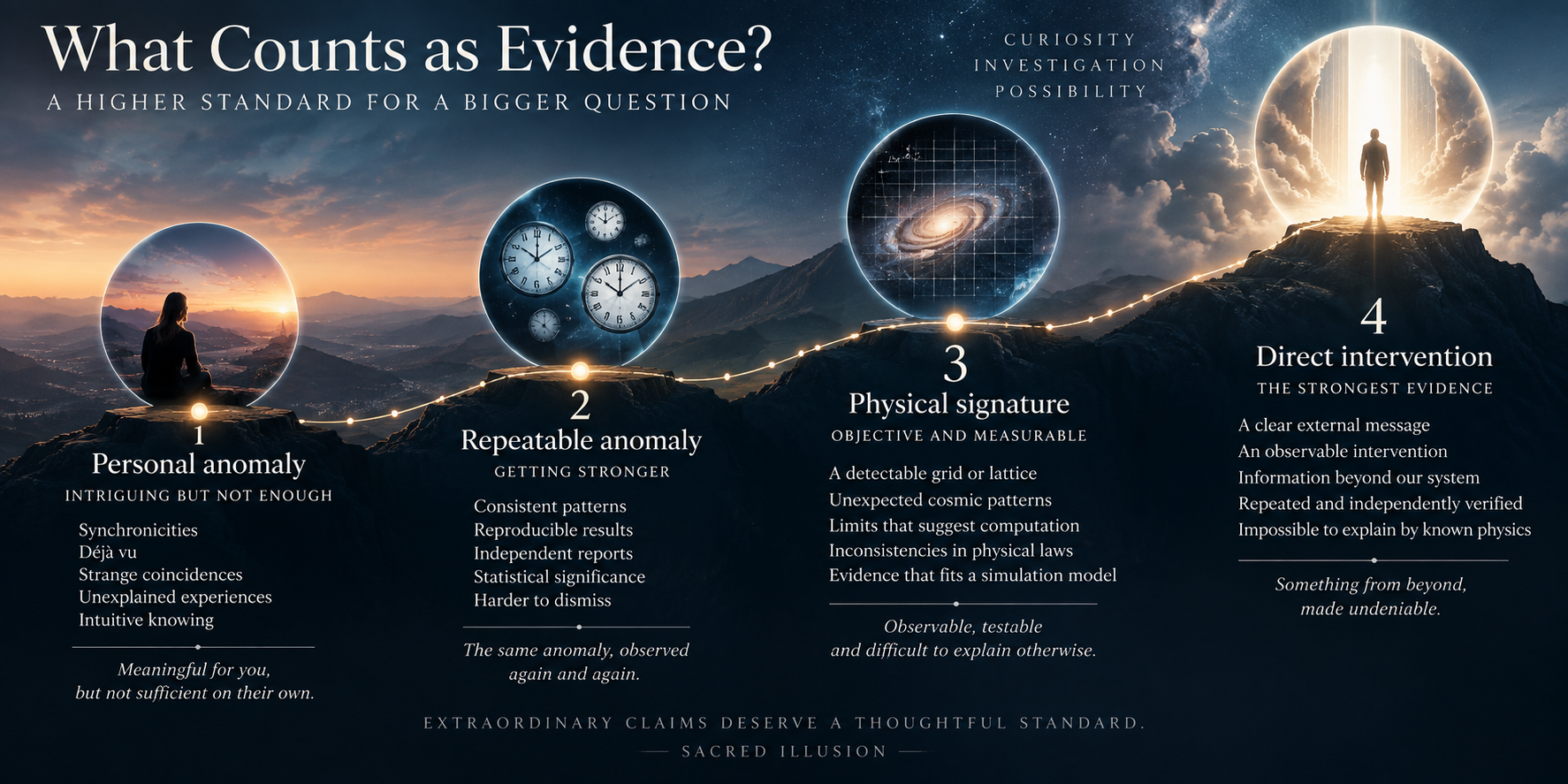
Scientific evidence becomes stronger when an observation can be measured, repeated, independently checked and shown to distinguish one explanation from competing explanations.
If we found an unusual pattern in cosmic rays, for example, it would not be enough for the pattern to resemble something computational. We would need good reasons why simulation explained it better than unknown physics.
The strongest possible evidence would be something far less ambiguous: direct intervention from outside our reality.
Nick Bostrom has used the deliberately absurd example of a window appearing in front of us announcing that we are inside a computer simulation.
If something like that happened publicly, repeatedly and in ways no known process could reproduce, the conversation would change very quickly.
Until then, we are dealing mostly with probabilities, clues and competing interpretations.
The problem of testing reality from inside reality
Imagine a character inside a computer game trying to prove the existence of the computer.
Every instrument available to the character would itself be generated by the game. Every experiment would operate according to the game's rules. Even apparently fundamental discoveries would reveal only the physics of the simulated environment.
The character might eventually discover that space is divided into discrete units or that the universe has an upper processing limit.
But those properties could simply be fundamental laws.
They would not automatically reveal a machine beyond them.
This creates one of simulation theory's central problems.
A simulation sophisticated enough to produce our universe might also be sophisticated enough to hide the evidence of its construction.
And if its creators wanted the inhabitants not to know, they could theoretically remove any experiment capable of revealing them.
The hypothesis might therefore be testable only to the extent that the simulation allows itself to be tested.
That thought is unsettling.
It is also fascinating.
Could we find the universe's grid?
One of the more serious attempts to think about observable simulation signatures came from physicists Silas Beane, Zohreh Davoudi and Martin Savage.
They considered a particular type of simulated universe: one calculated on something similar to a spacetime lattice.
Physics researchers already use lattice simulations when modelling complicated systems. Instead of treating space and time as infinitely smooth, calculations take place across a discrete grid.
If our own universe worked in an analogous way, the grid might leave traces.
The researchers suggested that extremely high-energy cosmic rays could potentially reveal unusual directional effects associated with an underlying lattice.
This was not a claim that they had discovered the simulation.
It was more interesting than that.
They showed that some specific versions of the simulation hypothesis can generate predictions.
If a proposed simulation has a particular architecture, that architecture might constrain what observers inside it can see.
That turns at least part of the question from pure philosophy into something closer to physics.
What if space really is discrete?
Physics already asks whether space and time are continuous at every possible scale. Some approaches to quantum gravity suggest that familiar spacetime may emerge from something deeper.
If scientists eventually discover a smallest meaningful unit of space, the comparison with pixels will be irresistible. But pixels are only one explanation for discreteness. Nature itself could simply be granular.
Finding a minimum scale would therefore be extraordinary, but not enough to prove simulation.
What would become more interesting is evidence of artificial-looking constraints: boundaries or patterns that seem arbitrary from within physics but make obvious sense as computational shortcuts.
Even then, we would have to be careful.
Human beings are extremely good at seeing design when confronted with patterns.
Could the speed of light be a processing limit?
Another popular idea treats the speed of light as something like a maximum information-transfer speed imposed by the system. It is an appealing analogy.
Nothing carrying information locally can simply accelerate past that limit, so it is easy to imagine a universe enforcing a maximum processing rate. But analogy is not evidence.
Relativity explains the role of the speed of light without requiring an external computer.
A simulated universe might contain a speed limit. A non-simulated universe might contain exactly the same one.
What would become more revealing is discovering that several apparently unrelated physical limits could all be derived from a deeper computational architecture.
That has not happened.
Yet.
The universe contains information
Modern physics increasingly treats information as fundamental.
Black-hole physics created profound questions about whether information can ever truly disappear. Quantum information theory describes physical systems in terms of information and states. Some researchers have explored whether spacetime itself could emerge from deeper informational relationships.
This does not establish that reality is a computer program.
But it weakens one intuitive objection to simulation theory: the assumption that "real" reality must be made from solid substance while information belongs only to computers.
At the deepest levels, nature may already be much less object-like than our senses suggest.
Perhaps matter is fundamental. Perhaps information is. Perhaps consciousness is. Perhaps all three emerge from something deeper.
Simulation theory sits inside that uncertainty.
What about the holographic principle?
The holographic principle is another genuine scientific idea that can sound almost absurdly simulation-like.
Work in theoretical physics suggests that, under certain conditions, information describing a volume of space may be represented on a lower-dimensional boundary.
Popular accounts sometimes transform this into "scientists prove the universe is a hologram".
That is not what the theory says.
But it does suggest that the apparent dimensional structure of reality may not be as fundamental as it seems.
A three-dimensional world emerging from information represented in another form would have sounded mystical for most of human history.
Physics arrived there by mathematics.
That still does not give us a simulator.
It gives us another reason not to assume ordinary perception shows us reality's deepest architecture.
Could we detect computational shortcuts?
A civilisation running an enormous universe might want to conserve resources. That leads to one of simulation theory's most tempting ideas: perhaps reality is not fully calculated everywhere all the time.
Computer games use versions of this approach. They devote resources to what players can currently encounter rather than simulating every hidden detail at maximum resolution. Could our universe work similarly?
Quantum mechanics is sometimes dragged into this argument because measurement affects how quantum systems are described. It is tempting to say that reality "renders when observed". That goes beyond what quantum physics establishes. But the broader possibility remains interesting.
If a simulated reality used optimisation or selective processing, perhaps sufficiently clever experiments could eventually reveal inconsistencies between regions or situations requiring different computational resources.
To count as serious evidence, those inconsistencies would have to be reproducible and difficult to explain through ordinary physics.
We have not found them.
There is another problem: running a universe may be impossibly expensive
Not every scientific argument makes simulation theory look easier.
Astrophysicist Franco Vazza has examined the information and energy requirements that might be involved in physically simulating a universe like ours.
For simulations running within a universe governed by physical laws like our own, the resource requirements become enormous. Detailed simulations of large portions of reality could require fantastical amounts of energy and computation.
That places pressure on the simple idea that somebody in a universe rather like ours has an ordinary supercomputer somewhere running every particle in our cosmos.
But there is an escape hatch. The external reality would not necessarily share our physics. The simulation might not calculate every particle.
Conscious experience could require dramatically less information than a full particle-by-particle universe. Or our entire understanding of computation might be primitive compared with whatever technology exists outside.
A scientific objection can constrain particular simulation models without eliminating every possible simulated reality.
Probability is not proof either
There is also the statistical route.
Bostrom's simulation argument suggests that if advanced civilisations eventually create enormous numbers of conscious ancestor simulations, simulated observers could vastly outnumber original observers.
That might make it statistically reasonable for someone like us to suspect they are simulated.
But probability depends on assumptions.
Astronomer David Kipping approached the argument using Bayesian reasoning and found that, before we know whether conscious ancestor simulations are actually possible, the statistical case does not simply force us towards the simulated conclusion.
If humanity eventually creates convincing conscious simulations, however, the balance changes.
That would not prove our reality is simulated.
It would demonstrate that one of Bostrom's crucial possibilities is achievable.
Every realistic artificial world we create therefore changes the philosophical landscape a little.
AI may make that question arrive sooner than we expected.
What would creating conscious AI tell us?
Imagine that humans eventually create a virtual world containing conscious beings.
Those beings grow up knowing only their world. They develop science. They measure their universe. They debate whether reality has a deeper level. Perhaps some of them mock the idea. Their creators would know something they did not.
At that moment we would have demonstrated that a civilisation can create observers who reasonably experience a generated reality as their world.
That would not tell us whether anyone did the same to us.
But the simulation hypothesis would stop depending on a purely hypothetical technological capability.
The philosophical question would become considerably harder to ignore.
Could fine-tuning be evidence?
Our universe contains physical constants that permit stars, chemistry and eventually life. Change some of those values enough and familiar complex structures may become impossible.
This is usually discussed through the fine-tuning problem.
Possible explanations include deeper physical necessity, selection effects, a multiverse, divine creation and other theories.
Simulation adds another possibility.
Perhaps some parameters were chosen.
But fine-tuning cannot currently distinguish between those explanations.
A universe compatible with observers will inevitably be observed only in places where observers can exist.
Still, if future physics revealed values that looked arbitrary yet astonishingly optimised for particular outcomes, the question of selection would become harder to avoid.
Whether we called the selector a creator, simulator or something else would then become another argument.
Could glitches count as evidence?
This is where public science and private experience begin to separate. People report events that feel like reality briefly behaving incorrectly.
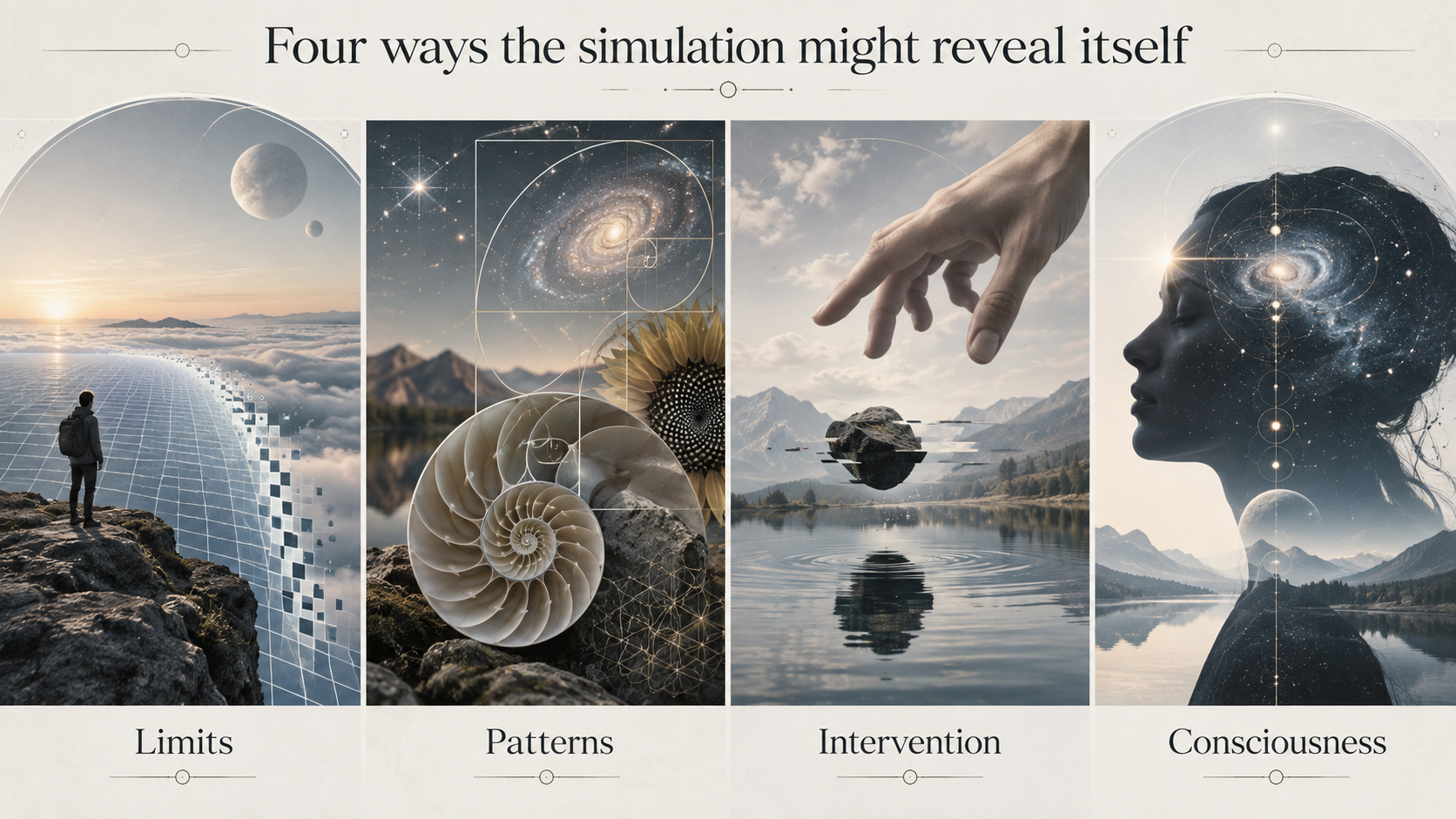
Objects disappear and return. Events appear to repeat. Multiple people remember something that apparently never happened. Time seems to jump. An extraordinarily unlikely coincidence arrives at precisely the right moment.
Most individual incidents cannot establish anything scientifically. For example, memories fail, attention fails, coincidences happen, human perception is incomplete and stories - as we know - change in retelling.
Yet "we can explain many glitches psychologically" is not logically identical to "every anomalous experience is therefore psychological".
There are experiences for which the person involved is left genuinely uncertain about what happened.
I'm is interested in that uncertainty. Not because every missing set of keys reveals the source code. Because unexplained experience is one of the places where our model of reality gets tested against reality itself.
Personal evidence and public evidence
This gives us two useful categories.
- Public evidence is evidence we can show other people. It can be recorded, repeated, measured and independently examined.
- Personal evidence changes what you believe because of something you directly experienced.
The two should not be confused. But personal evidence is not meaningless. Much of what any person believes about love, consciousness, identity and even other minds depends partly on direct experience.
Suppose you repeatedly experience extraordinarily precise synchronicities after entering a particular altered state.
That does not prove to science that reality is responding to you. It may nevertheless rationally make you more interested in that possibility.
The responsible next step is not blind belief. It is observation.
Record what happened. Record your prediction beforehand where possible. Look for misses as well as hits. See whether patterns persist.
Curiosity becomes much more interesting when it develops a method.
What if synchronicity is feedback?
Simulation theory gives synchronicity an intriguing interpretation. A meaningful coincidence could simply be coincidence interpreted through a pattern-seeking mind. Or it could represent information moving through reality in a way we do not currently understand.
If reality is interactive, perhaps synchronicity functions like feedback. Not a giant neon sign from the programmers. Something subtler. A convergence between inner state and outer circumstance.
Carl Jung explored synchronicity without simulation language, describing meaningful coincidences that appeared connected without an ordinary causal chain.
Simulation theory adds a modern metaphor to an old mystery. Maybe the system responds. Maybe consciousness participates. Maybe meaning itself sometimes forms relationships that our current causal models do not capture. We cannot prove that from coincidence alone.
But neither does the possibility disappear simply because it is difficult to quantify.
Manifestation may offer another kind of test
If consciousness can participate in reality, manifestation becomes one of the most provocative possibilities raised by simulation theory.
Not the cartoon version where every thought instantly changes the world.
Something more disciplined. Suppose attention, intention and emotional state influence which probabilities become realised. Could that be tested?
At a personal level, someone could define an intention in advance, record it, specify an outcome and observe what follows rather than retrofitting meaning afterwards.
Repeated results would still face enormous problems of chance, psychology and selection bias. But disciplined observation is already better than declaring every desired outcome a miracle.
At a scientific level, evidence would need to become much stronger: controlled experiments showing that conscious intention produces effects that consistently exceed chance and survive independent replication.
We do not currently have evidence strong enough to establish that mechanism.
Yet if such an effect were ever demonstrated reliably, it would force a profound rethink of the relationship between consciousness and physical reality.
Simulation would be only one possible explanation.
It would suddenly become a much more interesting one.
Could altered states reveal more of the system?
Another possibility involves altered consciousness. Dreams, deep meditation, near-death experiences and psychedelic states can produce experiences that feel more real, interconnected or information-rich than ordinary waking consciousness.
Neuroscience can show that altered brain states produce altered experience. That does not settle what those experiences ultimately represent. One model says the brain generates them.
Another says the brain normally filters consciousness and altered states change the filter. If the second model contained any truth, then unusual states might reveal aspects of reality usually hidden by the interface of ordinary perception.
Simulation language gives this a compelling metaphor. Perhaps waking consciousness is the user interface rather than the underlying system. That remains speculative.
But consciousness is still poorly enough understood that we should be wary of declaring the deepest question closed.
What would truly convincing evidence look like?
A genuine breakthrough would probably involve more than one intriguing clue. Imagine several things happening together.
- Physics identifies a previously unknown structural boundary in spacetime.
- That boundary makes little sense as fundamental physics but matches a specific computational prediction made in advance.
- Independent teams replicate the result.
- Related limits appear in other physical systems.
- Then an external intervention occurs that exploits precisely that structure.
At that point, simulation theory would move from philosophical possibility towards explanatory power.
The key is convergence. One strange event is an anomaly.
Many independent observations pointing towards the same hidden architecture become something else.
And what would count as proof?
Absolute philosophical proof may be impossible. An apparently external message could itself be a natural phenomenon. A simulator revealing itself could conceivably be another entity inside reality.
Even being "lifted out" of one simulation might only reveal another simulated layer. There could always be another level. So perhaps we should stop imagining proof as one final moment when every possibility disappears.
Science usually works through accumulated evidence.
Our confidence grows because one explanation repeatedly predicts reality better than its competitors.
Simulation theory may eventually work the same way.
Or it may remain forever beyond decisive testing.
What if the simulation does not want to be found?
There is one possibility no experiment can completely escape. Suppose the simulation is deliberately designed to prevent its inhabitants discovering it.
A sufficiently capable system could alter observations, prevent particular experiments succeeding or ensure that every apparent anomaly has a plausible internal explanation.
Any evidence could be hidden. Any glitch could be patched. Any civilisation getting too close could encounter a new barrier. At that point the hypothesis becomes effectively unfalsifiable from inside. That does not make it true.
But it places a limit on what an inhabitant could ever know.
Mystical traditions would recognise the shape of that problem immediately: the idea of a veil that cannot simply be removed by examining the objects appearing behind it.
Perhaps the only way to understand the system would be to change the observer.
So can we prove we're in a simulation?
Not today. We have no accepted experiment demonstrating an artificial substrate beneath reality. No confirmed glitch has exposed the source code.
Quantum mechanics has not revealed a rendering engine. Cosmic rays have not announced a grid. No simulator has introduced itself. But the situation is more interesting than saying "there is no evidence, therefore forget it".
Specific simulation models can produce possible observational signatures.
Physics continues to reveal a universe in which information, observation and the structure of spacetime are stranger than common sense expects.
We are rapidly developing artificial worlds of our own.
And consciousness, the very thing through which any reality is experienced, remains one of science's deepest unresolved problems.
Alongside that public investigation sits another category: human experience. Synchronicity. Déjà vu. Manifestation. Dreams. Altered states.
Moments when reality seems unexpectedly responsive or briefly less solid than usual.
None of them individually proves a simulated universe.
Together they keep alive a much older question: is the reality presented to ordinary consciousness the whole thing?
Perhaps the breakthrough will come from a particle detector.
Perhaps it will come from information theory.
Perhaps conscious artificial worlds will change the probability calculation entirely.
Perhaps consciousness itself will prove to be the missing piece.
Or perhaps a simulated universe is constructed so well that the beings inside it can never quite see beyond the interface.
For now, we are left with clues rather than proof.
That is not the end of the investigation.
It is where the interesting part begins.
Frequently asked questions
Is there scientific evidence that we live in a simulation?
There is currently no accepted scientific evidence demonstrating that our universe is simulated. Researchers have proposed possible tests for particular simulation models, but no experiment has confirmed an artificial substrate beneath reality.
Can simulation theory be tested?
Some versions can. A simulation built using a specific lattice, for example, might produce physical signatures. Nick Bostrom also argues that observations affecting the likelihood of his three possibilities can increase or decrease the probability of the simulation hypothesis.
Could cosmic rays reveal a simulation?
Researchers have explored whether extremely high-energy cosmic rays could show signatures associated with a hypothetical spacetime lattice. No such observation has established that the universe is simulated.
Does quantum mechanics prove reality is rendered?
No. Quantum mechanics behaves very differently from classical physics, but measurement effects do not demonstrate that the universe functions like a video game rendering objects only when conscious people look at them.
Are glitches in the Matrix evidence?
A personal anomaly can be interesting evidence to the person experiencing it, but isolated glitches cannot currently establish simulation scientifically. Memory, perception and coincidence provide competing explanations for many reported experiences.
Could synchronicity indicate a simulated reality?
Possibly, if reality is interactive or consciousness participates in it more deeply than we currently understand. There is no established evidence that synchronicity is feedback from a simulation, but it remains one metaphysical interpretation worth exploring.
Could manifestation be evidence?
For manifestation to become strong public evidence, controlled experiments would need to show reliable effects of intention on external outcomes beyond chance and established psychological mechanisms. Personal experiences may still influence individual beliefs before that scientific threshold is reached.
What would be the strongest proof?
An unmistakable, reproducible intervention from outside our physical system would be exceptionally powerful evidence, particularly if accompanied by independently measurable information about the underlying structure of reality.
Continue exploring
Simulation Theory 101: Are We Living in a Simulated Reality?
Start with the philosophical argument, consciousness, physics and the possibilities simulation theory opens.
Are Glitches in the Matrix Just Cognitive Errors?
What happens when anomalous experience meets memory science, psychology and the possibility that reality occasionally misbehaves?