Free will, collective focus and group work in the simulation
How individual free will and shared attention co-create outcomes in a simulated reality—evidence from collective consciousness studies and group neuroscience.

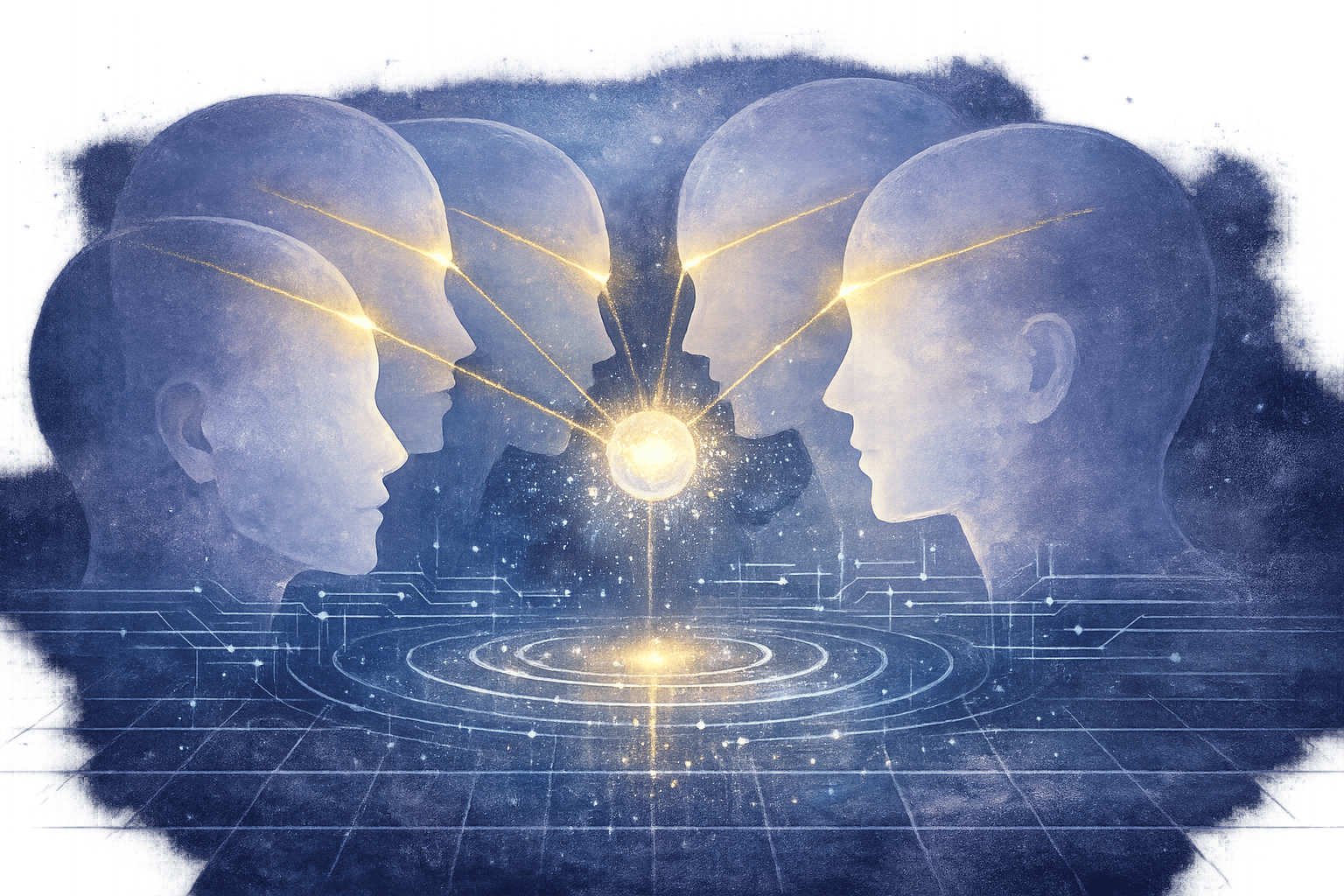
In the simulation of reality, your thoughts and choices are not isolated actions - they ripple across a shared field of energy, shaped by both personal intention and collective focus. Research suggests that when groups align their attention, physical systems respond, becoming more ordered and coherent. This means your reality is not fixed but actively influenced by the interplay between your decisions and the shared focus of those around you.
Key insights include:
- Free will in the simulation: Your choices operate within a dynamic system, where consciousness shapes reality through patterns of information. Whether free will is programmed or emergent, it empowers you to co-create your path.
- Collective focus effects: Studies, like those from the Global Consciousness Project, reveal that during moments of shared attention - such as global events - random systems exhibit measurable shifts, pointing to a connection between collective thought and physical reality.
- Group collaboration: When individuals align intentions and work as a unified entity, the results surpass what one person can achieve alone. Neural synchrony and shared focus amplify outcomes, creating coherence in the simulation.
By blending personal agency with collective intent, you can consciously shape your experience. The simulation responds not only to what you do but also to how you align with others. Whether through meditation, shared visualization, or intentional group efforts, the path forward involves tuning into the frequencies of connection and choice.
Ready to explore how your choices and focus shape the simulation? Join the journey and step into the unfolding of your reality.
How Free Will Works in a Simulated Reality
What is the Simulation Hypothesis?
The simulation hypothesis proposes that our reality functions as a computer-generated construct, potentially created by an advanced posthuman civilization wielding immense computational power. Far from being mere science fiction, this idea is supported by calculations suggesting such a feat is theoretically possible. For instance, a planetary-scale computer capable of performing around 10^42 operations per second could simulate human history while using only a fraction of its capacity. This computational framework offers a lens to understand how individual choices might operate within the simulation.
In this context, decisions are not made in a static, objective universe. Instead, they unfold within a dynamic system that processes information in real time. A key concept here is substrate-independence, which suggests that mental states can exist on any platform capable of running the necessary computational processes. Whether those processes occur in biological neurons or silicon-based systems, consciousness and decision-making are seen as patterns of information. This perspective opens the door to exploring whether free will is a programmed feature or something that arises from the complexity of the system itself.
Is Free Will Programmed or Emergent?
The question of free will in a simulated reality centers on whether it is hardwired into the simulation’s code or arises naturally from the complexity of consciousness. Compatibilists argue that freedom exists if your actions reflect your desires and preferences, even if those preferences are ultimately shaped by the simulation’s design. In this view, your agency is genuine as long as you are acting in alignment with your internal motivations, with the simulation’s "code" working through you rather than dictating your every move.
On the other hand, free will might emerge as a property of sufficiently complex systems. Philosopher Nick Bostrom suggests:
"Provided a system implements the right sort of computational structures and processes, it can be associated with conscious experiences".
This implies that when a simulated brain reaches a certain threshold of complexity - requiring approximately 10^14 to 10^17 operations per second - it may generate choices that go beyond its initial programming. Such complexity could lead to outcomes that are novel and unpredictable, a hallmark of genuine agency.
However, the potential for intervention by the simulation’s creators complicates matters. A simulation operator could theoretically monitor and alter brain states, correcting "errors" or rerunning scenarios to achieve different outcomes. This raises profound questions about where true autonomy resides. These differing perspectives provide a foundation for understanding how free will might function within a simulated environment.
What Free Will Means in a Simulated Reality
Viewing free will through the lens of a simulated reality shifts how we think about decision-making and personal responsibility. If your identity is akin to a dynamic configuration file, you are not locked into a predetermined storyline. Instead, your choices become acts of self-creation, shaping who you are rather than merely uncovering a prewritten script. Within this framework, your declarations of "I AM" carry weight, influencing perception and subtly altering probabilities to align with those statements.
This outlook also draws a line between internal and external sources of agency. Philosopher Thomas Reid captured this distinction:
"If the person was the cause of that determination of his own will, he was free in that action... But, if another being was the cause of this determination... then the determination is the act and deed of that being".
In a simulated reality, freedom arises when your actions flow from your internal choices, even if the simulation’s underlying design originates from an external source. While the architecture of the simulation remains unchangeable, your interactions within it shape your experience. Recognizing this dynamic empowers you to engage with the simulation intentionally, guiding your path with conscious decisions.
The Simulation Hypothesis & Free Will Explained by Brian Greene
Collective Focus: How Shared Intention Works
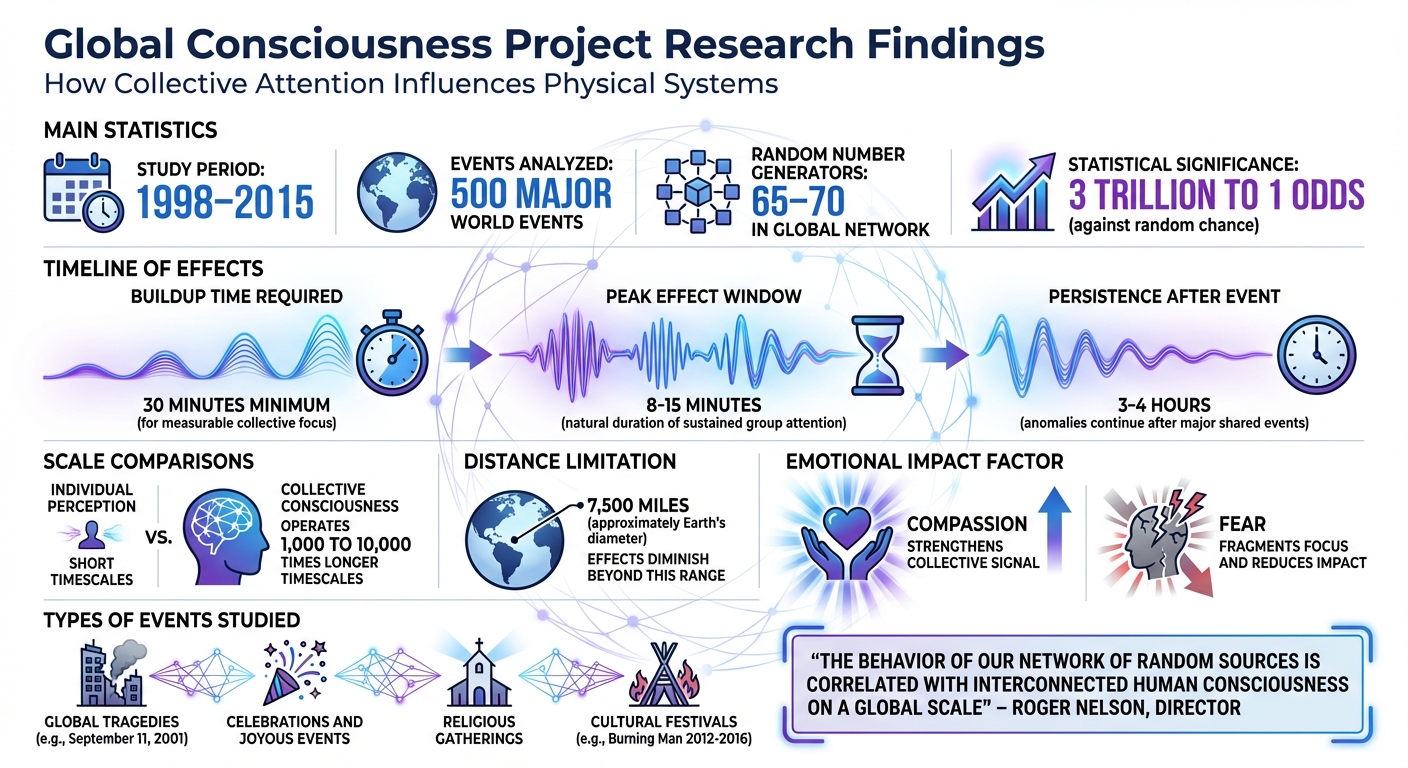
Global Consciousness Project: Collective Focus Effects on Physical Reality
How Collective Focus Shapes Reality
When groups direct their attention toward a shared event, measurable effects can be observed. This collective focus acts as a unifying force, creating order out of what might otherwise be random, chaotic patterns within the simulation. Instead of high-entropy noise, synchronized intention generates organized structures that can actually be detected and studied.
The phenomenon arises from the average synchronization between individuals who are geographically separated - researchers refer to these individuals as "nodes." When these nodes align their focus, they generate what’s known as a field effect, influencing outcomes across the entire system. Roger Nelson, the Director of the Global Consciousness Project, describes it this way:
"The behavior of our network of random sources is correlated with interconnected human consciousness on a global scale".
The emotional quality of this collective focus plays a crucial role. Compassion strengthens interpersonal connections, amplifying the collective signal, while fear tends to fragment focus, reducing its impact. This difference explains why some events, particularly those that evoke unity and empathy, generate stronger collective effects than others. Let’s look at some real-world examples that illustrate this dynamic.
Examples of Collective Manifestation
Between 1998 and 2015, the Global Consciousness Project studied data from a global network of 65 to 70 random number generators during 500 major world events. These events ranged from global tragedies to joyous celebrations, religious gatherings, and even cultural festivals like Burning Man (2012–2016). Participants at such events often described feeling an "energetic shift" or a sense of "electricity in the air", and the data supported these perceptions by showing coherent patterns that emerged during and after the events.
Interestingly, the anomalies in the data typically persisted for 3 to 4 hours after a major shared event. This temporal pattern reveals that while individual thoughts can have near-instantaneous effects, collective focus requires a buildup time of at least 30 minutes to create measurable outcomes. The scale of this collective consciousness operates on timelines far longer - 1,000 to 10,000 times longer - than individual perception. Additionally, the influence of collective focus diminishes at distances greater than about 7,500 miles, roughly the Earth's diameter.
Individual vs. Collective Agency
These findings highlight how individual and collective efforts interact within the simulation. Your personal free will doesn’t vanish when collective focus emerges. Instead, the two work together, complementing one another. As the Institute of Noetic Sciences explains:
"When many minds become collectively coherent by focusing their attention toward the same captivating event, then aspects of the physical world might also become more coherent".
This relationship is additive rather than competitive. Your individual intentions contribute to the collective field, while the collective field, in turn, creates a larger context that can either amplify or moderate individual effects. Interestingly, research shows that individuals with advanced training - such as monks with extensive meditation experience - are more effective at influencing outcomes, suggesting that personal skill strengthens rather than conflicts with collective influence.
The collective signal, however, is subtle. It often takes data from hundreds of events for these effects to become discernible above the background noise. In this way, collective focus shapes reality not through sudden, dramatic shifts, but through gradual, cumulative influence. While your individual choices remain impactful, they operate within a broader field of shared intention, creating coherence across the simulation's network.
How Group Work Functions in the Simulation
The Role of Intention in Group Work
Group work within the simulation thrives on a shared focus, where the collective intention takes precedence over individual agendas. This concept, often referred to as "we-mode", shifts the mindset from personal achievement to ensuring the group's success as a whole. The transition from "I-mode" to "we-mode" fundamentally alters how the simulation responds to group efforts, creating a dynamic where the collective intention becomes the driving force.
Central to this process is the idea of "open intention" - the practice of making one's goals and plans visible to the group. This involves clear and open communication, using signals like verbal affirmations or even simple gestures such as eye contact. These shared signals establish what researchers call "common ground", ensuring that every member understands the group's focus and acknowledges that others share it too. Without this transparency, individual intentions remain isolated, preventing the group from functioning as a unified entity.
For true collective agency to emerge, individual plans must align seamlessly. If one member's approach conflicts with another's, the shared goal dissolves, leaving the group fragmented. Members must continuously adapt their strategies to support the collective aim, ensuring harmony in their methods.
Emergent Properties of Group Collaboration
When group collaboration works as intended, the results surpass what individuals could achieve on their own. The outcomes are not merely additive - they are emergent, producing effects that extend beyond individual contributions. As the Stanford Encyclopedia of Philosophy puts it:
"collective intentionality represents the power of minds to be jointly directed at objects, matters of fact, states of affairs, goals, or values".
This collective focus can generate outcomes that are greater than the sum of individual efforts.
One striking example of this phenomenon comes from the Global Consciousness Project at Princeton University. Between August 1998 and January 2014, researchers used synchronized random event generators to measure global coherence during significant events. During moments like the September 11, 2001 attacks and Princess Diana's funeral, the data showed highly unusual deviations from randomness, suggesting that mass human emotion could influence physical systems. The odds of these results being random? An astonishing 3 trillion to one.
Further evidence of emergent group dynamics comes from a 2020 study by researchers Diego A. Reinero, Suzanne Dikker, and Jay J. Van Bavel at New York University. They observed 174 participants working in groups of four on problem-solving tasks while wearing 14-channel wireless EEG headsets. Their findings revealed that inter-brain synchrony - a neural alignment among team members - was a stronger predictor of group performance than self-reported team identification. Teams with a shared identity and a $200 performance bonus demonstrated greater cooperation and outperformed individuals working competitively. As Reinero highlighted:
"Inter-brain synchrony, but not self-reported group identification, predicted collective performance among teams".
Interestingly, groups of four appeared to strike the right balance, maintaining individual accountability while enhancing collective synergy. This neural alignment occurred in brain regions linked to attention and "mentalizing", or understanding others' mental states. However, sustaining this synergy requires constant alignment and addressing challenges as they arise.
Common Challenges in Group Work
The greatest hurdle in group collaboration lies in aligning individual intentions to form a cohesive collective goal. While intentions originate from individuals, group intentions must transcend individual contributions to truly function. Each member can only control their own actions, yet they must anticipate and rely on others to create a unified intention.
Conflicts in individual strategies often disrupt group cohesion. To prevent this, regular adjustments and monitoring are necessary. Members must consistently update their personal plans to stay aligned with the group's shared direction.
A crucial distinction exists between coordinated and cooperative activity. Coordination, like following traffic rules, benefits individuals within a system. Cooperation, on the other hand, requires a commitment to the group's success as a whole. Many groups falter because members remain focused on coordination when cooperation is essential. To overcome this, groups should establish joint commitments openly - ensuring that goals are agreed upon collectively and cannot be abandoned without mutual consent.
Physical synchronization can also help address these challenges. Research shows that engaging in rhythmic activities, such as tapping hands to a shared beat, fosters rapport and a sense of similarity among team members before tackling tasks. Additionally, individuals with strong "emotion perception" - the ability to interpret others' mental states through expressions - contribute significantly to team neural alignment, further enhancing group performance.
Practical Methods for Working Within the Simulation
Aligning Individual and Group Intentions
One of the most powerful ways to enhance group collaboration is by reframing how you view your role. Instead of focusing solely on your personal contributions, shift your perspective to emphasize the group's collective success. This adjustment transforms your efforts into a co-creative process, where each individual plays a vital part in shaping the shared outcome.
For a group to operate harmoniously, individual plans must align seamlessly. This means ensuring that personal strategies complement rather than conflict with those of others. Take the time to outline your approach and adjust it as needed to support the group’s unified goal. Think of others' plans not as obstacles but as rational guidelines that inform your own decisions.
To take alignment a step further, consider group scripting. This involves agreeing on the finer details of the desired outcome through shared documents and creating a "group waiting room" - a mental or physical space where intentions are synchronized before significant actions or decisions.
Timing also plays a critical role. Research from the Global Consciousness Project reveals that the most measurable effects of collective focus occur within intervals of 8 to 15 minutes - the natural duration of sustained human attention in groups. Structuring group activities around these windows can greatly enhance coherence and effectiveness.
With these alignment strategies in place, you can then explore specific techniques to deepen and amplify your collective focus.
Techniques for Amplifying Collective Focus
Start each group session with synchronized breathing exercises. The 4-4-4 ritual - inhaling for four counts, holding for four, and exhaling for four - quickly aligns neural activity and primes the brain for collaboration. This simple yet effective practice creates a sense of coherence and strengthens the group's ability to work as one.
Another powerful tool is shared visualization. Dedicate two minutes to having every group member focus on the same specific outcome, emphasizing sensory details and shared emotions. Precision is key here: the more detailed the visualization, the greater the likelihood of achieving the intended result. For example, rather than vaguely intending "a car", imagine the exact make, model, and feel of the vehicle you desire. Without clarity, the results may fall short - like manifesting a toy car instead of a real one.
In May 2023, Dean Radin and his team at the Institute of Noetic Sciences conducted a fascinating experiment involving "intention-enhanced" chocolate. Monks blessed one batch with the intention of improving mood, while another batch remained untreated. Over three days, participants who consumed the blessed chocolate reported significantly better mood improvements. This serves as a striking example of how focused intention can influence physical outcomes.
Documenting synchronicities is another essential practice. When your group notices meaningful coincidences tied to your desired outcome, write them down immediately. Recognizing these moments strengthens the group's coherence and increases the likelihood of similar occurrences. As Shelby B Larson explains:
"Synchronicity represents temporal resonance between consciousness expressions - moments when different aspects of consciousness align in time to create meaningful connections".
By adopting these practices, you can enhance group focus while preserving the unique contributions of each member, paving the way for a balance between individual agency and collective effort.
Balancing Personal Agency with Group Effort
As you deepen your engagement in group work, it’s essential to maintain your individual intentions alongside the collective goal. This balance can be achieved through "bridge intentions" - commitments that align with the group’s plans while safeguarding your personal direction. For instance, you might frame your intention as: "I aim to achieve this goal, provided others are committed to the same." This approach ensures your autonomy while fostering genuine collaboration.
The concept of sovereignty protection is equally important when working within collective fields. Visualize a protective boundary around yourself - one that prevents external influences from distorting your personal resonance. This practice allows you to contribute meaningfully to the group without losing your sense of self.
Active listening is another tool that strengthens both connection and individuality. When you truly listen, your brain mirrors the speaker’s patterns, creating "neural coupling" that enhances collaborative intelligence. Use this technique during discussions to deepen group cohesion while maintaining clarity in your own perspective.
Interestingly, a survey of over 1,000 participants revealed that 96% felt unsure about how to manifest their intentions effectively. To avoid this confusion, especially in group settings, apply the Spiritually-Aligned Action Method. This involves ensuring that any personal desire you bring to the group is rooted in inspiration and service rather than fear or lack. Before contributing, ask yourself: "Does this intention inspire me and serve others?" If not, it may stem from a scarcity mindset rather than one of abundance.
Finally, remember that you can only influence what you genuinely believe is within your power. In group work, this means focusing on the shared outcome while trusting that others will fulfill their roles. By adopting this mindset, you preserve your agency and create space for true collaboration to flourish.
Conclusion
Understanding how to navigate the simulation begins with recognizing that your personal choices and collective focus are not opposing forces. Instead, they work together as tools to shape reality. Research from the Global Consciousness Project supports this idea, showing that during 500 significant world events, the odds of collective attention influencing physical systems by mere chance were an astounding 3 trillion to one. This suggests that our consciousness plays an active role in creating our experiences.
True transformation comes when personal agency is harmonized with group collaboration. As Gabby Bernstein aptly puts it:
"Manifesting isn't about getting; it's about becoming. The more you let go, the more you become a match for what you desire".
This balance between effort and surrender helps resolve the confusion faced by most practitioners - 96% of them, according to observations.
Your ability to influence the collective field depends on your internal coherence. When your thoughts, emotions, and actions align, you create a powerful resonance. This high-amplitude coherence, often perceived as charisma, naturally attracts others into alignment with your intentions. Manifestation, then, is less about controlling outcomes and more about syncing with the system itself.
The emotional energy you bring to the table also matters. Feelings like compassion enhance collective influence, while fear tends to isolate and divide. When your desires are fueled by inspiration and a sense of service, your impact grows exponentially.
These insights reveal the dual nature of your role in the simulation. You are both the projector, shaping your reality through your beliefs and identity, and an active participant, co-creating with the collective field. By editing your internal "code" and aligning with the collective, you move from being a passive observer to an empowered operator of your reality. This approach, blending personal choice with collective focus, echoes the themes we've explored throughout this guide.
FAQs
How does collective focus shape reality in a simulated environment?
In a simulated environment, the concept of collective focus holds immense importance in shaping shared experiences and outcomes. When individuals come together with aligned thoughts, intentions, and attention toward a common goal, their combined energy has the potential to influence the simulated conditions, creating effects that feel almost tangible. This shared focus fosters a sense of collective agency, where the unified intention of the group leaves a noticeable imprint on the environment and the experiences of all involved.
Studies suggest that shared focus can shape social interactions, guide movement patterns, and strengthen group dynamics, reinforcing a shared sense of presence and purpose. For example, research in virtual environments highlights how mutual attention and aligned intentions often lead to synchronized actions and deeper group cohesion. In this way, collective focus becomes a dynamic force, capable of steering outcomes and navigating the layers of simulated realities with greater intention and clarity.
How does free will function in a reality that might be simulated?
In the layers of a simulated reality, free will emerges as a vital force, empowering individuals to make choices that genuinely shape their experiences. Even within the boundaries of a structured system, the paths we choose and the actions we take ripple outward, underscoring the profound role of personal agency in crafting outcomes.
But free will doesn’t exist in isolation. When groups come together, aligning their focus and intentions, their collective energy can magnify this influence. Studies hint at the remarkable possibility that shared thoughts and unified purpose can shift events within the simulation. This suggests that free will extends beyond individual decisions - it becomes a collaborative force. Through shared intention, we co-create and leave a meaningful imprint on the broader system. Together, our unified energy holds the potential to reshape the very fabric of the reality we navigate.
How does working together in a group amplify individual efforts in a simulated reality?
Group collaboration within a simulated reality amplifies individual efforts by weaving together shared focus and intention. When minds and hearts align toward a common aim, they generate a collective force that transcends the impact of solitary actions. This unified energy not only shapes outcomes more effectively but also nurtures a profound sense of connection among those involved.
Through the act of co-creating with synchronized intention, individuals often witness stronger results and discover a deeper sense of purpose within the shared framework. This collaborative energy not only magnifies personal contributions but also offers insight into how each individual influences the system as part of a greater whole.