Can We Prove We’re in a Simulation?
Examines scientific tests, philosophical arguments, and personal anomalies linked to the Simulation Hypothesis—and why definitive proof remains elusive.

The Simulation Hypothesis suggests that our reality might be a highly advanced digital construct, created by an advanced civilization. This idea has intrigued philosophers, scientists, and thinkers like Nick Bostrom, Elon Musk, and Neil deGrasse Tyson. While proving it remains elusive, researchers explore clues such as computational limits, quantum phenomena, and cosmic patterns. The hypothesis raises profound questions about consciousness, free will, and the nature of existence, but also comes with challenges - like the difficulty of testing a system from within it.
Key Points:
- Simulation Theory Basics: Reality might be a digital simulation, as proposed by Nick Bostrom's 2003 Simulation Argument.
- Scientific Clues: Researchers look for computational "glitches" like spacetime pixelation, quantum behaviors, and cosmic patterns.
- Philosophical Questions: Consciousness, free will, and the infinite regress of simulations are central topics.
- Personal Observations: Déjà vu, strange coincidences, and patterns in daily life are often seen as potential anomalies.
The question isn’t just whether we live in a simulation, but how such a possibility reshapes the way we perceive existence. Whether real or simulated, the experiences we live through remain deeply meaningful.
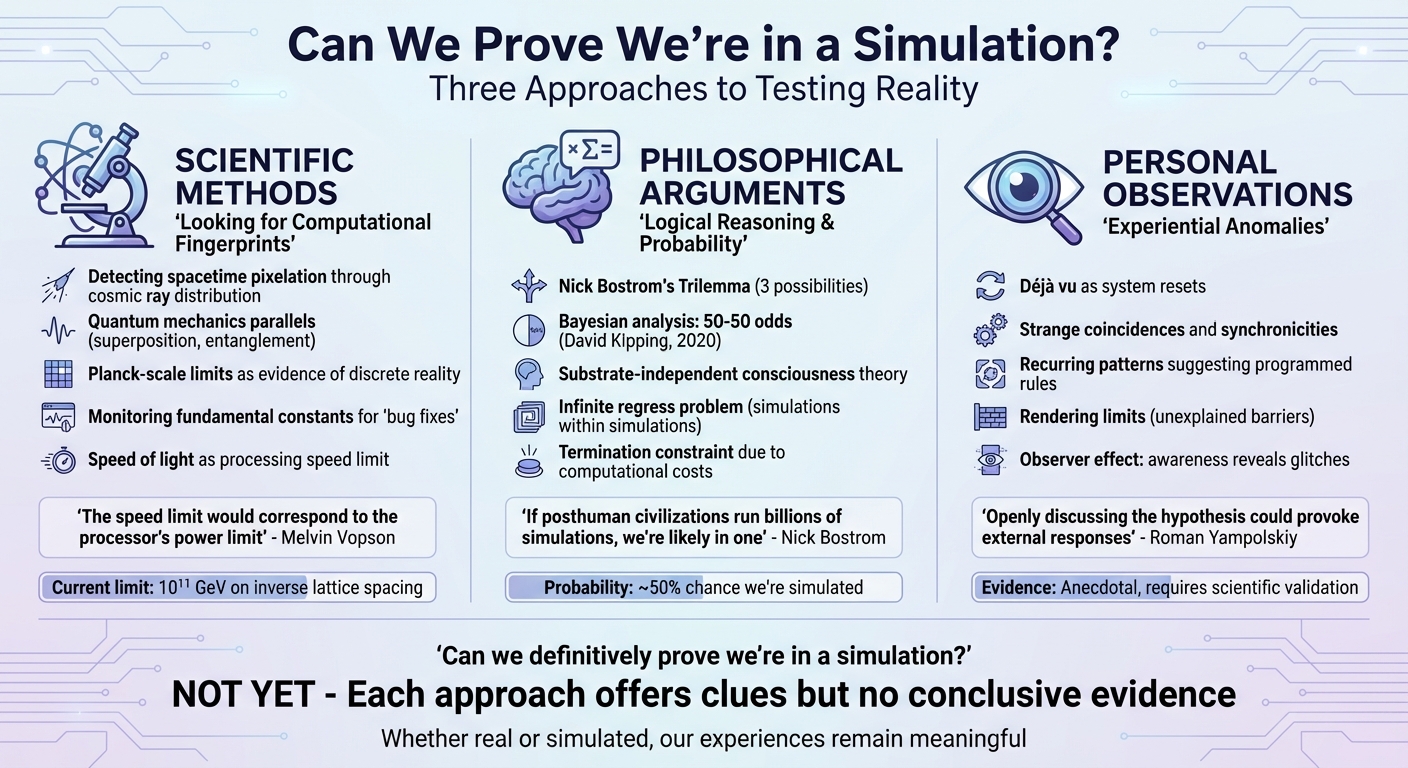
Three Approaches to Testing the Simulation Hypothesis: Scientific, Philosophical, and Personal Methods
How a New Experiment Will Prove if We're Trapped in a Simulation | Rizwan Virk
Scientific Methods for Testing Reality
The idea that we might be living in a simulation has sparked a wave of scientific curiosity. If this were true, researchers suggest the system would need to manage resources efficiently - similar to how a computer slows when overloaded. This could leave behind computational fingerprints embedded in the fabric of our reality.
Detecting Computational Limits
One of the most intriguing approaches involves searching for evidence of a digital grid in spacetime, akin to how pixels form an image. A simulated universe, constrained by finite resources, might rely on a lattice-like structure rather than continuous spacetime. This "pixelation" could potentially be observed at the smallest scales of existence.
In September 2014, researchers Silas R. Beane, Zohreh Davoudi, and Martin J. Savage proposed that such a grid could lead to an uneven distribution of high-energy cosmic rays. Instead of arriving uniformly from all directions, these rays might favor certain angles that align with the underlying lattice structure.
"The numerical simulation scenario could reveal itself in the distributions of the highest-energy cosmic rays exhibiting a degree of rotational symmetry breaking that reflects the structure of the underlying lattice." - Silas R. Beane, Zohreh Davoudi, and Martin J. Savage
Physicist Melvin M. Vopson from the University of Portsmouth is exploring whether information itself has measurable mass. Through experiments involving particle-antiparticle annihilation, he aims to detect photons at frequencies predicted by information-based physics. To fund this work, Vopson even initiated a crowdfunding effort. If successful, these experiments could provide direct evidence that reality operates on principles of information processing.
Another clue might lie in the speed of light, which Vopson theorizes could represent the maximum processing speed of the universe's "hardware." He explains:
"In a virtual reality, this limit [the speed of light] would correspond to the speed limit of the processor, or the processing power limit."
These possible computational boundaries suggest that the structure of spacetime itself could hold answers, particularly when viewed through the lens of quantum mechanics.
Quantum Mechanics and Simulation Theory
Quantum mechanics provides a wealth of parallels to simulation theory. For example, particles existing in multiple states until observed - a phenomenon called superposition - resembles how modern video games only render the parts of the world the player is actively looking at. This "rendering on demand" saves processing power and could explain quantum behavior.
Houman Owhadi from the California Institute of Technology draws a direct comparison:
"If it is just a pure simulation, there is no collapse. Everything is decided when you look at it. The rest is just simulation, like when you're playing these video games."
Quantum entanglement adds another layer to this discussion. When two particles are entangled, they remain connected instantaneously across any distance, a phenomenon Einstein famously referred to as "spooky action at a distance." In a simulated universe, this could be explained by the particles sharing the same location in the underlying code, despite appearing separated in three-dimensional space.
The existence of Planck-scale limits - the smallest measurable units of length, time, and energy - also aligns with the idea of a pixelated reality. These quantum boundaries suggest a universe built on discrete bits of information.
Shifting from the quantum scale to cosmic patterns, scientists are also investigating larger structures for signs of simulated design.
Patterns in the Cosmos
At the grandest scale, the universe's structure may also hint at artificial origins. Researchers are using advanced telescopes to study high-energy cosmic rays, searching for signs of anisotropy - where rays arrive from preferred directions rather than uniformly across the sky. Such patterns could indicate the presence of an underlying grid structure.
Another intriguing idea involves monitoring the fundamental constants of nature - like the fine-structure constant - over long periods. If these constants were to change suddenly or contradict established values, it might suggest "bug fixes" made by the simulation's programmers. Such glitches could reveal themselves as unexpected shifts in the mathematical rules governing our universe.
Currently, the most stringent constraint on the universe's "resolution" comes from the observed high-energy cosmic rays, which place a limit of 10¹¹ GeV on the inverse lattice spacing. While this doesn't confirm the simulation hypothesis, it suggests that if we are in one, the resolution is extraordinarily fine - far beyond anything humans could currently replicate.
Philosophical Arguments About Simulated Reality
While scientists investigate the possibility of computational patterns in spacetime, philosophers delve into the logical underpinnings of existence itself. Their arguments often hinge on probability, consciousness, and the core nature of reality, questioning whether our experiences might be part of a grand simulation.
Nick Bostrom's Simulation Argument
Philosopher Nick Bostrom from Oxford University introduced a trilemma that challenges our understanding of reality. His proposal suggests three possibilities: civilizations either fail to reach posthuman capabilities, decide against running ancestor-simulations, or we are almost certainly living in a simulation. Bostrom reasons that if advanced civilizations possess the computational power to create countless ancestor-simulations, the majority of minds experiencing human-like realities would be simulated rather than biological.
This argument invites us to reconsider the framework of our perceived reality. Central to Bostrom's reasoning is the "bland indifference principle", which posits that if posthuman civilizations generate billions of simulations, any rational observer is more likely part of the simulated majority.
"If we don't think that we are currently living in a computer simulation, we are not entitled to believe that we will have descendants who will run lots of such simulations of their forebears." - Nick Bostrom, Faculty of Philosophy, Oxford University
Adding to this, astronomer David Kipping from Columbia University applied Bayesian analysis in 2020 and concluded that the odds of living in base reality are about 50–50. He further remarked:
"The day we invent that technology, it flips the odds from a little bit better than 50–50 that we are real to almost certainly we are not real." - David Kipping, Columbia University
Consciousness and Free Will in a Simulation
A key assumption of the simulation hypothesis is that consciousness is substrate-independent, meaning mental states can emerge from any physical system capable of performing the necessary computations. This raises fundamental questions about the nature of awareness and the boundaries of what we consider "real."
Philosophers often distinguish between biological beings connected to a simulation (like a brain in a vat) and entirely digital entities whose consciousness is simulated. For the simulation hypothesis to hold, these digital beings must experience genuine consciousness rather than pre-programmed responses.
Yet, proving the existence of consciousness beyond one's own subjective experience remains a challenge. Philosopher David J. Chalmers from NYU highlights this dilemma:
"Any such evidence could be simulated... a simulated forest will look exactly like an ordinary one." - David J. Chalmers, New York University
This suggests that feelings of awareness, free will, and creativity could be flawlessly replicated in code, making them indistinguishable from what we perceive as "real." In this context, advanced simulators might not only observe but also intervene in the simulation, as Bostrom describes in his concept of "naturalistic theogony", where creators wield god-like control over the system.
This exploration naturally leads to pondering the implications of layered realities, especially the infinite regress problem.
The Infinite Regress Problem
When considering simulated consciousness, one must address the possibility of simulations within simulations. If a simulated civilization advances enough to create its own simulations, a hierarchy of realities could form, with each layer nested within another like Russian dolls. However, this raises questions about resource constraints. Each successive simulation would require computational resources, which diminish with each layer, limiting the depth of such nesting.
This limitation introduces what Bostrom describes as a termination constraint:
"One consideration that counts against the multi-level hypothesis is that the computational cost for the basement-level simulators would be very great. Simulating even a single posthuman civilization might be prohibitively expensive. If so, then we should expect our simulation to be terminated when we are about to become posthuman." - Nick Bostrom, Professor, Oxford University
Some theorists even speculate that simulations could be programmed to end once the simulated entities develop the technology to create their own simulations. This milestone, some estimate, might occur around 2050.
While the infinite regress problem doesn't disprove the simulation hypothesis, it suggests that there are natural limits. Either the nesting ends at a fundamental layer of reality, or the increasing computational demands force simulators to halt their creations before additional layers can emerge.
Personal Experiences: Glitches and Patterns
Stories from individuals often highlight strange occurrences that hint at the possibility of living in a simulated reality. These range from seemingly impossible coincidences to eerie moments where the world feels like it’s caught in a loop. While these accounts are anecdotal, they spark curiosity about whether our perceptions might reveal the edges of a programmed construct. Such experiences create a bridge between abstract theories and the tangible moments of daily life.
What Are 'Glitches' in Reality?
One of the most commonly reported glitches is déjà vu, that uncanny feeling of reliving a moment. Popularized by the movie The Matrix, it’s often interpreted as a sign of the simulation replaying or resetting - like a scene in a video game loading twice.
Physicist John Barrow introduced a technical perspective, suggesting that a simulation would likely accumulate minor computational errors over time. To keep the system running smoothly, the programmer might need to correct these errors. Barrow hypothesized that we might experience these fixes as sudden shifts, such as unexplained experimental results or abrupt changes in natural constants.
"A simulation would build up minor computational errors which the programmer would need to fix in order to keep it going. We might experience such fixing as contradictory experimental results appearing suddenly, such as the constants of nature changing." - John Barrow, Physicist
Another proposed glitch involves rendering limits. In a localized simulation - one designed to focus on a specific area like Earth - there could be moments where the system fails to fully load the environment. This might appear as landscapes morphing into basic geometric shapes or encountering unexplained barriers, like "Road closed" signs at the edge of a programmed zone. Even the speed of light has been theorized as a processing cap, ensuring we can’t reach distant galaxies faster than the system can generate them.
Recurring Patterns in Daily Life
Beyond isolated glitches, many people notice patterns in the events around them, suggesting an underlying order. These might take the form of coincidences, synchronicities, or perfectly timed occurrences that feel too precise to be random. For some, these patterns hint at a reality governed by programmed rules rather than pure chance.
From a computational angle, these patterns could reflect efficiency measures. Just as video games only render what’s visible to the player, quantum mechanics suggests particles exist in multiple states until observed. This "on-demand rendering" approach would conserve processing power, calculating reality only when someone is paying attention. Physicist Melvin Vopson has even proposed that gravity might not be a fundamental force but a compression tool designed to cluster matter. This would reduce the simulation’s information load, effectively shrinking its "file size".
If these patterns are indeed part of a larger design, they suggest the universe operates more like a system managing finite resources than an endlessly detailed physical reality.
How Awareness Affects Perception
An intriguing question arises: does heightened awareness make it easier to spot these glitches? If a simulation relies on computational shortcuts, focusing attention on specific phenomena might force the system to generate details it would otherwise skip. This idea parallels the observer effect in quantum mechanics, where the act of observation determines a particle’s state.
Houman Owhadi, a computational mathematics expert at the California Institute of Technology, emphasizes the role of observation in detecting anomalies:
"If the simulation has infinite computing power, there is no way you're going to see that you're living in a virtual reality... If this thing can be detected, you have to start from the principle that [it has] limited computational resources." - Houman Owhadi, California Institute of Technology
This suggests that deliberately observing reality - through scientific inquiry or mindfulness - might reveal inconsistencies or boundaries. Some theorists even speculate that openly discussing the simulation hypothesis could draw the attention of the system's creators, potentially leading to an "assisted escape". In the end, how we observe reality may directly influence what we experience, reinforcing the idea that our world might be governed by programmed rules, as suggested by the simulation hypothesis.
Ways to Test the Simulation Hypothesis
Delving deeper into the concept of a simulated reality, let’s explore methods that could potentially test its validity. These approaches move beyond theoretical musings and glitches, offering practical ways to examine the fabric of our existence.
Using Advanced Technology
One method involves keeping a close eye on the fundamental constants of nature. If sudden, unexplained shifts occur, they might resemble "patches" in a simulated system’s code. Similarly, quantum experiments could be revealing. For instance, if our universe functions like a video game - rendering only what’s observed - then phenomena like wave function collapse (where particles exist in multiple states until measured) might suggest such behavior.
Another daring idea is to create our own simulations and design AI systems capable of "breaking out." By studying these strategies, we could potentially apply them to our reality.
Thought Experiments to Probe Reality
Thought experiments offer another layer of inquiry, pushing the boundaries of how we perceive reality. Astronomer David Kipping has applied Bayesian reasoning to estimate the odds of living in a simulation, while Elon Musk famously posits the likelihood is as low as one in a billion. Meanwhile, astrophysicist Neil deGrasse Tyson leans the other way, suggesting the chances are "better than 50-50".
Classical philosophical puzzles also come into play. Descartes’ "Evil Demon" and the "Brain in a Vat" scenarios question whether our senses can be trusted and whether there’s any real difference between a perfectly convincing simulation and base reality.
Personal Experiments You Can Try
On a more individual level, you can conduct personal experiments to explore potential simulation artifacts. Computer scientist Roman Yampolskiy suggests that openly discussing the simulation hypothesis could provoke external responses - possibly from "outside" the system.
"The best option is always assisted escape, someone on the outside giving us information." - Roman Yampolskiy, Computer Scientist, University of Louisville
Pay attention to déjà vu, strange coincidences, or moments that feel "off." While these might simply be quirks of the brain, they could also hint at computational errors or issues in the rendering process. Use these experiences as data points for deeper contemplation.
Lastly, consider how your behavior might influence the simulation. Economist Robin Hanson theorizes that if our reality is a study of human behavior, staying engaging, morally upright, or even entertaining might prevent us from being "deleted" or sidelined. Whether you’re actively testing the hypothesis or simply living with greater awareness, this approach offers a meaningful way to interact with the world around you.
Conclusion
What We've Learned
The question of whether our reality is a simulation remains open-ended, fueled by scientific investigation, philosophical reasoning, and personal accounts. We've examined three perspectives: scientific methods probing quantum phenomena and computational boundaries, philosophical arguments like Nick Bostrom's trilemma, and individual experiences that suggest "glitches" in reality. While each offers intriguing possibilities, none provide definitive answers.
On the scientific side, features like quantum mechanics' discrete units and the observer effect bear a striking resemblance to elements of a programmed system. However, as physicist Sabine Hossenfelder notes, replicating General Relativity and the Standard Model algorithmically without introducing measurable inconsistencies is currently beyond reach. Philosophically, the hypothesis presents a paradox: if reality is simulated, the tools we use to investigate it might also be part of the simulation, rendering their reliability questionable. Meanwhile, personal experiences of anomalies could often be attributed to psychological factors.
Bayesian analysis has previously suggested about a 50-50 likelihood of living in a simulation, but proving or disproving this remains elusive with the tools we currently possess. This uncertainty invites reflection on how to navigate life meaningfully, even without concrete answers.
Embracing Uncertainty
Uncertainty, rather than being a source of fear, can be a doorway to deeper understanding. Theoretical cosmologist Paul Sutter offers a grounding perspective:
"A simulated universe isn't a fake universe; it's just real in a different way than we expect. Simulated pain still hurts. Simulated love is still powerful".
In other words, the meaning of your experiences isn't diminished by the nature of reality's foundation.
Instead of fixating on finding absolute answers, use this uncertainty as a way to explore existence more deeply. Continue to act with integrity, care for others, and pursue your passions - because the reality you perceive is the only one you can interact with. The simulation hypothesis isn't a call to disengage but an opportunity to rethink what "real" means and how your choices shape the world you inhabit.
FAQs
Is there a way to tell if we’re living in a simulation?
The notion that our universe might be a simulation has captured the imagination of both scientists and philosophers. Though conclusive evidence remains elusive, a few thought-provoking methods have been proposed to investigate this idea.
One suggestion is to search for irregularities or "glitches" in our reality - unexplained phenomena that could reflect computational errors, much like bugs in a digital system. Another avenue involves examining the fine-tuning of physical constants. If these constants seem unusually precise and perfectly aligned to support life, it might hint at deliberate design rather than random occurrence.
Researchers have also floated the idea of experiments to determine whether the universe operates like an "on-demand" system, akin to video games that render only what the player sees. Identifying deviations in quantum behavior or physical laws could potentially reveal signs of an underlying framework. While these concepts remain speculative, they open up intriguing paths for investigating the Simulation Hypothesis.
What does the simulation hypothesis reveal about consciousness and reality?
The simulation hypothesis opens a doorway to reimagining consciousness and the fabric of reality itself. It challenges long-held beliefs about existence, suggesting that if our reality is indeed a simulation, consciousness might not be tied solely to biological life. Instead, it could arise from highly advanced computational systems, pointing to the possibility that information processing, rather than the physical brain, might be at the heart of conscious experience.
This idea also prompts us to reconsider fundamental notions like free will, identity, and the nature of personal experience. In a simulated universe, these could be intricately crafted illusions, shaped by the simulation's underlying code. Such a perspective dissolves the boundary between the physical and the non-physical, hinting that consciousness might transcend the need for a biological form. It reshapes our understanding of the mind and challenges us to rethink our role within the greater structure of existence.
Could experiences like déjà vu be signs that we’re living in a simulation?
Some theorists have speculated that experiences like déjà vu might offer a glimpse into a simulated reality. They suggest these moments could be "glitches" or anomalies within the system - a brief hiccup where the underlying structure of the simulation peeks through. Philosophers often interpret déjà vu as a subtle hint that the world we perceive may not be as solid or fundamental as it appears.
On the other hand, scientific research in psychology and neuroscience provides a different perspective. Déjà vu is typically explained as a result of memory processes or specific brain activity, such as a temporary miscommunication between regions of the brain. Despite the allure of connecting déjà vu to the simulation hypothesis, there’s no scientific evidence to support this link. For now, it remains an intriguing idea rather than a definitive clue.