Understanding the Simulation: In a world of chaos and uncertainty
Explores the simulation hypothesis with scientific clues, possible 'glitches', philosophical questions about consciousness, and practical grounding tools for uncertainty.

In a world filled with strange coincidences and unexplained patterns, the simulation hypothesis offers a provocative lens: what if reality is a coded system, complete with rules, glitches, and a hidden structure? This idea, rooted in physics, philosophy, and quantum mechanics, suggests that the universe might resemble a vast computational framework.
Key takeaways:
- Simulation Hypothesis Basics: Advanced civilizations could create simulations indistinguishable from reality. Statistically, we might already be living in one.
- Scientific Clues: Quantum mechanics hints at a "pixelated" universe, while cosmic phenomena like the "Hubble Tension" may reveal system-level glitches.
- Philosophical Questions: Consciousness might be substrate-independent, raising questions about free will and the potential for nested simulations.
- Recognizing Glitches: Déjà vu, sudden anomalies, or shifts in physical constants could expose the system's underlying code.
The simulation hypothesis isn't just a theory - it’s a way to reinterpret chaos, encouraging curiosity and clarity in the face of life's uncertainties. If this resonates, perhaps it’s a signal worth exploring further.
Simulation Hypothesis: Bostrom's Trilemma and Scientific Evidence
The Simulation Hypothesis: Core Concepts and Relevance
Origins of the Simulation Hypothesis
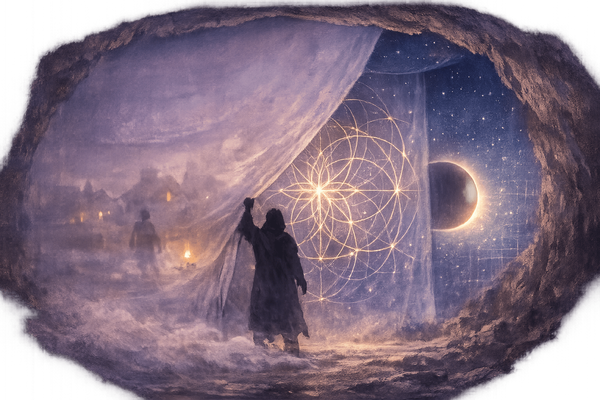
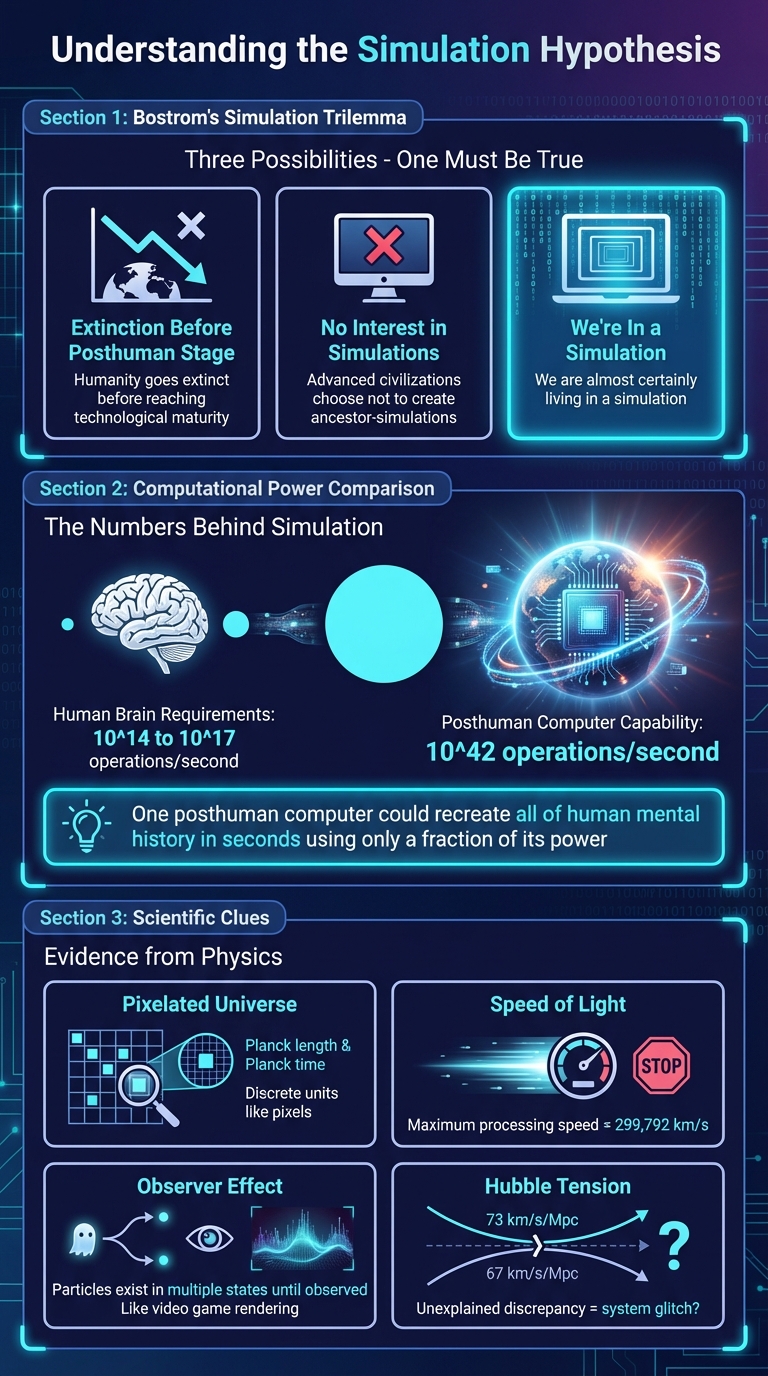
The idea that our reality might be an elaborate illusion has been a part of human thought for centuries. Ancient philosophies like Plato's Allegory of the Cave and Zhuang Zhou's Butterfly Dream posed questions about the nature of reality and perception, challenging the boundaries between what is real and what is imagined. Fast forward to 2003, and Nick Bostrom brought this age-old pondering into the modern age with his paper Are You Living in a Simulation? published in Philosophical Quarterly. Unlike the mystical musings of the past, Bostrom's approach is grounded in mathematical reasoning, presenting what he calls the "Simulation Trilemma." This framework suggests that one of three possibilities must hold true: humanity will go extinct before reaching a posthuman stage capable of running advanced simulations, advanced civilizations will have no interest in creating ancestor-simulations, or we are almost certainly living in a simulation.
The logic is strikingly straightforward. If advanced civilizations can simulate conscious beings, the sheer number of simulations they could create would vastly outnumber the "original" base reality. Statistically, the odds would then favor our existence within one of these simulations rather than in the "real" world. These philosophical foundations invite us to delve deeper into the technological and scientific evidence that might support - or challenge - this provocative idea.
Scientific and Technological Foundations
The simulation hypothesis finds support in cutting-edge science, particularly in the field of information physics. This discipline suggests that the fabric of reality isn't made of matter or energy alone but is fundamentally composed of bits - units of information. Physicist John Archibald Wheeler summed up this concept with the phrase "it from bit". Quantum mechanics adds another layer of intrigue, hinting that our universe operates like a digital simulation. At the smallest scales, reality appears "pixelated", with discrete units like the Planck length and Planck time resembling the pixels in a video game. Even the observer effect - where particles exist in multiple states until observed - mirrors the way video games only render what a player sees.
The numbers are equally compelling. Simulating a human brain would demand between 10^14 and 10^17 operations per second. Yet, a planetary-scale computer using advanced nanotechnology could theoretically perform around 10^42 operations per second. This means a single posthuman computer could potentially recreate the mental history of humanity using only a fraction of its processing power in mere seconds. In 2022, physicist Melvin Vopson proposed an experiment to test this hypothesis. By erasing information within elementary particles, he predicted the release of specific infrared photons as evidence of the mass-energy-information equivalence principle.
Further parallels between the universe and computational systems deepen the discussion. The speed of light resembles a maximum processing speed. Time dilation near massive objects could be likened to an overloaded system slowing down. Even quantum entanglement, where particles interact instantaneously across vast distances, suggests a network where all points are equidistant from a central processor. Together, these observations hint at a reality governed by computational rules, inviting broader questions about the nature of existence.
Philosophical and Metaphysical Questions
At its core, the simulation hypothesis challenges our understanding of consciousness and free will. The concept of substrate-independence suggests that consciousness isn't tied to biological neurons but could arise from any appropriately functioning physical system, including silicon-based processors. As Bostrom puts it:
It is not an essential property of consciousness that it is implemented on carbon-based biological neural networks inside a cranium: silicon-based processors inside a computer could in principle do the trick as well.
This perspective introduces the idea of simulators - beings within a simulation who might possess god-like abilities. Within their created worlds, these entities could manipulate physical laws, observe all events, and even provide an "afterlife" by transferring minds to new simulations. The hypothesis also entertains the possibility of infinite regress, where simulated beings create their own simulations, stacking realities upon each other like nested Russian dolls.
Opinions on the hypothesis vary widely. Some scientists invoke Occam's Razor, arguing that accepting reality as it appears is simpler and more plausible than assuming we're in a simulation. Others, like physicist Zohreh Davoudi from the University of Maryland, are examining high-energy cosmic rays for signs of a "preferred direction" - a potential indicator that spacetime might be discrete, akin to a computational grid.
Whether you find the simulation hypothesis plausible or far-fetched, it provides a fascinating framework for interpreting the complexities of existence. It suggests that behind the apparent chaos of life, there might be a system of rules and patterns - perhaps even glitches - that could help us navigate the mysteries of our reality.
The Simulation Hypothesis Explained by Nick Bostrom
Recognizing Patterns and 'Glitches' in the System
Now that we've laid the groundwork for understanding the simulation framework, let’s delve into how anomalies and sudden deviations might expose its underlying structure.
What Are Glitches? Defining Anomalies
In the context of a simulated reality, glitches are moments when the system falters - brief errors or corrections in the code that governs our experience. These aren’t supernatural occurrences but rather disruptions in the expected flow of reality.
One of the most familiar examples is déjà vu, that eerie sensation of having lived through a moment before. Within a simulation, this could reflect a "replay" or a temporary processing error, much like the iconic black cat scene in The Matrix. But glitches aren't confined to subjective experiences. Physicist John Barrow has proposed that abrupt, contradictory scientific results - such as shifts in the constants of nature - could signal the system undergoing a correction:
"A simulation would build up minor computational errors which the programmer would need to fix in order to keep it going. We might experience such fixing as contradictory experimental results appearing suddenly, such as the constants of nature changing".
Some glitches are reminiscent of computational shortcuts seen in video game design. For instance, quantum superposition - where particles exist in multiple states simultaneously - could be interpreted as an efficient rendering technique, revealing how the system manages its resources.
Interpreting Patterns: What Counts as a Glitch?
Not every odd event qualifies as a glitch. Timing is crucial. Computer scientist Roman Yampolskiy emphasizes that glitches must be sudden and unexpected: "It has to be sudden. [A glitch] can't be a trend over 3 billion years". Long-term patterns are more likely natural phenomena, while abrupt anomalies warrant closer inspection.
When encountering something unusual, it’s wise to apply Occam’s Razor: lean toward natural explanations unless the anomaly truly defies conventional reasoning. Many strange coincidences can be chalked up to probability or our brain’s natural tendency to find patterns, even in randomness.
However, certain phenomena stand out. Computational signatures - patterns that align with principles from computer science - are particularly compelling. For example, the Planck scale, which defines the smallest measurable units of time, space, and energy, suggests reality might be "pixelated" rather than continuous. Similarly, the speed of light as an absolute limit mirrors a maximum processing speed, while time dilation near massive objects resembles the slowdown of an overburdened processor.
Maintaining a balanced approach is key. Document unusual experiences, but stay curious instead of jumping to conclusions. As Houman Owhadi, an expert in computational mathematics at the California Institute of Technology, explains:
"If the simulation has infinite computing power, there is no way you're going to see that you're living in a virtual reality... If this thing can be detected, you have to start from the principle that [it has] limited computational resources".
These computational markers encourage deeper investigation, as illustrated by real-world examples below.
Case Studies: Glitches in Action
Several anomalies observed by scientists could point to system-level glitches. One prominent example is the "Hubble Tension", a puzzling discrepancy in measurements of the universe's expansion rate. Local observations suggest the universe expands at 73 kilometers per second per megaparsec, while data from the cosmic microwave background indicates a rate of 67 kilometers per second per megaparsec. This inconsistency, which has baffled physicists since the mid-2010s, might reflect an unevenly applied "patch" in the system.
Physicist Zohreh Davoudi at the University of Maryland is investigating high-energy cosmic rays for evidence of a "preferred direction" in spacetime. If spacetime behaves like a discrete grid - similar to pixels on a screen - it would challenge our understanding of reality as smooth and continuous. Such findings could reveal an underlying structure that aligns with the simulation hypothesis.
Beyond the realm of science, personal synchronicities - like recurring numbers or improbable events - offer another layer of intrigue. While these experiences are subjective and hard to verify, they often involve statistically unlikely coincidences. From a simulation perspective, these could represent rendering shortcuts or moments when the system’s limited resources leave detectable traces.
Building on these ideas, a 2022 proposal suggested erasing information within elementary particles and measuring the resulting infrared photons. If successful, this could uncover traces of the underlying code, linking information and physical reality in a way that supports the simulation theory.
The key is to approach such phenomena with both openness and skepticism. By documenting observations, identifying patterns over time, and staying informed about scientific advancements, we sharpen our ability to recognize subtle markers in an unpredictable system. These glitches, whether fleeting or profound, may offer glimpses into the hidden architecture of reality.
Practical Tools for Grounding and Clarity
These practices are designed to help you stay centered, even when faced with the unexpected twists and turns of reality.
Mindfulness and Presence
Meditation isn’t about running away from chaos - it’s about finding strength within it. Techniques like noting and global wayfinding meditation focus your attention on immediate sensations and thoughts, stripping away the mental labels we often attach to our experiences. Start small - just five minutes a day - and let your practice develop naturally. There’s no need to rush or force progress.
An important concept here is autodereification, which is essentially the art of letting go when a technique starts to feel rigid or creates mental clutter. The aim is to stop treating your thoughts and mental constructs as fixed, unchanging realities.
This kind of mindful awareness allows you to notice subtle shifts in your environment - those tiny clues that may hint at something deeper beneath the surface. With this foundation, you're better prepared to engage in more structured reality testing.
Reality Testing and Discernment
Journaling is a powerful first step. Use it to document anything unusual - experiences that don’t quite add up, contradictions you notice, or sudden changes in your surroundings. Over time, patterns may start to reveal themselves.
Pair this with inquiry-based meditation. Ask yourself questions like: Am I seeing this clearly, or am I caught up in my own mental projections? This practice helps you distinguish between what’s external and what’s shaped by your own mind. For example, if you notice recurring synchronicities, write down the details - when and where they happen, your emotional state at the time - and look for connections rather than jumping to conclusions.
Some scientists even suggest that tracking constants - things that should remain stable, like physical laws - can serve as a form of reality testing. While you might not have access to a particle accelerator, you can apply the same principle to your everyday life by observing routines, relationships, or your physical health. Sudden, unexplained changes in these areas might point to deeper shifts in the system.
By carefully assessing these patterns, you begin to uncover a clearer picture of the framework shaping your experiences. This discernment naturally leads to practices that ground you further in the here and now.
Rituals and Symbolic Anchors
When uncertainty feels overwhelming, symbolic rituals can offer stability. Even simple actions, like placing your feet firmly on the ground and focusing on the sensation, can help anchor you in the present moment. Lighting a candle or setting an intention can also serve as small yet powerful reminders of your connection to the now.
Another useful approach is taking refuge - a practice of creating a space or mindset that brings clarity and calm. This could mean dedicating a specific spot in your home for reflection or aligning yourself with a guiding principle that keeps you steady during uncertain times.
You might also experiment with personal "GameDays" - intentional, controlled exercises designed to test your routines and uncover potential weak points. These experiments transform vague anxieties into actionable insights, helping you build resilience and develop confidence in handling disruptions.
Finally, make your practices part of your daily rhythm. Instead of treating meditation or grounding exercises as separate tasks, weave them into your work, relationships, or creative projects. This way, they become natural extensions of your life rather than isolated escapes. The goal isn’t to rise above chaos but to move through it with clarity and presence, whether navigating the layers of a simulation or simply managing life’s unpredictability.
Conclusion: Working with Uncertainty
The simulation hypothesis reshapes how we perceive chaos, suggesting it is less random and more like a structured framework - an invitation to explore rather than fear. When we view reality as a flow of information, unpredictability becomes something to examine, not avoid. This shift encourages practical ways to navigate the uncertainties of both the cosmos and daily life.
Facing uncertainty requires presence, discernment, and steady action. Instead of seeing anomalies as threats, consider them as signals - opportunities to engage more deeply with the layers of reality. As Melvin M. Vopson aptly puts it:
The nature of our reality is one of the greatest mysteries out there. The more we take the simulation hypothesis seriously, the greater the chances we may one day prove or disprove it.
Moments of odd synchronicity or shifts in time can be seen as prompts for curiosity, not as sources of stress.
The practices outlined in this guide are not about escaping reality but about navigating it with greater clarity. Tools like mindfulness, reality testing, and symbolic rituals help us stay centered and responsive. By focusing on the present moment, we align with the idea that, if the universe operates on a "rendering on demand" principle, the now is the only fully active part of the system. This insight reinforces the earlier strategies we explored, grounding us in mindful awareness even amidst instability.
Uncertainty doesn’t call for immediate answers - it calls for attentiveness and inquiry. That openness allows us to engage with the simulation, however it may ultimately reveal itself.
FAQs
Is there scientific evidence supporting the idea that we live in a simulation?
The idea that we might be living in a simulation finds support in both philosophical musings and scientific exploration. Philosopher Nick Bostrom famously suggested that if advanced civilizations possess the capability to create intricate simulations of their ancestors, the odds are high that we ourselves exist within one of these simulations. This provocative notion has stirred lively discussions among scientists and philosophers alike.
On the other hand, some researchers question this theory, pointing to the universe's immense complexity and its often unpredictable nature - factors they argue may defy explanation through purely algorithmic means. While conclusive evidence remains elusive, the simulation hypothesis continues to serve as a compelling framework for examining the essence of reality and our role within it.
What does substrate-independence mean, and how does it change our understanding of consciousness?
Consciousness, according to the idea of substrate-independence, isn't bound to any particular material - like the biological brain. Instead, it could emerge from any system capable of supporting the necessary computational processes, such as a silicon-based processor. This shifts the focus from the physical substance of a system to its structure and function, suggesting that these are the true origins of conscious experience.
This perspective also opens the door to the possibility of consciousness existing within a simulated reality. As long as the simulation accurately reproduces the required computational patterns, it could, in theory, host conscious experiences. Such an idea blurs the line between physical and digital realities, raising profound questions about whether our own minds could be part of a highly intricate simulation. It invites a deeper exploration of what we consider real and how we define consciousness itself.
How can I recognize potential 'glitches' in reality?
Recognizing potential "glitches" in reality starts with noticing the oddities - those moments when the fabric of your everyday experience seems to ripple. It could be a sudden shift in perception, an event that feels inexplicably out of sync, or patterns and repetitions that stand out in ways you can’t quite explain. These irregularities might offer a glimpse into the possibility of reality functioning like a simulation.
On the scientific front, researchers are delving into this idea by examining cosmic structures for computational boundaries or probing physical laws for inconsistencies. While these studies are still unfolding, there’s something profoundly personal about tuning into the strange and unexpected in your own life. By pairing curiosity with keen observation, you open yourself to the possibility of uncovering patterns that challenge the ordinary and hint at something deeper beneath the surface.