Déjà Vu and the Illusion of Time
Explores scientific, metaphysical, and simulation explanations for déjà vu, with mindfulness, journaling, and reality-testing to probe how memory shapes time.

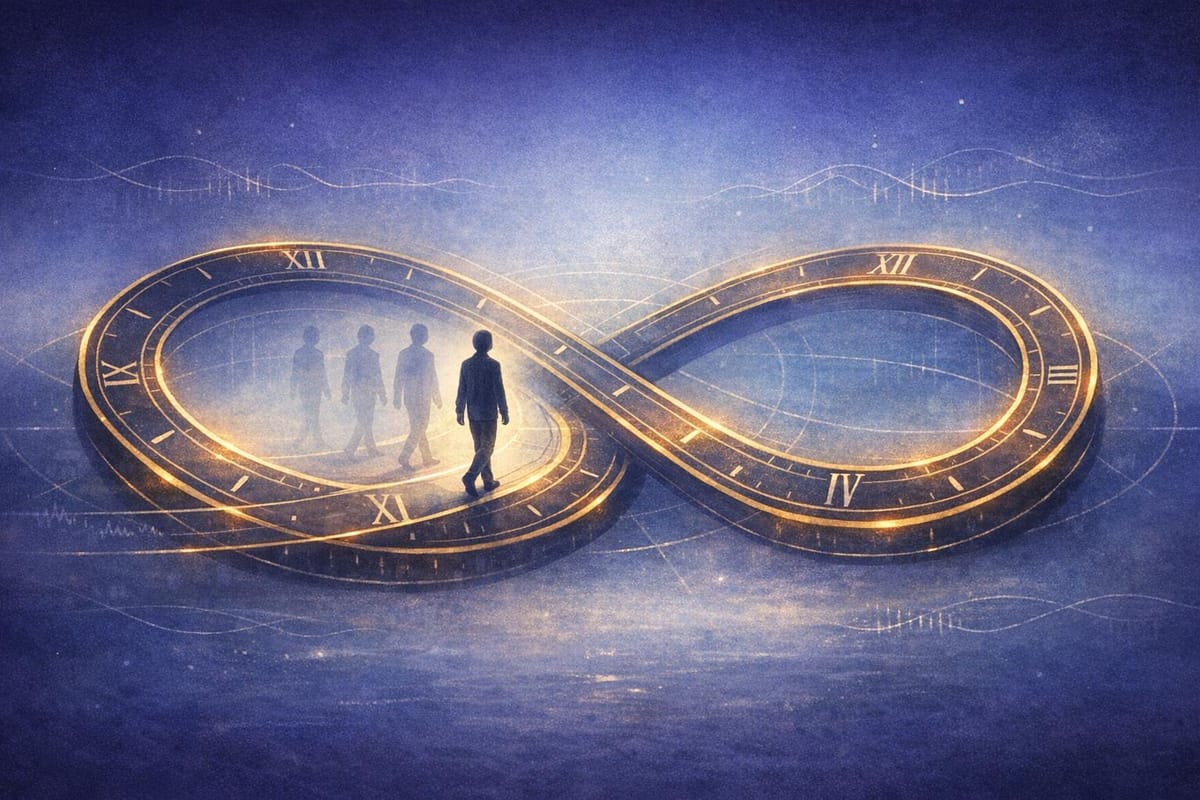
Déjà vu is a fleeting sensation of familiarity, often described as "already seen", experienced by up to 90% of people at least once in their lives. It’s a curious phenomenon that bridges memory, perception, and reality, offering glimpses into how the mind constructs time. Scientists attribute it to memory system glitches, where the brain misinterprets new experiences as familiar. Others see it as a clue to deeper truths about time, consciousness, or even the nature of reality itself.
Some theories suggest déjà vu arises from neurological hiccups, while metaphysical perspectives link it to past lives, parallel universes, or time loops. Simulation theorists go further, interpreting it as a glitch in a programmed reality. Whether you see it as a brain error or a sign of something greater, déjà vu invites reflection on how we experience time and memory.
This sensation often occurs during stress or fatigue, and mindfulness or journaling can help you explore its patterns. By observing these moments, you might uncover subtle insights into your perception of reality, memory, and the interplay between past, present, and future.
If déjà vu feels like a crack in time’s illusion, it may be worth pausing to listen to what it whispers.
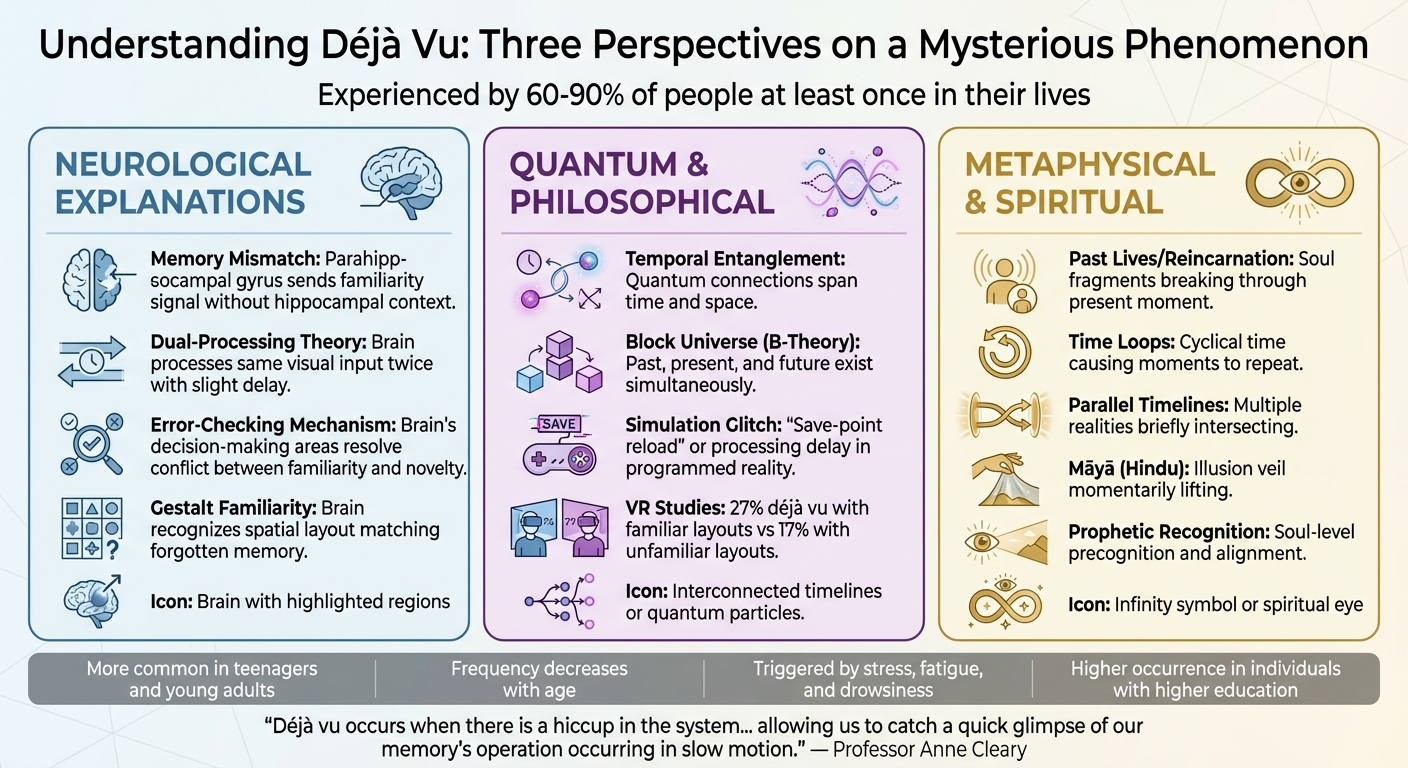
Scientific vs Metaphysical Explanations of Déjà Vu
Your Déjà Vu Breaks Reality. Here's How.
What Is Déjà Vu?
Déjà vu is that fleeting yet striking feeling of having lived through a moment before. Translating from French as "already seen", it perfectly describes the strange familiarity that can wash over an entirely new experience. Dr. Josef Spatt from Rosenhügel Neurological Hospital defines it as:
déjà vu experiences are "subjectively inappropriate impressions of familiarity of the present with an undefined past".
This sensation is brief, usually lasting only a few seconds before fading. It’s more commonly reported among teenagers and young adults, with occurrences decreasing as people age. Interestingly, déjà vu seems to show up more during periods of stress, extreme fatigue, or drowsiness. Studies also suggest that individuals with higher education levels may experience it more frequently. But what’s happening in the mind when this sensation strikes? Let’s explore the brain’s role in this puzzling phenomenon.
Neurological Explanations
Scientists have proposed several theories to explain déjà vu, many of which focus on how the brain processes memory and recognition. One prominent idea points to a "memory mismatch." In this scenario, the parahippocampal gyrus - responsible for recognizing familiarity - sends out a signal of recognition without input from the hippocampus, which provides detailed context. This disconnect creates the eerie feeling of familiarity without an actual memory to back it up.
Another explanation, called the dual-processing or double perception theory, suggests a temporary misalignment in how the brain processes information. For instance, if two cognitive pathways process the same visual input with a slight delay, the brain might interpret the repeated signal as a prior experience. Some researchers liken this to a "short circuit", where new information skips short-term memory and is stored directly in long-term memory.
Recent advances in fMRI studies suggest that déjà vu might be the brain’s way of error-checking. Instead of activating memory centers during these moments, the brain’s decision-making areas light up. This indicates the brain is resolving a conflict between the sensation of familiarity and the awareness that the moment is new. Professor Anne Cleary elaborates:
"Déjà vu occurs when there is a hiccup in the system, and we notice the pull on our attention; it grabs hold of our focus, allowing us to catch a quick glimpse of our memory's operation occurring in slow motion".
There’s also the gestalt familiarity theory, which suggests that the brain might recognize the overall layout of a new environment because it subconsciously matches a forgotten memory. Even if the details don’t align, the spatial resemblance creates a sense of déjà vu.
Metaphysical Interpretations
Beyond neuroscience, metaphysical perspectives offer a different lens on déjà vu, often tying it to the nature of time and existence. One theory links the experience to past lives and reincarnation. In this view, déjà vu isn’t a memory glitch but a fragment of a past life breaking through into the present moment.
The time loop theory suggests that time might not be linear but cyclical. Déjà vu, in this context, could hint at moments repeating across cycles of time. Contemporary abstract artist John Emmett captures this idea, saying:
"If time loops are real, then it suggests a level of predestination in life. Certain moments might be destined to repeat, locked into a cosmic rhythm we can't fully understand".
Another intriguing possibility comes from multiverse and parallel timeline theories. These propose that multiple versions of reality may exist simultaneously, and déjà vu could occur when parallel timelines briefly intersect. This overlap might create a ripple of familiarity from experiences in another version of one’s life.
Time as an Illusion: Scientific and Philosophical Views
The way we experience time might be more of a mental framework than a reflection of reality. Insights from modern physics and ancient philosophy suggest that time, as we perceive it, may not be a fundamental feature of the universe. Instead, it could be a lens through which our minds interpret a far more complex and unfamiliar reality. This idea bridges groundbreaking scientific discoveries with age-old philosophical debates about the essence of time.
Quantum Physics and Non-Linear Time
Quantum mechanics has upended many of our basic assumptions about the world, and time is no exception. At the quantum level, the orderly sequence of cause and effect starts to blur. Temporal entanglement reveals that quantum connections can span both time and space, challenging our conventional understanding of causality.
In cases of causal ambiguity, the sequence of events becomes uncertain, disrupting the linear cause-and-effect chain we rely on to make sense of reality. Physicist Časlav Brukner from the University of Vienna puts it starkly:
"If you don't have a well-defined causal order, you don't have space-time".
Experiments conducted between 2012 and 2015 confirmed that quantum systems can exhibit non-linear sequences of events.
Perhaps the most striking revelation comes from the Wheeler-DeWitt equation, which seeks to unify quantum mechanics with general relativity. Remarkably, this equation lacks any reference to time, implying that, at its core, the universe might be entirely static. Many physicists now believe that time is not a fundamental framework but an emergent property arising from quantum interactions across the universe. Philosopher Craig Callender explains:
"The universe may be timeless, but if you imagine breaking it into pieces, some of the pieces can serve as clocks for the others. Time emerges from timelessness".
These findings invite us to reconsider the very nature of time and its role in shaping our perception of reality.
Philosophical Questions About Time
Philosophers have long wrestled with whether time is an actual flow or merely a product of human perception. Einstein’s theory of relativity demonstrated that the sequence of events depends on the observer’s velocity, reframing time as a fourth dimension in a static "block universe" rather than a flowing stream.
The B-Theory of time, which aligns with this view, suggests that all moments - past, present, and future - exist simultaneously and are equally real. The sensation of time passing, in this framework, is purely subjective. In the early 20th century, philosopher J.M.E. McTaggart argued against the reality of time in his McTaggart's Paradox, claiming that the concepts of past, present, and future are inherently contradictory. According to him, every event would need to possess all three properties - past, present, and future - at different points, which he saw as logically impossible.
Other schools of thought offer alternative perspectives. Presentism holds that only the present moment exists, with the past gone and the future yet to come. Meanwhile, thinkers like Leibniz and Aristotle championed relationism, the idea that time is not an independent entity but a system of relationships between events. Without events or change, time itself would cease to exist. Hermann Minkowski, who formalized many of Einstein's ideas, encapsulated this shift in understanding:
"Space by itself, and time by itself, are doomed to fade away into mere shadows, and only a kind of union of the two will preserve an independent reality".
William James added another layer to this discussion with the concept of the "specious present" - the notion that our experience of "now" isn’t a fleeting instant but a span of time with a beginning and an end. He described it as having "a rearward- and a forward-looking end", allowing us to perceive change and continuity directly, rather than as static, isolated moments. This perspective opens up intriguing possibilities: if time is a construct of consciousness rather than an external reality, phenomena like déjà vu might hint at moments when this construct falters, exposing the underlying framework of our perception.
Simulation Theory and Déjà Vu
Picture the universe as a massive computer program. This concept forms the foundation of simulation theory, offering a bold way to interpret déjà vu - not just as a fleeting memory error, but as a potential sign that reality itself might be experiencing a hiccup. This perspective ties into earlier ideas about the fluid nature of time, suggesting that déjà vu could hint at underlying "coding errors" in the fabric of existence.
Déjà Vu as a Simulation Glitch
In 2016, Elon Musk famously posited that the likelihood of our reality being the original "base reality" is slim. Philosopher Nick Bostrom expanded on this, proposing that a supercomputer the size of a planet might be simulating human history, running an astonishing 10^42 operations per second. As Bostrom explains:
"We are the characters living in the virtual computer world".
From this angle, déjà vu might represent a glitch in the system. One analogy likens it to a "save-point reload" in a video game: imagine failing a mission and being reset to an earlier checkpoint, with faint echoes of the previous attempt lingering. Another explanation suggests that déjà vu could result from leftover data from a prior cycle blending with current experiences, creating an eerie sense of familiarity. Some theorists even point to unusual phenomena, like xenoglossy (speaking a language never learned) or sudden savant abilities after brain injuries, as possible signs of "restored" data from earlier iterations.
Experiments with virtual reality (VR) environments have added weight to these ideas. Research shows that familiar spatial layouts are more likely to trigger déjà vu (27% vs. 17%), which aligns with the notion that the system might reuse templates or experience minor processing delays . Between 2010 and 2012, Professor Anne Cleary and her team at Colorado State University used The Sims 2 and VR goggles to explore this phenomenon. By designing pairs of distinct scenes with identical spatial arrangements, they supported the "recycled assets" theory: if reality operates like a program, it might conserve resources by reusing spatial templates. Another idea suggests that a slight processing delay in the system could cause an event to register twice, creating the sensation of déjà vu. These findings hint that both time and reality may be more flexible than they seem.
The Simulation Hypothesis and Consciousness
If déjà vu is a glitch in a simulated reality, what does that mean for our understanding of consciousness? Are we merely advanced algorithms, tricked into believing we have free will, or does our awareness transcend the code?
Theoretical physicist Michio Kaku has described déjà vu as "a form of memory glitch that happens when fragments of memories stored in the brain are elicited by moving into an environment that resembles something we've already experienced". Within the simulation framework, such anomalies might reveal the hidden mechanics of existence - moments when the boundary between our everyday experience and the system's underlying structure briefly fades.
Some theories propose that déjà vu occurs when parallel universes or timelines overlap, suggesting that consciousness might stretch across multiple versions of reality. Another perspective, the block universe model, argues that past, present, and future all coexist, with déjà vu offering a fleeting glimpse of this non-linear structure. From a clinical standpoint, Professor James J. Giordano of Georgetown University describes déjà vu as "literally a person's subjective experience of repeating a particular set of events, activities, thoughts and feelings, even though that has never in reality occurred before".
Studies estimate that 60% to 90% of people have experienced déjà vu at least once . Whether viewed as a quirky brain misfire or a peek behind the curtain of a programmed existence, déjà vu pushes us to reconsider what we think we know about reality itself.
Spiritual and Mystical Views on Time and Reality
Beyond scientific theories and technological explanations, ancient wisdom offers a different perspective on déjà vu. While science and simulation ideas highlight flaws in how we perceive time, spiritual traditions suggest that déjà vu may reveal a deeper, interconnected order. Across cultures and centuries, these traditions have often taught that time is not linear, and déjà vu could be a fleeting glimpse into the seamless flow of past, present, and future.
Ancient Teachings on the Illusion of Time
In Hindu philosophy, the concept of Māyā portrays the physical world as an illusion - a veil that conceals profound spiritual truths. From this viewpoint, déjà vu might be a rare moment when the soul perceives a hidden order beyond our usual experience of time. Similarly, the ancient Maya viewed time as cyclical rather than linear. Scholar Arturo Arias explains:
"Mesoamerican Time is cyclical... Cycles thus served as history and prophecy at the same time, anticipating the future as well as recording the past".
This cyclical understanding suggests that déjà vu could occur when time cycles intersect, evoking a sense of cosmic memory tied to earlier experiences. Many spiritual traditions interpret these moments as evidence of reincarnation or past lives, hinting that the soul has encountered the moment before. This perspective aligns with Carl Jung's idea of the collective unconscious, where déjà vu might connect us to shared ancestral patterns or archetypes.
Déjà Vu as a Gateway to Greater Awareness
For spiritual seekers, déjà vu is often seen as more than just a passing sensation - it’s a nudge toward recognizing a larger design at work. Philosopher and artist John Emmett captures this idea:
"Perhaps déjà vu isn't just a passive experience but a subtle message from the universe - a reminder that we're part of something much bigger, a repeating dance of moments that we might eventually come to understand".
Modern mystics often interpret déjà vu as a sign of alignment with one’s path, a kind of confirmation that events are unfolding as they should. Astro Pagan writer Symbolic Whispers refers to it as "prophetic recognition", a spiritual marker of connection. In this sense, certain moments may carry a kind of soul-level precognition, preserved in memory to guide us.
Some spiritual philosophies go further, suggesting that déjà vu arises when parallel realities momentarily overlap, creating a resonance between different versions of one’s life. This idea aligns with the concept of the block universe, where past, present, and future coexist simultaneously. Déjà vu, then, could offer a fleeting awareness of this timeless structure.
While scientific studies and virtual models point to external glitches, inner exploration offers its own insights into these moments. Professor Anne Cleary of Colorado State University describes déjà vu as a shift from outward focus to inward reflection. Practices like mindfulness, journaling, or meditation can deepen this introspection, helping individuals uncover recurring patterns and insights that support personal growth.
Whether viewed as a mere anomaly of memory or a portal to profound truths, déjà vu challenges us to rethink the nature of time and reality, inviting us to explore the mysteries of our own awareness.
How to Recognize and Interpret Déjà Vu
If déjà vu offers a fleeting glimpse into the deeper layers of time and consciousness, learning to observe these moments can sharpen your awareness. Instead of brushing off the sensation, you can adopt practices that help you recognize patterns, test your perceptions, and weave these experiences into your personal exploration. These approaches build on existing insights into déjà vu's origins, offering practical ways to engage with its mysteries.
Mindfulness and Journaling
A simple yet effective way to understand your déjà vu experiences is to document them. For instance, one individual recorded 144 déjà vu episodes in a single year, some so intense they caused physical discomfort. This remains one of the most detailed personal accounts used in psychological research.
When déjà vu strikes, don’t just note that it happened - capture the details. Pay attention to the spatial layout and surroundings, as familiarity in layouts has been linked to déjà vu. A 2012 study at Colorado State University led by Professor Anne Cleary explored this using virtual reality. Participants reported déjà vu 27% of the time when encountering scenes with a familiar layout, compared to 17% for unfamiliar ones.
Also, track your physical and emotional state - fatigue, stress, and mood can all influence how often déjà vu occurs. It’s worth noting that between 50% and 90% of people experience déjà vu at least once, with its frequency generally decreasing with age. Additionally, jot down any feelings of precognition, even though research suggests these are typically illusions.
Professor Cleary describes déjà vu as:
"Déjà vu occurs when there is a hiccup in the system, and we notice the pull on our attention; it grabs hold of our focus, allowing us to catch a quick glimpse of our memory's operation occurring in slow motion."
When déjà vu happens, take a moment to observe this shift - from external surroundings to an internal memory search. Notice if your mind tries to fill in missing details. Interestingly, a survey of students found that 80% eventually recalled a forgotten, similar past event after experiencing déjà vu, suggesting that journaling can help uncover genuine memory connections.
Meditation for Non-Linear Awareness
Meditation offers another way to engage with déjà vu, sharpening your sensitivity to these fleeting moments. It can help you tune into subtle shifts in perception and time. Déjà vu is often reported during periods of relaxation, fatigue, or twilight states. Practicing evening meditation may enhance your ability to notice these moments of spontaneous familiarity. Rather than dismissing them, observe how your mind constructs your sense of time and memory.
Meditating on the phenomenon of temporal repetition - the way repeated events feel pushed further back in time - can also provide insight. Studies show that repetition can distort time perception by as much as 25%.
When déjà vu occurs during meditation or daily life, treat it as an opportunity to practice discernment. Mindfulness can help you distinguish between cognitive quirks and genuine recollection, turning these moments into opportunities for deeper awareness.
Reality Testing and Awareness Rituals
To make sense of déjà vu, consider developing reality-testing habits. When an episode happens, consciously evaluate whether the experience feels illusory or grounded in reality. This reflection can help you differentiate between déjà vu and other perceptual oddities.
You can also test your perception by attempting to predict a specific upcoming event. While research suggests precognitive feelings are usually illusions, testing them can clarify whether you’re experiencing a memory glitch or a subtle perceptual shift. Be mindful of postdictive bias - the tendency to believe you "knew it all along" - as this is a common cognitive trap tied to déjà vu.
Another helpful practice is keeping a familiarity journal. Note the “sense of where you are” and your first-person perspective of the scene. Look for patterns - do your episodes align with specific moods, periods of apathy, or irregular routines? Some people even track instances of jamais vu - the feeling that a familiar person or place suddenly seems completely unfamiliar - to identify recurring themes.
Ultimately, the key is to approach déjà vu with curiosity rather than dismissal. Whether you see these moments as memory glitches or windows into a deeper awareness, careful observation can reveal patterns in your consciousness and enrich your understanding of how you experience reality.
Conclusion
Blending scientific ideas, metaphysical musings, and practical observations, déjà vu invites us to rethink how we understand time. This fleeting yet profound experience sheds light on how the brain constructs reality and challenges the notion of time as strictly linear. Whether explained by modern physics' "block universe", where past, present, and future coexist, or as a cognitive hiccup revealing memory processes in action, déjà vu nudges us to question our everyday perception of time.
Studies show that about two-thirds of people encounter déjà vu at least once in their lives. These moments weave together memory, familiarity, and awareness, creating a subtle shift in how we experience the flow of time.
Professor Anne Cleary notes that déjà vu can reveal the intricate workings of the mind. Instead of brushing off these occurrences, consider them opportunities to pause and reflect, offering a deeper understanding of your own consciousness.
Whether explored through quantum theories, simulation ideas, or ancient teachings, déjà vu hints at a reality that is layered and less rigid than it seems. By journaling these episodes, observing them mindfully, and testing your perceptions, you can transform what feels like an odd glitch into a tool for self-awareness - reminding you that reality may hold far more depth than meets the eye.
The next time you feel déjà vu, take a moment to acknowledge it. You might just be glimpsing a fracture in time's carefully constructed illusion.
FAQs
What causes the feeling of déjà vu?
Déjà vu, that strange feeling of having lived through a moment before, is often attributed to how our brain handles memory and perception. Researchers suggest it might arise from a brief malfunction in the brain's memory system, particularly in the parahippocampal gyrus, which plays a key role in recognizing familiarity. When this system temporarily misfires, it can trick us into feeling as though a completely new experience is oddly familiar.
Another explanation points to tiny delays in neural processing. In this scenario, the brain processes the same information twice, but slightly out of sync. This split-second lag can create the illusion of repetition. Additionally, déjà vu has been observed in individuals with epilepsy, where seizure activity in the medial temporal lobe may trigger these episodes. These findings suggest that déjà vu is more likely tied to brief disruptions in brain function rather than anything mystical or otherworldly.
What do metaphysical theories say about déjà vu?
Metaphysical perspectives often frame déjà vu as a tantalizing hint about the true nature of time and existence. Some see it as a "glitch" in the simulation, a moment where timelines seem to overlap, suggesting that time might not flow in a straight line but instead exists as layers or dimensions intertwined.
One interpretation is that déjà vu arises when parallel realities or timelines briefly touch, creating the eerie sense of having lived a moment before. Another view ties it to past lives or alternate dimensions, offering a fleeting peek beyond the veil of our usual perception. These ideas invite us to consider that déjà vu might not be a mere mental hiccup but rather a small opening into the intricate and interconnected web of reality - one far more intricate than our everyday experience reveals.
Does déjà vu reveal anything about the nature of time and reality?
Déjà vu often feels like more than just a fleeting moment of familiarity - it stirs questions about the nature of time and reality. Some theories propose that it might be a brief glimpse into a non-linear perception of time, where timelines intersect or moments echo, challenging the conventional view of time as a straight, continuous path.
From a scientific angle, déjà vu is frequently tied to small hiccups in the brain or the activation of implicit memories. These occurrences can create a false sense of recognition, offering a window into how our brains weave together time and memory. Such processes suggest that our experience of reality might be more layered and adaptable than it appears.
Though much remains to be discovered, déjà vu continues to captivate both researchers and thinkers as a possible key to understanding the fluid nature of time and the mysteries of consciousness.