Are Glitches in the Matrix Just Cognitive Errors?
Explains how déjà vu, pareidolia and memory lapses can stem from cognitive and neural errors, and contrasts scientific explanations with simulation theory.

Are glitches in the matrix signs of a simulated world or just quirks of the brain? These moments - like déjà vu, seeing patterns where none exist, or feeling time "stutter" - can feel uncanny. But science suggests they may stem from how our brains process memory, perception, and familiarity. Here's the essence:
- Psychology: Your brain constantly searches for patterns. Sometimes it misfires, creating illusions like déjà vu or pareidolia (seeing faces in random objects). Memory errors, like recalling dreams as real events, also play a role.
- Neuroscience: Brain misfires, such as a disconnect between memory systems, can create feelings of false familiarity. Visual processing delays can make repeated events feel like glitches.
- Simulation Theory: Some believe these anomalies hint at a simulated reality, where "code errors" reveal the artificial nature of our world.
While most glitches are explainable through science, they still invite us to question the boundaries of reality. Are they internal brain quirks - or signs of something deeper? The answer lies in balancing curiosity with critical thinking.
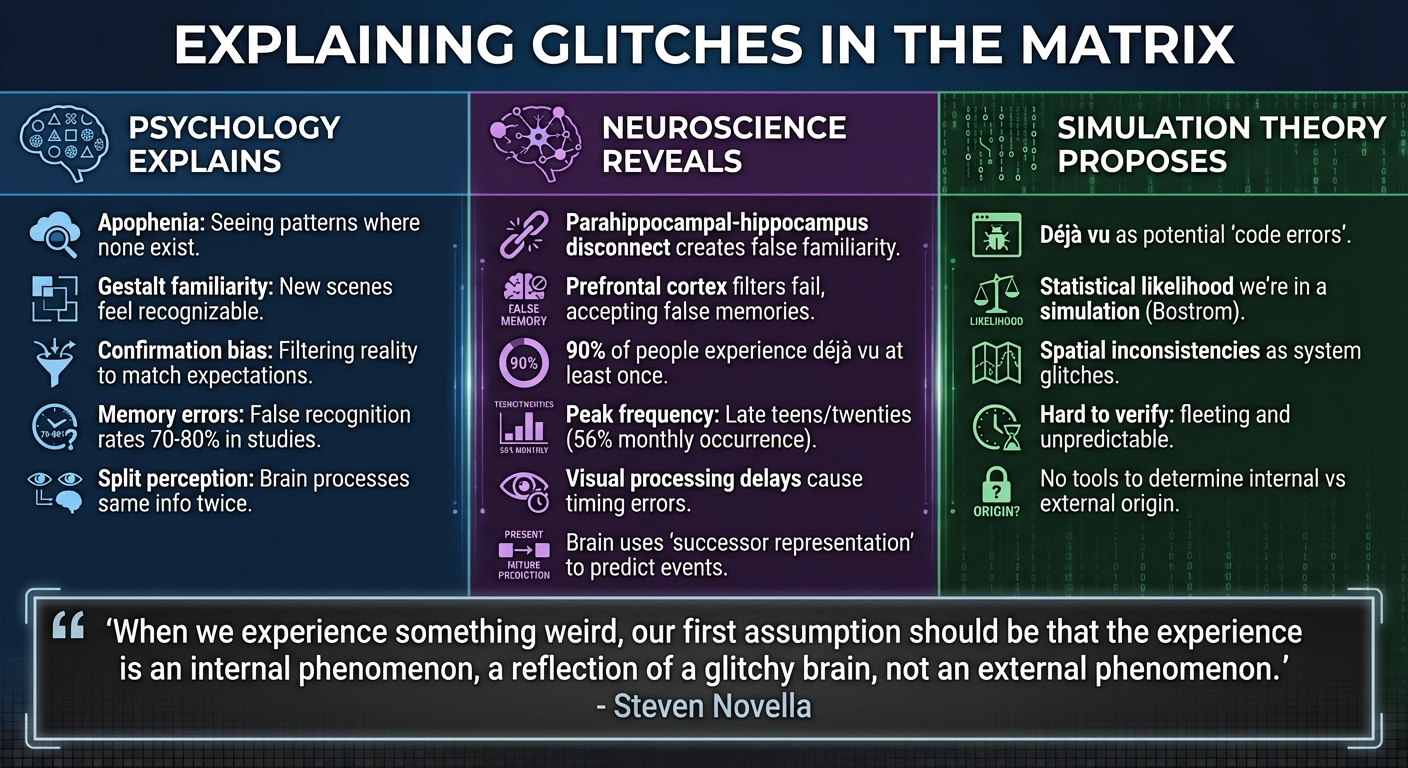
Brain Glitches vs Simulation Theory: Scientific Explanations for Matrix-Like Experiences
How Psychology Explains Glitches
Pattern Recognition and Cognitive Bias
Our brains are wired to constantly search for patterns, an ability that has been crucial for survival. This instinct, called apophenia - the tendency to perceive patterns where none actually exist - helps us make sense of the world. It allows us to recognize faces, anticipate events, and move through familiar spaces without overthinking every detail. However, this same mechanism can sometimes go awry, leading us to see patterns or connections that aren't real.
When you encounter something that feels like a "glitch", your brain might be trying too hard to fit a new experience into a structure it already knows. This phenomenon is linked to Gestalt familiarity, where a new scene feels oddly recognizable because its layout resembles something you've encountered before, even if the details are entirely different. A virtual reality study demonstrated this effect: participants were placed in environments with similar 3D arrangements to previously viewed spaces but filled with new objects. Many reported experiencing déjà vu, suggesting that spatial patterns alone can evoke that uncanny sense of familiarity.
Adding to this is confirmation bias, which reinforces your belief in anomalies once you start noticing them. When you're primed to see glitches, your brain begins filtering reality to match that expectation. Minor coincidences or ambiguous experiences suddenly seem like undeniable evidence of something unusual. Together, these cognitive tendencies can create the illusion of patterns and meaning where none exist.
Memory Errors and Déjà Vu
Memory is far from a perfect recording of reality. Instead, it’s a reconstructive process, piecing together fragments stored across different parts of the brain. This makes memory vulnerable to distortion. One common error is a source monitoring failure, where you recall a vivid scene but misattribute its origin. What feels like a real memory could actually stem from a dream, a movie, or your imagination.
"Memories do not preserve a literal representation of the world; memories are constructed from fragments of information that are distributed across different brain regions, and depend on influences operating in the present as well as the past."
Research has repeatedly shown how unreliable memory can be. In a 1995 study by Roediger and McDermott, participants studied lists of related words like "bitter", "taste", and "candy." When tested later, they often confidently "remembered" seeing the word "sweet", even though it was never on the list. False recognition rates in these experiments have reached as high as 70–80%. Another striking example involves Patient BG, a 65-year-old man with a right frontal lobe lesion. In a 1996 study, BG falsely "remembered" nearly 40% of new words that were never presented to him, compared to just 5% in healthy participants. His damaged prefrontal cortex struggled to filter out incorrect matches, turning vague similarities into vivid, yet false, memories.
Memory errors aren’t the only way glitches can manifest. Split perception offers another explanation for moments that feel like a duplicated reality. This occurs when you briefly glance at something - like a person walking by - while distracted, and then take a second, more focused look. The second perception feels strangely familiar because your brain already processed the information milliseconds earlier, just outside your conscious awareness. What seems like a glitch in reality is simply your mind playing catch-up, creating an illusion of repetition.
Real Life Glitches That Prove The Matrix Is Failing
What Neuroscience Says About Glitches
These neurological insights add depth to earlier psychological findings, offering a clearer view of how glitches might occur.
Brain Misfires and False Familiarity
Neuroscience suggests that certain glitches stem from misfires in the brain. One of the most intriguing explanations for déjà vu points to a disconnect between two memory systems. When the parahippocampal gyrus - responsible for feelings of familiarity - activates without input from the hippocampus, which provides context and conscious recollection, it creates an unsettling sensation: a feeling of knowing without a memory to back it up. It’s like seeing a photograph but having no map to place it.
"Déjà vu experiences reflect an inflexible parahippocampal recognition memory system, responsible for feelings of familiarity, working in isolation while the more flexible hippocampal recall system is not involved." - Josef Spatt, M.D., Ludwig Boltzmann Institute for Epilepsy and Neuromuscular Disorders
The parahippocampal system processes spatial information as snapshots - dependent on the viewer's perspective - while the hippocampus acts like a map, offering a broader, context-independent view. During a glitch, you’re left with the snapshot but lose access to the map.
The prefrontal cortex also plays a key role by filtering irrelevant data and keeping false recognitions in check. When this monitoring system falters, the brain may accept vague similarities as actual memories.
Interestingly, about 90% of people report experiencing déjà vu at least once in their lives, with the highest frequency occurring in late teens and twenties, gradually declining with age. Among surveyed students, 56% noted at least one déjà vu event in the past month. These occurrences aren’t rare; they’re common neurological quirks that highlight how delicate our perception of reality can be.
But glitches aren’t limited to memory misfires - errors in visual processing add another layer to the experience.
Visual Processing Errors and Perception Mistakes
Beyond memory, your brain’s visual systems can also distort perception. The brain doesn’t merely record sensory input - it actively constructs reality by merging sensory data with its own expectations. This process, known as Bayesian perceptual inference, can lead to glitches when predictions override new sensory input. In such moments, you might see details that aren’t there or experience time distortions.
"Hallucination proneness could reflect direct alterations in the representation or use of perceptual priors independent of sensory noise." - Emeline Duhamel et al., Department of Psychiatry, Columbia University
Timing errors in neural transmission also play a role. If a slight delay occurs in how signals travel between brain hemispheres, identical information from your eyes might reach different areas of the brain at staggered times. This delay can cause the same event to be processed twice, creating the illusion of having experienced it before. It’s not a flaw in reality itself - it’s a hiccup in your brain’s timing mechanisms.
A 2024 study published in Nature recorded single neurons in 17 epilepsy patients, revealing how hippocampal neurons "replay" activity to predict upcoming events. When these predictions were disrupted, patients displayed delayed responses, confirming that the brain uses a "successor representation" to anticipate what happens next. When these predictions falter or misfire, the result feels like a glitch - your brain catching itself in the act of making a wrong guess about the world around you.
Simulation Theory and Metaphysical Views
Shifting focus from the inner workings of the mind, let’s consider the possibility that these anomalies might point to something larger - something external. While brain misfires offer one explanation, simulation theory suggests an entirely different perspective, one that questions the very fabric of our reality. Metaphysical interpretations take this further, proposing that these "glitches" might not be simple cognitive errors but hints of an artificial, computer-generated world created by advanced entities.
The Simulation Argument and Reported Evidence
Philosopher Nick Bostrom posits that if advanced civilizations possess the capability to create highly realistic simulations, it’s statistically likely that our reality could be one of them. Within this framework, odd phenomena like déjà vu, spatial inconsistencies, or duplicate objects aren’t just quirks of memory - they could be interpreted as potential "code errors" within the simulated environment.
"Déjà vu is a 'glitch in the Matrix' - the simulated reality that keeps humanity unaware that intelligent machines have actually taken over the world."
- Sabrina Stierwalt, PhD, Astrophysicist
This idea, while popularized in films, has seeped into philosophical discussions, suggesting that these anomalies might expose deeper truths about existence rather than simply reflecting errors in human cognition.
One intriguing example comes from a 2012 study at Colorado State University, where researchers used The Sims video game to investigate déjà vu. They recreated a "junkyard" scene that spatially mirrored a previously viewed "garden" scene, swapping bushes for trash piles while keeping their positions identical. Participants reported a strange sense of familiarity, despite the vastly different visual elements. While the study primarily aimed to explore cognitive processes, proponents of simulation theory see such experiences as potential evidence of systemic glitches within a simulated reality.
The philosophical implications are profound. If these anomalies are external system errors rather than internal brain misfires, they could offer glimpses into the true nature of existence. This reframes the question from "Why does my brain do this?" to "What does this reveal about the structure of reality?"
Why Glitches Are Hard to Verify
A major challenge lies in separating subjective experiences from objective reality. Anne M. Cleary, a Professor of Cognitive Psychology, sheds light on the complexity of déjà vu:
"Déjà vu is perhaps the most interesting and dramatic of memory illusions because it involves a clash of two rational and routine cognitive evaluations - familiarity versus unfamiliarity."
Glitches, by their nature, are fleeting and unpredictable, making them almost impossible to capture in controlled settings. They often vanish before they can be fully analyzed. For instance, an fMRI study involving 21 participants experiencing lab-induced déjà vu revealed brain activity primarily in decision-making areas rather than memory centers. This suggests the brain was working to resolve perceptual conflicts, but it doesn’t clarify whether the conflict stems from a neural error or an external anomaly.
If our reality operates like a sophisticated simulation, its "code" would define our perceptions, making it incredibly difficult to verify any anomalies. Interestingly, reports of déjà vu are more common among individuals who are well-educated, widely traveled, and open-minded. While these patterns suggest a link between cognitive awareness and the reporting of anomalies, they don’t definitively explain whether these experiences arise from brain processes or glitches in a simulated system.
At present, we lack the tools to determine whether these phenomena are internal or external in origin. This duality challenges us to weigh the evidence and consider whether these fleeting moments are simply tricks of the mind or glimpses into something far greater.
How to Evaluate Your Glitch Experiences
Whether it's déjà vu, spatial oddities, or bizarre synchronicities, understanding these moments starts with careful observation. By approaching them systematically, you can separate internal quirks from potential external anomalies. The strategies below draw from the neuroscience and psychological insights discussed earlier, offering practical ways to assess these experiences.
Keeping a Glitch Journal
When something unusual happens, jot it down right away. Capture details like the time, location, your physical and mental state (e.g., tiredness, stress, or recent alcohol consumption), and who else was present. Describe the environment as thoroughly as possible. Sometimes, what feels like a glitch may simply reflect familiar spatial patterns or environmental factors.
Over time, these records can reveal trends. For instance, you might find that glitches occur more often during periods of sleep deprivation or that they become less frequent as you age. Research indicates that déjà vu, for example, tends to decline after your twenties.
Applying Occam's Razor and Critical Thinking
As you review your journal, use Occam's razor: prioritize simple, internal explanations before considering external or metaphysical causes. This mindset, rooted in neuropsychological awareness, encourages you to rule out everyday explanations first. For example, experiencing "missing time" on a road trip is more likely due to briefly nodding off than to a simulation error. Similarly, the eerie familiarity of a new place might stem from split perception - your brain processing the same visual input twice in rapid succession if your attention was initially divided.
Consider this: What’s more plausible based on what we know about human cognition? Our brains often misinterpret randomness as patterns and assign meaning to coincidences. Before concluding that you've glimpsed behind the veil of reality, reflect on whether your experience aligns with known cognitive phenomena, such as retrieval monitoring errors or implicit memory triggers.
Once you’ve examined your experience internally, seek external perspectives to gain further clarity.
Getting Outside Confirmation
If others were present during the event, ask for their account without sharing your own version first. This ensures their recollection remains unbiased. If multiple witnesses report similar observations, evaluate whether shared factors like exhaustion or stress might explain the occurrence.
For example, if everyone involved was fatigued, stressed, or emotionally heightened, it’s more likely that the anomaly was a synchronized brain glitch rather than an actual disruption in reality. By comparing perspectives and considering shared conditions, you can better understand whether the experience points to an internal misfire or something more elusive.
Conclusion: Balancing Curiosity with Critical Thinking
The debate over whether glitches are simply quirks of the brain or glimpses into a hidden layer of reality continues to intrigue. Many occurrences that feel like "glitches in the matrix" can often be traced back to the way our brains interpret and reconstruct information. Memory, for instance, is not a perfect recording but a process prone to distortions. When you experience phenomena like déjà vu or notice something that seems out of place, your brain - specifically the prefrontal cortex - may be working to reconcile conflicting signals.
This perspective is echoed by experts in the field. Steven Novella, Founder of NeurologicaBlog, explains:
"When we experience something weird, our first assumption should be that the experience is an internal phenomenon, a reflection of a glitchy brain, not an external phenomenon, a reflection of a glitchy reality."
– Steven Novella
Yet, moments that feel inexplicable shouldn't be dismissed outright or immediately attributed to the supernatural. Neuroscientist Uwe Wolfradt of Martin Luther University highlights their scientific value:
"For neuroscientists, these small errors offer invaluable insight into the workings of our consciousness".
These anomalies provide a unique lens through which to understand how our minds assemble reality from incomplete data.
The challenge lies in maintaining an openness to the unknown while staying grounded in critical thinking. This approach requires what might be called neuropsychological humility. Begin by exploring straightforward explanations - factors like fatigue, stress, or perceptual shortcuts such as split attention and gestalt familiarity. Only after ruling out these possibilities should you entertain the idea of something more unusual. Without this process, there's a risk of misinterpreting future experiences.
Cultivate curiosity about these moments, but let evidence guide your understanding. Striking a balance between wonder and skepticism doesn't dilute the mystery - it refines your ability to discern when something genuinely extraordinary might be unfolding.
FAQs
What does neuroscience say about the cause of déjà vu?
Déjà vu, from a neuroscience perspective, is tied to the way our brain handles memory. Specifically, it involves the parahippocampal gyrus, a region responsible for recognizing familiarity. When this system identifies something as familiar but cannot link it to a specific memory, it creates the feeling that the moment has happened before.
This peculiar sensation often stems from slight misfires in the brain's memory networks. For instance, a current experience might resemble something from the past, but the brain struggles to fully access the original memory. This disconnect results in the eerie impression of reliving a moment.
What does simulation theory say about 'glitches in the matrix'?
Simulation theory proposes that moments like déjà vu, uncanny synchronicities, or puzzling inconsistencies might hint at the artificial nature of our reality - what some call "glitches in the matrix." These occurrences are thought to emerge when the underlying system of the simulation encounters errors, updates, or unforeseen conditions, much like bugs in a software program.
In this view, such glitches could be fleeting cracks in the veil, moments when the "code" behind our perceived reality falters or adjusts. While fields like psychology and neuroscience often attribute these phenomena to memory distortions or the brain's natural tendency to recognize patterns, simulation theory offers a strikingly different lens: these anomalies might be subtle evidence of a constructed, digital universe.
Can keeping a journal help make sense of 'glitches in the matrix'?
Keeping a journal can serve as a meaningful tool for understanding experiences that feel out of the ordinary. By recording events like déjà vu, uncanny coincidences, or moments where reality seems inconsistent, you create a space to track patterns and reflect on the circumstances surrounding these occurrences. Over time, this practice can reveal whether such events are isolated or tend to repeat, and if they connect to particular emotional or mental states.
Journaling also offers an opportunity to examine these phenomena more closely. Are they shaped by cognitive processes, like memory distortions or the brain’s tendency to find patterns? Or do they suggest something that feels harder to explain? By cultivating this habit, you may sharpen your awareness of how your mind interprets reality and begin to discern whether these 'glitches' are simply quirks of perception or something that brushes against the edges of the extraordinary.