Why the Universe Seems Coded in Math
How Fibonacci, fractals, the golden ratio and precise physical laws suggest the cosmos follows mathematical rules and hints at a coded reality.

The universe speaks in patterns, and mathematics is its language. From the spirals of galaxies to the structure of DNA, the same mathematical principles echo across scales, revealing a reality woven with precision. This isn’t just about describing what we see - mathematics may be the very foundation of existence itself.
Key points:
- Mathematics as Reality: Physicist Max Tegmark suggests the universe is mathematics, not just described by it.
- Patterns in Nature: The Fibonacci sequence, fractals, and the golden ratio appear in everything from plants to galaxies.
- Physics and Prediction: Equations like Einstein’s or Schrödinger’s don’t just describe reality - they predict it with stunning accuracy.
- Simulation Theory: The universe’s mathematical order raises questions about whether reality is programmed, like a cosmic code.
These patterns and laws suggest more than randomness - they hint at a deeper structure, inviting us to look beyond the surface of what we call "reality."
Is the Universe a Mathematical Simulation?
Mathematical Patterns in Nature and the Cosmos
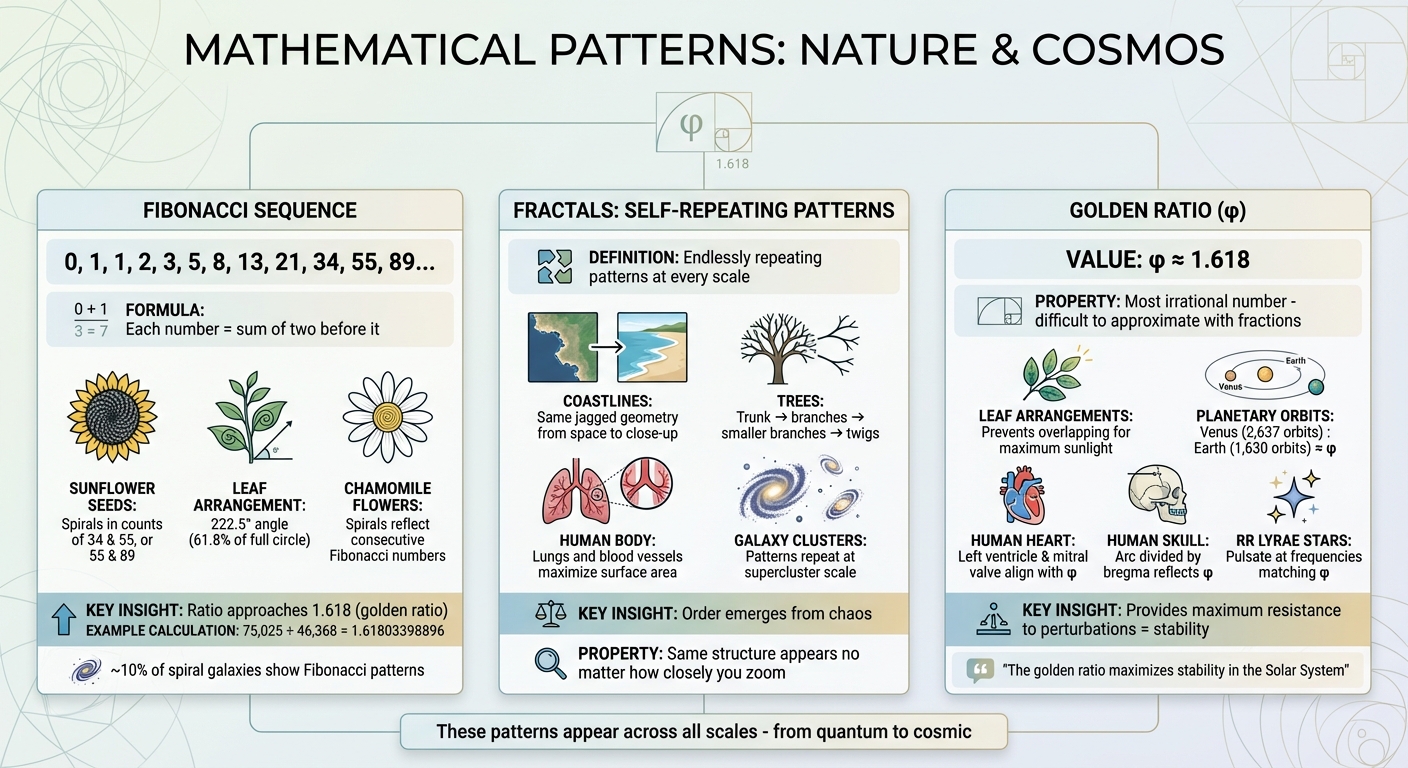
Mathematical Patterns in Nature: Fibonacci, Fractals, and Golden Ratio
Math leaves its fingerprints everywhere, from the spirals of hurricanes to the way leaves grow on a stem. It’s not some hidden abstraction - it’s woven into the very fabric of reality. Three patterns stand out as particularly striking examples of how deeply mathematics shapes the world: the Fibonacci sequence, fractals, and the golden ratio.
The Fibonacci Sequence in Nature and Space
The Fibonacci sequence is a simple yet profound numerical pattern: 0, 1, 1, 2, 3, 5, 8, 13, and so on, with each number being the sum of the two before it. This sequence doesn’t just exist in theory - it shows up in the natural world, from the arrangement of leaves to the spirals of flower petals.
Plants use this pattern to optimize survival. For example, new leaves often grow at an angle of about 222.5° (or 61.8% of a full circle) from the previous one, ensuring maximum exposure to sunlight. Chamomile flowers take this a step further, forming spirals that reflect consecutive Fibonacci numbers.
Sunflowers offer another striking example. Their seeds arrange themselves in spirals, often in counts like 34 and 55 or 55 and 89 - again, Fibonacci numbers. This arrangement ensures seeds are packed as efficiently as possible, leaving no wasted space. Interestingly, as you divide successive Fibonacci numbers, the ratio approaches 1.618, a value tied to the golden ratio. For instance, dividing 75,025 by 46,368 gives 1.61803398896.
In the cosmos, spiral galaxies sometimes mirror Fibonacci patterns, though only about 10% of these "Grand Design" galaxies display such precision. Astrophysicist Ethan Siegel has pointed out, however, that these patterns are more a trick of perception than a universal rule:
"The Fibonacci-like patterns seen in spiral galaxies are inventions of our eyes, rather than a physical truth of the Universe".
But math’s influence doesn’t stop at sequences - it also emerges in patterns that repeat across scales.
Fractals: Self-Repeating Patterns Across Scales
Fractals are endlessly repeating patterns, appearing at every scale. No matter how closely you zoom in, the same structure reappears, creating a sense of infinite complexity from simple rules.
Take coastlines, for example. Whether viewed from space or up close, their jagged edges reveal the same repeating geometry. Trees follow a similar logic: a trunk splits into branches, which then divide into smaller branches and twigs, all echoing the same pattern. Even within our own bodies, fractal branching maximizes surface area in the lungs and blood vessels.
On a cosmic scale, fractals emerge again. Galaxy clusters form patterns that resemble the arrangement of even larger superclusters, suggesting that the same mathematical principles govern both the tiny and the immense. These fractal structures highlight how order can emerge from apparent chaos, revealing an underlying unity in the universe.
The Golden Ratio: Mathematical Harmony in Design
While fractals reveal repeating structures, the golden ratio (φ) represents balance and harmony. This proportion, approximately 1.618, appears repeatedly in nature, creating a relationship where the whole mirrors its parts. It’s a kind of mathematical resonance that shows up in both form and function.
Mathematicians and physicists have uncovered why φ is so prevalent: it’s the "most irrational" number, making it difficult to approximate with fractions. This property proves useful in nature. In leaf arrangements, for instance, φ prevents overlapping, ensuring each leaf gets maximum sunlight. In planetary orbits, relationships tied to φ enhance stability; Venus completes roughly 2,637 orbits for every 1,630 Earth orbits, a ratio close to φ.
The golden ratio even shows up in human anatomy. Studies using CAT scans and ultrasound reveal that healthy hearts align with φ in the left ventricle and mitral valve, while deviations from this ratio often indicate health problems. Similarly, the dimensions of the human skull - such as the arc divided by the bregma - tend to reflect φ, a pattern that becomes more pronounced as species grow more complex.
A fascinating discovery came in 2015 when researchers studying data from the Kepler space telescope found that certain stars, known as RR Lyrae, pulsate with frequencies nearly matching φ. This phenomenon, described as "strange non-chaotic dynamics", highlights the golden ratio’s role in maintaining stability:
"The golden ratio provides the most resistance to perturbations. Thus, in the case of the Solar System, having orbital periods related by φ maximises stability."
Far from being just a mathematical curiosity, the golden ratio represents a kind of optimization. It balances structure and stability, appearing everywhere from quantum scales to the movements of celestial bodies. It’s no wonder φ resonates so deeply - not just mathematically, but aesthetically, as it aligns with our innate sense of beauty.
Physics as the Language of the Universe
Physics translates the workings of nature into precise mathematical expressions. By observing patterns in the natural world, physics uncovers that even forces we cannot see follow strict mathematical rules. From gravity's pull to the behavior of subatomic particles, every fundamental law of the cosmos is written in the language of mathematics, suggesting a universe inherently shaped by these principles.
How Equations Explain Reality
Physics has the extraordinary ability to predict and describe the universe with striking accuracy. Take James Clerk Maxwell's work in the 1860s, for example. His four equations captured the essence of electromagnetism and even predicted the existence of radio waves - two decades before Heinrich Hertz confirmed their presence experimentally in the 1880s. The math itself revealed what experiments would later confirm.
Albert Einstein's field equations, rooted in non-Euclidean geometry, go even further. They describe how mass curves spacetime, offering not just an explanation of gravity but also a deeper understanding of how massive objects shape the very structure of the universe.
The precision of these mathematical laws is astonishing. Newton's law of gravitation, which once had an accuracy of about 4%, is now confirmed to within less than one ten-thousandth of a percent. Such precision suggests that these laws are not arbitrary but foundational to how the universe operates.
This extraordinary accuracy in describing large-scale phenomena leads naturally to the question of how mathematics governs the smallest scales of reality.
Quantum Mechanics: Math at the Smallest Scales
When we delve into the quantum realm, reality becomes stranger - and the role of mathematics even more profound. The Schrödinger equation, for instance, uses complex numbers to describe particles as probabilities, existing in a state of potential until measured.
The predictive power of quantum mechanics is unmatched. In 2008, researchers used quantum electrodynamics to calculate the electron's magnetic moment as 1.00115965218073. When measured experimentally, this value agreed with the theoretical prediction to within a few parts per trillion. Similarly, the calculated energy level of helium's lowest state aligns with experimental results to within one part in ten million.
Physicist Eugene Wigner captured this awe perfectly:
The enormous usefulness of mathematics in the natural sciences is something bordering on the mysterious and that there is no rational explanation for it.
The universe doesn't just allow for mathematical descriptions - it insists on them. From Maxwell's equations foretelling unseen waves to quantum mechanics describing particles through probabilities, physics reveals a cosmos that operates through mathematical precision. This pervasive mathematical order raises profound questions: Is the universe's structure a product of design, or is it simply the intrinsic nature of reality? Either way, the omnipresence of mathematics remains one of the deepest and most enduring mysteries of existence.
Simulation Theory: Is Reality Programmed?
The intricate mathematical order that defines the universe sparks a provocative idea: what if the universe isn't merely described by math, but is math? This is the essence of simulation theory, which suggests reality functions like a program, its "code" embedded in mathematical laws.
MIT physicist Max Tegmark pushes this notion further with his Mathematical Universe Hypothesis (MUH). He proposes that our world doesn't just follow mathematical principles - it is a mathematical structure:
Our physical world not only is described by mathematics, but that it is mathematics.
From the objects we interact with to our innermost thoughts, everything emerges from mathematical relationships, much like the virtual worlds in video games arise from written algorithms. By observing the undeniable order in these patterns, simulation theory presents reality as a manifestation of pure code. This idea opens the door to exploring the evidence that our universe might indeed be a programmed creation.
Evidence for a Coded Universe
Modern physics offers several intriguing clues that reality might be built on a programmed framework rather than existing as purely physical.
The holographic principle, as demonstrated by the AdS/CFT correspondence, suggests that our three-dimensional universe could be equivalent to two-dimensional quantum information encoded on a distant boundary. Space-time, in this view, emerges as a projection - a hologram - arising from deeper quantum data, much like a 3D image projected from a 2D plane.
Physicist Juan Maldacena explains:
Gravity is not something separate from regular quantum theory... gravity is just a different description of a quantum theory.
Another compelling hint lies in the fine-tuning of physical constants. The universe operates on exactly 32 fundamental numbers, such as the proton’s mass being 1,836.15267 times that of the electron, or the existence of precisely three spatial dimensions. These values appear meticulously calibrated, much like the initial settings for a simulation, pointing to a deliberate mathematical framework rather than random chance.
Mathematical consistency across the cosmos further supports this idea. The laws of physics remain unchanged, whether observed on Earth or in galaxies billions of light-years away.
The recurrence of the golden ratio (Φ ≈ 1.618) across scales - from the structure of DNA to black hole thermodynamics - provides yet another clue. In binary matrix mathematics, Φ and -1/Φ emerge as the most probable non-trivial eigenvalues. This recurring ratio hints at a programmed mathematical architecture underlying reality.
These patterns, woven into the fabric of the universe, not only define physical laws but also invite deeper reflection on their potential metaphysical significance.
Spiritual Meaning of Simulation Theory
Simulation theory intriguingly connects modern physics with ancient spiritual insights. If reality is fundamentally mathematical, then concepts like randomness, complexity, and even time itself might be illusions, arising from a deeper, unchanging mathematical structure.
This perspective aligns with spiritual teachings that describe the material world as an illusion. It suggests that individual consciousness is not isolated but part of a larger, interconnected mathematical whole.
The idea of relational reality - where existence is defined by relationships between entities rather than the entities themselves - resonates with this interconnected view of the universe.
Albert Einstein once pondered this profound connection:
How is it possible that mathematics, a product of human thought that is independent of experience, fits so excellently the objects of physical reality?
Whether one interprets this as evidence of a designed system, a cosmic program, or simply the intrinsic nature of existence, the mathematical "coding" of reality suggests something extraordinary. The physical world, it seems, may be less about substance and more about information. For those on a spiritual journey, this perspective offers a way to see reality as both tangible and illusory - a sacred code waiting to be explored and understood.
Resources for Further Study
Sacred Illusion Articles on Mathematical Reality
Sacred Illusion offers articles that explore the intricate mathematical framework underlying reality. The Hidden Code of Reality: Sacred Geometry dives into how geometric principles shape the cosmos - from the spiraling arms of galaxies to the structure of DNA. It presents geometry as a symbolic "hidden grid" that brings order to the universe. Patterns like the Golden Ratio (1.618…), the Fibonacci Sequence, and fractals are highlighted as recurring elements in nature, pointing to a deeper, underlying design.
Another article investigates how science examines the idea that space-time itself could emerge from a quantum web of entanglement. These studies connect observable natural patterns to the universe's deeper, coded architecture.
Books and Tools for Deeper Learning
For those eager to explore the mathematical essence of reality, these books are excellent starting points:
- Our Mathematical Universe by Max Tegmark: This book introduces the concept that our physical reality is, at its core, mathematics. It’s available in Kindle, Paperback, and Hardcover editions.
- Infinite Powers by Steven Strogatz: A fascinating look at how calculus uncovers the hidden mathematical language that governs the cosmos.
- Programming the Universe by Seth Lloyd: This work delves into the idea of the universe functioning as a massive quantum computer, constantly processing information.
- Is God a Mathematician? by Mario Livio: A thought-provoking exploration of why mathematics is so uncannily effective in explaining the natural world.
You can also observe Fibonacci patterns in the natural world - look closely at pinecones, sunflower spirals, or the arrangement of leaves to see these mathematical ratios in action. For visual learners, documentaries like What is Reality? by Quantum Gravity Research and the In Theory video series by Quanta Magazine provide engaging, visual explanations of these ideas.
Conclusion
Mathematical patterns, stretching from the spirals of galaxies to the subtle motions of quantum particles, reveal a universe woven with order. These patterns suggest that the cosmos is not merely described by mathematics but may, at its core, be mathematics itself. As Max Tegmark, Professor of Physics at MIT, explains:
Our reality isn't just described by mathematics - it is mathematics, in a very specific sense. Not just aspects of it, but all of it, including you.
This perspective challenges our understanding of randomness and chaos, hinting that what seems disordered might actually conceal a deeper, stable structure.
The "unreasonable effectiveness" of mathematics - its uncanny ability to predict and describe the natural world - underscores this connection. Consider how Riemann's geometry laid the foundation for Einstein's General Relativity, demonstrating the profound precision of abstract equations in framing reality itself. This alignment between the human mind and the cosmos suggests that our consciousness is intricately linked to the mathematical fabric of existence.
How does this relate to your journey? The synchronicities you notice, the recurring numbers that catch your eye, or the sense of hidden order you feel may be glimpses of the underlying structure that shapes reality. Mathematics, often seen as sterile or detached, takes on a new light when viewed as a reflection of inner harmony. As Andrea Gawrylewski, Editor of Scientific American, insightfully puts it:
Mathematics is not alien at all but a mirror held up to ourselves.
Through this lens, the patterns around you become more than coincidences - they become sacred echoes, inviting you to explore your role within this grand design. By recognizing this, you can engage with existence more consciously, understanding that you are both shaped by and shaping this intricate framework.
Whether the universe is a coded construct, a deliberate design, or an emergent phenomenon from quantum depths - a question we've touched on before - the mathematical order at every level calls for deeper exploration. It suggests that you are awakening to a structure that has always been present, waiting for you to see it.
FAQs
How does the Fibonacci sequence appear in nature?
The Fibonacci sequence appears in nature through mesmerizing patterns and structures. You’ll notice it in the spirals of sunflower seeds, the arrangement of pine cone scales, the curves of nautilus shells, and even in the swirling forms of hurricanes and galaxies. These shapes often align with the sequence’s proportions, bringing a sense of balance and symmetry to the natural world.
This isn’t mere chance - it reveals how nature organizes growth and efficiency, hinting at an underlying blueprint woven into the fabric of the universe.
Why is the golden ratio important in understanding the universe?
The golden ratio holds a special place in our understanding of the world because it emerges time and again in nature, art, and even the vast expanse of the cosmos. You can see it in the spiraling arms of galaxies, the swirling patterns of hurricanes, the arrangement of petals on flowers, and the curves of seashells. It’s as if this proportion whispers a hidden order woven into the fabric of existence.
Its recurring appearance across such varied phenomena stirs the imagination, hinting at a profound link between mathematics and the very blueprint of reality. This connection has long inspired thinkers to explore whether the universe itself carries an intentional design or follows fundamental principles shaped by this timeless ratio.
Is it possible that the universe is based on mathematical principles or a simulation?
Some thinkers in science and philosophy suggest that the universe might be rooted in mathematics, resembling a coded system at its core. Patterns found in nature - such as the Fibonacci sequence, fractals, and the golden ratio - could hint at a deeper mathematical structure shaping reality.
Expanding on this, the idea of a mathematical simulation proposes that our reality might function like a designed system, akin to a computer simulation. While this remains a theoretical perspective, it opens up intriguing questions about existence and invites us to look closer at the mathematical rhythms that define the world around us.