What Dreams Might Reveal About the Source Code
Dreams may expose hidden rules and symbols that reveal the 'source code' shaping both consciousness and reality.

Dreams are more than fleeting nighttime visions - they might hold clues about the structure of reality itself. Your mind builds entire worlds while you sleep, raising questions about whether our waking experiences operate on similar principles. Key ideas explored in this article include:
- Dreams as Simulations: Neuroscience shows dreams are immersive, rule-based experiences crafted entirely by the brain, without external input.
- Reality as a System: The universe may function like an engineered construct, with boundaries akin to a digital system’s limits (e.g., Planck length, time).
- Recurring Symbols: Patterns in dreams, such as archetypes, could reflect deeper structures in consciousness or reality’s "code."
- Lucid Dreaming: Becoming aware in dreams allows for testing their limits, revealing "glitches" or consistent rules within the dream space.
- Shared Dreams: Experiences of mutual dreaming suggest consciousness might connect to a shared informational field.
Dreams may mirror the hidden frameworks shaping both inner and outer realities. By journaling, analyzing symbols, and experimenting with lucid dreaming, you can engage with these layers and uncover recurring patterns. What if the boundaries between dreaming and waking are thinner than we assume?
Why Dreams Further Prove Simulation Theory | Riz Virk
Dream Phenomena and Reality Patterns
Dreams, often seen as internal simulations, offer a glimpse into the intricate workings of consciousness. Through recurring symbols, lucid dreaming, and shared dreams, we encounter evidence of a structured, rule-based system that shapes our mental and perhaps even shared realities.
Recurring Symbols: Clues to the Code
When certain images or symbols appear repeatedly in dreams, they may signify more than personal experiences or psychological themes. Carl Jung introduced the concept of archetypes, describing them as universal patterns embedded within human consciousness. As Jung noted:
"Archetypes are typical modes of apprehension, and wherever we meet with uniform and regularly recurring modes of apprehension we are dealing with an archetype, no matter whether its mythological character is recognized or not".
From a systems perspective, these recurring symbols could act as core data points - the building blocks that help organize and process information within the dream and, potentially, the waking world. Just as subatomic particles adhere to consistent rules, these symbols might represent fixed elements within reality's underlying structure. Studies back this idea, showing that people recall symbols more effectively when tied to their archetypal meanings, even without consciously recognizing those connections.
This consistency invites further exploration, particularly through active dream experiments.
Lucid Dreaming as a Tool to Explore the System
Lucid dreaming, where the dreamer becomes aware they are dreaming, offers a unique opportunity to actively investigate the mechanics of the dream state. By conducting reality tests, lucid dreamers can uncover the rules and boundaries of the dream environment. Common experiments include looking at digital clocks (which often display erratic numbers), counting fingers (which may appear distorted), or attempting actions that defy physical laws. These tests often expose "glitches" or inconsistencies in the dream's construct, much like debugging software.
Interestingly, lucid dreaming operates within measurable limits. It correlates with a Phase Alignment Score (PAS_n) above 0.72, suggesting it functions according to defined, quantifiable parameters. Devin Bostick from CODES Intelligence explains:
"Lucidity is not a dream state with heightened awareness - it is a lawful resonance field with symbolic gating, coherence checks, and recursive identity confirmation".
This structured nature becomes even more compelling when we examine shared dream phenomena.
Shared Dreams: Evidence for Connected Realities
Shared dreams - where two or more people report experiencing the same dream environment - provide intriguing evidence for interconnected consciousness. These experiences hint at a networked reality, where individual minds may tap into a shared informational field. A 2017 study revealed that 96% of reported mutual dreams occurred between individuals with close emotional connections, suggesting that emotional bonds might facilitate access to this shared network.
In a striking example, the California-based company REMspace made headlines in September 2024 with a bold experiment. During the study, researchers transmitted a random word from a constructed language - "Zhilak" - to one participant during REM sleep via earbuds. That participant repeated the word within their lucid dream. The same word was then transmitted to a second lucid dreamer, who successfully confirmed hearing "Zhilak" upon waking. Reflecting on this achievement, CEO Michael Raduga remarked:
"Yesterday, communicating in dreams seemed like science fiction. Tomorrow, it will be so common we won't be able to imagine our lives without this technology".
Such findings challenge the view of dreams as purely subjective experiences. Ed Kellogg, PhD, emphasizes:
"The existence of dream-psi has made strictly subjective, solipsistic, theories of dreaming outdated and untenable".
If dreams were merely isolated neural events, shared experiences and verifiable communication between dreamers would be impossible. Instead, these occurrences suggest that consciousness may interact with a shared informational field - what some researchers refer to as an "information universe" that exists beyond the confines of individual minds.
Techniques to Decode Dreams and Find Reality's Patterns
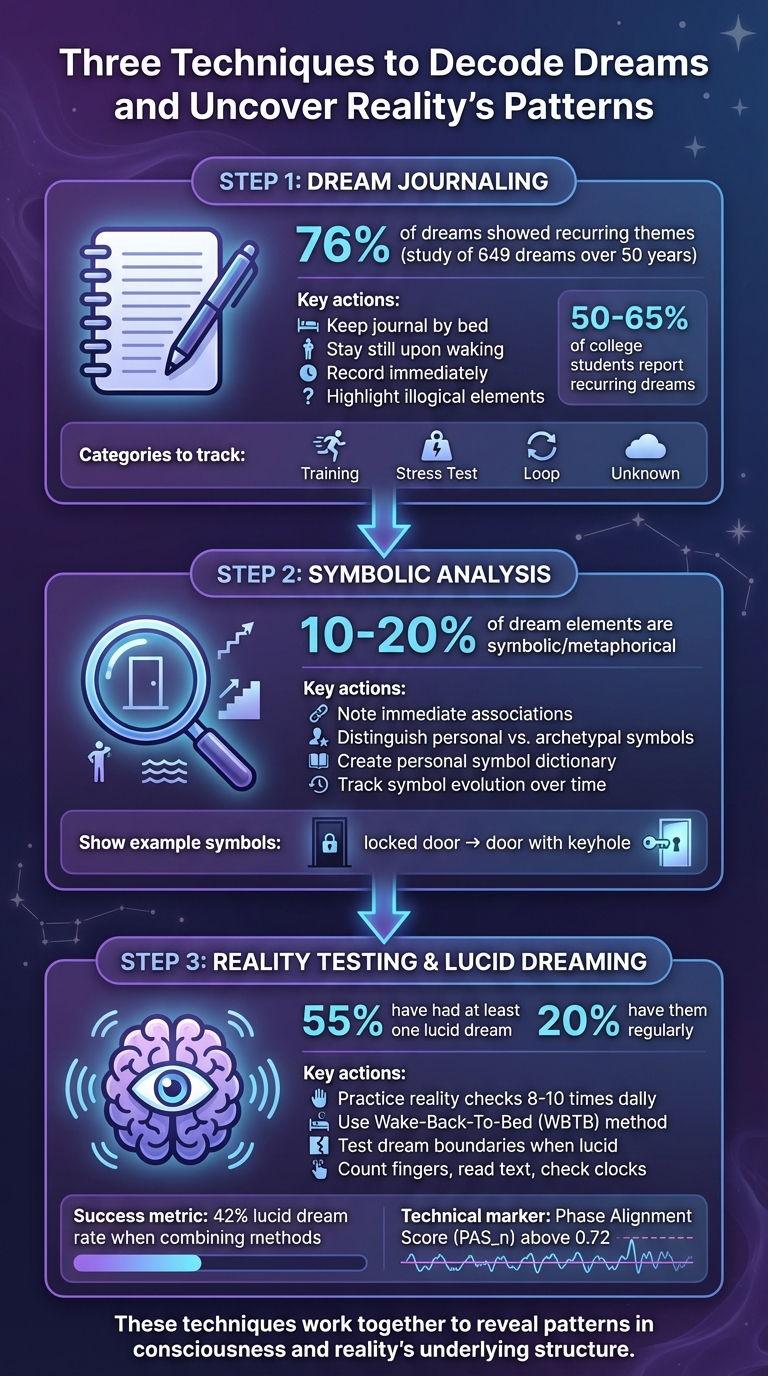
Three-Step Dream Exploration Technique Guide
If dreams offer a window into the deeper workings of reality, then learning to work with them intentionally becomes a powerful tool. These methods can help you turn fleeting nighttime images into meaningful patterns, revealing how consciousness might interact with the fabric of existence.
Dream Journaling: Capturing the Subconscious in Words
A dream journal is more than a notebook - it's a lens to uncover recurring themes. Research has shown that dreams often repeat themselves, with one study documenting 649 dreams over 50 years, where six recurring themes appeared in 76% of entries. This level of consistency hints at an underlying structure, almost like a program running predictable subroutines.
To start, keep a journal by your bed. Upon waking, stay still for a moment to recall your dream, then jot it down immediately. Even saying a key phrase aloud can help unlock deeper memories. Highlight elements that defy everyday logic - talking animals, impossible landscapes, or warped time. These "glitches" might reveal where the system's seams are visible.
Pay attention to how often certain characters, places, or actions appear. For example, between 50% and 65% of college students report experiencing recurring dreams at some point. The frequency of these elements can reveal what some call "source code concerns" - underlying preoccupations or unresolved patterns. Categorize your dreams by structure - Training, Stress Test, Loop, or Unknown - to identify whether they serve as simulations meant to rewire behaviors.
Symbolic Analysis: Interpreting Dream Imagery
Once you've recorded your dreams, the next step is to decode their symbols. Dream imagery ranges from deeply personal (like a childhood bicycle) to archetypal - universal symbols like water, doors, or heights that resonate across humanity. Carl Jung referred to this shared reservoir of imagery as the "collective unconscious". Dr. Sophia Chen, a dream researcher, explains:
"Even universal symbols are filtered through personal experience. The archetypal mother figure will manifest differently for someone who had a nurturing mother versus someone with a complicated maternal relationship".
When analyzing a dream, start by noting your immediate associations with each image. For example, if you dream of a locked door and think "missed opportunity", that personal connection is more revealing than any generic interpretation. Studies suggest that 10% to 20% of dream elements are symbolic or metaphorical, mirroring how often we use figurative language in daily life. Dreams don't hide meanings in objects; they express them through the structure and flow of the dream itself.
Over time, create a personal symbol dictionary. Track how recurring symbols evolve - like a locked door that eventually reveals a keyhole or a staircase that changes direction. These shifts can reflect changes in your inner world or how you perceive the rules of reality. A good interpretation often feels like a "click" - a moment of clarity when the meaning resonates deeply.
Reality Testing Through Dream Engineering
Move beyond passive observation and experiment with your dreams to uncover their underlying logic. Lucid dreaming - becoming aware that you're dreaming while still asleep - allows you to test the boundaries of the dream environment. Around 55% of people have experienced at least one lucid dream, and 20% report having them regularly.
To encourage lucidity, practice reality testing during the day. Check your reality frequently - press a finger into your palm or glance at a digital clock to look for inconsistencies. Combine this with the Wake Back to Bed (WBTB) technique: set an alarm for 5 hours after falling asleep, stay awake for 30–60 minutes reading about lucid dreaming or journaling, then return to sleep. Studies show that combining methods like Vitamin B6, WBTB, and Mnemonic Induction of Lucid Dreams (MILD) can lead to lucid dreams on 42% of nights.
Once lucid, experiment within the dream. Try counting your fingers, reading text, or performing impossible actions to uncover "glitches" in the system. From a scientific perspective, lucid dreaming operates within measurable parameters, such as a Phase Alignment Score (PAS_n) above 0.72 and increased gamma activity in the brain's frontal lobe. Devin Bostick from CODES Intelligence describes it as:
"Lucid dreaming is not a blending of states - but the emergence of a stable third phase marked by recursive symbolic awareness and internal coherence".
This suggests that lucid dreaming isn't just heightened awareness - it's a controlled space to explore the symbolic logic that might shape both dreams and waking reality.
What Dreams Reveal About Reality
Dreams as Reflections of a Programmable Reality
Dreams might offer a glimpse into how our minds interact with the fundamental "source code" of reality. Some theories suggest that reality itself is built on mathematical patterns, and dreams allow us to bypass physical senses, diving straight into this deeper layer of existence.
In the context of simulation theory, the universe can be likened to software, complete with constraints that act as the smallest "pixels" in its rendering engine. Dreams, seen through this lens, become a kind of runtime environment - a space where consciousness navigates symbolic patterns without the interference of external stimuli. This idea aligns with the notion that our internal experiences, like dreams, may mirror the structures of the external world.
Take lucid dreaming, for example. When you become aware within a dream, you enter a stable state where symbols and events follow a set of rules. This indicates that dreams are not random or chaotic; rather, they operate with a coherence that mirrors the principles governing waking reality. Such structured experiences raise questions: Are the anomalies in dreams - those moments that defy logic - system glitches, or are they intentionally designed features?
The brain's ability to create lifelike, immersive worlds during dreams also invites a provocative question from G. Globus of the University of California at Irvine:
"The brain's capabilities for world creation during lucid dreaming open the possibility that there is actually no world out there during waking too: Perhaps our brains each create parallel world thrownnesses de novo in waking life and there is no external world in common!"
If your mind can construct entire realities while you sleep, could it also be generating the reality you experience when awake?
Are Dreams Glitches or Features?
Dream anomalies - those surreal landscapes and impossible scenarios - might hold clues about reality's structure. Are they errors in the system, or are they intentional? It depends on how you interpret the framework of reality. For example, paradoxical imagery in dreams might represent entropy packets or memory fragmentation within a universal runtime. Alternatively, these anomalies could be mechanisms designed to surface insights from deeper layers of consciousness.
Shared dream experiences add another layer of complexity. When two people report dreaming about the same place or event, it challenges the idea that dreams are purely subjective. As researcher Ed Kellogg points out:
"The existence of dream-psi has made strictly subjective, solipsistic, theories of dreaming outdated and untenable"
This suggests that dreams might connect to a shared system - a kind of universal web where individual consciousness overlaps. On the neuroscience front, measurable patterns in dreams further support the idea of a structured framework. A 2025 study by Demirel and colleagues used high-density EEG and fMRI to identify a "neural triad" of lucid consciousness: persistent beta/gamma resonance, activation of the right precuneus and anterior insula, and coherence across the default mode network. This research established lucidity as a stable third phase of consciousness, distinct from both waking and sleeping states. These findings reinforce the concept that dreams operate within a programmable system.
Interestingly, the universe itself shows signs of constraints similar to engineered systems. For instance, cosmological redshift - the stretching of light from distant galaxies - could be interpreted as lossy compression, where the simulation reduces detail for far-off objects to conserve memory. Black holes might act as garbage collectors, consolidating fragmented data and re-encoding it through Hawking radiation. If reality functions like software, dreams could be where the system runs diagnostics, experiments with new configurations, or allows consciousness to explore alternative scenarios.
Whether viewed as glitches or intentional features, dreams provide a unique lens through which to examine how reality processes information. The recurring symbols, defiance of physical laws, and shared dream phenomena all hint at an underlying architecture - one that may be far more malleable than we realize.
Conclusion
Key Points on Dreams and the Source Code
Dreams provide a window into the deeper framework of reality. Recurring symbols in dreams often serve as structural elements rather than mere metaphors, hinting at an underlying design. Lucid dreaming offers a unique state where the brain creates experiences entirely free from external stimuli, showcasing its ability to generate independent realities. Research supports this, showing that dreams follow identifiable patterns, with neural markers confirming states of lucidity.
Whether you see reality as a simulation, an information-based construct, or a conscious design, dreams present a space to explore how consciousness shapes experience. The brain's ability to craft vivid, coherent dream worlds raises profound questions about the nature of waking life. As neuroscientist Christof Koch observes:
"Dreams are vivid, sensorimotor hallucinations with a narrative structure... they bear witness that the brain alone is sufficient to generate consciousness".
These insights set the stage for using dreams as a tool for deeper exploration.
Next Steps for Dream Exploration
To start, keep a detailed dream log and organize entries into categories like "Training", "Stress Test", or "Loop" to identify recurring themes and patterns. Practice reality checks 8–10 times a day - simple actions like counting your fingers or rereading text can help train your mind to detect inconsistencies. You might also experiment with the Wake-Back-To-Bed method: sleep for six hours, stay awake for 30–60 minutes, then return to sleep while focusing on recognizing dream cues.
When you achieve lucidity, engage with the dream environment. Ask questions of dream characters, test the boundaries of the dream space, and record your findings. Placing a meaningful object by your bed can act as a memory trigger, improving dream recall. Over time, documenting your dreams can reveal patterns that may extend beyond personal psychology, offering glimpses into how reality itself organizes information, enforces rules, and creates the experience of existence.
FAQs
How does lucid dreaming help us explore the nature of reality?
Lucid dreaming offers a unique window into the fabric of reality, giving you the rare opportunity to consciously navigate and shape dreamscapes. In these moments of awareness, you witness your mind crafting entire worlds - complete with their own rules, symbols, and interactions - entirely independent of external sensory input. It’s a reminder of how powerful and intricate the mind truly is, sparking thoughts about whether our waking reality might also be influenced by unseen cognitive or metaphysical frameworks.
Some researchers propose that the coherence and patterns found in lucid dreams might reflect the deeper architecture of reality itself. By diving into these dream experiences, you may begin to notice hidden patterns or symbolic connections, shedding light on the interplay between your subconscious and the external world. Tools like dream journaling and symbolic analysis can help unravel these mysteries, potentially hinting at whether our reality behaves like a simulation or an intricately connected system of meaning.
What can recurring symbols in dreams tell us about reality and the subconscious?
Recurring symbols in dreams often serve as subtle markers, revealing the patterns or themes your subconscious is working through. These symbols can shine a light on unresolved feelings, ongoing struggles, or unspoken desires, acting as a mirror to your inner landscape.
Some perspectives go further, suggesting that these symbols might not only reflect personal experiences but also hint at something larger - hidden structures or 'rules' that govern reality itself. They could even gesture toward the possibility that existence functions like a simulation. By paying attention to these recurring images, you may uncover not just personal revelations but also glimpses into the underlying framework of reality.
Can shared dreams reveal a deeper connection between people?
Shared dreams, where two or more people describe experiencing related or overlapping dream events, spark curiosity about the possibility of an interconnected consciousness. These occurrences are often viewed as hints of a deeper link between minds, potentially pointing to a shared or collective layer of awareness that extends beyond individual perception.
Although scientific studies on shared dreams are scarce and mostly anecdotal, some metaphysical perspectives suggest they might offer a fleeting glimpse into the 'source code' of reality. These dreams could reveal subtle patterns or connections within the subconscious, suggesting a world where consciousness weaves together more intricately than we usually recognize. While far from definitive, shared dreams continue to intrigue those drawn to the mysteries of the mind and the threads that bind our shared experiences.