Animals and the simulation
Animals navigate magnetic fields, perceive senses unavailable to us and may possess forms of conscious experience very different from our own. What does that mean if reality is informational?

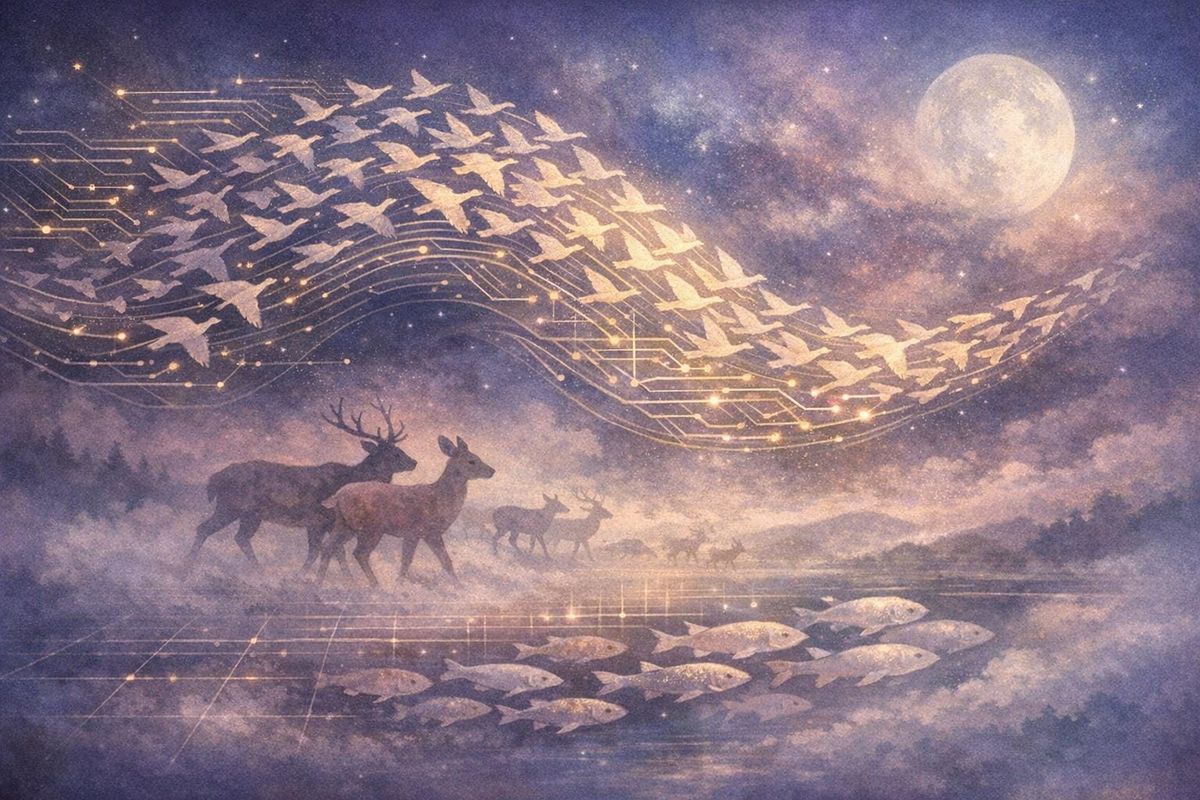
If reality were a simulation, what exactly would animals be?
At first glance, animal behaviour lends itself almost too easily to computational language. Birds follow migratory routes across continents. Sea turtles appear to carry inherited information about where to swim before making their first journey. Bees communicate the location of food. Flocks and shoals change direction with startling coordination.
It is tempting to describe all of this as programming.
Biology already gives us a less dramatic explanation. Evolution produces inherited behavioural systems shaped by millions of years of selection, while learning allows individual animals to adjust those systems to changing conditions.
Yet simulation theory gives us another way of framing the question. Animals may not simply be background characters populating a human world. They may be conscious participants experiencing versions of reality radically different from our own.
Animals as biological programs
The idea that animals operate according to built-in instructions is much older than simulation theory.
René Descartes famously treated non-human animals as essentially mechanical beings, although modern research has moved a long way from that view. What remains true is that some animal behaviour can look remarkably algorithmic.
A newly hatched animal can perform highly complex actions without being taught them. Spiders build species-specific webs. Birds migrate along routes they have never travelled before. Insects carry out elaborate reproductive and social behaviours without anything resembling formal instruction.
Calling these behaviours "programs" is metaphorical, but it is not a useless metaphor.
DNA contains inherited information. Nervous systems process sensory inputs. Behaviour changes according to internal rules and environmental feedback. Natural selection gradually modifies those rules across generations.
A simulated organism might be expected to work in much the same way.
The important difference is that none of this provides evidence that animals actually are programmed entities inside an artificial universe. Evolution already explains why useful inherited behaviours develop.
Simulation theory enters when we ask a different question: why does living reality lend itself so readily to informational descriptions?
Animal navigation is particularly strange
Few behaviours look more like built-in navigation software than migration.
Loggerhead sea turtles provide one of the clearest examples. Young turtles from Florida enter the Atlantic and undertake enormous migrations around the North Atlantic before eventually returning towards North America.
Experiments have shown that hatchlings respond differently when exposed to magnetic fields matching different geographical locations along that route. The evidence suggests that they begin life with an inherited form of magnetic map that allows regional features of Earth's magnetic field to guide their movement.
More recent research has shown that turtles can also learn magnetic signatures associated with particular locations. The magnetic map and magnetic compass may even depend on different sensory mechanisms.
This is extraordinary biology. It does not require us to assume hidden code.
But from the viewpoint of an animal, Earth's magnetic field forms part of reality in a much more direct way than it does for us. Information exists in the environment that humans cannot naturally access, while another species reads it and acts upon it.
That fact alone should make us cautious about assuming that human perception gives us a complete picture of the world.
Every animal inhabits a different reality
Biologist Jakob von Uexküll used the word Umwelt to describe the perceptual world available to a particular organism.
There is no single experienced environment shared equally by every creature.
Bees see ultraviolet patterns on flowers that we cannot. Bats construct their surroundings through echolocation. Some snakes detect infrared radiation. Sharks and rays detect weak electrical fields. Many animals respond to magnetic information that humans do not consciously perceive.
The physical environment may be shared, but the experienced worlds generated from it are profoundly different.
This becomes fascinating through the lens of simulation theory.
A computer game may contain information that only certain characters or systems are equipped to access. The data are present globally, while each agent receives only the information relevant to its interface.
Animals provide a natural version of that idea.
The bat, bee, turtle and human occupy the same planet, but each interacts with a different slice of its available information.
If reality does have an informational architecture, there is no obvious reason to assume that humans have privileged access to it.
Animals as conscious participants
The old picture of animals as elaborate reflex machines has weakened considerably.
The New York Declaration on Animal Consciousness, announced in 2024, states that there is strong scientific support for conscious experience in other mammals and birds, and at least a realistic possibility of consciousness in all vertebrates and many invertebrates, including cephalopods, crustaceans and insects.
That does not mean scientists have proved exactly which animals are conscious or what their experience feels like.
It reflects a growing body of evidence suggesting surprisingly sophisticated cognition across very different branches of life.
Great apes can anticipate behaviour based on what another individual appears to believe. Scrub-jays alter food-caching behaviour depending on whether another bird has observed them. Crows have been trained to report whether they perceived a visual stimulus, with activity in a higher-order brain region tracking what they reported seeing rather than simply whether a stimulus was physically present.
Cephalopods solve problems and explore their environments. Bees can learn complex tasks despite having brains containing a tiny fraction of the neurons found in humans.
None of this tells us whether we live in a simulation.
It changes what an imagined simulation would have to contain.
Animals could not simply be treated as scenery if many of them are having experiences of their own.
One world, many centres of experience
This creates an interesting problem for simulation theory.
If consciousness matters to the simulation hypothesis, why should humans be the only meaningful observers?
A crow perceiving an object, an octopus investigating a container or a turtle navigating across an ocean may each represent another centre from which reality is experienced.
That sits comfortably with a broader point raised in Simulation Theory 101: even if reality were computational, we would still need to explain consciousness rather than assume the simulation idea solves it.
A simulated nervous system may behave exactly like a biological nervous system.
The harder question remains whether there is something it is like to be that system.
Animals make that question much harder to ignore because consciousness appears unlikely to begin suddenly at the boundary of our own species.
Collective behaviour and apparent algorithms
Animals also produce extraordinary patterns at group level.
Bird flocks sweep across the sky without a leader directing each turn. Fish form coordinated shoals. Ant colonies allocate labour and solve navigation problems through the combined actions of individuals following relatively simple local rules.
Computer simulations can reproduce strikingly similar behaviour using simple algorithms.
Craig Reynolds' famous "boids" model showed in the 1980s that convincing flocking behaviour could emerge from a small number of rules governing separation, alignment and cohesion.
Nature works through similar forms of emergence.
Complex order does not always need a central controller.
That observation cuts both ways for simulation theory. Such behaviour can look programmed, but it also shows how sophisticated patterns can arise naturally from simple interactions.
We should therefore be careful about treating order itself as evidence of design.
The more interesting observation is that reality repeatedly generates complexity through rules operating locally.
Whether those rules ultimately arise from physics, computation or something deeper remains a separate question.
Animals as symbols
There is another way animals enter human models of reality that has little to do with biology.
We make them symbolic.
Owls become wisdom. Snakes carry associations with transformation, danger or hidden knowledge. Butterflies represent change. Ravens become messengers. Wolves stand for wilderness, loyalty or threat depending on the culture.
These associations tell us more directly about human consciousness than about the animals themselves.
Yet they reveal something important about how we experience reality. Humans do not merely register the presence of other species. We place them inside systems of meaning.
Sometimes an unusual encounter with an animal becomes part of a synchronicity. A particular bird appears repeatedly during a period of change. An animal associated with someone who has died suddenly seems to appear everywhere. A chance encounter takes on personal significance.
There is no scientific basis for assuming that the animal was deliberately inserted into reality as a message.
There is also no need to dismiss the meaning a person finds in the encounter.
The animal exists simultaneously as another living subject and as part of the symbolic world created by human consciousness.
What animals might tell us about the simulation
Animals do not provide evidence that we live inside a computer simulation.
Their behaviour can be explained through evolution, physiology, learning and ecology, and there is no need to invoke hidden programmers to account for migration or flocking.
Yet animals complicate the picture of reality in useful ways.
They show that the world contains far more information than human senses reveal. They show that sophisticated behaviour can emerge from surprisingly simple rules. They challenge us to consider consciousness as something distributed across many forms of life rather than reserved for humans.
Most importantly, they remind us that what we call reality is partly an interface.
The physical world encountered by a bat is not the one experienced by a human. A turtle navigating through magnetic information occupies the same Earth while accessing features of it we barely notice.
If reality ultimately does have deeper informational layers, animals offer one intriguing clue about how such a system might work: different conscious beings could inhabit the same underlying world while receiving very different versions of it.
The simulation question remains open.
Animals make the world strange enough before we even need to answer it.