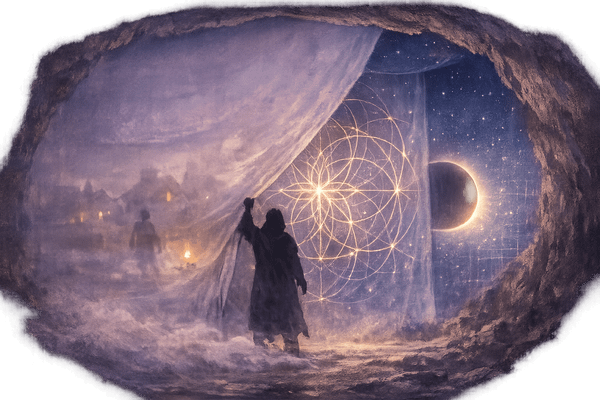
Are You Living Someone Else’s Pattern? Clearing Ancestral Blocks
Some family patterns travel further than the stories that created them. Explore inherited beliefs, intergenerational trauma and gentle ways to honour your lineage while choosing your own path.


Some family rules are never spoken aloud. You learn them by watching who receives approval, which subjects bring a room to silence and what happens when someone wants a life different from the one expected of them.
Don't make a fuss. Keep your head down. Money never lasts. Family comes first. Never depend on anyone.
A phrase may have begun as practical advice in a difficult time. Generations later, it can feel like a law.
Perhaps you hesitate before an opportunity because visibility feels dangerous. Perhaps you take responsibility for everyone else's emotions, even when nobody has asked you to. You may recognise a pattern in your relationships, your attitude towards money or the way you respond to conflict, yet struggle to explain why it feels so familiar.
In contemporary spirituality, these recurring influences are sometimes called ancestral blocks: patterns believed to be passed through a family line, shaping the choices and experiences of later generations.
The idea can be powerful. It suggests that the story of a life does not begin entirely at birth.
But we need to distinguish between what is known, what can be explored and what remains spiritual interpretation.
Families do transmit beliefs, behaviours, resources, stories and the consequences of historical events. Research also investigates biological pathways through which early adversity and parental experiences may affect subsequent generations. It does not establish that specific ancestral memories are stored in our DNA or that a ceremony can erase an inherited trauma.
A family pattern is not an invisible sentence you are required to serve.
And it is not the whole of your inheritance.
We also receive humour, resourcefulness, courage, creativity, affection and the capacity to survive difficult circumstances.
Perhaps ancestral work is not about clearing every trace of those who came before us.
Perhaps it is about discovering which parts of their story we want to carry forward, and where our own story can begin to change.
What are ancestral patterns?
An ancestral pattern is a recurring way of thinking, behaving or relating that appears within a family across generations.
Some patterns are obvious.
A particular trade is passed from parent to child. Family members gather for the same celebration. A language, recipe or story remains important long after the people who introduced it have died.
Others are more difficult to recognise.
A family may avoid conflict, place great importance on financial security, distrust outsiders or expect one person to hold everyone together.
These patterns can develop through upbringing, family relationships, social circumstances and collective history.
Not every recurring behaviour is harmful. Some traditions create belonging and offer practical wisdom.
The question is whether a particular pattern continues to serve the people living with it.
A belief that once helped a family survive scarcity may become restrictive when circumstances change. A habit of emotional restraint may have protected someone in a dangerous environment but leave a later generation struggling to ask for support.
The pattern can make sense in its original context while becoming less useful in another.
That is where conscious reflection begins.
The family story beneath the family story
Every family has an official story. Perhaps it celebrates hard work, independence, loyalty or sacrifice. Perhaps certain ancestors are remembered as brave, difficult, generous or unreliable.
Alongside that story are the things people rarely discuss. An early death. A period of poverty. A relationship that ended badly. Migration from a familiar place. A conflict nobody has fully explained.
There may also be circumstances that remain visible in daily life: the effects of war, discrimination, displacement, insecure housing or long-term financial pressure.
These experiences can shape subsequent generations without requiring a mysterious biological mechanism.
Children observe how adults respond to stress, affection, disappointment and uncertainty. They learn which topics are safe, which emotions receive attention and what their community expects from them.
Family narratives also help transmit values. They tell us what previous generations admired, feared or believed was necessary to survive.
Sometimes we absorb the lesson before we are old enough to question it.
Later, the rule may feel like part of our personality rather than something we learned.
How patterns travel across generations
There is no single mechanism through which family history shapes a person's life. Several pathways may operate together.
Learned behaviour
Children learn from what they see as well as what they are told. If difficult subjects are always avoided, avoidance may come to feel normal. If disagreement is met with hostility, speaking honestly may begin to feel risky.
The pattern can continue when the next generation uses the same approach in its own relationships. But repetition is not inevitable.
People also learn from different environments, supportive relationships and experiences that challenge familiar assumptions.
Family beliefs and expectations
A phrase repeated across childhood can become an internal rule.
People like us don't do that.
You have to work twice as hard.
Never let anyone see you struggle.
Such beliefs may contain valuable historical knowledge. They may also place limits on choices that are available today.
An important question is whether a belief describes present reality or reflects the conditions in which an earlier generation learned to survive.
Relationships and attachment
The way people experience care, security and conflict can influence their later expectations of relationships.
A person may become highly attentive to other people's moods, fear rejection or find it difficult to express needs.
These tendencies can emerge through many pathways and are not automatically evidence of ancestral trauma.
They can also change.
Supportive relationships and new experiences may create opportunities for different responses.
Material and social circumstances
Not every pattern is primarily psychological. A family may experience repeated financial insecurity because of limited resources, unequal opportunities or wider social conditions.
Migration, war and displacement can alter access to housing, education and community for decades.
It would be misleading to describe those consequences as a personal energy blockage. Some patterns require practical resources, social change or institutional support, not simply a different mindset.
Biological influences
Genes and developmental environments contribute to human health and behaviour. Researchers are also studying epigenetic processes involved in how gene activity is regulated.
This is a developing scientific field, and it deserves particular care because its findings are often exaggerated in spiritual accounts of ancestry.
What epigenetics actually tells us
Epigenetics examines mechanisms that influence gene activity without changing the underlying DNA sequence.
One widely studied mechanism is DNA methylation, which involves chemical modifications associated with the regulation of gene expression.
Experiences and environmental conditions may be associated with epigenetic changes. Some changes can persist over time.
Researchers are investigating whether parental experiences of adversity can influence biological patterns in their children and, if so, through which pathways.
But it is a substantial leap from that research to the claim that a particular fear, family secret or traumatic memory is encoded within the DNA of descendants.
A 2023 scoping review of human research into intergenerational epigenetic transmission found evidence of associations between parental stress or trauma and DNA methylation differences in offspring, while emphasising that the role of epigenetic mechanisms remains debated.
The studies vary in design and findings. Human families also share environments, relationships and social circumstances that can be difficult to separate from biological effects.
The field is fascinating precisely because the question remains complex.
What about the Dutch Hunger Winter?
The famine in the Netherlands during 1944–1945 provided researchers with a way to study the long-term consequences of severe nutritional deprivation.
A 2008 study found differences in DNA methylation decades later among people who had been exposed to the famine before birth, compared with their unexposed siblings.
This is evidence that conditions during early development may leave lasting biological associations.
It is not proof that a person's grandchildren inherit a specific emotional memory of famine.
The people studied had themselves been exposed during prenatal development.
That distinction matters when discussing inheritance across generations.
And the research involving Holocaust survivors?
A 2016 study of Holocaust survivors and their adult children reported differences in methylation associated with FKBP5, a gene involved in stress-response regulation.
The study was small, and the findings do not establish a universal inherited trauma signature.
Later research has explored related associations, but human outcomes are varied. The effects of family experience, parental health, childhood conditions and broader social history remain important.
The American Psychological Association's review of trauma across generations examines several of these possible pathways.
There is no evidence that we can identify a person's ancestral trauma by interpreting an ordinary physical symptom, or remove an epigenetic mark through a symbolic release ceremony.
Intergenerational is not always transgenerational
These words are sometimes used interchangeably, but they can describe different kinds of exposure.
A pregnant person, the developing baby and the reproductive cells developing within that baby may all be affected by the same original environmental exposure.
Showing a biological effect in a directly exposed child is therefore different from demonstrating inheritance through later generations that were not directly exposed.
Evidence for true transgenerational epigenetic transmission in humans remains limited and difficult to establish.
We can take the research seriously without turning it into a claim of genetic destiny.
How to recognise a possible inherited pattern
You do not need to find a dramatic ancestral event before you can examine a behaviour. Begin with something you have noticed in your own life.
Perhaps you find it difficult to rest without guilt. You may avoid discussing money, become uncomfortable when someone praises you or feel responsible for preventing conflict between other people.
Ask whether the response feels familiar within your family.
Who modelled it? What did they say about it? Under what circumstances might that behaviour have made sense?
Consider other explanations too.
Your present environment, personal experiences, personality and current responsibilities may all be relevant.
A recurring family theme is a clue for reflection, not a diagnosis.
| Pattern you notice | Family question | Present-day question |
|---|---|---|
| Difficulty asking for help | Was self-reliance especially valued? | What support would be reasonable now? |
| Anxiety around spending | Was money historically insecure or rarely discussed? | What do my actual finances allow? |
| Avoiding disagreement | How was conflict handled? | Can I express a view safely and respectfully? |
| Feeling responsible for everyone | Who usually provided care or kept the peace? | Which responsibilities are genuinely mine? |
| Fear of visibility | Was standing out discouraged or unsafe? | What small opportunity might I choose to pursue? |
These examples do not prove a particular ancestral cause.
Their value lies in making an automatic response available for examination.
The pattern may have begun as protection
This is one of the most important ideas in ancestral work. A family belief can be limiting now while having once served a genuine purpose.
Imagine someone who lived through displacement or severe financial insecurity. They may have taught their children to save everything, avoid risk and never rely on circumstances remaining stable.
The next generation could pass on those rules, even in a different environment. A later descendant might recognise that their relationship with security has become restrictive.
That does not make the original survivor foolish or defective. Their choices belonged to their circumstances.
You can understand the purpose of an inherited behaviour while deciding that you need a different response today.
The question is not simply What is wrong with this pattern?
It is: What did it protect, and is that protection still needed in the same form?
Create a three-generation pattern map
A family tree usually shows relationships and ancestry.
A genogram goes further, allowing someone to explore family relationships, significant events and recurring themes.
Genograms are used within some forms of family and systemic therapy. They are tools for organising information, not tests that reveal invisible inherited wounds.
For a personal reflection, you can create a simple version without attempting to reconstruct every detail of your family history.
Draw three levels: grandparents, parents or caregivers, and your own generation.
Include only what you know and feel comfortable recording.
You might note significant moves, changes in occupation, major losses, periods of hardship, supportive relationships and family traditions.
Then consider themes rather than searching for a culprit.
Did several people take on caregiving roles early? Was education strongly valued? Were particular subjects difficult to discuss? Who offered stability during change?
Use three different labels:
Known: A fact you can reasonably establish.
Remembered: A story or recollection that may be partial.
Possible: An interpretation you are exploring.
Keeping those categories separate prevents a family map from becoming a story in which assumptions are treated as discoveries.
You do not need to contact estranged relatives, investigate private records or pressure anyone to reveal an experience they do not wish to discuss.
Some gaps will remain.
An incomplete map can still be useful.
The family sayings exercise
One of the simplest ways to identify an inherited belief is to remember familiar phrases.
Write down five statements that were repeated in your childhood or wider family.
They might concern money, work, relationships, trust, achievement or what it means to be a good person.
Then examine each one.
| Family saying | What it may have offered | What I believe now |
|---|---|---|
| “Don't get above yourself.” | Protection from criticism or social risk | I can remain grounded while pursuing opportunities |
| “You must never depend on anyone.” | An emphasis on self-reliance | Asking for appropriate support can be wise |
| “Family comes first.” | Loyalty and belonging | Care and healthy boundaries can coexist |
You may decide that some inherited beliefs remain valuable.
Keep them.
The purpose is not to replace every family teaching with its opposite.
It is to recognise that you have a choice about which principles you continue to practise.
When the family story is painful or incomplete
Ancestral exploration can bring up grief, anger or confusion.
Some families contain abuse, neglect, estrangement or experiences that have never been openly acknowledged.
Other people know very little about their ancestry because of adoption, displacement, lost records or family separation.
You are not required to uncover a hidden story in order to move forward.
Nor should a meditation, dream or practitioner be treated as reliable evidence of an event you cannot remember or verify.
Imagination can produce meaningful symbols, but it is not a dependable method for recovering historical facts.
You can work with the experience you know you have had.
If the subject involves significant trauma or distress, appropriate professional support may be more useful than a self-guided attempt to reconstruct the past.
And if contact with a family member is unsafe, a spiritual practice does not oblige you to resume it.
You can explore your relationship with your history while maintaining your present boundaries.
Ancestral energy, karma and spiritual inheritance
Within contemporary metaphysical practice, ancestral patterns are sometimes described through energy cords, karmic imprints or agreements carried between lifetimes.
A practitioner may imagine a line connecting the living and the dead, or interpret a recurring family pattern as a lesson that one generation has been called to complete.
Such imagery can be emotionally meaningful.
It may offer a way to honour people we never met, recognise the scale of a family story or mark a change we want to make.
But these concepts belong to spiritual interpretation.
There is no established method for measuring an ancestral energy cord, verifying a karmic agreement or showing that a ritual has changed another person's DNA.
Nor should a spiritual reading be used to assign blame to an ancestor or make definitive claims about a relative's private experience.
A symbolic practice is most useful when it opens possibilities without pretending to settle facts.
You might picture a family line as a river.
Some things have been carried towards you through its waters. Some you wish to preserve. Others you want to approach differently.
The image can support reflection without becoming a literal explanation of inheritance.
An ancestor ritual that honours without idealising
You do not need to believe that ancestors are present as spirits to create a meaningful remembrance ritual.
Choose a small space and bring an object connected with your family history.
It might be a photograph, a letter, a recipe, a piece of fabric or something that represents a place your family came from.
If you do not know your ancestry, choose an object that represents the wider idea of those who made your life possible.
You can also leave the space empty.
There is no obligation to celebrate every person in your family line.
Some ancestors may have caused harm, and you may have complicated feelings towards them.
The ritual can acknowledge that complexity.
1. Establish the space
Place your object somewhere comfortable and safe.
You may add a flower, a glass of water or a small light if you wish.
These are symbols, not equipment required to open communication with the dead.
Notice your surroundings and take a moment to arrive.
2. Name what you know
Think of one person, family story or quality that has shaped your sense of where you come from.
Stay with what you know or what has been told to you.
You do not need to fill every gap.
3. Honour what deserves honouring
Consider a strength, act of care or form of wisdom you wish to carry forward.
Perhaps it is resourcefulness, humour, generosity, devotion to learning or the ability to maintain community during difficult times.
Allow that quality to become the focus of your attention.
4. Recognise what you want to change
Think of one belief or behaviour that no longer serves you.
Do not try to erase it through force.
Write down how you would like to respond differently.
For example:
I can value loyalty without surrendering my boundaries.
Or:
I can respect the hardship my family endured while allowing myself to enjoy greater security.
5. Close with one action
Choose a small way to express the new understanding.
You might begin a conversation, reconsider a commitment, develop a supportive habit or pass on a family story with greater honesty.
Put the object away or leave it somewhere meaningful.
The ritual is complete.
It does not need to produce an intense sensation or a message from beyond.
Its meaning becomes clearer through what you do afterwards.
Do you have to forgive your ancestors?
No.
Understanding historical circumstances is not the same as excusing harmful behaviour.
You may recognise that a parent or grandparent faced pressures you did not experience. That perspective can make a family story more complex.
It does not require you to minimise what happened to you.
Forgiveness may become meaningful for some people, but it cannot be imposed as the price of spiritual freedom.
You are allowed to feel gratitude for one part of your inheritance and anger about another.
You can also maintain distance from someone whose behaviour remains harmful.
Ancestral work should make room for a truthful relationship with the past, not demand a flattering one.
Body-based practice without the claim of stored ancestral trauma
Some ancestral-healing approaches focus on movement, breath or physical sensations.
A person may notice tension when considering a difficult relationship or find a gentle walk helpful after an emotional conversation.
Those experiences can be explored with care.
But unexplained pain, fatigue, digestive symptoms or disturbed sleep do not prove that ancestral trauma is stored in a particular muscle or organ.
Claims that the psoas is literally the muscle of the soul, or that rhythmic shaking releases a measurable inherited memory, go beyond the available evidence.
Physical symptoms deserve appropriate assessment.
If you want a gentle reflective practice, begin with something ordinary.
Notice where your body is supported. Choose a comfortable position. Take an unforced breath or move in a way that feels appropriate.
Then ask what support you need in the present.
If attending to your body is distressing, use an external point of focus instead.
A practice should be adaptable, not a test of how much discomfort you can endure.
Family constellations and professional support
Family constellation workshops sometimes appear in ancestral-healing circles.
They use symbolic arrangements of people or objects to explore perceived dynamics within a family system.
Participants may find the imagery meaningful, but it is important not to mistake a dramatic group experience for a verified reconstruction of family history.
A 2021 systematic review of family constellation therapy reported some encouraging findings but concluded that the quantity and overall quality of evidence were low. It also identified reports of adverse effects among a minority of participants in some studies.
A facilitator should not make definitive claims about hidden abuse, family secrets or medical conditions based on a symbolic arrangement.
For people experiencing trauma-related symptoms, evidence-based psychological support is a separate matter.
The UK's NICE guidance on post-traumatic stress disorder recommends specific trauma-focused treatments, including trauma-focused CBT and EMDR in appropriate circumstances.
A spiritual ritual may complement someone's broader life, but it should not replace necessary care.
The strengths your ancestors passed down
The language of ancestral blocks can make family history sound like an accumulation of damage.
That is an incomplete picture.
Families also transmit protective habits, shared knowledge, relationships, cultural identity and ways of supporting one another.
Someone may have learned how to solve problems because a grandparent was resourceful. A family tradition may create belonging during uncertainty. A story of migration may carry both loss and extraordinary courage.
Even when an earlier generation experienced trauma, its descendants are not defined solely by vulnerability.
A 2026 scoping review of resilience in the context of transgenerational trauma identified potential protective factors involving emotional regulation, human connection, meaning-making and the wider environment.
These findings remind us that inheritance is not a one-way transmission of harm.
There can be continuity in care as well as in fear.
Ancestral work may therefore involve recovering something, not only releasing something.
- What strengths deserve a more visible place in your life?
- Which family practices help you feel connected?
- What would you like those who come after you to remember?
Creating a different pattern
Recognising an inherited belief is only the beginning. The change becomes meaningful when a different response starts to appear in daily life.
Suppose you have recognised a family expectation that capable people never ask for help. A new pattern might involve making a reasonable request before you become overwhelmed.
If conflict was traditionally avoided, you might practise expressing a disagreement respectfully rather than waiting until resentment builds.
If security has always meant refusing every opportunity, you might learn to evaluate risk using present facts rather than an inherited warning alone.
These changes are not instant. The old response may continue to feel familiar for some time.You can notice it, understand why it makes sense and still choose a different action.
A simple three-part practice can help:
The old rule: What familiar belief or behaviour am I examining?
The current reality: What is true about my circumstances now?
The new choice: What small action better reflects the life I want to build?
For example:
Old rule: I must keep everyone happy.
Current reality: I have limited time and several competing responsibilities.
New choice: I can decline one request without providing an elaborate defence.
The new action does not erase the past.
It creates another possibility for the present.
What about the next generation?
Ancestral work often becomes particularly meaningful when people consider what they want to pass forward.
You may wish to preserve family stories, values and traditions while changing how conflict, emotion or responsibility are handled.
But the desire to break a cycle can become another impossible demand.
No parent or caregiver can remove every difficulty from a child's life. No relationship is free from mistakes.
A different legacy may be built through ordinary, repeated acts.
Listening when someone expresses a need. Apologising when appropriate. Allowing disagreement without making affection conditional. Seeking support rather than expecting one person to manage everything.
These practices create opportunities for new experiences.
The change is not guaranteed to travel perfectly through every future generation.
It does not have to.
A more honest pattern today is valuable in its own right.
A different inheritance
There is a powerful temptation to imagine that freedom requires cutting every connection with the past.
But identity is rarely that simple.
We may carry a family accent, a familiar turn of phrase or a love for a landscape we first knew through someone else's stories. We may cherish a tradition while questioning the rule that once surrounded it.
Ancestral work does not require us to reject those connections.
It asks us to distinguish inheritance from obligation.
We can acknowledge the people and circumstances that shaped us without granting them unlimited authority over our choices.
We can recognise historical hardship without interpreting every present difficulty as its inevitable echo.
We can honour resilience without pretending that suffering was necessary or deserved.
And when we find a pattern that no longer fits, we can begin changing it through attention, support and action.
Perhaps the most meaningful ancestral ritual is not one that claims to erase the past.
It is the moment we recognise an old rule and decide, with care, that the next chapter can be written differently.
The people before us lived within conditions we cannot fully know.
We live within our own.
We receive a story, but we are still allowed to participate in its telling.