The Eleusinian Mysteries: Grain, Darkness, and the Secrets of Return
For more than a thousand years, initiates travelled to Eleusis to enter secret rites of Demeter and Persephone. What happened inside remains one of antiquity’s greatest mysteries.

For more than a thousand years, people travelled to a small town outside Athens to take part in a ceremony they were forbidden to describe.
They walked the Sacred Way, purified themselves, fasted, carried sacred objects and entered a vast hall at Eleusis associated with the goddesses Demeter and Persephone. What happened next was considered so sacred that initiates were expected to keep silent about it.
Some ancient writers later described initiation as one of the greatest gifts Athens had given humanity. Others connected it with a better hope concerning death.
Yet despite the fame of the Eleusinian Mysteries, the central secret remains exactly that.
A secret.
We can reconstruct much of the journey towards initiation. We know the myth around which it revolved. We know where the rites took place and that generations of Greeks and Romans considered them profoundly important.
What we do not possess is a reliable script telling us exactly what initiates saw inside the sanctuary.
That gap has generated theories for more than two thousand years.
Demeter and Persephone
The religious story at the heart of Eleusis concerns Demeter, goddess of grain and agriculture, and her daughter Persephone, also called Kore.
In the Homeric Hymn to Demeter, Persephone is gathering flowers when Hades emerges from the underworld and carries her away. Demeter searches desperately for her daughter and, in her grief and anger, withdraws fertility from the earth.
Human life begins to fail.
Eventually a settlement is reached. Persephone returns to her mother, but because she has eaten in the underworld, she must spend part of her existence there before returning again.
The myth binds together several fundamental human experiences: fertility and barrenness, presence and absence, separation and reunion, life and death.
At Eleusis, these were not merely stories told about gods.
Initiates entered a ritual world shaped by them.
Why Eleusis?
Eleusis lies roughly twenty kilometres west of Athens.
According to the Homeric Hymn, Demeter comes to Eleusis during her search for Persephone. Disguised as an old woman, she enters the household of King Celeus and eventually reveals herself, commanding the people to build her a temple.
The sanctuary became one of the most important sacred sites in the Greek world.
Its central building was the Telesterion, an enormous initiation hall rebuilt several times during its long history. Unlike a conventional Greek temple, it was designed to accommodate large numbers of people inside.
This was the destination towards which the initiates travelled.
Who could be initiated?
The Mysteries were unusual partly because participation was comparatively broad.
Initiation was not confined to an elite male priesthood. Women could participate, as could non-Athenians and even enslaved people under some conditions. The cult therefore crossed social boundaries that defined many other aspects of ancient Greek life.
There were restrictions. Participants had to meet ritual requirements and understand enough Greek to follow the ceremony, and certain forms of religious pollution could exclude someone.
But the important point is that initiation was something individuals chose to undergo.
This was not simply membership of the religion into which someone happened to be born.
People travelled deliberately to Eleusis because they wanted the experience.
The Lesser and Greater Mysteries
Ancient sources distinguish between Lesser Mysteries and the larger annual festival usually called the Greater Mysteries.
The Lesser Mysteries, associated with Agrae near Athens, appear to have served as preparation for the greater initiation at Eleusis.
The Greater Mysteries took place over several days and included public announcements, ritual purification, sacrifice, fasting and a major procession from Athens to Eleusis.
This matters because the climactic event was not isolated.
Participants approached it through preparation.
By the time an initiate entered the Telesterion, they had already been removed from ordinary life and immersed in a carefully structured religious journey.
Walking the Sacred Way
One of the most dramatic stages was the procession from Athens to Eleusis along the Sacred Way.
Initiates, priests and sacred objects moved through the landscape towards the sanctuary.
The journey involved ritual actions, songs and stops along the route. Ancient religious processions were not simply practical ways of moving crowds between locations. The movement itself created meaning.
Leaving Athens and travelling towards Eleusis marked a transition.
The initiate was moving physically towards a place where ordinary distinctions between life and death, human and divine, visible and hidden would be explored.
The pilgrimage began before the doors of the sanctuary opened.
Fasting and the kykeon
The myth of Demeter was reproduced in important ways by the initiates.
Demeter fasts during her grief. Initiates also fasted before eventually drinking a beverage known as kykeon.
The Homeric Hymn describes Demeter accepting a drink made from water, barley and pennyroyal. Something resembling this became part of the Eleusinian ritual.
The exact composition of the ceremonial kykeon has attracted enormous modern attention because of the theory that it may have contained a psychoactive substance.
Ergot, a fungus that can grow on grain, is most often suggested.
If initiates were deliberately given a psychoactive drink, it could help explain ancient reports of overwhelming visionary or transformative experiences.
But the evidence does not currently allow us to state that this happened.
We know there was kykeon.
We know barley was involved.
We do not possess an ancient recipe saying that Eleusinian priests deliberately prepared a psychedelic compound.
Did psychedelics cause the Eleusinian visions?
It is possible.
It is not proven.
The psychedelic hypothesis became particularly popular through modern attempts to reconstruct the Mysteries, but several other factors could have produced unusually intense states of consciousness.
Participants had travelled, fasted and undergone days of ritual preparation. They were entering a sacred space at night surrounded by hundreds or perhaps thousands of other initiates. There were torches, darkness, expectation, chanting, ritual drama and the knowledge that they were about to encounter something forbidden to outsiders.
That combination alone can profoundly alter human experience.
A psychoactive substance may have contributed.
Or it may not have.
We simply do not know.
The documented ritual is already extraordinary.
Into the darkness
The nocturnal setting mattered.
Evidence suggests that initiates moved through darkness before the climax of the rites. Torchlight was closely associated with the myth of Demeter searching for Persephone, and ancient visual representations frequently show the goddesses with torches.
The Metropolitan Museum describes a ritual pattern in which initiates wandered in darkness before torch-bearing priests met them as they approached the Telesterion.
Again, the symbolism is difficult to miss.
Loss.
Search.
Darkness.
Then revelation.
Whether participants understood this as acting out Persephone's descent, Demeter's search or something more complex, the ritual seems designed to make myth experiential.
What happened inside the Telesterion?
This is where responsible reconstruction has to stop.
We know the Telesterion was the great initiation hall at Eleusis.
We know secret rites occurred there.
Ancient sources sometimes refer to things said, shown and performed, although reconstructing those categories into a detailed ceremony remains speculative.
A sacred object may have been revealed.
There may have been dramatic or sensory elements connected with Demeter and Persephone.
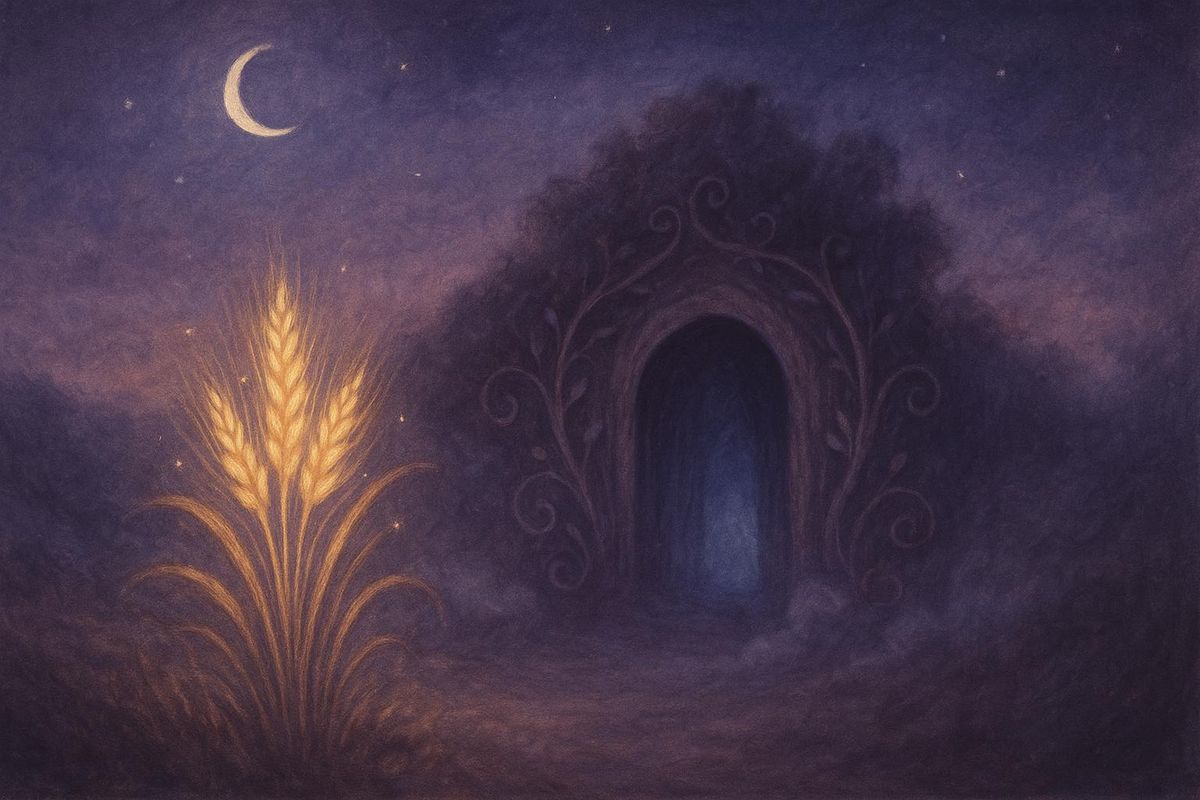
Some later sources mention an ear of grain in connection with the culminating revelation.
But we do not possess enough evidence to say, “This is exactly what the initiate saw.”
The secrecy worked.
Thousands upon thousands of people were initiated over centuries, yet the central experience was never preserved for us in a complete trustworthy account.
Why keep it secret?
Modern explanations often assume the secrecy protected dangerous esoteric knowledge.
Perhaps.
But secrecy itself can transform an experience.
Something encountered only after preparation, oath and initiation acquires a different psychological and religious weight from something anyone can casually observe.
The secret may not have been a piece of information such as “here is the hidden truth of the universe”.
It may have been an experience whose meaning depended upon undergoing it.
Tell someone exactly what happens before an initiation and the event changes.
That may be one reason the boundary between initiated and uninitiated mattered so much.
Did initiates symbolically die and return?
Modern writing frequently describes the Eleusinian Mysteries as a ritual death and rebirth.
That captures something important but should not become too literal.
The Persephone myth certainly revolves around descent into the underworld and return. Ancient discussions of mystery initiation also repeatedly draw connections between initiation and death.
Plutarch, for example, later compared the soul's experience at death with undergoing initiation.
Yet we cannot reconstruct a scene in which every initiate literally enacted their own death and resurrection in the modern workshop sense.
What we can say is that the boundary of death was central to the meaning of Eleusis.
Initiation appears to have changed how participants imagined what happened beyond it.
What did Eleusis promise?
This may be the most important part of the whole tradition.
The Homeric Hymn to Demeter distinguishes the initiated from those who have not witnessed the rites and connects initiation with a different fate after death.
Later Greek and Roman writers repeatedly associate the Mysteries with hope concerning the afterlife.
Cicero, himself writing as a Roman admirer of Greek culture, famously praised the Mysteries for teaching people not only to live with greater happiness but to die with better hope. Ancient evidence more broadly suggests that mystery cults could promise initiates an improved lot beyond death.
That does not necessarily mean initiates were given a detailed map of heaven.
The promise may have been more experiential.
Having encountered Persephone's return, perhaps death no longer looked like a completely one-way journey.
Grain and resurrection
It is easy to understand why grain became such a powerful symbol.
Seed disappears into the earth.
For a time, nothing is visible.
Then life emerges.
Ancient agricultural societies experienced this cycle with an immediacy that modern urban life can obscure. The survival of communities depended upon the apparent death and return of vegetation.
Demeter was not merely a decorative goddess of harvest.
Grain meant life.
The Eleusinian symbolism could therefore hold together agriculture and mortality without requiring the two to be identical.
Human beings die.
Seeds are planted.
Persephone descends.
Persephone returns.
The pattern creates hope, even if it does not provide a literal botanical explanation for human survival after death.
Was Persephone's return simply about the seasons?
That interpretation is familiar, but it can become reductive.
The myth undoubtedly connects with agricultural cycles, particularly Demeter's relationship with fertility and grain.
But myths accumulate meaning.
Persephone is not simply a piece of vegetation wearing human clothes. She becomes queen of the underworld and a major divine figure in her own right.
The Eleusinian Mysteries also survived for centuries because they addressed more than agricultural scheduling.
They spoke to people who knew they would die.
A seasonal myth became a way of confronting mortality.
Why was Eleusis so successful?
The Mysteries endured for more than a millennium and attracted initiates from across the Greek and later Roman world. Cambridge scholarship describes Eleusis as the oldest and most venerable of the mystery cults, sought out by people from a wide range of social and ethnic backgrounds partly because initiation offered hope for a blessed afterlife.
That longevity suggests the experience answered a genuine religious need.
Public Greek religion was deeply connected with cities, families and civic identity.
Eleusis offered something more personal.
You underwent initiation yourself.
Your relationship with death changed.
The promise belonged to the initiate.
Famous initiates
Over centuries, prominent Greeks and Romans participated in the Mysteries.
Their presence helped give Eleusis extraordinary prestige.
But celebrity is not the most interesting part.
The remarkable thing is that powerful officials and ordinary people could enter the same ritual tradition.
For a brief period, social status was not the only thing defining who mattered.
Both had become mystai, initiates.
That temporary shared identity may itself have contributed to the emotional power of the experience.
Were the Mysteries a school of secret philosophy?
Probably not in the way the modern phrase “Mystery School” suggests.
We do not have evidence for classrooms at Eleusis teaching an esoteric curriculum in sacred geometry, astrology, meditation and universal laws.
Eleusis was an initiatory religious cult centred on ritual experience.
That distinction is why it is such a useful anchor for our broader Mystery Schools guide.
If we want to understand what an ancient mystery actually looked like, Eleusis gives us something concrete.
A sanctuary.
A procession.
A myth.
Initiates.
Secrecy.
Ritual.
And a promised transformation.
Did Plato reveal the Eleusinian secret?
Plato repeatedly uses the language of initiation in his philosophy, and scholars have explored how deeply the Mysteries shaped his imagery.
In dialogues concerned with knowledge, beauty and the soul, philosophical understanding can be described in language reminiscent of ascending through levels of initiation towards direct vision.
That does not mean Plato secretly published the Eleusinian ritual.
Instead, the Mysteries offered him a powerful model for philosophy itself.
Preparation leads to transformation.
Ordinary perception is inadequate.
The highest understanding is not merely information but a form of seeing.
Modern scholarship continues to explore how Plato used mystery initiation to think about knowledge, the divine and the fate of the soul.
What finally happened to Eleusis?
The sanctuary survived political upheaval, conquest and enormous cultural change.
Eventually the religious world around it changed beyond recognition.
Christianity expanded through the Roman Empire and traditional pagan cults increasingly lost state support. In the late fourth century CE, pagan religious practices faced growing legal restriction.
Eleusis was also damaged during the period of invasions affecting Greece near the end of the fourth century.
The ancient sequence of initiation came to an end.
The secret was not transferred neatly into another documented institution.
There is no reliable evidence for an uninterrupted lineage carrying the original Eleusinian rite through medieval occult orders and into modern Mystery Schools.
What survived instead was memory.
The modern hunger to recreate Eleusis
That memory remains remarkably powerful.
Modern pagans, esoteric groups, psychologists, classicists and psychedelic researchers have all returned to Eleusis for different reasons.
Some see an ancient model of initiation.
Some see a women's mystery centred on mother and daughter.
Some see psychedelic ritual.
Others see an early recognition that confronting death can transform how we live.
These interpretations tell us something about Eleusis.
They also tell us something about ourselves.
We keep returning to the site because we still want what its initiates apparently wanted: an experience powerful enough to change our relationship with mortality.
What can we know?
We know the Mysteries centred on Demeter and Persephone.
We know there were stages of preparation and initiation.
We know initiates processed from Athens to Eleusis, fasted and drank kykeon.
We know the central rites were secret and took place in or around the Telesterion.
We know initiation was comparatively inclusive for the ancient world.
And we have good reason to believe that participation was associated with hope for a better fate after death.
What we do not know is the precise content of the final revelation.
We do not know whether initiates consumed a psychedelic substance.
We do not know every word spoken or every object shown.
That uncertainty is not a failure of history.
It is one of the most extraordinary things about Eleusis.
The secret that survived by disappearing
There is a strange irony at the heart of the Eleusinian Mysteries.
If one initiate had ignored the oath and written a meticulous account of everything that occurred in the Telesterion, modern historians would be delighted.
But Eleusis would have lost part of what makes it Eleusis.
The initiates preserved the boundary between those who had undergone the experience and those who had not.
We remain on the outside.
We can reconstruct the procession, the sanctuary, the myth and much of the preparation. We can read what initiates later said about hope, death and sacred experience.
But when they reached the moment that mattered most, they fell silent.
More than fifteen centuries after the last initiates entered the sanctuary, that silence still holds.
And perhaps that is the most authentic part of the mystery we have left.