Dream Travel and Astral States: Your Soul Beyond the Body
People across cultures have described leaving the body during sleep, meditation and altered states. Are these vivid experiences produced by the brain, or could consciousness really travel beyond it?

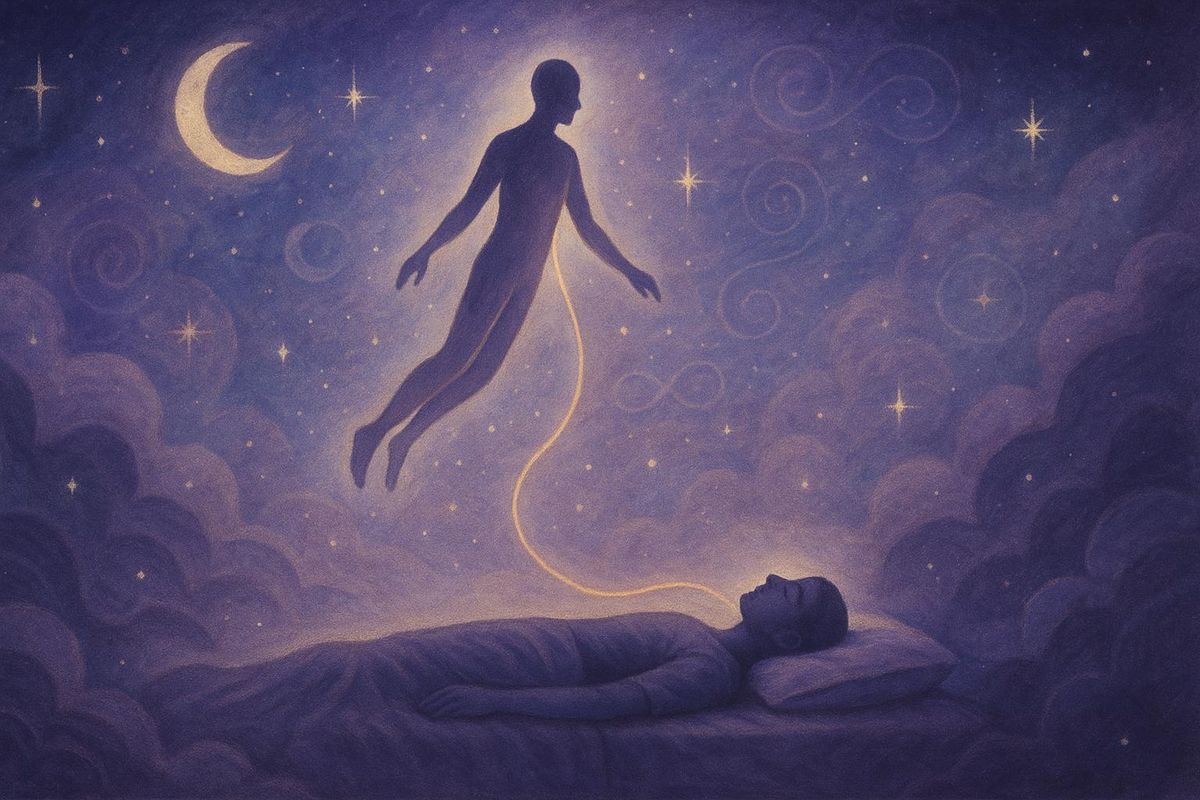
You are asleep, or almost asleep, when something strange happens.
There is a sensation of movement or vibration. You seem to rise, roll or float away from the physical body. Perhaps you look down and see yourself lying beneath you. Perhaps you move through the room, travel somewhere unfamiliar or enter a landscape that feels completely different from an ordinary dream.
Then you wake.
Experiences like these have been described as astral projection, dream travel and out-of-body experiences.
Spiritual traditions have often interpreted them literally: consciousness, spirit or an astral body temporarily leaves the physical body and travels elsewhere.
Neuroscience offers other possibilities involving sleep, body perception and altered states of consciousness.
The fascinating part is that the experience itself is real.
What remains uncertain is where you actually went.
What is astral projection?
Astral projection is the idea that some aspect of consciousness can separate from the physical body and move independently through another location or level of reality.
Different traditions describe that travelling component differently.
It might be called the soul, spirit body, subtle body, astral body or consciousness itself.
The destination is equally variable. Some accounts describe travelling through the ordinary physical world. Others involve unfamiliar landscapes, encounters with beings, deceased relatives, symbolic environments or entire non-physical realms.
Within esoteric traditions, these are often collectively described as the astral plane.
Science has not established the existence of an independently travelling astral body or astral realm.
It has, however, established that human beings can have extremely convincing experiences of existing outside their physical bodies.
That makes the question more interesting than simply dismissing the phenomenon as fantasy.
What is an out-of-body experience?
Researchers generally use the less metaphysically loaded term out-of-body experience, or OBE.
An OBE involves a striking alteration in where the self appears to be located.
You may feel as though you are outside your body, observing the environment from another position. Some experiences include seeing the physical body from above. Others involve movement through the surrounding space without necessarily seeing the body itself.
OBEs can occur around sleep, during meditation and in other altered states. They have also been reported in association with neurological events, anaesthesia and near-death experiences.
A major 2024 review noted that sleep-related OBEs frequently occur around transitions in vigilance and may overlap with REM sleep, lucid dreaming and sleep paralysis.
So the experience of “leaving the body” is not merely a spiritual idea.
It is a recognised phenomenon of human consciousness.
Astral projection and lucid dreaming are not necessarily the same thing
Lucid dreaming occurs when you become aware that you are dreaming while the dream continues.
This is well established scientifically. Experienced lucid dreamers can even signal researchers from inside REM sleep using predetermined eye movements.
Astral projection is more difficult to classify.
People who experience it often insist that it feels fundamentally different from a dream. The environment may appear more stable. Thinking can feel unusually clear. There may be a powerful sense that the experience is happening somewhere rather than being generated internally.
But subjective certainty cannot tell us where an experience originates.
Interestingly, researchers themselves are still debating how sharply OBEs and lucid dreams can be separated. A recent phenomenological analysis found that many commonly proposed distinctions fail reliably to distinguish them, while suggesting that the defining feature of an OBE may simply be disembodiment, the experience of existing without the ordinary physical body.
So rather than creating a rigid divide, it may be more useful to imagine a family of unusual conscious states.
The strange territory around sleep
Sleep is not an on-off switch.
There are transitional states in which features of waking consciousness and dreaming can overlap.
This helps explain several experiences that frequently cluster together:
- lucid dreams
- sleep paralysis
- false awakenings
- vivid hypnagogic imagery
- sensations of floating or falling
- sensed presences
- vibrations or buzzing
- out-of-body experiences
During sleep paralysis, for example, awareness may return while the muscular paralysis normally associated with REM sleep remains in place.
The result can be extraordinary.
You feel awake but cannot move. Dream imagery may intrude into the bedroom. A presence can seem to stand nearby. Pressure may be felt on the chest. Movement may be experienced even though the body remains still.
For someone unfamiliar with sleep paralysis, the event can easily feel supernatural.
For someone actively exploring astral projection, the same state may be interpreted as the beginning of separation from the body.
Why leaving the body can feel completely real
Our normal sense of being located inside the body feels so obvious that we rarely question how it is produced.
But the brain has to continually combine several streams of information to maintain it.
Vision tells you where the body is.
Touch tells you what belongs to it.
The vestibular system helps establish orientation and movement.
Proprioception tracks the position of limbs.
The brain integrates all of these signals into a remarkably stable model:
I am here, inside this body, looking out from this location.
Experiments and neurological studies show that this model can be disrupted.
Research has particularly implicated the temporo-parietal junction, an area involved in integrating bodily and spatial information. Disturbances in this integration can produce experiences of altered self-location and perspective that resemble OBEs.
That gives neuroscience a plausible mechanism for at least some out-of-body experiences.
It does not necessarily settle their ultimate interpretation.
Does that explain astral projection away?
Not entirely.
Explaining how the brain could generate an out-of-body experience is not the same as demonstrating that every reported OBE is nothing more than an internally generated illusion.
There are two different questions:
Can the brain produce the experience of leaving the body?
Clearly, yes.
Has consciousness ever genuinely perceived something while apparently located outside the body?
That question is much harder.
A strong demonstration would require information obtained during the experience that could not have been known through ordinary means, ideally under controlled conditions.
Claims of this kind exist, particularly around near-death and out-of-body experiences.
But they have not produced generally accepted evidence that consciousness can travel independently of the brain.
So the door is not scientifically open in the sense of having proven astral travel.
Nor is the subjective experience itself in doubt.
Why the astral interpretation persists
If an OBE feels as real as waking life, the natural conclusion is that something genuinely travelled.
You remember leaving the body.
You remember moving through a space.
You may encounter people or environments that seem autonomous rather than dreamlike.
Calling that an “illusion” can therefore feel inadequate to the person who experienced it.
Spiritual traditions go further.
They suggest ordinary waking consciousness is attached to the physical body but not necessarily created by it. Sleep, trance and deep meditation may loosen that attachment, allowing awareness to operate elsewhere.
From this perspective, the physical body is not the container of consciousness.
It is one interface through which consciousness experiences reality.
That idea remains metaphysical.
But it sits naturally beside larger questions about consciousness that neuroscience has not yet resolved.
Dream travel
Dream travel occupies the territory between conventional dreaming and explicit astral projection.
Some dreams have an unusual quality.
You return repeatedly to the same landscape.
You encounter places that seem to continue existing when you are not there.
You meet people who behave independently.
You wake with the feeling that you have been somewhere rather than merely dreamed about somewhere.
These experiences appear in many spiritual traditions.
Dreams may be regarded as journeys, teachings, encounters with ancestors or visits to another world.
Modern psychology would generally understand them through memory, imagination and the generative capacity of the dreaming brain.
Sacred Illusion does not need to force those interpretations into a single answer.
A dream can be generated by the mind and still contain profound meaning.
And if consciousness turns out to be stranger than our current models suggest, the possibility that some dream states involve more than private simulation remains an open metaphysical question.
The vibration stage
One of the most frequently described features of deliberate astral-projection attempts is a sensation of vibration, buzzing or electrical energy.
People may feel waves moving through the body shortly before the apparent separation occurs.
There are several possible explanations.
Sleep transitions can produce unusual sensory experiences. The relationship between bodily awareness, muscle atonia and changing vestibular information can create sensations of movement where no physical movement occurs.
Meditation and intense attention can also amplify sensations that would normally remain unnoticed.
Astral practitioners interpret the vibrations differently, often describing them as a change in the relationship between the physical and subtle body.
We do not currently have evidence that a measurable astral vibration is occurring.
But the recurring phenomenology is interesting.
Different people using similar techniques often report remarkably similar transitional sensations.
Can you deliberately enter an astral state?
Many traditions claim that you can.
Common techniques include deep relaxation, meditation, visualisation and maintaining awareness while the physical body falls asleep.
The well-known rope technique, for example, involves imagining yourself climbing an invisible rope without physically moving, using the imagined sensation of movement to encourage the feeling of leaving the body.
Other approaches focus on rolling sideways, floating upward or imagining consciousness relocating elsewhere in the room.
From a sleep-science perspective, these practices may help maintain reflective awareness while entering dream or REM-related states.
From the astral perspective, they facilitate separation.
Again, the technique may be real even when its mechanism remains contested.
A simple way to explore the boundary
If you are curious about these states, there is no need to begin by trying to prove that you possess an astral body.
Begin with observation.
Keep a notebook beside the bed.
Record:
- dreams that feel unusually vivid
- lucid dreams
- sleep paralysis
- false awakenings
- sensations of floating or leaving the body
- repeated dream locations
- information you believe you obtained during an experience
The final category matters.
If an experience appears to provide verifiable information about somewhere you could not normally perceive, write the details down before checking them.
That helps reduce the enormous influence of hindsight and memory reconstruction.
Approach the experience like a curious investigator rather than someone trying to confirm a belief.
What about frightening encounters?
Astral literature contains plenty of warnings about hostile entities, dangerous realms and attacks during projection.
It is worth being cautious about taking these descriptions literally.
Sleep paralysis in particular can generate intensely convincing sensed presences and threatening figures. Cultural expectations strongly influence how these experiences are interpreted.
Feeling that something is in the room does not demonstrate that an independent entity is actually there.
At the same time, an experience can be frightening regardless of its source.
If something becomes distressing, stop actively trying to induce it for a while, restore ordinary sleep routines and ground yourself in waking life.
Exploration should make your relationship with reality richer, not make ordinary reality impossible to trust.
So does the soul leave the body?
We do not currently know that it does.
Science can demonstrate lucid dreams.
It can study out-of-body experiences.
It can manipulate aspects of body ownership and self-location.
It can identify neural systems involved in constructing the ordinary experience of being embodied.
It has not demonstrated that a soul or consciousness physically departs from the body and travels through an independently existing astral realm.
But there is something worth resisting at the other extreme too.
The existence of a neurological mechanism does not make the experience trivial.
Love has neural correlates.
So does music.
So does seeing a mountain.
Discovering what the brain does during an experience does not by itself tell us everything about what consciousness ultimately is.
The real mystery of dream travel
Perhaps astral projection will eventually be understood entirely as an unusual configuration of sleep, body perception and dreaming.
Perhaps consciousness is capable of forms of experience that our current models have not yet captured.
At present, both propositions occupy very different evidential positions. The first has substantial scientific support. The second remains speculative.
Yet the phenomenon still leaves us with a profound question.
Every night, the physical body becomes almost completely still while consciousness constructs worlds, people, places, movement and identity.
Sometimes, within those worlds, awareness wakes up.
And occasionally it finds itself looking back at the body it thought it could never leave.
Whether that is the brain creating an astonishing illusion or consciousness glimpsing something beyond its usual boundaries remains one of the stranger questions at the edge of sleep.