Harmonic Resonance in Consciousness Studies
The brain is rhythmic. Neurons synchronise, brain networks form harmonic patterns and those patterns change with consciousness. How far can we take the idea of resonance?

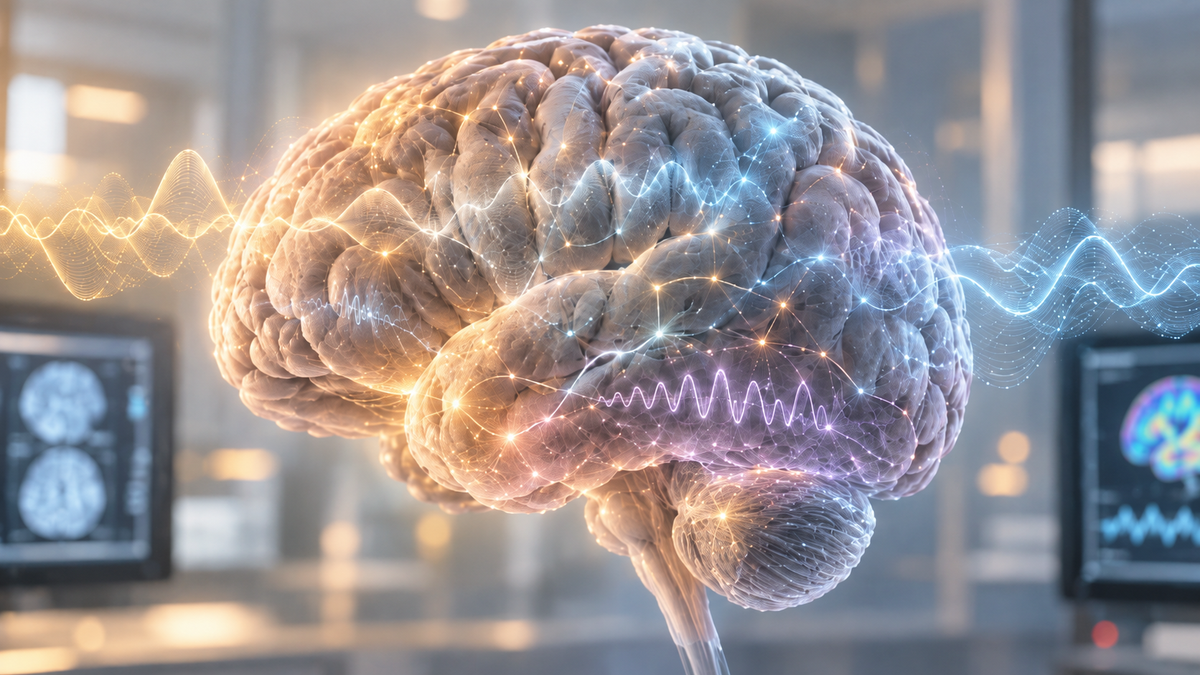
The language of spirituality is full of resonance.
People talk about raising their frequency, being on the same wavelength, feeling another person's energy or entering a state of coherence. Some of that language is metaphorical. Some is presented as literal physics.
Neuroscience gives us a more grounded reason to take resonance seriously.
The brain is an electrical and chemical system filled with rhythms. Populations of neurons oscillate at different frequencies. Their activity can synchronise, fall out of step, couple across different frequency bands and organise into patterns that stretch across large areas of the brain.
Those patterns change when we sleep, pay attention, take psychedelic drugs or lose consciousness under anaesthesia.
So there is a real scientific question underneath the spiritual language: does some form of resonance help organise conscious experience?
Possibly.
But we need to be precise about what that means.
What resonance actually means
In physics, resonance occurs when a system responds strongly to stimulation at or near one of its natural frequencies.
Push a child on a swing at the right rhythm and the movement grows. Strike one tuning fork and another tuned to the same frequency may begin vibrating. Buildings, bridges, molecules and electrical circuits can all have resonant frequencies.
The nervous system is more complicated than a tuning fork, but rhythm is fundamental to its operation.
Neurons communicate using electrical impulses and chemical signalling. When large populations of neurons become active rhythmically, their combined electrical behaviour can be measured using techniques such as EEG and MEG.
These rhythms are often grouped into frequency bands such as delta, theta, alpha, beta and gamma.
The bands are useful descriptions, not five separate gears that the brain simply clicks between. Different rhythms occur simultaneously across different regions, interact with one another and change according to task, attention, arousal and state.
What matters is often not a single frequency but how activity is coordinated across the system.
Why synchrony matters to the brain
Imagine two groups of neurons trying to exchange information.
The effectiveness of that exchange depends partly on timing. Signals arriving when receiving neurons are ready to respond can have a greater impact than identical signals arriving at an unhelpful point in their activity cycle.
Neuroscientist Pascal Fries developed this idea in the Communication Through Coherence framework. Neural populations whose rhythms become appropriately aligned may communicate more effectively because periods of high excitability occur at compatible times.
That does not mean every region of the brain needs to pulse together.
Useful coordination appears to involve shifting patterns of synchrony and desynchrony. Different networks can temporarily align, exchange information and then reorganise as another task takes priority.
Attention provides a good example. Gamma-band activity has been associated with selective communication between neuronal populations, while slower alpha and beta rhythms appear to contribute to other forms of coordination and top-down control.
The brain begins to look less like a static wiring diagram and more like a continuously changing set of conversations whose timing matters.
Does synchrony create consciousness?
This is where we have to slow down.
Neural synchrony is associated with many processes, including perception, attention, memory and movement. Finding synchronised activity during conscious perception does not mean synchrony itself produces consciousness.
Gamma oscillations are a good example.
Gamma activity, broadly around 30 to 100 Hz depending on how it is defined, has often been discussed as a possible mechanism for binding separate features of experience into a unified percept. If different neural populations processing colour, shape, position and movement synchronise, perhaps that coordination helps the brain represent one coherent object.
There is evidence linking oscillatory synchrony with conscious perception.
There is also evidence that gamma activity occurs during many processes that are not uniquely conscious. Reviews of consciousness research have therefore warned against treating gamma synchrony as a simple neural signature of awareness.
The useful conclusion is more modest.
Consciousness seems to involve coordinated activity distributed across the brain, and oscillatory synchrony is one mechanism capable of providing that coordination.
Whether it is the mechanism that generates subjective experience remains unknown.
The brain has harmonics too
The word harmonic becomes especially interesting when we move from ordinary brainwaves to the structure of the whole brain.
In 2016, Selen Atasoy and colleagues introduced a method known as connectome harmonic decomposition.
The basic idea is easier to understand through music.
A vibrating guitar string has natural modes. It can vibrate as a whole or in more complex harmonic patterns. The shape and physical constraints of the string determine which patterns are possible.
The brain also has a physical structure: its connectome, the vast network of anatomical connections linking different regions.
Atasoy's work asked whether activity across that structure could be represented using its own set of natural spatial patterns.
The answer was yes.
Researchers identified what they called connectome harmonics, patterns shaped by the architecture of the brain itself. Resting brain activity could be decomposed into combinations of these modes.
This use of the word harmonic is mathematical and physical.
It does not mean that the brain is playing an invisible spiritual chord.
But it gives the idea of harmonic organisation in consciousness a surprisingly concrete foundation.
Harmonic patterns change with consciousness
The story became more interesting as researchers began comparing different conscious states.
A 2023 study led by Andrea Luppi used connectome harmonic decomposition to examine brain activity during anaesthesia, severe brain injury, ketamine and LSD.
The researchers found systematic differences.
During loss of consciousness through anaesthesia or brain injury, brain activity became more tightly constrained by the underlying anatomical structure. During psychedelic states induced by LSD or ketamine, brain activity showed the opposite tendency, becoming relatively less constrained by that structure.
These patterns were sufficiently informative to help distinguish different states of consciousness, including evidence relevant to patients whose outward behaviour made their level of awareness difficult to assess.
A 2024 study in non-human primates strengthened that line of work.
Researchers examined distributed brain organisation during anaesthesia and then stimulated a specific region of the central thalamus. As behavioural signs of arousal returned, distributed patterns associated with consciousness were also restored.
This starts to give the word orchestration some scientific substance.
Consciousness does not appear to correspond simply to more brain activity or less brain activity. The relationship between structure, connectivity and large-scale patterns of activity changes with conscious state.
Psychedelics make the harmonic picture stranger
Psychedelic states are particularly useful because consciousness remains present while its normal structure changes dramatically.
People report altered boundaries of self, unusual associations, intensified sensory experience, changes in time perception and sometimes a sense of unity or interconnectedness.
Research using connectome harmonics has found that LSD expands the repertoire of harmonic brain states that become active and changes the way those states are distributed across frequencies.
The brain appears to explore a broader set of configurations than it does during ordinary waking consciousness.
More recent work continues to use connectome harmonic methods to investigate psychedelic consciousness, precisely because they provide a way to examine how brain activity relates to the structural network through which that activity travels.
None of this demonstrates access to another dimension or a universal consciousness.
It does give us a physical correlate for something psychedelic users have described for decades: the normal boundaries and constraints of experience appear to loosen.
The subjective metaphor and the neural observation are unusually compatible here.
Resonance theories of consciousness
Some researchers have gone further and proposed resonance itself as part of a theory of consciousness.
Tam Hunt and Jonathan Schooler's General Resonance Theory, published in 2019, proposes that shared resonance may help explain how smaller physical systems combine into larger unified conscious systems.
Their idea begins with a real observation: synchronisation can change the speed and efficiency with which systems exchange information.
They then make a much larger philosophical move.
General Resonance Theory adopts a panpsychist starting point, proposing that very basic forms of subjectivity accompany matter and that shared resonance allows smaller conscious entities to combine into richer macro-conscious systems.
That part is theory, not established neuroscience.
The authors are explicit that their central proposals require empirical testing.
This makes General Resonance Theory interesting for Sacred Illusion because it sits almost exactly on the boundary we care about.
The mechanism of neural synchronisation is real.
The claim that resonance solves the combination problem of consciousness remains speculative.
Those two statements can comfortably coexist.
Could consciousness itself be a field?
Resonance naturally raises questions about fields.
Neural activity generates electromagnetic fields. Some theories of consciousness propose that these fields might play more than a passive by-product role and may contribute directly to the integration of conscious experience.
Electromagnetic field theories of consciousness are an active but minority area of research. They remain contested, and there is no scientific consensus that the brain's electromagnetic field is the physical seat of consciousness.
Yet the question is legitimate.
Neurons do not exist as isolated switches. They operate inside an electrochemical system whose components continuously influence one another.
If consciousness depends on integration across vast numbers of neurons, then understanding exactly how that coordination occurs remains central to the problem.
Resonance, synchrony and field effects all belong somewhere in that investigation.
What about two brains resonating together?
This is where the subject starts sounding remarkably close to ordinary human experience.
You have probably felt it.
A conversation begins awkwardly and then suddenly flows. Two musicians lock into the same groove. A parent and child settle together. A room of people starts laughing. Two close friends seem to anticipate each other's timing.
Researchers can now measure some forms of this coordination.
Hyperscanning studies record brain activity from two or more people at the same time. These studies have found increased inter-brain synchrony during various forms of social interaction, cooperation, communication and shared attention.
A 2024 meta-analysis of close relationships found consistent interpersonal neural synchronisation across frontal, temporal and parietal regions in studies involving romantic partners and parent-child pairs.
A broader 2026 meta-analysis of EEG hyperscanning studies found stronger inter-brain synchrony during social-interaction conditions and associations between synchrony and behavioural outcomes. The authors also stressed substantial variation between experiments and the difficulty of separating genuine interpersonal coupling from shared sensory input, matching behaviour and methodological choices.
That caution matters.
Two people listening to the same rhythm may show similar neural timing simply because both brains are responding to the same stimulus.
Inter-brain synchrony therefore does not demonstrate telepathy or a shared field of consciousness.
But something measurable does happen when people coordinate.
Bodies synchronise too
The brain is not the only rhythmic system involved in social connection.
Heart rate, breathing, movement and other physiological processes can become temporally coordinated between people.
A 2024 systematic review and meta-analysis found associations between neural synchrony and behavioural synchrony, with smaller associations between physiological and behavioural synchrony.
A 2026 review in Nature Reviews Psychology concluded that interpersonal physiological synchrony is a real feature of social interaction, while warning that its psychological meaning varies considerably across situations.
So when people describe being "in sync", the phrase is sometimes more literal than it appears.
Their gestures may coordinate.
Their breathing may coordinate.
Parts of their neural activity may coordinate.
None of this requires invisible energy fields.
It does suggest that human interaction is much more dynamically coupled than the picture of two sealed brains exchanging information through words alone.
Music makes resonance impossible to ignore
Music gives us perhaps the most intuitive example.
Sound is vibration. Rhythm organises vibration through time. The auditory system responds to those patterns, and neural activity can become synchronised with musical structure.
A 2025 Nature Reviews Neuroscience perspective described neural synchronisation with music as part of a much broader neurodynamic process involving expectation, movement, emotion and social coordination.
That may help explain why rhythm can change subjective state so rapidly.
A drumbeat can alter movement.
A lullaby can settle a child.
A dance floor can coordinate hundreds of bodies.
Chanting, drumming and repetitive music appear in spiritual traditions across cultures for good reason. They reliably affect attention, arousal and social coordination.
The leap comes when we claim that a particular frequency heals an organ, opens a chakra or connects consciousness to a universal field.
Those are separate claims and require separate evidence.
What about meditation?
Meditation also changes rhythmic brain activity, although there is no single "meditation frequency".
Different practices involve different cognitive states, and studies report changes across several frequency bands depending on technique, experience and experimental design.
Experienced meditators have sometimes shown unusual patterns of gamma activity and synchrony. That makes meditation relevant to the resonance discussion, but gamma cannot simply be translated into a measure of spiritual attainment.
The more defensible observation is that deliberate mental training can change the temporal organisation of brain activity.
Subjective states and neural rhythms are linked.
That is already significant.
And the Schumann resonance?
This is where a great deal of spiritual writing loses its footing.
The Schumann resonances are real electromagnetic resonances in the cavity between the Earth's surface and ionosphere. The fundamental mode is roughly 7.8 Hz, with additional higher-frequency modes.
Some human EEG activity occurs in overlapping numerical frequency ranges.
That numerical overlap has led to claims that human consciousness is naturally tuned to the Earth's electromagnetic field.
At present, evidence does not justify that conclusion.
Two systems operating at superficially similar frequencies do not automatically resonate with one another. Coupling requires a physical mechanism and sufficient interaction strength.
An alpha or theta brain rhythm existing near a Schumann frequency does not itself demonstrate entrainment by the Earth.
It remains an intriguing research question whether weak environmental electromagnetic fields have subtle biological effects.
It should not be presented as established evidence that the planet synchronises human consciousness.
Frequency is not a spiritual quality scale
Another useful correction concerns the idea of "high frequency" and "low frequency" states.
In spiritual language, high frequency tends to mean loving, expanded, compassionate or spiritually awake. Low frequency means fear, anger, shame or material density.
That language may work as metaphor.
It is not how frequency operates in neuroscience.
Higher-frequency brain activity is not inherently more conscious, healthier or more spiritual than lower-frequency activity. Deep sleep contains prominent slow oscillations. Gamma activity can occur during ordinary sensory processing. Healthy brain function depends on interactions across timescales.
The brain does not climb a ladder from low vibration to enlightenment.
Its rhythms form a system.
Where science ends and the larger question begins
The scientific case for resonance in consciousness studies is stronger than it first appears.
Neural populations oscillate.
Timing affects communication.
Synchrony coordinates distributed activity.
The structural connectome supports harmonic modes.
Those harmonic patterns differ between ordinary waking consciousness, anaesthesia, brain injury and psychedelic states.
Brains and bodies can show measurable synchronisation during social interaction.
Those are substantial findings.
They stop short of showing that consciousness is a universal vibration, that human beings exchange thoughts through resonant fields or that particular external frequencies can tune us into alternate realities.
The larger metaphysical possibility remains interesting precisely because the physical foundation is real.
Nature repeatedly produces organisation through rhythm, coupling and synchronisation. Pendulums entrain. Fireflies synchronise. Cells oscillate. Brains coordinate distributed activity through timing.
It is reasonable to ask whether consciousness depends, at least partly, on the same general family of principles.
Could resonance be deeper than the brain?
Here we move beyond established evidence.
Suppose consciousness ultimately turns out to be less like a thing located somewhere in the brain and more like a process produced when information becomes organised in particular ways.
Resonance becomes an obvious candidate mechanism.
Perhaps the boundaries of conscious systems depend partly on which components can coordinate rapidly enough to function as a unified whole.
Perhaps altered states change consciousness because they alter that coordination.
More speculatively, perhaps brains participate in forms of coupling that current neuroscience has not yet detected.
General Resonance Theory pushes further still, asking whether resonance is the mechanism through which smaller pockets of experience combine into larger ones.
We do not know.
But this is a productive kind of uncertainty because the speculation grows out of measurable phenomena rather than borrowing scientific vocabulary after the fact.
What harmonic resonance really tells us about consciousness
The old spiritual cliché says that everything is vibration.
Physics gives that phrase enough truth to be seductive and nowhere near enough precision to make every conclusion drawn from it valid.
What neuroscience shows is more specific.
The brain is rhythmic. Its rhythms interact. Synchronisation changes communication between neural populations. Whole-brain activity can be represented through harmonic patterns constrained by the connectome, and those patterns change dramatically when consciousness changes.
That puts resonance somewhere near the machinery of consciousness.
Whether it is merely one mechanism among many, a central organising principle, or something deeper remains unresolved.
The most interesting possibility is therefore also the simplest.
Our conscious experience may depend on the brain's ability to bring enormous numbers of processes into temporary relationships with one another, repeatedly forming and dissolving patterns of coordination.
We experience one moment.
Underneath it, billions of cells are keeping time.