Sound Healing: Tuning the Body Like an Instrument of Light
From temple bells and sacred chants to modern sound baths, discover why sound moves us, how the practices work and where the evidence meets the mystery.

The first sound is almost too quiet to notice.
A wooden mallet touches the rim of a metal bowl, and a low note begins to gather in the room. Another bowl answers it. Then a deeper gong sounds, sending a wash of overlapping tones through the space.
For a moment, listening becomes the only thing you need to do.
The sound seems to move around you, changing as it fades. You may feel the vibration through the floor, notice your breathing or find that a memory has appeared without warning. The experience can be calming, emotional, strange or simply beautiful.
This is the world of sound healing: the use of sound, music and vibration as part of a practice intended to support relaxation, reflection or wellbeing.
Across contemporary spiritual communities, sound baths, singing bowls, gongs, tuning forks and vocal practices have become increasingly popular. They are often described using the language of frequency, resonance, energy and the idea that the body can be brought back into harmony.
There is genuine science behind sound's capacity to affect us. Music engages networks involved in emotion, attention and memory, while rhythm can influence movement and the way we experience time.
But the claims attached to sound healing vary enormously. Enjoying a sound bath is not the same as demonstrating that a particular tone repairs cells, clears an energy blockage or treats a medical condition.
The more interesting approach is to explore the physical, psychological and spiritual dimensions without pretending they all describe the same mechanism.
What is sound healing?
Sound healing is a broad term for practices that use sound with the intention of influencing a person's experience or wellbeing.
A session might involve listening to singing bowls, lying down during a gong bath, humming a sustained note, chanting a mantra or working with a tuning fork.
Some approaches are primarily contemplative. Others are framed as energy work, with practitioners using particular instruments or frequencies to balance chakras or restore harmony.
Modern sound healing is not one standardised treatment with a single agreed method.
A session in a yoga studio may be very different from an individual appointment with a sound practitioner, a traditional religious chant or a clinical intervention delivered by a registered music therapist.
They may share the use of sound, but their histories, purposes and evidence bases differ.
Why sound affects us so deeply
Sound is physical.
When a bowl, string, drum or gong vibrates, it disturbs the surrounding air. Those changes in pressure travel as sound waves and are received by the hearing system.
The brain then processes the incoming information, identifying pitch, rhythm, location, pattern and meaning.
But listening is never purely mechanical.
A few notes can bring back a childhood memory. A voice can signal safety or danger. A repeated rhythm can draw our attention into the present, while an unexpected sound can make us instantly alert.
Our response depends partly on the sound's physical properties and partly on our history, expectations, surroundings and emotional state.
That is why two people can leave the same sound bath with very different impressions.
One may feel deeply relaxed. Another may find the gong overwhelming. Someone else may have an emotional experience connected to the music rather than to any unique property of the frequencies being played.
All three responses are possible without assuming that a particular instrument has correctly or incorrectly tuned their energy.
Frequency, vibration and resonance
Sound-healing language frequently borrows terms from physics.
They are worth understanding because they describe real phenomena.
Frequency tells us how many times a repeating vibration occurs in a second. It is measured in hertz, or Hz.
Amplitude relates to the strength of the vibration. In sound, this contributes to sound pressure and perceived loudness.
Resonance occurs when a system responds strongly to an appropriate driving frequency.
A tuning fork provides a useful illustration. When struck, its prongs vibrate and produce a relatively stable pitch. Under suitable conditions, another fork tuned to the same frequency can respond sympathetically.
That is physical resonance.
In spiritual language, however, resonance also describes the way something feels meaningful or aligned with us. We might say that a place resonates, a person's words strike a chord or a piece of music seems to express something we cannot explain.
Those experiences matter, but they are not necessarily examples of measurable acoustic resonance occurring within the body.
For the fuller distinction, explore Frequency: The Invisible Code Running the Whole Show.
The instruments of sound healing
Metal singing bowls
A metal singing bowl produces sound when struck or when a mallet is moved around its rim.
Its shape and material allow different vibrational modes to interact, creating the rich, sometimes shimmering tones that make these instruments so distinctive.
A bowl can produce a sound that seems to shift even after the mallet has stopped moving. As the note decays, different components of the sound become more or less noticeable.
That changing quality makes the instrument especially absorbing.
Singing bowls are frequently marketed as Tibetan bowls, often accompanied by claims about ancient Himalayan healing systems. The historical picture is more complicated, and the contemporary sound-healing use of such bowls should not be assumed to represent an unchanged Tibetan Buddhist practice.
The bowls have nevertheless become meaningful instruments within modern meditation and sound-bath culture.
They can be used simply as objects of attention, without assigning them a guaranteed medical or energetic effect.
Crystal singing bowls
Crystal singing bowls are generally made from quartz-based material and produce sustained, often powerful tones.
They are popular in contemporary chakra and sound-healing sessions, partly because their clear appearance and distinctive sound lend themselves to a sense of spaciousness and ritual.
Sets are sometimes labelled according to chakra colours or frequencies.
Those assignments are part of modern spiritual practice, not an established anatomical map showing which sound belongs to each organ or energy centre.
Crystal bowls can also be surprisingly loud. Their clear tone should not be mistaken for an inherently gentle one.
Gongs
Few instruments create a soundscape quite like a gong.
A soft strike may produce a low, spreading resonance. More energetic playing can build into a complex wash of sound containing shifting overtones, pulses and sudden changes in intensity.
Unlike a simple pure tone, a gong's sound is rich and dynamic.
That complexity is one reason it can feel immersive. The listener has no single melody to follow, and the experience may become more about texture, attention and sensation.
Some practitioners describe gong baths as journeys through layers of consciousness.
That can be a meaningful way to approach the experience, but there is no need to assume that the instrument automatically induces a particular altered state.
A gong bath can be peaceful for one person and overstimulating for another. Good facilitation should make space for both responses.
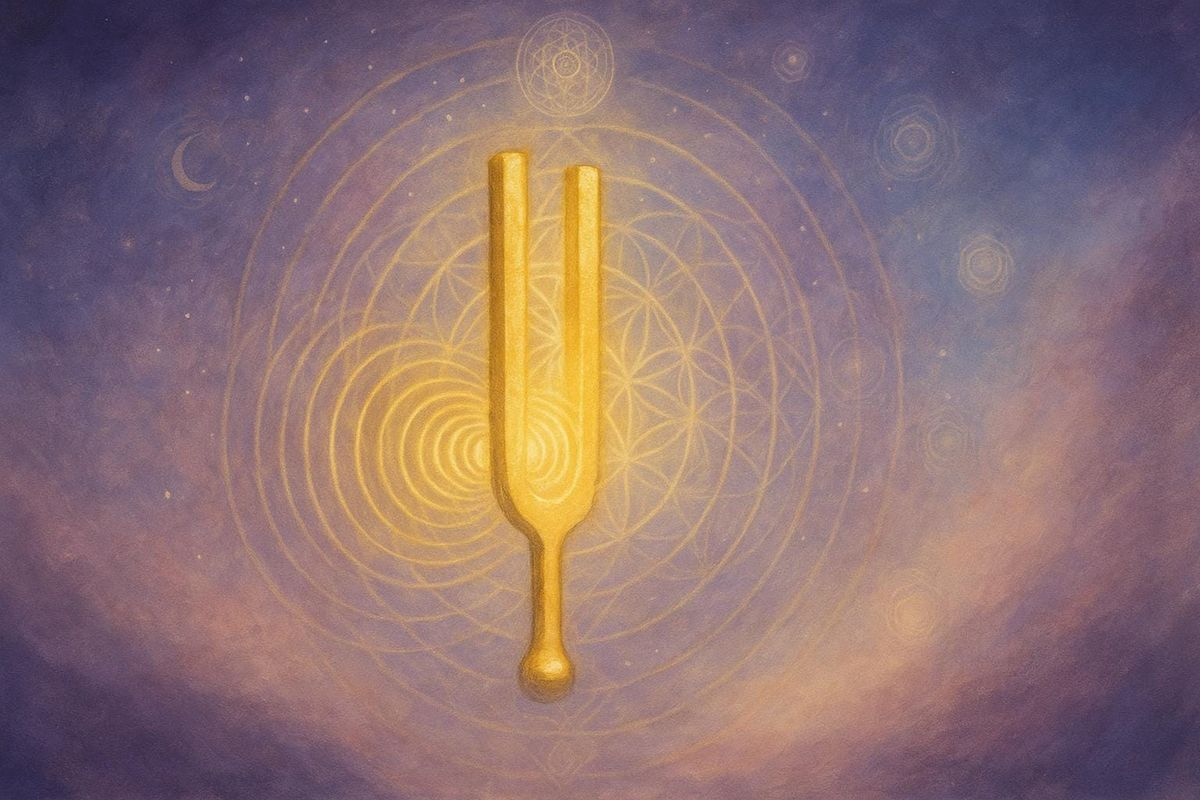
Tuning forks
A tuning fork is a two-pronged metal instrument designed to vibrate at a characteristic frequency when struck.
The tuning fork was invented in 1711 by musician John Shore and became important in music, acoustics and later medical examination.
In contemporary sound healing, practitioners use forks tuned to particular notes or frequencies, sometimes holding them near the body or applying suitable weighted forks to specific areas.
The fixed pitch offers a clear, focused listening experience.
But a fork producing a measurable frequency does not establish that the corresponding number can repair DNA, activate an organ or change a person's external reality.
Its sound may support contemplation or become part of a personally meaningful ritual.
Clinical applications of tuning forks for assessing hearing and vibration sensation are separate from modern energetic claims.
Drums and rhythmic instruments
A drum works differently from a sustained singing bowl.
Rather than inviting attention through a long, fading tone, it establishes a pulse.
Rhythmic practices appear in many cultural and religious settings, often connected to ceremony, music, dance and communal experience.
The repetition can support movement and make it easier for a group to act together.
Some contemporary practitioners use steady drumming during meditation or inner-journey exercises. Others prefer it for grounding because rhythm gives attention something clear and predictable to follow.
These modern practices should not be treated as interchangeable with the specific ceremonial traditions from which an instrument or rhythm may have been borrowed.
Context matters.
The human voice
The simplest sound-healing instrument is one you already possess.
Humming, chanting, singing and sustained vocal tones allow you to experience sound from both sides: you produce it, and you hear and feel it.
A low hum may create a noticeable sensation around the lips, throat or chest. A chant can establish a rhythm for breathing and attention.
Vocal practice can be private and simple, or it can form part of a religious tradition with particular meanings and methods.
Its appeal is that it requires very little equipment.
You do not need to be a trained singer to notice what happens when you gently sustain a comfortable sound.
Sacred sound through history
Human beings have used sound within spiritual life for thousands of years.
Chant, recitation, instruments, bells and drums have marked ritual time, carried teachings and helped create the atmosphere of sacred spaces.
But there was never one universal ancient sound-healing system from which every modern technique descends.
India: mantra and sacred sound
Within Hindu traditions, sound can carry profound religious and philosophical significance.
Mantras may be recited, sung or contemplated within specific traditions of worship, meditation and spiritual discipline.
The syllable Om has a particularly important place in several Indian philosophical and religious contexts.
These practices cannot be reduced to the claim that ancient practitioners discovered modern healing frequencies in hertz.
The meaning of a mantra involves its language, tradition, transmission and purpose, not simply its acoustic measurement.
Tibetan Buddhism: ritual instruments and chant
Tibetan Buddhist traditions include rich forms of chanting and ritual music, with instruments such as bells, cymbals, drums and long horns.
Their use belongs to particular ceremonies, teachings and lineages.
The modern sound bath marketed around a collection of Tibetan singing bowls should not automatically be presented as an ancient monastic therapy.
That distinction respects the tradition while allowing contemporary sound-bath culture to have its own history.
Bells, chant and sacred architecture
Church bells, Gregorian chant and the acoustics of large religious buildings offer another example of sound becoming inseparable from spiritual experience.
A single voice changes character when sung beneath a vaulted ceiling. Reverberation allows notes to overlap, filling the space long after the singer has stopped.
The architecture becomes part of the musical experience.
Similar relationships between sound, place and ritual appear across many cultures, though their meanings differ.
Sound can mark a threshold, gather a community or change the quality of attention without requiring the building to possess an undiscovered healing frequency.
What happens during a sound bath?
A sound bath is usually a listening experience in which one or more instruments create an extended soundscape.
Despite the name, there is no water involved.
Participants may lie on mats, sit in chairs or choose another comfortable position while a practitioner plays singing bowls, gongs, chimes or other instruments.
A session may begin with an invitation to notice the breath or set an intention. The sounds then develop, sometimes slowly and gently, sometimes with dramatic changes in volume and texture.
There may be long periods without speech.
At the end, the practitioner often allows the final sounds to fade before inviting participants to return their attention to the room.
No two sessions are identical, and there is no required response.
You do not have to experience visions, emotional release, spiritual messages or a profound state of calm.
Simply listening is enough.
What does the research say?
The wider research into music and health offers encouraging findings.
According to the US National Center for Complementary and Integrative Health, music-based interventions may help with stress, anxiety, pain and some other health-related outcomes.
The strength of evidence varies between conditions and interventions.
Much of this research examines music listening or music therapy rather than commercial sound baths, so it cannot automatically validate every practice marketed as sound healing.
Singing bowl studies
A 2017 observational study of 62 participants examined responses before and after a singing-bowl meditation session. Participants reported reductions in tension, anger, fatigue and depressed mood, alongside increased spiritual wellbeing.
Those findings are interesting, but the study did not include a comparison group that could establish how much of the change was specifically caused by the bowls.
The quiet setting, opportunity to rest, meditation and participants' expectations may also have contributed.
A 2025 systematic review identified 19 clinical studies of singing bowls, including nine randomised controlled trials. It found possible benefits for outcomes such as anxiety, mood and sleep, while highlighting major limitations.
The studies differed substantially in their methods and populations, and the randomised trials were assessed as having high risk of bias.
The appropriate conclusion is that singing-bowl interventions are worth investigating further, not that their advertised therapeutic claims have all been established.
Music and stress
The broader evidence is more developed.
A review of music-based interventions found benefits across psychological and some physiological measures associated with stress.
That is meaningful, although the effects depend on the context, the music and the intervention being studied.
Listening to personally chosen music may be helpful for some people, while a structured clinical programme may serve a different purpose.
The existence of these benefits does not establish that every instrument or frequency has a separate, predictable healing function.
Sound healing is not the same as music therapy
This distinction is especially important when a practice is advertised as treatment.
In the UK, Music Therapist is a legally protected professional title. Music therapists must be registered with the Health and Care Professions Council and work within a recognised professional framework.
Music therapy involves the use of music within a therapeutic relationship to address identified needs and goals.
A sound bath or private session with a sound-healing practitioner may be enjoyable and supportive, but it does not automatically provide the same service or professional safeguards.
The British Association for Music Therapy explains the profession and the role of registered practitioners.
If you are seeking help for a medical or psychological condition, the distinction matters.
A contemplative sound session may complement appropriate care, but it should not replace diagnosis, treatment or support from a suitably qualified professional.
Can sound heal physical tissue?
Sound can interact with matter, and particular medical technologies use acoustic energy for specific purposes.
Diagnostic ultrasound and focused ultrasound, for example, have carefully defined applications involving specialised equipment and controlled delivery.
That does not make an ordinary singing-bowl session equivalent to a medical ultrasound procedure.
The claim that a bowl or tuning fork repairs cells because the body contains water skips over the mechanism that would need to be demonstrated.
Likewise, there is no established universal frequency at which a healthy human body vibrates, nor a reliable frequency reading that diagnoses illness through an ordinary sound-healing session.
The body contains many different tissues, rhythms and processes.
It is not one instrument with a single pitch that can be corrected by playing the matching note.
Vibroacoustic therapy: when sound is also felt
Some approaches involve deliberately transmitting low-frequency mechanical vibrations through a chair, mat or other specially designed surface.
This is often called vibroacoustic therapy.
It differs from simply listening to sound in a room because the equipment is designed to deliver vibrations through physical contact.
Researchers have explored such methods for a range of outcomes, but the evidence depends on the particular equipment, intervention and population being studied.
It is therefore misleading to treat results from one specialised vibroacoustic study as proof that an ordinary recording or singing bowl produces the same effects.
The term vibration identifies a common physical principle, not a guarantee of equivalent treatment.
What about 432 Hz, 528 Hz and the healing tones?
Sound-healing recordings often feature specific numbers.
A 432 Hz track may be described as naturally harmonious. A 528 Hz recording may be associated with love or DNA repair. The Solfeggio system assigns further meanings to a sequence of nine tones.
The frequencies themselves are real and measurable.
Their advertised spiritual or medical properties are a different matter.
There is no established evidence that listening to 528 Hz repairs human DNA, or that a particular tone reliably removes fear, regenerates tissue or activates an individual chakra.
You may find one recording calming and another distracting. That response is worth noticing without assuming the number alone explains it.
For the history and individual meanings, explore Solfeggio Frequencies: The Nine Tones, Their Meanings and the Science.
Binaural beats: a different kind of sound experience
Binaural beats are often grouped with sound healing, but they involve a particular auditory phenomenon.
When slightly different tones are presented separately to each ear through headphones, a listener may perceive a beat corresponding to the difference between the two frequencies.
For example, 400 Hz in one ear and 410 Hz in the other can produce the perception of a 10 Hz beat.
Some recordings are marketed as a way of encouraging particular brainwave states.
The evidence remains mixed.
A 2023 systematic review in PLOS ONE found inconsistent results in studies investigating whether binaural beats produce the expected changes in brain oscillatory activity.
You can explore the listening experience without treating a recording labelled theta or alpha as a guaranteed switch for consciousness.
Read How Binaural Beats Shift Consciousness for a closer look.
When sound and light are used together
Contemporary practitioners sometimes combine sound with coloured lighting, projection or other visual elements.
There is an obvious experiential appeal. Soft illumination, moving patterns and a changing soundscape can create a distinctive atmosphere.
But the general claim that sound and light together produce superior healing is too broad.
Some specific research is investigating synchronised 40 Hz light and sound stimulation, including early-stage studies involving people with Alzheimer's disease.
That is a defined experimental intervention. It is not evidence that combining a sound bath with coloured lights repairs cells or treats neurological disease.
Early findings from small studies cannot establish clinical effectiveness, and experimental devices should not be confused with decorative lighting used during meditation.
Sound and light can work together aesthetically without requiring a universal healing mechanism.
Chakras and energetic balance
Many sound-healing systems arrange instruments or frequencies around the chakras.
A practitioner might place different bowls around the body, use vocal sounds associated with particular centres or choose tones according to a modern seven-chakra chart.
For someone working within that spiritual framework, the practice may offer a meaningful structure for contemplation.
But the modern fixed-frequency charts should not be presented as an unchanged ancient science of human anatomy.
Chakra traditions have their own histories and religious contexts, while the assignment of modern frequencies in hertz belongs largely to contemporary interpretation.
A sound session may help someone explore the symbolic qualities they associate with a chakra.
It does not establish that an invisible blockage has been measured or physically removed.
Explore Chakra Frequencies: Mapping Energy Flow for the fuller discussion.
How to experience your first sound bath
You do not need to prepare for a sound bath as though it were an examination or a test of spiritual sensitivity.
Choose a session that clearly explains what will happen, how loud the instruments may become and whether participants can change position or leave if uncomfortable.
Wear comfortable clothing and bring any support you need to sit or lie down.
If you prefer to remain seated, that is a perfectly valid way to participate.
During the session, let yourself listen without trying to produce a particular result. Notice the qualities of the sound and how your experience changes as different instruments enter or fade.
Some moments may feel peaceful. Others may bring restlessness or emotion.
There is no obligation to interpret every sensation as an energetic event.
Afterwards, allow yourself a little time before returning to the demands of the day. If you wish, write down what you noticed while the experience is fresh.
A simple sound-healing practice at home
You can create a gentle fifteen-minute practice using a recording, a singing bowl or simply your own voice.
The aim is not to reproduce a professional sound bath.
It is to make a small space for listening and reflection.
1. Choose a sound
Select something that feels comfortable: a sustained bowl tone, gentle instrumental music, a natural soundscape or a quiet hum.
Use a moderate volume.
The sound should invite attention rather than overwhelm it.
2. Set a simple intention
Ask what would be useful to bring into this moment.
Perhaps you want to settle after a busy day, reconnect with your body or give yourself permission to stop striving for a little while.
The intention is a direction, not a command to produce a particular outcome.
3. Listen for five minutes
Notice the beginning and ending of each sound.
Pay attention to changes in pitch, texture and silence. When your mind wanders, return gently to what you can hear.
You do not need to control your breathing.
4. Add a gentle vocal tone
If comfortable, hum softly for a few breaths.
Notice the sensation around your lips and throat, and allow the pitch to remain natural.
There is no need to force a deep note or sustain the sound until you run out of breath.
5. Finish in silence
Turn off the recording or allow the final note to fade.
Notice how the room feels without the sound.
Ask whether anything has changed in your attention, mood or sense of presence.
That may be enough. The practice does not need to culminate in a dramatic revelation.
How to choose a sound-healing practitioner
An effective session should begin with clear information rather than extraordinary promises.
A practitioner ought to explain their approach, the instruments they use, what the session involves and whether physical contact is part of it.
You should be able to express discomfort, request a lower volume or opt out of a particular element.
Be cautious about guaranteed claims involving trauma release, disease treatment, detoxification or cellular regeneration.
A practitioner cannot infer a medical diagnosis simply because a bowl sounds different near you or a tuning fork produces a particular sensation.
There should also be clarity about qualifications. Someone offering a sound bath is not necessarily a registered music therapist or healthcare professional.
A good practitioner can respect the spiritual dimension of an experience without overstating what they can establish or treat.
Is sound healing safe?
A quiet sound practice may seem inherently gentle, but sound intensity matters.
Gongs and crystal bowls can become loud, particularly in small spaces or when a listener is close to the instrument.
Long or repeated exposure to excessive sound can damage hearing. The National Institute on Deafness and Other Communication Disorders explains how risk increases with sound level and exposure time.
People with tinnitus, sound sensitivity, migraines or conditions affected by sensory stimulation may need to be particularly careful about the setting and instruments.
Sound can also bring up unexpected memories or emotions.
You should never be pressured to remain through an overwhelming experience because discomfort is described as evidence that healing is occurring.
If a recording or session makes you feel unwell, stop or leave.
And if you are considering sound healing for a health condition, use it as a possible supportive practice rather than a replacement for appropriate medical care.
Sound as ritual, rather than a miracle cure
One reason sound healing can be meaningful is that it gives attention a form.
A bell marks the beginning. A sustained note occupies the space. A final resonance fades, and the silence afterwards feels different.
These moments can help separate ordinary activity from contemplation.
The practice may become a personal ritual, a way to acknowledge a transition or an opportunity to reconnect with qualities you want to cultivate.
A particular sound might come to represent steadiness, courage or compassion.
That meaning is not invalid because it is personal.
Nor does it require the instrument to possess a supernatural property.
Sound can be important because of what it allows us to notice and experience.
The instrument of light
There is something wonderfully evocative about the idea of tuning the body like an instrument of light.
Taken literally, it is not a scientific description of human physiology.
But as an image for becoming more attentive to our inner lives, it has its own beauty.
We respond to rhythm. We carry memories in music. We recognise familiar voices, find comfort in repeated sounds and sometimes experience an unexpected sense of connection when people sing together.
These are not small things.
The human relationship with sound reaches across ceremony, community, creativity, memory and the search for meaning.
Sound healing, at its most thoughtful, makes room for that relationship.
It invites us to listen without demanding that every sensation become a diagnosis or every note become a cure.
And perhaps the most interesting moment arrives after the instruments fall silent.
The world has not necessarily changed.
But the way we are listening to it may have.