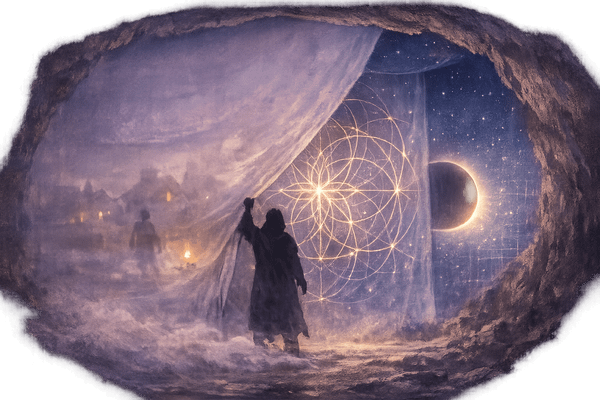
Love, Soul Contracts and the Hidden Heart in the Simulation
What if the deepest mystery in a simulated reality is love? Explore soul contracts, karmic patterns and the possibility of pre-birth agreements without surrendering free will.


Imagine meeting someone and feeling that the introduction has come too late.
You have only just learned their name, yet something about the encounter seems familiar. Conversation moves with an ease you cannot explain. A stranger begins to feel like someone you have been trying to remember.
Or perhaps the opposite happens. A person enters your life and unsettles everything. They challenge your identity, expose a neglected longing or draw you into a pattern that feels much older than the relationship itself.
Some connections seem to arrive carrying a story.
Within modern spirituality, these experiences are often understood through the idea of soul contracts: agreements made between souls before birth, shaping the people we encounter and the lessons we may explore during a lifetime.
Within simulation theory, the same idea takes on a different image. What if important relationships are not random encounters inside the programme, but part of its deeper architecture? What if love, grief, recognition and reunion are among the experiences that make consciousness meaningful?
It is a beautiful possibility.
It is also a belief, not an established description of how the universe works.
We cannot demonstrate that two people agreed to meet before birth, or that an intensely familiar relationship has been written into the code of reality. Yet the idea opens questions worth exploring: why certain bonds feel so significant, why patterns recur, what love teaches us and how much freedom we retain within relationships that seem destined.
Perhaps the heart is not a secret device for escaping the simulation.
Perhaps it is where the question becomes personal.
What is a soul contract?
A soul contract is a spiritual agreement believed to exist before incarnation.
In contemporary metaphysical accounts, souls may choose to meet one another during a lifetime in order to explore particular experiences, relationships or forms of growth.
Those imagined agreements might involve love, family, friendship, mentorship, separation or a significant turning point.
Some versions describe a pre-birth gathering in which souls review previous lives and choose the circumstances of the next. Others suggest that agreements can be revised during life through conscious reflection or spiritual practice.
The details vary because soul contracts are not a single doctrine shared by all spiritual traditions.
They belong principally to contemporary metaphysical frameworks that combine ideas about reincarnation, karma, life purpose, spiritual guides and the continuity of consciousness.
There is no independently verified method for identifying a pre-birth agreement. A psychic reading, dream, meditation or feeling of recognition may carry personal meaning, but it cannot establish that a contract objectively exists between two people.
The idea can still be explored as a way of asking why a particular relationship matters and what we wish to learn from it.
The crucial distinction is between finding meaning in an experience and claiming certainty about its invisible cause.
Did we choose our lives before we were born?
The thought that souls participate in choosing their lives has a much longer philosophical history than modern soul-contract language.
At the end of Plato's Republic, the Myth of Er describes souls selecting their next lives before returning to the world.
The choices are profound and consequential. The myth asks readers to consider the relationship between character, freedom, responsibility and the kind of life worth living.
You can read the relevant passage in Book X of the Republic.
But Plato's story is not an ancient manual explaining how people arrange specific relationships with their future partners, parents or colleagues.
It is a philosophical myth, interpreted in different ways by later readers. The Stanford Encyclopedia of Philosophy explores how these stories function within Plato's thought.
The idea of reincarnation also appears in Hindu, Buddhist and other religious traditions, but their accounts of karma, continuity and liberation differ substantially.
They should not all be reduced to the modern claim that we personally selected every painful event before arriving here.
That claim has consequences.
If a person believes they deliberately chose illness, violence or mistreatment, spiritual interpretation can become a form of self-blame.
There is no evidence requiring anyone to understand suffering in that way.
A spiritual belief about pre-birth purpose should not erase the reality of circumstances, other people's actions or the limits of personal control.
Soul contracts in a simulated universe
Simulation theory proposes that the reality we experience might be generated by an underlying system.
In philosophical discussions, the question concerns the nature of the world we inhabit and what it would mean for our experiences to arise within a simulated environment.
It does not establish that our lives actually contain programmed quests, spiritual interfaces or preloaded relationships.
Still, as a metaphysical thought experiment, the analogy is intriguing.
Imagine a simulated environment designed not merely to calculate events but to allow conscious beings to encounter one another.
Its most consequential moments might not be spectacular glitches or visible changes to the rules.
They might be profoundly ordinary: a child recognising a parent's voice, two friends finding one another during a difficult year, someone learning to trust again or a person grieving a love that changed their life.
If the simulation were concerned with experience, relationships would be central to what happens inside it.
In that imagined framework, a soul contract resembles a narrative thread: a meeting that carries significance across a larger story.
But narrative significance is not proof of predetermined code.
We can explore the image without claiming that an unseen designer has assigned each person a role or that we can decode the intentions of other souls.
For the broader philosophical background, read Simulation Theory 101.
Love in the code: real or rendered?
The most unsettling question about a simulated world may not be whether the mountains or stars are physically fundamental.
It may be whether love remains real.
If an experience unfolds within a constructed environment, is it somehow less meaningful?
Consider the emotional life of an ordinary person.
Love changes attention. It influences memory, commitment and choice. It can make us more willing to care for someone beyond immediate self-interest. It can also leave an absence that changes the shape of daily life.
These experiences matter to the people living through them.
Whether the underlying structure of the universe is fundamental, simulated or something we have not yet imagined, the experience of loving is still part of the reality available to us.
This does not prove that love transcends a simulation.
It raises a different possibility: the significance of an experience need not depend entirely on the material from which its world is made.
A conversation is meaningful because someone hears it. An act of care matters because it affects another being. A bond becomes important through the life shared within it.
Perhaps love is not evidence that we have discovered the simulation's hidden code.
Perhaps it is one reason the question of consciousness matters so much.
Soulmates, karmic relationships and soul groups
Contemporary spirituality uses several overlapping descriptions for significant relationships.
These terms are not objective diagnoses, and there is no universal agreement about their meanings.
| Spiritual idea | Common interpretation | A grounded way to explore it |
|---|---|---|
| Soulmate | A person with whom we share deep recognition or affinity | What makes this connection meaningful and mutually nourishing? |
| Karmic relationship | A bond involving recurring lessons or unresolved patterns | Which dynamics repeat, and what can change through conscious choices? |
| Soul group | Souls believed to encounter one another across lifetimes | Who forms the enduring community through which you experience belonging? |
| Twin flame | A relationship interpreted as an intense spiritual counterpart | Does the relationship support respect, safety and each person's independence? |
| Dharmic connection | A bond associated with purpose, service or growth | What meaningful work or contribution becomes possible through this connection? |
The labels can provide a vocabulary for experiences that feel difficult to describe.
But a label should never outrank the actual relationship.
Calling someone a soulmate does not establish compatibility. Calling a relationship karmic does not make repeated harm necessary. And describing a person as a twin flame does not create an entitlement to their affection, attention or consent.
The spiritual meaning of a relationship must remain distinguishable from how the people involved behave towards one another.
Karma is not a punishment algorithm
In the original article, karma was imagined as a kind of feedback engine within the simulation.
The metaphor is evocative: actions create consequences, patterns become visible and experience can lead to change.
But karma is not simply a universal scoring system.
Within Hindu, Buddhist and Jain traditions, karma has different philosophical meanings and relationships to action, intention, rebirth and liberation.
The modern phrase karmic relationship often uses the word much more loosely to describe a recurring or emotionally challenging connection.
It is worth keeping those meanings separate.
If a relationship repeats a familiar pattern, there may be something useful to examine.
Perhaps you struggle to express your needs. Perhaps you are drawn towards emotionally unavailable people. Perhaps you have assumed responsibility for everyone else's wellbeing.
But repetition does not prove that the universe has assigned you a lesson.
Nor must you endure the same experience until you supposedly pass a spiritual test.
Sometimes the lesson, if you choose to use that language, is that a particular pattern no longer deserves your participation.
Why some connections feel instantly familiar
A powerful sense of recognition can be difficult to explain.
Two people may discover shared experiences, similar values, compatible humour or a striking sense of ease.
Attraction and attachment can also develop quickly.
Psychological research offers frameworks for understanding some aspects of these experiences.
Attachment theory, for example, examines how experiences of connection and security can influence later relationships.
Our expectations about closeness, reassurance and independence may affect who feels familiar to us and how we respond when intimacy develops.
But attachment patterns are not fixed destinies. They can change through experience, relationships and appropriate support.
The Cleveland Clinic's overview of attachment theory offers an accessible introduction.
A feeling of familiarity may be meaningful.
It may reflect shared values, a sense of safety, learned expectations or aspects of experience we have not yet understood.
A spiritual practitioner may interpret it as recognition between souls.
The feeling itself cannot determine which explanation is true.
What it can do is invite us to pay attention.
Intensity is not the same as love
One of the most important distinctions in soul-contract work is between intensity and the quality of a relationship.
A bond may feel overwhelming, magnetic or impossible to ignore.
That does not mean it is healthy, mutual or destined to continue.
Strong longing can coexist with uncertainty. Familiarity can arise within difficult patterns. A relationship may move repeatedly between closeness and withdrawal, making each reunion feel exceptionally powerful.
Research on traumatic bonding has examined emotional attachment within abusive relationships, including the role of intermittent mistreatment and power imbalance.
This is different from the everyday phrase bonding over shared trauma.
An early study of traumatic bonding theory explored attachment following abusive relationships.
Not every intense or unstable relationship involves abuse, of course. The point is that powerful emotional attachment does not establish that a bond is spiritually ordained or beneficial.
Ask what happens between the moments of intensity.
Can both people express a need without fear? Are boundaries respected? Is care reciprocal? Does each person remain free to have friendships, interests and an independent life?
A relationship should be understood through its actual pattern, not only through the force of its most extraordinary moments.
Can a soul contract require you to stay?
No spiritual interpretation can take away your present right to choose.
In contemporary soul-contract language, some practitioners describe agreements as flexible, revisable or complete once their purpose has been fulfilled.
That can be a helpful image for personal reflection.
But there is no verified contract that another person can produce and use to override your consent.
You do not owe someone a relationship because they believe you met in a previous life.
You do not have to accept mistreatment because it has been called a karmic lesson.
You do not need to wait for a twin flame to awaken or fulfil an invisible promise.
If someone uses spiritual language to pressure, isolate, threaten or control you, the relevant question is not whether the connection is metaphysically important.
It is what is happening now and what support you need.
The NHS guidance on domestic abuse explains that abuse can include emotional, controlling and coercive behaviour, as well as physical and sexual harm. It also provides routes to confidential support.
The possibility of meaning never cancels the importance of safety.
What might a soul contract actually teach us?
Used carefully, the soul-contract idea can become a lens for examining the relationships that have changed us.
It need not imply that the difficult event was arranged or deserved.
Perhaps a friendship helped you rediscover a part of yourself that had become neglected.
Perhaps a mentor recognised an ability you had not yet learned to trust.
Perhaps a relationship revealed that you were continually placing another person's needs above your own.
Perhaps a loss changed your understanding of love and what it means to carry someone with you.
These reflections can be profound.
The meaning is discovered through your present experience, not necessarily retrieved from an invisible document.
And it may change over time.
Something you initially understood as a lesson in perseverance may later look like a lesson in boundaries. A connection that once represented destiny may come to represent an important stage of your life.
You are allowed to revise the story.
The soul contract interface
Imagine that every significant relationship appears within a hidden interface.
Not as a fixed instruction, but as a set of questions:
What brought these two lives together?
What has each person offered?
Where do their choices intersect?
What remains possible, and what may be complete?
The interface is a metaphor, but it offers a useful way of organising reflection.
Instead of asking a psychic or an algorithm to reveal the secret meaning of someone else's actions, you can examine what you actually know.
You can consider the history of the relationship, what has changed and what kind of participation is available to you now.
The interface does not have to tell you who someone was in another lifetime.
It can help you decide who you want to be in this one.
A soul-contract review ritual
This contemporary exercise treats the contract as a symbolic document. It is designed for reflection, not as a method of uncovering verifiable pre-birth memories.
Choose a quiet space and bring a notebook.
You might light a candle or place an object beside you to mark the beginning of the practice.
Think of one relationship that has been important to you.
Choose a manageable subject, particularly if the relationship has involved distress or loss.
1. Name the connection
Write the person's name and a few sentences about how the relationship has shaped your life.
Focus on what you know rather than trying to interpret their soul's intentions.
What did you share? What changed because you knew them?
2. Notice the recurring pattern
Ask whether a particular dynamic has appeared more than once.
Perhaps you repeatedly avoid disagreement, seek reassurance or take responsibility for another person's emotions.
Also notice the strengths of the connection.
What has been generous, joyful, steady or creative?
3. Separate meaning from obligation
Write two statements:
What this relationship means to me.
What I am and am not willing to accept now.
These answers may sit comfortably together, or they may reveal tension.
A relationship can be deeply meaningful and still require distance.
4. Imagine revising the agreement
Picture a symbolic document containing the assumptions you have carried into the relationship.
Perhaps one line reads: I must keep everyone happy to remain loved.
Imagine replacing it with something more truthful:
I can care for someone without abandoning my own needs.
There is no need to believe you have edited a literal contract beyond ordinary reality.
You are giving a new intention a memorable form.
5. Choose a present-day action
Close the exercise by identifying something you can actually do.
It might be a conversation, an apology, a request, a boundary or a decision to seek support.
If no action is needed, you may simply keep the reflection.
The ritual does not require reconciliation, contact with an estranged person or forgiveness before you are ready.
It belongs to you.
Akashic records and pre-birth readings
Some soul-contract practices involve the Akashic records, commonly described in modern esoteric spirituality as an archive containing information about a soul's experiences across lifetimes.
A practitioner may seek insight through meditation, guided imagery or a reading.
Such experiences can be personally meaningful, much as dreams and symbolic rituals can be.
But there is no scientifically validated method for accessing an objective archive of pre-birth agreements.
A reading should not be treated as reliable evidence that another person owes you a relationship, that you chose a traumatic event or that a particular future is guaranteed.
Nor should it replace decisions based on observable behaviour, consent or appropriate professional advice.
If you choose to explore this spiritual framework, consider whether the experience increases your clarity and agency or makes you dependent on someone else's account of your destiny.
A useful spiritual tool should not require you to surrender your judgement.
Can soul contracts be broken or completed?
Within contemporary metaphysical language, contracts are often described as evolving.
A connection may be said to complete its purpose when a pattern changes, a relationship ends or two people move in different directions.
This can provide a gentle way to honour a bond without insisting that it last forever.
But there is no objective completion test.
Feeling peaceful after a relationship ends does not prove a cosmic contract has closed. Still longing for someone does not mean you are required to return.
Sometimes growth involves staying and working together. Sometimes it involves recognising that two lives have diverged.
And sometimes there is no neat lesson or final moment of understanding.
A relationship can matter even when it ends ambiguously.
You do not need the universe to issue a certificate before you are allowed to move forward.
When the contract ends but love remains
Not every meaningful relationship continues in the same form.
A friendship may become less central. A romantic relationship may end. A loved one may die.
The language of soul contracts sometimes offers an image of continuity across these changes.
For someone who believes in reincarnation or an enduring soul, the connection may be understood as extending beyond a single lifetime.
Others may understand continuity through memory, values and the ways a person has shaped their life.
Bereavement research uses the term continuing bonds to describe the ongoing inner relationship people may maintain with someone who has died.
A systematic review published in Death Studies explored the varied roles such bonds can play in grief, identity and meaning-making. The findings are complex, and do not establish that retaining or relinquishing a bond is universally beneficial.
The research does not prove communication between souls after death.
It does recognise that a relationship does not always disappear from inner life when physical contact ends.
You may still carry someone's humour, advice, tenderness or influence.
Love can change form without becoming meaningless.
The heart as an interface
The original question returns.
What if the heart is the real interface within the simulation?
In a literal scientific sense, the heart is an organ with measurable physiological functions. There is no established evidence that it decodes simulation instructions or detects pre-birth agreements.
But as an image, the heart remains powerful.
It represents the part of our experience through which connection becomes personal.
We can analyse a relationship, identify patterns and describe the psychology of attachment. Yet those explanations do not exhaust what the experience means to the people involved.
A parent recognises the sound of their child's footsteps. A familiar voice carries decades of shared life. An ordinary object becomes precious because someone we love once held it.
The world becomes meaningful through relationship.
Perhaps the heart is not a hidden mechanism operating outside reason.
Perhaps it reminds us that understanding reality involves more than understanding its physical structure.
It involves asking what conscious beings experience within it, and what they choose to do for one another.
Love, free will and the unfinished script
The most restrictive version of the soul-contract idea suggests that important events have already been arranged.
But if every relationship were entirely predetermined, what would become of consent, growth and choice?
Contemporary soul-contract beliefs often attempt to resolve this by describing agreements as broad possibilities rather than fixed scripts.
That makes an appealing spiritual metaphor.
A person might enter our life at a significant moment, but what happens next still depends on actual decisions.
A meeting does not guarantee a partnership. A powerful connection does not require mutual romantic feeling. A history of love does not remove the need for respect.
Other people are not characters placed in our lives solely to teach us something.
They have perspectives, hopes and choices of their own.
That may be the more interesting meaning of co-creation.
We do not write another person's part for them.
We discover what can emerge where two freely participating lives meet.
A meditation for the hidden heart
This exercise is a symbolic contemplation of love and connection.
Sit somewhere comfortable and notice the room around you.
Imagine a quiet space lit by a gentle, steady light. It may resemble a temple, a garden or a room that exists only in your imagination.
At its centre is a place where you can sit.
Bring to mind a relationship that has helped shape who you are.
You might think of someone present in your life, someone you no longer see or someone you have lost.
There is no need to summon a vision of them or establish whether their soul is nearby.
Simply notice what the relationship evokes.
Ask yourself:
What did this connection awaken in me?
What do I want to honour?
What remains mine to carry forward?
If the relationship has been difficult, you may imagine placing a boundary around the space. Meaning does not require renewed contact.
If the relationship has ended, you may allow both gratitude and sadness to exist.
When you are ready, imagine the light becoming part of the ordinary room around you.
Return your attention to the present.
You do not need to leave the meditation with a message, prediction or proof of a spiritual agreement.
The experience can end with a deeper awareness of what matters.
Signs a spiritual interpretation is helping
A soul-contract framework may be useful when it encourages reflection while leaving you free to assess reality.
It may help you consider recurring patterns, honour an important connection or explore a sense of purpose.
But be cautious if the framework begins to narrow your choices.
A belief becomes unhelpful when it requires you to excuse harm, ignore a clear rejection, endlessly wait for another person's transformation or interpret every setback as punishment for an unfinished lesson.
Likewise, spiritual claims about someone else's feelings should never override what that person has actually communicated.
The most grounded question may be the simplest:
Does this interpretation help me engage more clearly and responsibly with the life I am living?
If the answer is yes, it may serve as a meaningful personal framework.
If it replaces your judgement with fear, obligation or dependency, it deserves reconsideration.
For a wider discussion of agency and responsibility, explore Manifestation Ethics: Balancing Desire and Impact and The Shadow Side of Manifesting.
Is love the point of the simulation?
Suppose, for a moment, that reality really is simulated.
Suppose our familiar world emerges from an architecture we cannot directly see.
Would that discovery make the love within it less important?
Perhaps not.
The experience of connection would still shape lives. Kindness would still affect someone who receives it. Betrayal would still wound. A promise would still matter because people choose to make and honour it.
It is possible to imagine that relationships form part of a deeper design.
It is also possible that we create their meaning together, moment by moment, without an invisible contract arranging the outcome.
We do not know whether souls meet before birth, whether love extends across incarnations or whether consciousness exists within a simulated world.
Those questions remain open to philosophy, spiritual belief and personal interpretation.
What is available to us is the relationship itself.
We can listen. We can care. We can recognise a pattern, make a different choice, protect a boundary and honour what has been shared.
And when a connection ends, we can carry its meaning forward without claiming that it was meant to hurt.
The simulation, if there is one, may remain hidden.
But love is not hidden in quite the same way.
It appears in what we do.