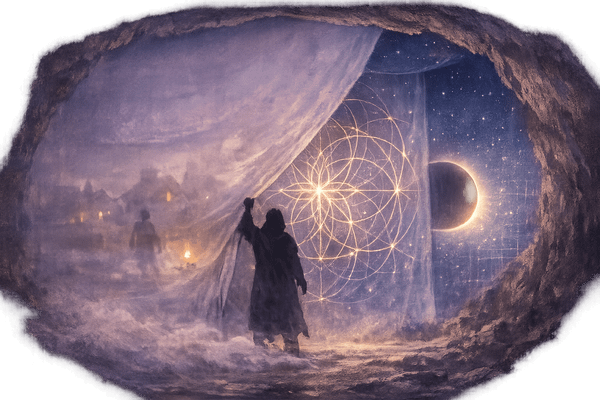
Manifesting Abundance: More Than Just Money
Abundance can include money, but it also lives in time, love, creativity, opportunity, rest and support. A grounded spiritual practice for noticing and creating more of what matters.


Abundance is not just about money. Money is part of it, of course, and pretending otherwise can become another form of spiritual avoidance. Having enough money can create safety, freedom, choice and extraordinary possibility. But abundance is a much larger idea than the number sitting in a bank account.
It can be time. Health. Friendship. Ideas. A home in which you can exhale. Work that leaves something of you intact at the end of the day. Someone arriving with help at exactly the right moment. A morning with nowhere to rush. A full cupboard, an empty page and something worth saying, a body allowed to rest, or a life containing enough space for you to actually inhabit it.
When manifestation culture reduces abundance to bigger houses, higher incomes and endless acquisition, something important gets lost. The deeper question is not simply, How do I get more? It is: What would a genuinely abundant life feel like to me?
What is abundance?
At its simplest, abundance is the experience of enoughness combined with possibility. It does not mean having everything, pretending limits do not exist or insisting that an empty bank account is secretly overflowing. It means recognising that life contains resources that can sometimes be drawn upon, cultivated, shared, discovered or created.
Some of those resources are material: money, food, housing, possessions, access to healthcare and financial security. Others are less easily measured: time, attention, energy, love, belonging, knowledge, creativity, opportunity, support, beauty and meaning. Many sit somewhere between the two.
A friend who watches your children for an afternoon has effectively given you time. A mentor can give you access to knowledge and opportunity. A community can provide practical help, connection and emotional support. A library contains more knowledge than most of us could consume in a lifetime. A garden may offer food, beauty, exercise, quiet and a relationship with place.
Abundance, then, is not simply about accumulation. It is also about access, circulation and relationship.
Abundance and wealth are not the same thing
This distinction is what makes abundance worth exploring separately from How to Manifest Wealth.
Wealth deals specifically with money: earning it, receiving it, managing it, keeping it and deciding what role it should play in your life. Abundance asks a wider question about whether life feels resourced.
A person can have substantial financial wealth and experience scarcity everywhere else. They may have no time, no trust, no meaningful relationships, no room to think and no sense of purpose. Equally, someone with relatively modest financial resources may experience profound abundance through friendship, creativity, community, autonomy or time.
That does not mean money does not matter. Romanticising financial hardship is no more useful than worshipping wealth. It simply means money is one form of resource among many.
The aim is not to replace material needs with spiritual slogans. It is to stop overlooking the rest of your life while pursuing them.
Real scarcity and the feeling of scarcity
One of the problems with abundance culture is that it often confuses two very different experiences.
There is real scarcity. Not enough money for food. Not enough housing. Not enough time because you are working several jobs. Not enough support, healthcare or safety. Those situations cannot be dissolved by changing your vibration.
Then there is the experience of scarcity that can persist even when something is available. You may have people willing to help but never ask. You may have enough money for what you need but feel unable to spend it. You may receive praise and immediately dismiss it. You may finally achieve something you once desperately wanted and barely notice before moving the target again.
Both forms matter, but they call for different responses. Real scarcity often needs practical resources, structural change, support or money. Perceived scarcity may require attention, self-awareness and a different relationship with what is already present.
A useful abundance practice learns to tell the difference.
Why more never automatically becomes enough
There is a trap hidden inside the idea of abundance. If abundance always means more, it has no natural endpoint.
More money, more followers, more opportunities, more experiences, more achievement, more healing, more spiritual growth. Eventually abundance itself can become scarcity in more attractive clothing, because your attention remains fixed on what is missing.
This is why abundance needs a second question: Enough for what?
Enough money to feel secure? Enough time to see your children? Enough work to make a business viable? Enough space to create? Enough friendship to feel connected? Enough solitude to hear yourself think?
Without some idea of enough, you can receive endlessly and never arrive.
A grounded abundance mindset
“Abundance mindset” is one of those phrases that can either be useful or almost completely detached from reality.
It does not have to mean believing there is an unlimited supply of everything for everyone. Some things really are limited. Time is limited. Natural resources can be limited. Places on a course are limited. Jobs may be limited. Your own energy certainly has limits.
A more grounded abundance mindset asks a different question: What possibilities, resources or routes might I be failing to see because I have assumed there is only one?
Perhaps there is another way to earn. Another person you can ask. Another route into the work. Another use for something you already own. Another interpretation of what success could look like. Another opportunity beyond the one that disappeared.
Abundance does not require believing that every door remains open. It means remembering that one closed door is rarely the whole landscape.
The different forms abundance can take
Money dominates conversations about abundance because it is measurable, but a useful practice looks more widely at the resources already shaping your life.
Financial abundance is about whether you have enough for your needs, whether you have choices and whether your resilience is increasing. If money is genuinely the missing resource, it is worth addressing directly rather than pretending spirituality should make material conditions irrelevant.
Time abundance is different. Time can feel more precious than money because it cannot be stored or earned back. An abundant relationship with time does not mean unlimited leisure. It means having enough margin to occasionally choose your pace rather than living permanently in reaction.
Relational abundance is about the quality of connection around you. Who can you call? Who knows you? Who would help if something went wrong? Who makes you laugh? A large social network can still feel relationally poor, while three dependable people can represent extraordinary wealth.
Creative abundance is the availability of ideas and the space to follow them. Creativity often feels scarce because it has nowhere to land. Sometimes the answer is not more inspiration but protecting the hour in which inspiration has a chance to arrive.
There is also physical abundance: food, warmth, rest, movement, pleasure, clean water, a functioning home and the ordinary infrastructure of daily life. When these things are present, they can become invisible through familiarity. Noticing them does not erase the fact that many people lack them. It simply restores awareness of what is actually supporting you.
Experiential abundance includes nature, music, conversation, travel, books, ritual, learning and play. Many meaningful experiences cost little or nothing, and their value does not disappear because they cannot be bought.
Finally, there is spiritual abundance: a sense of connection, meaning, wonder, stillness, mystery or participation in something larger than the immediate concerns of the self. Different traditions explain this experience in different ways. You do not need to resolve the metaphysics to recognise its significance.
How to manifest abundance
If manifestation has a useful role here, it is because it turns abundance into something you practise rather than simply something you possess.
The first step is to define what abundance actually means to you. Complete the sentence: My life would feel more abundant if I had more... Then keep going until you reach something honest.
Perhaps it is money. Perhaps it is time, friendship, energy, beauty, space, opportunity, rest or purpose. You may discover that what looked like a desire for wealth is really a desire for freedom, or that what looked like a desire for success is actually a longing to be recognised.
Once you have named what is missing, ask a second question: What would enough look like? Clarity changes what you pursue.
The next practice is to notice what is already available. This is where gratitude belongs, not as a magnetic force that compels the universe to send more, but as an act of attention.
Human beings become accustomed to what they repeatedly experience. The extraordinary becomes ordinary. The answered prayer becomes the baseline. Something you desperately wanted last year can become something you barely notice this year.
A simple gratitude practice can interrupt that process. At the end of the day, ask what supported you, what you had access to, who helped, what was beautiful, what became easier and what you received that you did not create alone.
This is not about denying what is wrong. You can be grateful for dinner and worried about the electricity bill. Reality can contain both.
Learning to receive
Giving is culturally celebrated. Receiving can be much more uncomfortable.
A compliment arrives and we deflect it. Someone offers help and we insist we are fine. An opportunity appears and we immediately decide we are probably not qualified. Rest becomes available and we invent another task.
Receiving requires vulnerability because it means accepting that none of us is entirely self-sufficient.
Practising reception can be very simple. Accept the compliment without minimising it. Let someone buy lunch. Ask a friend for help. Apply for the opportunity. Rest when the work is finished rather than manufacturing more work to justify your existence.
In spiritual language, this might be described as opening yourself to what life offers. In psychological terms, it may simply mean learning not to reject support before it reaches you. Those interpretations do not have to compete.
Creating space for what matters
The original version of this article described clutter as “energetic noise”. We do not need to make that claim to recognise the practical value of space.
A crowded calendar leaves little room for opportunity. A cluttered room can make it difficult to use what you already own. Constant digital input leaves less room for original thought. Relationships maintained purely through obligation consume time and attention.
Creating space can therefore become an abundance practice.
That might mean leaving one evening unscheduled, clearing a working surface, unsubscribing from relentless marketing, giving away things you do not use, finishing an unresolved task, protecting creative time or saying no to something that consistently drains more than it gives.
The point is not that empty shelves magically attract new possessions. The point is that space increases your capacity to notice and use what arrives.
Wanting more is not ingratitude
Gratitude should never become a method of talking yourself out of legitimate desire.
You can appreciate what you have and still want change. You can love your house and need another bedroom, value your job and want better pay, love your family and need more time alone, or care deeply about a relationship while still needing stronger boundaries within it.
Abundance is not passive contentment. Sometimes the abundant response is to ask, negotiate, move, create, leave, begin or say clearly what would make a situation better.
The practice lies in holding gratitude for what is present without using it to silence the part of you that knows something needs to change.
Circulation matters too
Abundance becomes more interesting when resources move.
Money can be shared. Knowledge can be taught. Books can be lent. Introductions can be made. Encouragement can be given. Food can be offered. Attention can be paid. A contact that means little to you might transform someone else's week.
This is not an invitation to exhaust yourself in the name of generosity. You do not need to empty yourself to prove you trust abundance. Healthy circulation includes boundaries.
Give from what you genuinely have available, and receive when someone else does the same. Communities become richer through both.
Participation is part of manifestation
Manifestation becomes vague when every outcome is handed over to “the universe”.
A more useful question is: What part of this abundance can I participate in creating?
If you want more friendship, invite someone for coffee. If you want more time, examine what is consuming it. If you want more creativity, make something, even badly. If you want more support, tell somebody what you need. If you want more financial security, work with the practical and spiritual approach in How to Manifest Wealth.
If you want more opportunity, increase the number of places where opportunity could realistically find you.
There may also be mysterious openings. There may be synchronicities. There may be moments when circumstances line up so strangely that coincidence feels like an incomplete explanation. Sacred Illusion is interested in those moments.
But spiritual openness works best when paired with participation.
A simple abundance ritual
If ritual helps you create meaning around an intention, try something simple.
Choose three objects. Let the first represent what is already abundant in your life, the second represent what you want more of, and the third represent what you are willing to do.
Sit with each object in turn. With the first, name what is already present. With the second, state the intention clearly. With the third, choose one practical action.
Then ask: What am I not seeing?
Do not force an answer. Write down whatever comes. Sometimes it will be an obvious insight. Sometimes it will be an uncomfortable truth. Sometimes nothing happens at all. Occasionally the answer seems to appear later in conversation or circumstance.
The ritual does not need to control reality to change your relationship with it.
Abundance is not an obligation to feel positive
You are allowed to experience lack. You are allowed to grieve. You are allowed to say, This is not enough.
Some situations genuinely are not.
A bad relationship does not become abundant because you can identify three things to appreciate about it. Exhaustion is not abundance. Being overworked and underpaid is not abundance. Inadequate support is not abundance.
This is where abundance practice requires discernment.
Gratitude helps you see what is present. It should never prevent you from recognising what needs to change.
Does gratitude attract abundance?
There is a spiritual belief that gratitude attracts more of what we appreciate, and many traditions and practitioners find that idea meaningful.
There is also a simpler explanation. What we repeatedly attend to becomes more visible. Gratitude can make existing support, pleasure and opportunity easier to notice. It may also affect how we behave towards other people and what we choose to do next.
Whether something beyond that occurs remains a metaphysical question rather than an established mechanism.
You do not have to settle the question before saying thank you.
Can abundance exist during a difficult period?
Sometimes. At other times the honest answer is that life currently contains a great deal of scarcity.
The purpose of an abundance practice is not to rename suffering. It is to look carefully for whatever remains available without denying what has been lost.
A terrible month may still contain one loyal friend. A financial crisis may still contain information, support or a next step. Grief can exist alongside love. Fear can exist alongside beauty.
Abundance does not have to mean that everything is good. Sometimes it simply means recognising that even when something important is missing, not everything is missing.
Spiritual wealth
There is also a form of abundance that cannot be reduced to assets.
The ability to be moved by music. To love somebody. To learn. To make something. To sit quietly without needing the moment to perform for you. To feel connected to a place. To encounter beauty. To experience awe. To believe that reality may contain dimensions we do not yet understand.
None of these things pays the mortgage. That is not their purpose.
Their value lies elsewhere.
A genuinely abundant life probably needs both material sufficiency and things that no amount of money can manufacture on demand.
Abundance is a relationship
Perhaps abundance is not a destination that you finally reach. Perhaps it is a way of relating to life.
It is knowing when to seek more and when to notice what is already here. Knowing when to receive and when to give. Knowing when something is genuinely insufficient. Knowing when desire is opening your life and when it is simply moving the finish line again.
You can work towards more without living permanently inside not enough. You can enjoy what you have without abandoning ambition. You can hold gratitude and dissatisfaction at the same time.
And you can remain open to the possibility that life occasionally gives back in ways you did not engineer.
That feels closer to abundance than endless accumulation ever could.
Continue exploring
If you want to take the financial side further, read How to Manifest Wealth (Without Losing Your Soul), which focuses specifically on money, earning, financial intention and stewardship.
For turning vague desires into something more deliberate, continue with How to Set Intentions for Sacred Manifestation.
To bring manifestation into ordinary routines, explore 7 Daily Manifestation Practices That Actually Work.
For the necessary counterweight, The Shadow Side of Manifesting looks at spiritual bypassing, toxic positivity and the ways manifestation can become harmful.
And if you are new to the subject, begin with Manifestation 101: A Beginner's Guide.