NPCs and Background Characters: Are Some People Just Code?
Some people can seem scripted, predictable or strangely absent. Does simulation theory offer an explanation, or does the NPC idea reveal more about perception than other people?
NPCs and Background Characters: Are Some People Just Code?
Spend enough time thinking about simulation theory and eventually you encounter the NPC question.
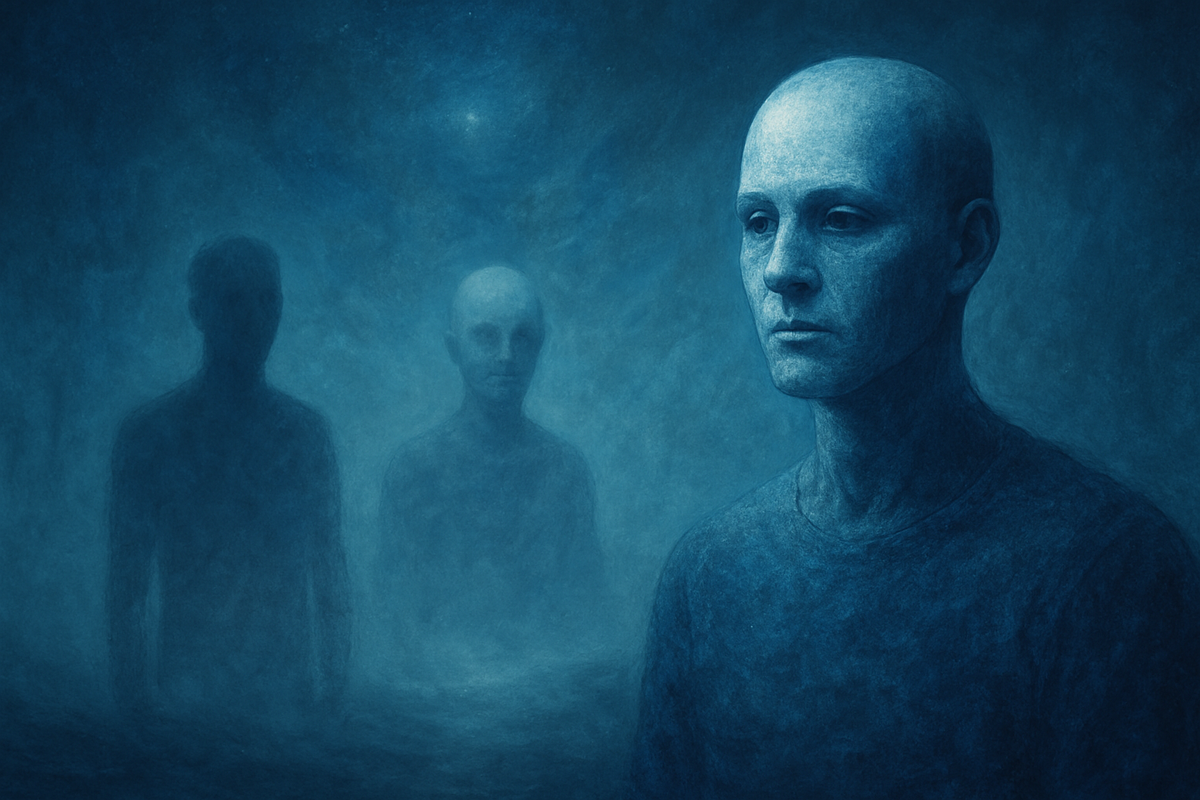
Some people seem intensely present. They surprise you, challenge you and reveal inner lives you could never have predicted. Others can appear almost scripted: the same opinions, the same responses, the same routine repeated day after day.
Internet culture borrowed a term from video games for this second experience: NPC, or non-player character.
In a game, an NPC is a character controlled by the software rather than by a human player. They may walk a predetermined route, repeat dialogue and respond only within a limited set of possibilities.
Applied to real people, however, the idea becomes much more complicated.
Could some people literally be background characters in a simulated reality?
There is no evidence that they are.
But the question opens onto something genuinely strange: how do you know anybody other than you is conscious at all?
What is an NPC?
In gaming, the definition is straightforward.
A non-player character is simply a character that is not being directly controlled by a player. Modern NPCs can range from extremely simple scripted figures to sophisticated AI-driven characters capable of adapting to what happens around them.
The metaphor entered online culture because real human behaviour can sometimes look surprisingly similar.
People repeat social scripts. We give automatic answers to familiar questions. We follow routines without thinking about them. We absorb opinions from the groups around us. Most of us spend at least part of every day operating on something close to autopilot.
That resemblance does not mean people are literally code.
It means human behaviour is often more automatic than we like to admit.
Why can other people feel like background characters?
Much of everyday life depends on selective attention.
You pass hundreds of people without thinking about them. The person at the next table, the commuter across the carriage and the cashier in a shop may briefly enter your awareness and then disappear from it.
From your perspective, they occupy the background of your life.
From theirs, you may be doing exactly the same thing.
That is one reason the NPC idea is so seductive. Conscious experience is naturally centred on the self. You experience your own thoughts, memories, doubts and sensations directly. Everybody else's inner life has to be inferred from their behaviour.
A stranger can therefore appear comparatively flat simply because you cannot see the enormous private world behind their face.
The mistake is moving from “I cannot perceive their inner life” to “they may not have one.”
Those are very different claims.
The problem of other minds
Philosophers have wrestled with this problem for centuries.
You know you are conscious because consciousness is happening to you.
You cannot enter somebody else's experience directly. You infer that they are conscious because they behave in broadly similar ways to you, possess similar brains and bodies, describe thoughts and feelings, respond to pain and demonstrate complex intentions.
That inference is extremely strong.
But it remains an inference.
This is known as the problem of other minds.
Simulation theory does not solve it. If anything, it makes the thought experiment easier to imagine.
A simulated world could theoretically contain fully conscious beings, sophisticated behavioural agents without subjective experience, or some mixture of the two. From inside such a world, distinguishing between them might be extremely difficult.
But possibility is not evidence.
Nothing about somebody being predictable, boring, distracted or uninterested in metaphysics demonstrates an absence of consciousness.
We all run scripts
There is, however, a useful version of the NPC idea.
Human beings rely heavily on habits and automatic processes.
Think about how often you say “fine, thanks” without considering whether you are fine. You drive a familiar route and barely remember parts of the journey. You respond defensively before consciously deciding what you think. You repeat an opinion that originally came from somebody else.
Social life is full of scripts.
Greetings have scripts. Workplaces have scripts. Families develop scripts. Arguments can repeat so reliably that both people seem to be reading dialogue from the previous episode.
None of this makes anyone an NPC.
It shows that conscious beings can behave automatically.
The more interesting question may therefore be not “Which people are NPCs?” but:
How often am I behaving like one?
Consciousness is not the same as constant self-awareness
We should also distinguish consciousness from introspection.
Someone may have little interest in analysing themselves, questioning reality or discussing philosophy while still possessing a rich conscious life.
A person who talks about football, childcare, television or the weather is not necessarily less awake than somebody discussing quantum mechanics and manifestation.
Likewise, being highly introspective does not automatically make someone more conscious in any meaningful hierarchy.
Different people direct attention towards different things.
One reason NPC language becomes uncomfortable is that it can quietly turn personal preferences into a ranking system. People who think like us become “players”. People who do not become background characters.
At that point, simulation theory stops being a thought experiment and starts becoming a way of dismissing other human beings.
What would an actual NPC look like?
Suppose, purely as a thought experiment, that we really did inhabit a simulation containing non-conscious human-like agents.
How could you identify one?
Probably not by ordinary behaviour.
A sufficiently sophisticated artificial agent could talk about feelings, remember a childhood, tell jokes, complain about work and insist passionately that it was conscious.
Conversely, a fully conscious human being might appear withdrawn, repetitive, distracted or emotionally flat because they were exhausted, anxious, depressed, traumatised or simply uninterested in talking to you.
Behaviour alone would not provide an easy test.
That is increasingly relevant as artificial intelligence develops. We may eventually encounter systems whose behaviour appears increasingly human while the question of whether anything is actually being experienced internally remains unresolved.
The philosophical NPC problem may therefore become less abstract, but it still gives us no reason to apply the label casually to other people.
The simulation version
Within simulation theory, the NPC possibility works best as a question about computational efficiency.
A simulated world might not need to calculate every element with equal depth at every moment. Video games already use techniques such as level-of-detail rendering, procedural generation and selective simulation to conserve computing resources.
From there comes the speculation: perhaps conscious observers receive the richest processing while other parts of reality are generated only when required.
It is an intriguing analogy.
But there is an enormous leap between selectively rendering a landscape and generating apparently human beings without consciousness.
Nick Bostrom's simulation argument does not require NPC humans. A simulated civilisation could consist entirely of conscious simulated people.
The existence of a simulation would therefore tell us almost nothing about whether some humans were more “real” than others.
Why NPC encounters can feel uncanny
The experience itself is still worth examining.
Sometimes an interaction genuinely feels strange.
A stranger repeats almost exactly what somebody else said earlier that day. Several unrelated people seem to deliver the same message. Someone behaves with such rigid predictability that the encounter feels scripted.
In a simulation framework, these moments can feel like repeated code.
Psychologically, they may involve coincidence, pattern recognition, social conventions or the fact that human beings share far more behavioural templates than we usually notice.
The two interpretations are not necessarily emotionally equivalent.
The important thing is to preserve the distinction between an uncanny experience and a conclusion about another person's consciousness.
You can investigate the first without pretending to know the second.
Dream characters make the analogy even stranger
Dreams offer an interesting comparison.
Dreams can contain people who appear completely convincing. They argue with us, surprise us and seem to possess their own intentions.
Others are barely more than scenery.
Yet, assuming an ordinary dream is generated by one sleeping brain, those characters do not necessarily possess independent conscious lives of their own.
That raises an obvious metaphysical question.
If waking reality turned out to resemble a dream or simulation at some deeper level, could some apparent agents operate in a similar way?
Possibly.
But the analogy cannot tell us whether this is actually happening.
Dreams demonstrate that a mind can generate convincing social characters. They do not demonstrate that people encountered while awake are generated in the same way.
The danger of making yourself the player
There is another trap hidden inside NPC theory.
It naturally places you at the centre.
You become the player. Everybody else becomes a candidate background character.
But why assume that?
From the perspective of the stranger you barely noticed this morning, perhaps you were the forgettable character who walked into the scene, delivered one line and disappeared.
That reversal is useful.
If reality is populated by many conscious observers, then there may be no central player at all. Each person experiences themselves at the centre of an enormous private universe while simultaneously appearing in the margins of countless others.
That is arguably stranger than the NPC theory.
Billions of first-person worlds may be overlapping every day.
A better way to use the NPC idea
NPC theory is most useful when turned back on ourselves.
Where are you operating automatically?
Which beliefs have you inherited rather than examined?
Which conversations do you repeat?
Which parts of your life are running from habit long after they stopped serving you?
Seen this way, the NPC metaphor becomes less about identifying supposedly unreal people and more about noticing when conscious choice has been replaced by default behaviour.
That fits the deeper question running through Sacred Illusion.
If reality is stranger than it appears, the goal is not to divide the world into players and props.
It is to become more attentive to the experience you are actually having.
So are some people just code?
We do not know of any evidence that apparently human people are non-conscious background characters.
Simulation theory allows us to imagine such a world, but imagining a possibility is not the same as discovering that it is true.
What we do know is that people can behave automatically, consciousness is inaccessible from the outside and every human being experiences other people largely through partial information.
That combination is enough to produce the NPC feeling without requiring anyone to be empty.
Perhaps the deepest twist is that we are all background characters in thousands of other lives while remaining the central character in our own.
If this is a simulation, that might be exactly what a world full of genuine players would look like.