Timeline Jumping 101: Can You Shift Into a Different Reality?
What if the life you want already exists as a possibility? Explore timeline jumping, parallel selves, quantum theory and the practice of becoming the version of you who chose differently.


There is a version of your life in which you said yes.
Another in which you said no. One where you left earlier, stayed longer, made the move, took the job, wrote the book, met somebody different or became a person you can currently imagine but have not yet quite managed to become.
Most of us understand those lives as roads not taken. They exist in imagination because the past cannot be changed and the future has not happened yet.
Timeline jumping asks a stranger question.
What if possibility is more real than that?
What if the different versions of your life are not merely fantasies but potential realities, and changing your state, identity and choices somehow shifts which of those possibilities you experience?
At its most grounded, timeline jumping is a powerful way of working with identity and future possibility.
At its most metaphysical, it proposes something extraordinary: consciousness may be capable of moving between different versions of reality.
We do not know that this literally happens. But it is a fascinating possibility to explore.
What is timeline jumping?
Timeline jumping is the idea that instead of creating an entirely new future from scratch, you shift towards a version of reality in which a different outcome is already possible. The language varies.
You may hear timeline shifting, quantum jumping, reality shifting, parallel realities or parallel selves.
Some people understand these ideas metaphorically. You imagine a future version of yourself so clearly that your beliefs, decisions and behaviour begin to align with that person.
Others understand timeline jumping much more literally. They believe multiple versions of reality exist simultaneously and that consciousness can somehow tune towards, select or experience a different branch.
We are interested in both possibilities. The psychological interpretation is already useful. The metaphysical interpretation is far more provocative.
And we do not need to prematurely decide that only one of them can be true.
The physics behind parallel worlds
The scientific idea most often connected to timeline jumping is the Many-Worlds Interpretation of quantum mechanics.
It grew out of work by physicist Hugh Everett III in the 1950s.
Quantum systems can be described as containing multiple possible outcomes. In some interpretations, measurement is associated with one outcome becoming the result we observe.
Everett proposed a different approach. Rather than requiring the underlying quantum state to collapse to one result, all of the possibilities remain part of the universal quantum state.
The popular Many-Worlds interpretation developed from that idea.
Very loosely, the universe appears to branch into different histories corresponding to different outcomes.
In one branch, one result occurs.
In another, something else does.
If taken seriously as a description of reality, the idea is breathtaking.
There may be versions of history containing outcomes we never experience.
Does that mean another version of you exists?
Possibly, within particular interpretations of Many-Worlds.
But this is where the popular timeline-jumping story goes beyond the physics.
Quantum mechanics does not currently tell us that every personal decision magically generates an accessible universe containing another version of you.
Nor does Many-Worlds give us a known mechanism through which consciousness can move deliberately from one branch into another.
Once branches become effectively separated through a process called decoherence, the standard physical description gives us no simple method for a person to hop between them.
So the statement "quantum physics proves timeline jumping" goes too far.
But the physics does give us something genuinely strange.
At least one serious interpretation of our best theory of the microscopic world allows reality to contain far more simultaneous possibility than ordinary experience suggests.
That is enough to keep the philosophical door open.
The metaphysical leap
Timeline jumping begins when we take one step beyond the physics. Suppose multiple possible realities exist.
Suppose consciousness is not merely a passive by-product of matter but participates somehow in the reality we experience.
- Could consciousness select among possibilities?
- Could changing the observer alter which version of experience becomes available?
- Could intention, belief, emotional state or identity act as some kind of tuning mechanism?
We do not currently know. Science has not demonstrated such a process.
But consciousness itself remains deeply unresolved. We experience reality entirely through it, yet we still cannot explain why subjective experience exists or whether consciousness is produced entirely by the brain.
That uncertainty creates space for bigger possibilities.
Timeline jumping lives in that space.
Quantum jumping and the parallel self
The modern practice often called Quantum Jumping was popularised by Burt Goldman.
Goldman's method involved entering a relaxed or meditative state and imagining contact with another version of yourself in a parallel reality.
Perhaps that other self is an artist. A successful business owner. A musician. Somebody confident. Somebody healthy, adventurous, calm or creatively free.
You encounter that version imaginatively and return with something from them: an insight, a state, a skill to practise, a decision or simply a different understanding of who you might be.
Goldman interpreted the exercise through parallel-universe ideas.
It can also be understood as a sophisticated form of visualisation.
Both interpretations lead to the same practical question:
What can the other version of you show you that your current identity cannot?
Your possible selves are already psychologically real
Psychology has its own language for something surprisingly similar.
Researchers have studied possible selves, the versions of ourselves we imagine becoming, hope to become or fear becoming.
Those possible identities can shape motivation and behaviour.
This does not mean psychologists have discovered parallel universes.
It means the mind already seems capable of orienting itself towards versions of the self that do not yet exist in present experience.
Imagine yourself as somebody who exercises regularly and you have created more than a picture.
You have created an identity against which today's decisions can be compared.
What would she do? What would he tolerate? What would that version of me stop doing?
The metaphysical question is whether this process changes only behaviour, or whether identity and consciousness participate in reality more deeply than that.
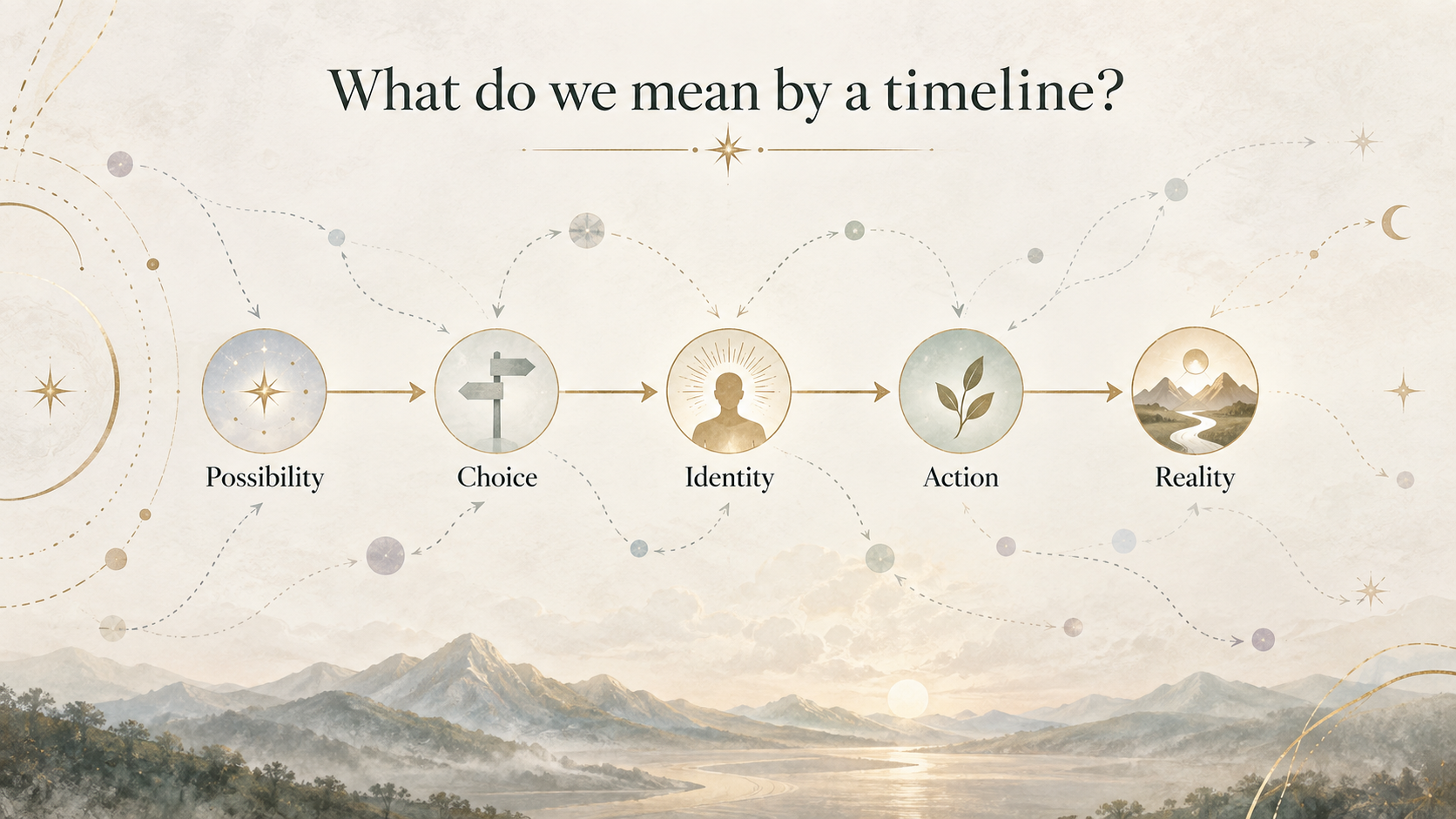
What do we actually mean by a timeline?
The word timeline can make this sound more technical than it is.
Think of a timeline as a sequence of events that produces a particular version of your life.
- One decision affects another.
- One relationship introduces you to a new group of people.
- A job places you in a different city.
- A conversation changes your confidence.
- A habit changes your health.
- A chance encounter alters the next ten years.
Life is already full of branching possibility. Most of those branches can be explained through ordinary cause and effect.
Timeline jumping proposes that possibility may also exist at another level, with consciousness somehow navigating between versions of experience rather than merely building the future one step at a time.
Perhaps that is literal. Perhaps it is symbolic. Perhaps reality contains aspects of both.
Manifestation and timeline jumping are close cousins
Manifestation usually begins with a desired outcome.
You focus on something you want to experience and attempt to bring your thoughts, emotions and actions into alignment with it.
Timeline jumping begins slightly differently.
It asks:
Who is the version of me for whom this reality is already normal?
Instead of concentrating only on obtaining the thing, you concentrate on becoming the person living in the reality where the thing belongs.
That changes the emphasis from wanting to identity.
You are no longer endlessly visualising becoming confident. You begin making choices as somebody who is confident. You stop asking the universe to send you a different life while repeatedly reinforcing the identity attached to the old one.
At the psychological level, that can alter behaviour dramatically.
At the metaphysical level, practitioners believe the shift in identity changes the timeline itself.
Could reality respond to identity?
This is one of the most interesting possibilities. We know identity changes behaviour. Change what you believe you are capable of and you notice different opportunities, tolerate different treatment and make different decisions.
That alone can make life appear to reorganise.
But people who practise manifestation and timeline work sometimes describe something stranger. Coincidences increase. People appear at useful moments. Old situations end suddenly. Opportunities arrive that could not easily have been planned. Things that previously felt blocked become unexpectedly easy.
A conventional explanation can point to attention, behaviour, probability and selection effects.
A metaphysical explanation asks whether the internal change somehow alters the pattern outside the person as well.
Maybe consciousness does not merely navigate reality. Maybe there is some form of relationship between the two. We cannot demonstrate that from individual stories.
But those stories are one reason people keep experimenting.
Synchronicity after a timeline shift
Synchronicity frequently appears in accounts of timeline jumping.
You decide to change direction and suddenly encounter three unrelated references to exactly that path. You commit to moving somewhere and unexpectedly meet somebody from that place. You abandon one identity and the relationships reinforcing it begin to fall away. You make a private decision and circumstances seem to reorganise around it.
These could all be coincidences amplified by increased attention. They could also be what Carl Jung called meaningful coincidences, events connected through significance rather than ordinary cause. Timeline language offers another interpretation.
Perhaps synchronicities appear when the relationship between inner state and outer experience is changing. Not necessarily proof that you have leapt universes. Perhaps feedback. Perhaps navigation markers. Perhaps simply the mind becoming exquisitely sensitive to the road it has finally chosen.
You can leave all three possibilities open.
What would a timeline jump actually feel like?
Popular accounts sometimes make it sound dramatic. You wake up and everything has changed. People remember events differently. Objects move.
History contains details you swear were not there before. Most deliberate change is probably much quieter. A new reality begins to feel normal.
Something you once struggled to imagine becomes unsurprising. Old behaviours become oddly difficult to inhabit. Certain relationships stop fitting.
The way you speak about yourself changes. Possibilities you once dismissed become obvious. Sometimes the shift is only visible in retrospect.
Six months later you realise that the person making your current decisions is not quite the person who began the process. Was that a psychological identity change? A manifestation? A new sequence of ordinary choices? A literal timeline shift?
Perhaps we use different languages for processes that overlap more than we realise.
What about the Mandela Effect?
Timeline theories are frequently used to explain the Mandela Effect, where groups of people strongly remember something differently from the documented record.
One metaphysical explanation suggests that people retain memories from another timeline. Another suggests realities merge or consciousness shifts between similar versions of history.
There is no established scientific evidence for either mechanism. Memory is reconstructive, and collective memory can spread errors remarkably effectively.
But unusually vivid mismatches between personal memory and recorded reality can be deeply unsettling. The interesting question is not whether every incorrect memory proves another universe.
It is whether consciousness and memory tell us everything we assume they do about continuity.
We will explore the Mandela Effect separately because it deserves more than being reduced to a footnote in timeline jumping.
Dreams and parallel lives
Dreams create another intriguing doorway. Sometimes a dream is obviously dreamlike. Other times you seem to inhabit a complete life.
You know people. You know where you live. You carry memories that make perfect sense while you are there. Then you wake up.
A neurological account treats that world as generated by the sleeping brain. A metaphysical interpretation leaves open a more adventurous possibility: consciousness may sometimes experience realities beyond ordinary waking awareness.
That might mean symbolic inner worlds. It might mean information assembled in ways we do not understand. But anyone who has awakened grieving a person who never existed in this life will understand why the question survives.
A practical timeline-jumping exercise
You do not have to decide whether parallel worlds literally exist before experimenting with the practice.
The useful version of timeline jumping combines imagination with action rather than using spirituality to avoid action.
- Notice the current timeline. Describe the life you are actually living, including the patterns you keep repeating, the identity beneath them and what appears to be keeping that reality stable.
- Choose the alternative. Do not begin with ten million pounds, immortality and a castle. Choose a reality you can genuinely imagine inhabiting. What changes there? How does daily life feel?
- Meet the version of you who lives there. In meditation, visualisation or journalling, imagine this person in detail. Do not only look at what they possess. Notice how they think, what they no longer tolerate, how they make decisions and what they believe is normal.
- Take something back. Ask what this version of you knows that you do not currently embody. The answer may be surprisingly ordinary: make the call, leave the situation, practise daily, apply for the role, stop apologising, rest more, begin.
- Embody before evidence arrives. Choose one behaviour that belongs to the new identity and enact it now. This is where timeline work stops being fantasy and begins changing experience.
- Observe the response. Over the following days and weeks, record both internal changes and external events. Notice opportunities, resistance, synchronicities and old patterns returning. Record the misses as well as the extraordinary hits.
That last part is important because a practice becomes much more interesting when you can see what actually happened rather than rebuilding the story afterwards.
Do you need to believe it literally?
No. You can treat timeline jumping as an imaginative identity practice and still gain something from it.
You can also hold a stronger metaphysical belief that other realities genuinely exist. Or you can occupy the position I find most interesting: I don't know, but I am willing to experiment.
Not knowing does not prevent participation. It simply prevents belief from becoming dogma. If the psychological explanation is sufficient, the practice can still change your life.
If consciousness really does interact with a larger field of possibility, you have left room to discover something more.
The trap of waiting for the universe
Timeline jumping becomes useless when it turns into avoidance. You cannot spend every evening visualising the wealthy version of yourself while refusing to open the email that could change your career.
You cannot shift into the healthy timeline while repeatedly choosing behaviours that reinforce the opposite identity. You cannot claim to be in a new reality while organising your life entirely around proof that nothing has changed.
Even the most magical interpretation of timeline work requires participation. If reality responds, you still have to give it something to respond to.
Perhaps action is part of the mechanism. Perhaps action is the mechanism. Either way, take the action.
Can you accidentally jump timelines?
People sometimes describe abrupt periods when life suddenly feels different. Afterwards, the old life can feel strangely distant, as though it belonged to somebody else.
Psychology has plenty of ways to describe that. Timeline language gives it a metaphysical frame. Perhaps major transitions really do move us into dramatically different branches of possibility.
Whether the branch was already there or created through the transition may ultimately be less important than the lived experience of crossing into it.
Can you go back?
If timeline jumping is understood psychologically, of course. Old habits, identities and relationships exert enormous pull. People frequently change and then return to what feels familiar.
Metaphysical practitioners sometimes describe this as slipping back into the old timeline.
The practical advice is the same either way. Do not panic. Notice what you are reinforcing. A new identity becomes stable through repetition.
One bad day does not erase a transformation. Nor does one spectacular meditation complete one.
If there is such a thing as timeline selection, perhaps it is less like stepping through a portal and more like repeatedly voting for one reality until it becomes the one you inhabit.
What about impossible timelines?
This is where I would keep some humility. Timeline jumping should not become a claim that every conceivable reality is available to every person if only they vibrate correctly.
People live inside bodies, histories, economic structures, responsibilities and circumstances that are real within this experience.
Spiritual ideas become cruel when every hardship is interpreted as evidence that somebody selected the wrong frequency.
Possibility can be vast without being unlimited in every moment.
The useful question is not: "Why haven't I manifested literally anything I can imagine?" It is: "What possibility becomes available if I stop treating my current identity as the only version of me that can exist?"
That question can be revolutionary all by itself.
What if timelines are real?
Now we can allow ourselves the bigger possibility. Suppose reality genuinely contains multiple branches. Suppose consciousness is more fundamental than current materialist models assume. Suppose intention and identity affect our relationship with those branches.
Then what we call timeline jumping might describe a genuine feature of reality that we currently experience only subjectively. Perhaps consciousness does not physically leap like a passenger changing trains. Perhaps the process is closer to alignment, with awareness increasingly identifying with one trajectory rather than another.
Perhaps we are continuously shifting between near-identical versions of reality and ordinarily notice nothing because the differences are too small. Perhaps moments of extreme synchronicity, déjà vu, anomalous memory or sudden life reorganisation sometimes accompany larger shifts.
We have no established way to demonstrate this.
But it is no longer necessary to pretend the only interesting questions are those we already know how to measure.
A universe of possibility
The deepest appeal of timeline jumping may have very little to do with quantum mechanics. It is the recognition that the self you currently experience is not finished.
Your present life feels inevitable because you are standing inside it. Looking backwards reveals how little was inevitable at all.
One meeting could have failed to happen. One application could have gone unanswered. One decision could have gone the other way. The person you call me sits at the end of an astonishing sequence of contingencies.
There are futures ahead of you now that will eventually feel just as inevitable.
Timeline jumping asks you to become conscious of that before they happen.
And perhaps consciousness itself changes which future arrives.
So, can you really jump timelines?
We do not know whether a human being can literally transfer consciousness between parallel quantum worlds.
Physics has not demonstrated such an ability. But that is not the whole question. We know that people can transform identity. We know imagined future selves can shape motivation and behaviour. We know that changing choices changes trajectories.
We know that reality contains far more possibility than the one future we ultimately experience. And many people report synchronicities, dreams, altered states and periods of transformation that feel as though something more than ordinary cause and effect is occurring.
Perhaps timeline jumping is a useful metaphor for psychological change. Perhaps it is a spiritual practice built around possibility. Perhaps consciousness is doing something stranger.
I am comfortable leaving that last possibility alive.
Because if reality is more fluid, participatory or layered than it appears, the question may not simply be whether another timeline exists.
It may be: Which version of reality are you continually choosing to make more real?
Frequently asked questions
What is timeline jumping?
Timeline jumping is a metaphysical idea and personal practice based on shifting towards a different possible version of your life. Some interpret it as identity change and manifestation, while others believe consciousness can align with genuinely different realities.
Is timeline jumping based on quantum physics?
It borrows language from quantum theory, particularly the Many-Worlds interpretation, but quantum physics does not demonstrate that people can consciously move between branches of reality.
What is quantum jumping?
Quantum Jumping is also the name given to a visualisation method popularised by Burt Goldman. Practitioners imagine meeting alternate versions of themselves and bringing back their insight, confidence or abilities.
Are parallel universes real?
Some interpretations and models in physics include multiple worlds or universes, but there is no established evidence that the specific alternative lives imagined in timeline-jumping practice are physically accessible parallel realities.
Is timeline jumping the same as manifestation?
They overlap. Manifestation usually focuses on bringing an outcome into your experience, while timeline jumping tends to focus on shifting identity towards the version of yourself for whom that experience is already normal.
How do you know if you have shifted timelines?
There is no objective test. Practitioners describe changes in identity, circumstances, relationships, synchronicities, dreams or a strong sense that the old version of life no longer fits. Those experiences can also have psychological and ordinary causal explanations.
Can dreams be parallel realities?
There is no scientific evidence demonstrating that dreams provide access to parallel realities. Some metaphysical traditions and individuals interpret unusually vivid dreams that way, while neuroscience explains dreaming through activity within the sleeping brain.
Can the Mandela Effect prove timeline shifts?
No. The Mandela Effect can be explained in many cases through memory and social processes. The idea that it represents residual memory from another timeline remains a metaphysical interpretation rather than an established mechanism.
Continue exploring
Simulation Theory 101
Could the reality we experience be generated by something deeper, and what would that mean for consciousness and manifestation?
Can We Prove We're in a Simulation?
What would genuine evidence of a hidden architecture behind reality actually look like?