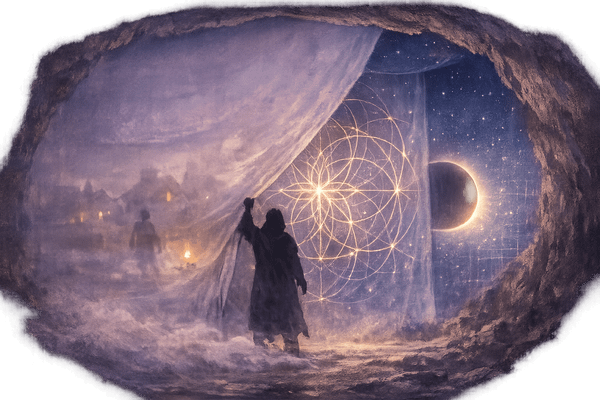
Quantum Jumping Meditation: A Script to Shift Timelines in Real Time
A 10-minute guided meditation for exploring your future self, visualising a different timeline and bringing its qualities into your life now.

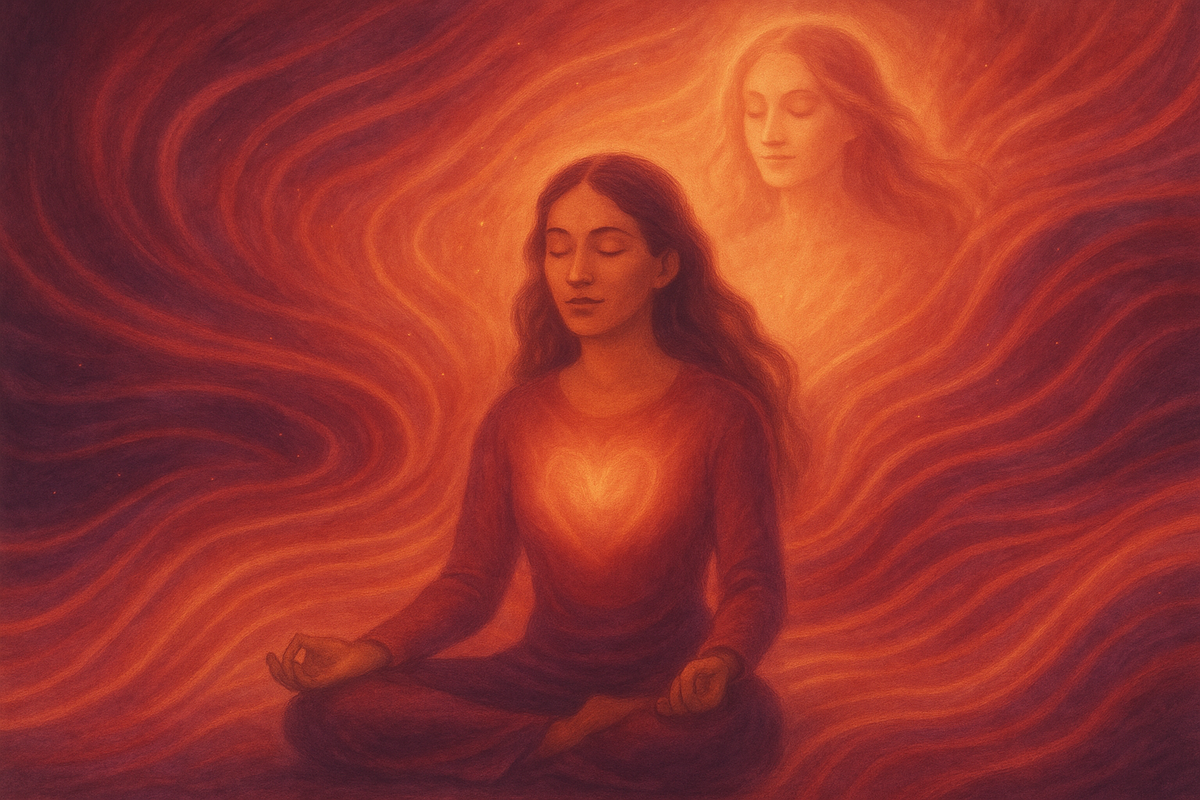
Sometimes change feels close before you can explain what is changing. You can sense the possibility of a different life, but the distance between where you are and where you want to be still feels difficult to cross.
This is where the idea of quantum jumping can be useful as a meditation practice.
Within metaphysical timeline work, quantum jumping is imagined as aligning with another possible version of your life. There is no scientific evidence that meditation literally transfers consciousness between quantum realities, but the image can be powerful: instead of asking only what do I want?, you ask who would I be if I were already moving towards it?
This meditation uses visualisation to meet that future self and bring some of their qualities into the choices you make now. You can read it slowly, record it in your own voice or simply use the structure as a guide.
For the wider idea behind the practice, start with Timeline Jumping 101.
When to use this meditation
Try this practice when you feel caught between an old identity and something new, when you know you want change but cannot quite see the route, or when you have been thinking about a particular future so much that you need to move from abstract wishing into something more tangible.
You can also use it before a decision. The aim is not to receive an infallible message from another universe, but to create enough psychological distance from your current habits to ask what a different version of you might notice or choose.
Allow around 10 minutes.
Quantum jumping meditation script
Begin with grounding
Sit or lie somewhere comfortable and let your eyes close. Take a slow breath in through your nose and release it without forcing anything. Take another breath and notice your body becoming slightly heavier against the chair, bed or floor beneath you.
Allow your attention to move away from whatever happened before this moment. You do not need to solve anything yet. For the next few minutes, your only task is to notice, imagine and remain curious.
Let your breathing find its own rhythm.
Imagine the field of possibility
Picture yourself in a wide, quiet space. It might appear as darkness, light, open sky, a landscape or simply a sense of spaciousness. Do not worry about making the image perfect.
Imagine that this space contains many possible directions your life could take. Some are close to the life you are living now. Others represent choices, identities and futures that would lead somewhere very different.
You might picture those possibilities as paths, doors, threads of light or separate landscapes. Choose whichever image arrives most naturally.
Among them, notice one possibility that draws your attention.
You do not need to know why.
Follow one possible future
Allow yourself to move towards it.
Imagine crossing whatever distance separates you from that possibility. As you move closer, begin to notice details. Where are you? What kind of life seems to exist here? What feels familiar and what feels different?
You are not trying to predict the future. You are giving the mind a way to represent one possible version of it.
Now imagine that someone is approaching.
It is you.
Not an idealised, flawless version of you, but a version who has already made some of the changes you are considering now.
Take a moment to observe them.
How do they carry themselves? What feels different about their pace, expression or attention? What do they appear to have stopped worrying about? What have they learned to take more seriously?
Notice whatever stands out.
Ask your future self
Imagine sitting or standing with this future version of you. Ask them three questions:
What do you understand now that I do not fully understand yet?
What did you have to stop believing in order to get here?
What is one choice I could make now that would move me in your direction?
Do not strain for an answer. It may arrive as words, an image, a memory, a bodily feeling or simply an idea that suddenly seems obvious.
Let the response come in whatever form it takes.
If nothing arrives, that is fine too. The useful part may appear later.
Notice what this version of you embodies
Now pay attention less to what this future self has and more to how they are.
Perhaps they seem calmer, more decisive or less apologetic. Perhaps they protect their time differently. Maybe they are more visible, more creative, more disciplined or more willing to disappoint other people when necessary.
Choose one or two qualities that feel important.
Imagine what it would feel like to borrow those qualities for a moment. Adjust your posture slightly. Let your breathing change if it wants to. Notice how you might sit, stand or think if those qualities were already more available to you.
You are not becoming another person. You are practising access to capacities that may already exist within you.
Bring the future self closer
Instead of imagining this version of you remaining somewhere in the distance, allow the separation between you to soften.
Picture their qualities being integrated into your present self. You might imagine stepping into their place, embracing them or simply recognising that the future version is made from choices available to you now.
Notice what changes in your body when you imagine this.
You might silently say:
I allow this version of me to influence what I choose next.
I do not need the whole path to take the next step.
I can begin living in the direction of this future now.
Let those statements settle without trying to force belief.
Rehearse tomorrow
Now imagine waking up tomorrow with slightly more access to the qualities you identified.
Picture an ordinary part of the day. Perhaps you open your email, get dressed, speak to somebody, begin work or make a decision.
How does this future-oriented version of you handle that moment differently?
Keep it realistic.
You do not need to transform your entire life overnight. Look for one behaviour, one conversation or one decision that changes because you are no longer operating entirely from the old identity.
See yourself doing it.
Return
Bring your attention back to your breathing and the physical sensations of the room.
Notice where your body is supported. Move your fingers and toes. Take another comfortable breath and open your eyes when you are ready.
Before immediately returning to everything else, write down anything that seemed important.
In particular, capture the answer to one question:
What would this version of me do next?
After the meditation
The most useful part of this practice happens after you open your eyes.
Choose one concrete action that belongs to the future you just imagined. It might be sending an email, making an appointment, changing something in your environment, declining something, beginning a piece of work or having a conversation you have been postponing.
The action does not need to be dramatic. It simply needs to be consistent with the version of yourself you encountered.
You can also keep an object as a reminder of the practice, such as a ring, stone, perfume or note on your desk. The object does not need to hold a special frequency. Its purpose is to interrupt automatic behaviour and remind you of the direction you chose.
Should you repeat it?
You can return to the meditation whenever you feel yourself slipping back into an old pattern. There is no special requirement to repeat it for seven days or a particular number of sessions.
More repetition is not automatically better.
If the exercise continues giving you useful insight or changing the way you approach decisions, use it. If you are repeatedly visualising a different life without doing anything differently afterwards, pause the meditation and concentrate on action instead.
Timeline work becomes useful when imagination and behaviour remain connected.
Is this really quantum jumping?
That depends on what you mean by it.
In a literal metaphysical interpretation, parallel versions of you may already exist and the meditation is a way of tuning consciousness towards one of them. That is an intriguing possibility, but it is not something quantum physics has demonstrated.
In a psychological interpretation, you are using guided imagery to explore a possible future self and rehearse the thoughts and behaviours associated with that identity.
Those explanations are very different, but the meditation can be used without resolving the argument.
The experience itself asks a simpler question: if a version of your life exists in which you respond differently, what could you begin doing now to make that path more likely?
The point is not to escape the present
The most useful future-self work does not encourage you to abandon the life you currently have. It changes how you participate in it.
Every significant change eventually becomes visible through ordinary choices. You make the call, leave the situation, start the work, ask for more, stop repeating the pattern or finally commit to something you have been circling for months.
Calling that a timeline shift is a metaphysical interpretation.
Calling it identity change is a psychological one.
Either way, the movement starts here.