Suppressed Senses: Exploring the Science Behind Latent Psychic Abilities
A controversial brain-stimulation experiment found an unusual psi effect after temporarily inhibiting part of the frontal cortex. Could the brain filter more than we realise?

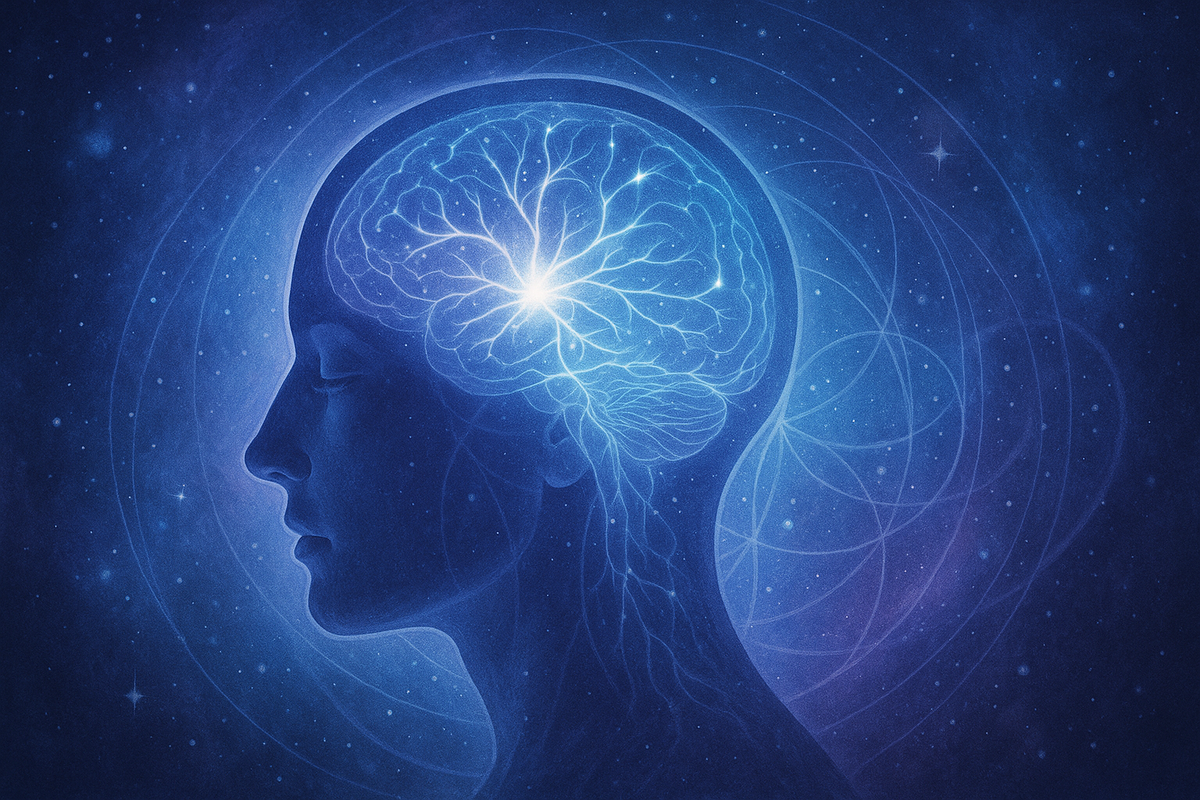
What if some experiences we describe as psychic are not additional senses at all, but information the ordinary mind normally filters out?
Telepathy, precognition, clairvoyance and other forms of so-called psi remain controversial. People report them across cultures and throughout history, yet reliable experimental evidence has proved difficult to reproduce, leaving researchers deeply divided over whether psi represents an unknown feature of consciousness, statistical noise or something more conventional that has not been adequately controlled.
A provocative brain-stimulation experiment has added another possibility to that debate. Rather than asking whether the brain creates psychic ability, researchers asked whether parts of the brain might actually inhibit it.
What the brain-stimulation study found
The study, published in Cortex in 2024 by neurologist Morris Freedman and colleagues, followed earlier work involving people with damage to particular areas of the frontal lobes.
The researchers proposed that the left medial middle frontal region might act as a biological filter, suppressing psi effects during normal consciousness. To test the idea, they used repetitive transcranial magnetic stimulation, or rTMS, to temporarily inhibit activity in that region in healthy volunteers.
Participants then completed a mind-matter interaction task involving the output of a random-event generator. The researchers reported a significant psi effect after stimulation of the targeted brain region.
That is interesting, but it needs careful interpretation. The experiment did not demonstrate telepathy or clairvoyance, nor did it prove that the participants had suddenly acquired psychic powers. The significant result also relied on a post-hoc weighting procedure, one reason the paper prompted methodological debate after publication.
The appropriate conclusion is therefore narrower: the experiment produced an anomalous result consistent with the researchers' proposed psi-filter hypothesis, and it deserves further independent testing.
The filtering theory of consciousness
The idea that the brain might filter consciousness rather than manufacture all of it is much older than this experiment.
William James considered versions of what became known as a transmission or filter theory of mind. Aldous Huxley later popularised the metaphor of the brain and nervous system as a reducing valve, limiting the enormous quantity of possible experience so that we can function effectively in everyday life.
The basic idea is easy to understand. A biological organism cannot attend equally to every piece of information available to it, so perception is necessarily selective. We already know that our brains ignore, predict, reconstruct and suppress huge amounts of sensory information before conscious awareness occurs.
The speculative step is asking whether what gets filtered might include information that does not arrive through the recognised senses.
That has not been established. The Freedman study makes the question testable rather than answering it.
What do researchers mean by psi?
Psi is an umbrella term used in parapsychology for claimed forms of information transfer or influence that are difficult to explain through recognised sensory or physical mechanisms. It can include:
- Telepathy, usually defined as apparent mind-to-mind information transfer
- Clairvoyance or remote viewing, involving information about distant or hidden targets
- Precognition, where information appears to concern a future event
- Mind-matter interaction, sometimes called psychokinesis, involving apparent effects of intention on physical or random systems
These should not be treated as interchangeable. Evidence for one type of anomalous effect would not automatically demonstrate all the others.
The 2024 rTMS experiment concerned mind-matter interaction, specifically attempts to influence a random-event generator. It did not show that participants could read another person's thoughts or see distant locations.
That distinction was blurred in the original reporting around the study and is important to restore.
Does the brain normally suppress unusual information?
This is where the research becomes genuinely intriguing.
The brain is not a passive recording device. It continuously predicts what is likely to happen, prioritises information relevant to survival and suppresses signals judged unimportant. Attention itself is a filtering system.
There are also neurological conditions in which alterations to normal brain function produce unusual abilities or experiences. Acquired savant syndrome is a rare example, while experimental work using brain stimulation has explored whether temporarily disrupting particular regions can alter access to lower-level perceptual information.
None of this proves psi. It does show that removing a cognitive process can sometimes reveal abilities or information that were previously inaccessible.
The question raised by the psi-filter hypothesis is whether that principle could extend further than conventional perception.
Be careful with the left-brain/right-brain story
The original version of this article framed the experiment as analytical left-brain activity suppressing an intuitive psychic right brain. That is too simple.
There are real functional differences between the brain's hemispheres, particularly in areas such as language and spatial processing, but people are not neatly divided into logical left-brained and intuitive right-brained modes.
More importantly, the rTMS experiment targeted a specific frontal region, not a general switch controlling the entire analytical left hemisphere.
If something interesting is happening here, it is likely to involve specific processes such as inhibition, self-monitoring or attention rather than one half of the brain simply getting out of the way so the psychic half can speak.
Could psychic ability be latent?
This remains the most provocative possibility.
If the filter hypothesis were eventually supported by larger, preregistered and independently replicated experiments, one interpretation would be that anomalous information is more widely available than conscious awareness normally permits.
That would raise extraordinary questions about perception and consciousness. Why would such information be suppressed? Would filtering be necessary to maintain a stable model of reality? Could altered states weaken it?
People have long associated unusual intuitive experiences with dreams, meditation, trance, near-death experiences and the hypnagogic state between waking and sleep. Those states also involve changes in attention, sensory processing and ordinary self-awareness.
That does not make every vivid dream precognitive or every intuitive feeling psychic. It does suggest a sensible research question: whether anomalous experiences become more frequent or measurable when the ordinary cognitive filters of waking consciousness change.
What about psychic experiences in childhood?
People sometimes recall unusual experiences from childhood: knowing who was about to call, sensing presences, vivid imaginary companions or apparently knowing something they could not explain.
It is tempting to interpret this as evidence that children begin life psychically open before society teaches them to close down.
There are more ordinary possibilities too. Childhood imagination is exceptionally rich, memory changes over time and children do not always maintain the same boundaries adults use between imagination, dream and external event.
Rather than assuming either explanation, these reports become more useful when they are recorded prospectively and tested where possible.
That principle applies throughout psi research: the stranger the claim, the more valuable good records become.
Can you explore this yourself?
You do not need brain stimulation to investigate your own intuitive experiences, and there is no evidence that trying to reproduce rTMS effects through frequencies, sound tracks or other home practices would produce the same neurological result.
A simpler approach is to treat intuition as something to observe.
If you think you know who is about to contact you, write the name down before checking your phone. If you have an apparently precognitive dream, record it immediately with a date and compare it with later events rather than reconstructing the dream afterwards. If you experiment with remote viewing, decide the target independently and keep enough records to distinguish memorable hits from forgotten misses.
Meditation and quiet attention may help you notice subtle thoughts and bodily signals more clearly. Whether anything genuinely extrasensory appears is a separate question.
This approach allows curiosity without building the conclusion into the experiment.
Why this matters for consciousness
The most interesting part of the suppressed-senses idea is not necessarily whether humans can develop spectacular psychic powers.
It is the possibility that ordinary conscious awareness represents only a tightly filtered portion of what the mind is doing.
We already know this is true in many conventional ways. The brain processes patterns before we consciously recognise them, regulates internal bodily information and continually predicts aspects of the world outside awareness.
Psi research asks whether those hidden processes stop at the recognised boundaries of the organism.
Mainstream neuroscience currently has no established mechanism showing that information can be acquired independently of ordinary sensory channels. Psi effects also remain disputed because they are often small and difficult to replicate.
The Freedman experiment does not remove those problems. It gives researchers an unusual new way to investigate them.
The simulation interpretation
If reality were informational or simulated, the idea of perceptual filtering would fit naturally into the model.
An agent inside a complex system would not necessarily need access to every layer of information available within that system. Its interface might reveal only the data necessary for ordinary functioning while concealing everything else.
In that metaphor, unusual intuition or psi would represent access to information outside the default interface.
There is no evidence that this is actually how reality works, but it provides a useful thought experiment. The more important point is that even conventional neuroscience tells us perception is selective rather than complete.
We never experience reality unfiltered.
Whether those filters conceal only ordinary sensory information or something stranger is precisely the question worth investigating.
The 2024 brain-stimulation study does not prove a hidden sixth sense. It does something more modest, and perhaps more useful: it gives us a surprising result that can be tested again.
If the effect disappears under stronger replication, we learn something.
If it persists, the questions become considerably more interesting.