The Moon as Mirror: What Lunar Phases Really Reflect in You
The Moon changes its appearance without becoming a different world. Explore how its phases can become a mirror for your emotional life, with a practical lunar journal and gentle reflective rituals.
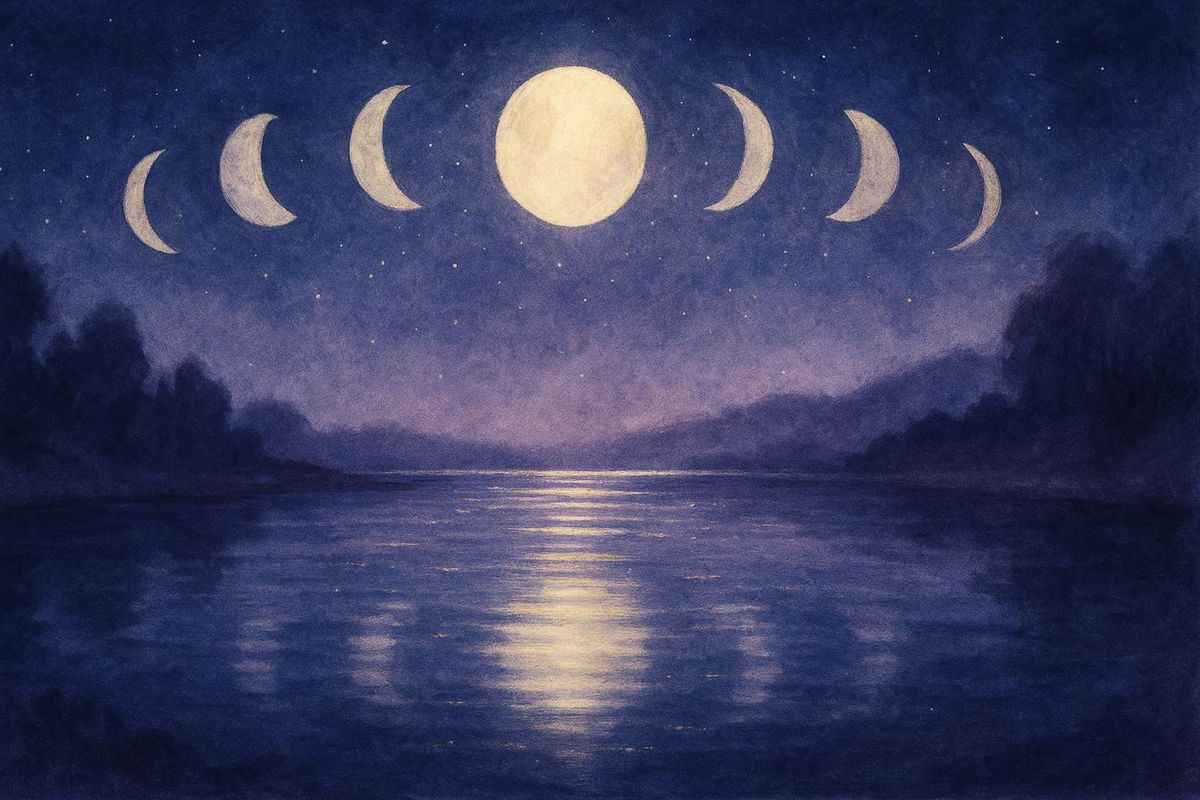
There are evenings when the Moon seems to arrive carrying exactly the feeling we needed.
A thin crescent hangs above the rooftops, barely visible in the fading light. A week later, half its familiar face is illuminated. Then it becomes full, bright enough to draw our eyes away from whatever we were doing.
And eventually, the light begins to recede.
We watch the Moon change, even though the Moon itself has not become a different object. Its shape remains. What changes is our view of the sunlight falling across its surface.
There is a beautiful metaphor here for the inner life.
Some parts of ourselves are easy to recognise. Others become visible only at certain moments. A feeling may come into focus during a difficult conversation, an old ambition may return after years of quiet, or a period of exhaustion may reveal how much we have been carrying.
The Moon offers a recurring image for these changes.
Not because it necessarily causes them, but because its visible cycle gives us a reason to pause and notice.
This is the Moon as mirror: a contemplative practice of using the changing lunar phases to reflect on our emotional lives, our energy, our expectations and the patterns that become visible over time.
It is not about forcing ourselves to feel a particular way at a particular phase.
It is about learning to see more clearly.
What does the Moon actually reflect?
Moonlight is reflected sunlight.
As the Moon travels around Earth, we see different proportions of its illuminated half. This creates the familiar sequence from new Moon to full Moon and back again.
The complete phase cycle lasts approximately 29.5 days, as explained in NASA's guide to the Moon's phases.
The Moon does not physically grow and shrink.
Our perspective changes.
This is what makes it such a compelling symbol for self-reflection. Our experience of ourselves is also incomplete and changeable. What feels central today may recede tomorrow. A quality we thought we had lost may become visible again when circumstances change.
In spiritual language, the Moon is often said to reveal our hidden emotional landscape.
Taken literally, that would require evidence that lunar phases cause or expose particular emotional states. Such a relationship has not been reliably established.
As a metaphor, however, the image can be useful.
We do not need to believe that the Moon is controlling a feeling to use its changing light as an invitation to examine it.
The difference between a lunar guide and a lunar mirror
There are two complementary ways to work with the Moon.
A lunar guide uses the phases to organise a practice. You might set intentions around the new Moon, review progress at the full Moon and use the waning period to reconsider commitments.
A lunar mirror begins somewhere more personal.
Instead of asking, What am I supposed to do at this phase?, it asks:
What is actually happening within me?
You might discover that you feel energised during a period traditionally associated with rest. Or that a full Moon arrives on an ordinary evening when nothing especially emotional occurs.
There is no need to correct your experience to match the calendar.
The symbolic framework is there to support reflection, not to prescribe your inner state.
For the full eight-phase ritual sequence, explore Moon Phases and Manifestation: Timing the Field.
Here, we are interested in what becomes visible when you return to the same questions over time.
New Moon: what is waiting in the dark?
At the new Moon, the sunlit side faces away from us and the Moon is ordinarily lost in the Sun's glare.
The Moon is still present.
That makes this phase an evocative symbol of things that exist before they have taken a clear form.
An intention may be beginning to emerge. A feeling may be difficult to name. You might recognise that something needs to change without yet knowing what that change should look like.
In modern spiritual practice, the new Moon is often associated with introspection and fresh beginnings.
As a mirror, it invites a gentler question: what have I not yet given myself space to notice?
Perhaps you have been too busy to recognise how tired you are. Perhaps a creative idea keeps returning, but you dismiss it before considering whether it matters. Perhaps you need time without the pressure to produce an answer.
You do not have to turn every new Moon into a goal-setting exercise.
Sometimes the beginning is simply admitting what is present.
A question for the dark Moon
Sit quietly with your notebook and finish this sentence:
Something I have been reluctant to acknowledge is…
You may discover a desire, a worry or a practical need.
You may also find that nothing particular comes.
Both are acceptable. The point is to make room for attention, not to manufacture a revelation.
Waxing Moon: what is becoming visible?
As the Moon waxes, more of its sunlit face becomes visible from Earth.
In the symbolic language of lunar practice, this is the movement from possibility towards expression.
An idea becomes a conversation. A private decision becomes an action. Something you have been considering begins to occupy a more visible place in your life.
The waxing Moon can therefore become a mirror for emergence.
What part of you is asking to be expressed? What are you beginning to understand? Is there a quality you want to practise rather than merely admire in others?
This need not be about achievement.
You may be learning to ask for help, speak more honestly or allow yourself a kind of rest you previously considered unproductive.
Sometimes growth looks less like doing more and more like becoming willing to do something differently.
A question for the growing light
Ask yourself:
What has begun to change, even if the result is not yet obvious?
Notice the small evidence.
A difficult conversation started. A habit reconsidered. A preference expressed without immediately apologising for it.
These moments may matter more than an imagined dramatic transformation.
Full Moon: what can I see clearly?
The full Moon has a particular presence.
When its Earth-facing side is fully illuminated, it becomes one of the most noticeable objects in the night sky.
Its brightness has inspired associations with revelation, completion and heightened feeling.
Contemporary spiritual accounts sometimes claim that the full Moon automatically intensifies emotion or intuition. Research does not establish such a dependable effect for everyone.
But the symbolism remains valuable.
A bright Moon can become a reminder to bring something into the light of honest reflection.
What has developed since you last paused? What have you learned about yourself? Is there a situation you have been interpreting through hope, fear or habit rather than the available facts?
Illumination is not always comfortable.
You might recognise progress you have been too busy to acknowledge. You might also realise that a relationship, commitment or ambition no longer resembles the version you imagined.
The purpose is not to make yourself feel positive.
It is to see what is there.
A question for the full Moon
Write two sentences:
What I can now see more clearly is…
What I am still uncertain about is…
Allow both to be true.
Clarity does not require pretending that every question has been answered.
Waning Moon: what deserves to be carried forward?
After the full Moon, the illuminated portion visible from Earth diminishes.
Modern lunar practice often associates the waning phases with release, completion and rest.
As a mirror, this part of the cycle invites us to consider what we have been carrying.
Some things are worth retaining: a new understanding, a meaningful connection, a habit that supports us.
Other things may need revisiting.
Perhaps a goal was based on an expectation that no longer fits. Perhaps you keep agreeing to something that leaves you resentful. Perhaps an old story about yourself has become too restrictive.
Release does not have to mean a dramatic severing of ties.
It may mean changing a timetable, letting go of a demand for perfection or deciding that an unfinished project can wait.
Nor must you release an emotion before you have had time to experience it.
Grief, anger and uncertainty do not follow lunar deadlines.
A question for the fading light
Consider:
What do I want to carry into the next cycle, and what am I ready to approach differently?
The distinction matters.
Not everything needs to be discarded for something new to begin.
The Moon does not tell you how you should feel
One of the problems with rigid lunar guidance is that it can make ordinary emotional variation seem spiritually significant.
If you feel low near a full Moon, the phase may be blamed. If you feel unusually energetic at the new Moon, you may wonder whether you are out of alignment.
But emotions arise within complex lives.
Sleep, stress, relationships, physical health, work, environment and countless everyday experiences all affect how we feel.
A calendar cannot replace attention to those circumstances.
There is no requirement to feel reflective during the new Moon or emotionally heightened during the full Moon.
If a phase arrives and you feel entirely ordinary, that is an experience worth accepting.
The mirror should reflect you.
You should not have to become a reflection of the chart.
Does the Moon influence emotions?
The Moon has real physical effects on Earth, particularly through its gravitational contribution to ocean tides.
But the existence of tides does not demonstrate that lunar phases cause predictable changes in human emotion.
Research into lunar cycles and mental health has generally failed to establish the popular claim that psychiatric crises increase around the full Moon.
For example, a 2019 study of 17,966 psychiatric inpatient cases found no relationship between lunar phases and admission rates, discharge rates or length of stay.
This does not prove that every possible lunar effect on human biology has been ruled out.
It does mean that claims about the full Moon reliably causing emotional instability go beyond the evidence.
The same caution applies to descriptions of lunar energy.
In physics, energy is a measurable quantity. In personal reflection, we often use the word to mean vitality, motivation or how much capacity we feel we have for the day ahead.
Those everyday experiences are real.
They do not require a claim that the Moon has physically charged or depleted our bodies.
What about the Moon and sleep?
Sleep is an interesting area of lunar research because moonlight has an obvious relationship with the natural night environment.
A 2021 study of sleep in rural and urban settings reported that participants tended to fall asleep later and sleep for a shorter period on nights leading up to the full Moon.
The researchers suggested that access to moonlight during the evening may have contributed to the pattern.
Other studies have reported different results, and findings across the field remain mixed.
It would therefore be misleading to promise that everyone will sleep poorly at the full Moon or experience predictable bursts of energy as the Moon waxes.
If you are interested in your own sleep, you can record it alongside the lunar phase.
Just avoid assuming that a matching date identifies the cause.
Bedtime, light exposure, noise, workload and stress may provide more immediate explanations.
A Moon journal that reflects your life
The most useful part of the original Moon-as-mirror practice is observing your experience over time.
You do not need an elaborate journal or a specialist app.
A few minutes of consistent, honest recording can help you notice what is happening in your life without relying entirely on memory.
Try using this simple format:
| Date | Moon phase | Mood and energy | What was happening | What I noticed |
|---|---|---|---|---|
| Monday | Waxing crescent | Calm, moderate energy | A quieter working day | I felt better after getting outside |
| Thursday | First quarter | Restless, tired | Several competing deadlines | I need to reconsider my workload |
| Following week | Full Moon | Content, low energy | A welcome evening at home | Rest felt more useful than another task |
Keep the entries short.
If you want to investigate whether the Moon corresponds with anything in your own experience, record your mood before checking the phase. Then add the lunar information afterwards.
This reduces the temptation to describe your day according to what a lunar guide has told you to expect.
Record the unremarkable days too.
Otherwise, the striking coincidences will occupy the entire journal, and you will have little basis for comparison.
How to recognise a pattern without inventing one
Human beings are excellent at finding patterns.
This ability helps us learn, anticipate and make sense of the world. It can also lead us to see a meaningful connection in a small number of coincidental events.
Imagine recording three difficult evenings near successive full Moons.
It might feel as though you have discovered an important lunar relationship.
But were those evenings also at the end of demanding working weeks? Did you sleep badly beforehand? Were you already expecting the full Moon to affect you?
And what happened during the other phases?
A useful journal records enough context to keep several explanations available.
If you enjoy the process, follow more than one lunar cycle and review the complete record rather than a few memorable entries.
Even then, a personal pattern does not establish that the Moon caused it.
It may be enough to learn that you tend to become tired after a particular kind of week, or that you benefit from pausing more often than you currently do.
The aim is insight, not proof of cosmic control.
A monthly mirror practice
Rather than creating a separate ritual for every phase, return to the same four questions at four points in the lunar cycle.
This allows you to notice what changes over time.
| Lunar moment | Mirror question |
|---|---|
| New Moon | What am I not yet acknowledging? |
| First quarter | What is beginning to emerge? |
| Full Moon | What can I see more clearly? |
| Last quarter | What will I carry forward or approach differently? |
Spend ten minutes at each check-in.
Write honestly, even when your answer does not match the conventional meaning of the phase.
At the end of the month, read the four entries together.
You may notice a shift in perspective. A worry that dominated the first entry may have become more manageable. An ambition may have lost its appeal, or an issue you barely mentioned may have become important.
This is the value of returning to a question.
You encounter your own life from more than one point of view.
A quiet ritual beneath the Moon
You do not need special equipment to practise with the lunar mirror.
Find a comfortable place where you can see the night sky, or sit beside a window if the weather is uninviting.
If the Moon is hidden by cloud, the practice still works. You do not have to see it for the cycle to continue.
Take a few moments to notice the space around you.
Then imagine the Moon as an image of changing visibility.
Some parts of your life feel clear. Others remain uncertain. Some qualities are present but not receiving much attention.
Ask yourself:
What can I see today that I could not see before?
Do not force an answer.
You may think of something important, or simply enjoy a moment away from the demands of the day.
If a thought emerges, write it down afterwards.
Let the ritual end without requiring a sign, prediction or revelation.
The ordinary act of paying attention can be enough.
The darker side of lunar self-reflection
There is a point at which tracking and ritual can become less helpful.
If you begin checking the lunar calendar anxiously before every decision, interpreting every difficult feeling as an energetic disturbance or fearing particular phases, the practice may be narrowing your freedom rather than supporting it.
You do not need permission from the Moon to have an important conversation, seek help, begin a project or leave an unsuitable situation.
Nor should a journal become a daily examination that you feel you have failed whenever you miss an entry.
The rhythm is available to you.
It does not demand compliance.
If you are experiencing persistent distress, the relevant support should be based on your needs, not postponed until a more favourable astrological or lunar moment.
A spiritual framework can accompany life without taking authority over it.
Your cycles do not have to match the sky
The Moon provides a repeating pattern, but human experience is not equally regular.
Some days we have more capacity than others. Projects unfold at different speeds. Relationships change unexpectedly. Loss and renewal do not arrive according to the same timetable.
A person's menstrual cycle, where relevant, is not required to match the lunar month.
And people who do not menstruate can find the imagery of growth, fullness, release and renewal just as meaningful.
There is no universal inner calendar.
Sometimes a period of rest arrives during the waxing Moon. A major beginning may occur during a waning phase. A full Moon may pass while you are absorbed in something entirely different.
That is not a failure of alignment.
The symbolism becomes richer when it makes room for the reality of your life.
What the Moon might really show us
The Moon is one of the most familiar objects in the sky, yet we never see its entire surface from one place at one time.
The visible light changes, revealing some features while others remain in darkness.
Our understanding of ourselves is similarly incomplete.
A difficult season may reveal a need for support. A new relationship may bring forward a quality we had forgotten. Rest may expose exhaustion that achievement had been masking.
Not every discovery is dramatic. Some are so ordinary that they take time to recognise.
The Moon as mirror gives these changes a recurring place in our attention.
It asks us to observe without insisting on a predetermined answer.
To notice without turning every feeling into a cosmic message.
To accept that something can be hidden without being absent, and that becoming visible is not the same as becoming new.
The Moon does not have to manage our emotions or determine our future to have a place in spiritual practice.
It can simply remind us to look again.
And perhaps, in the changing light, we will see something we are finally ready to understand.