Vision Boards vs Feeling Boards: A Better Way to Create Your Reality
A vision board can clarify what you want, but a feeling board asks a deeper question: how do you want your life to feel? Here’s how to use both without mistaking inspiration for action.
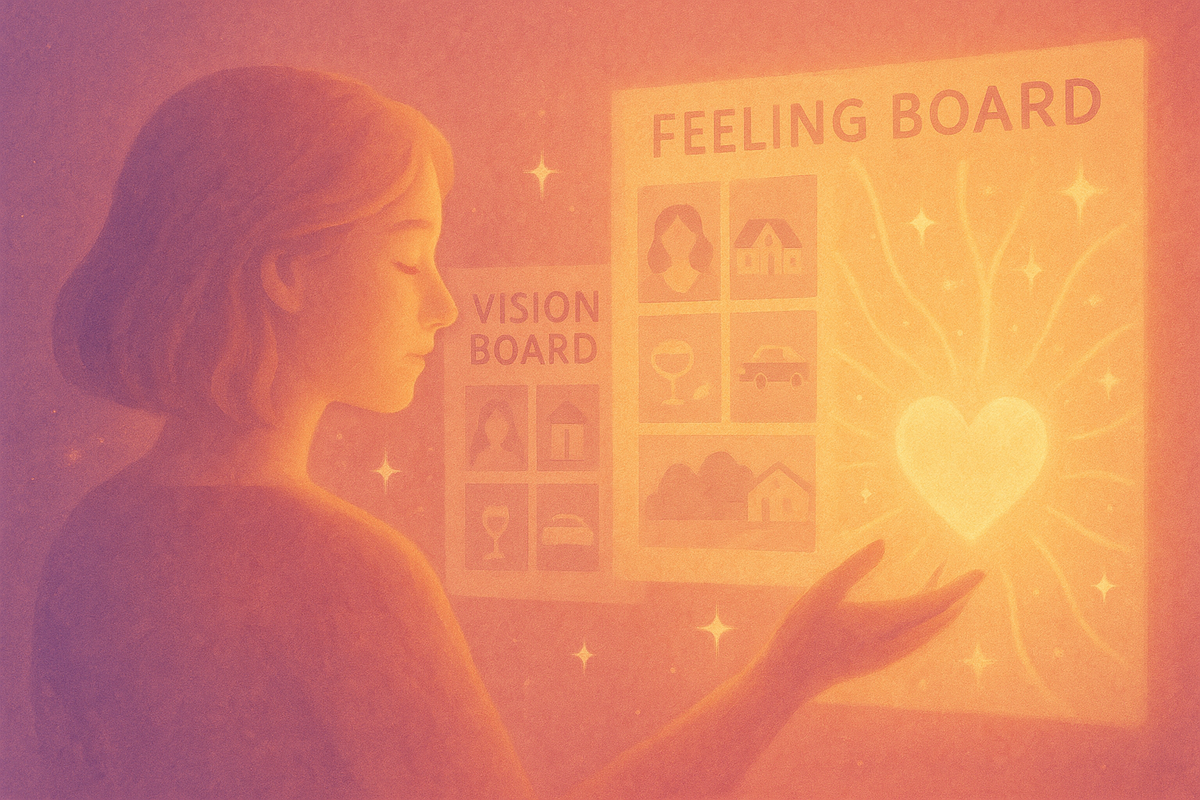
Vision boards have become almost inseparable from modern manifestation culture. Collect the photographs, choose the dream house, add the destination, the relationship, the career, perhaps a number representing the bank balance, arrange everything beautifully and put it somewhere you will see it every day.
There is nothing inherently wrong with that. Making a visual representation of what you want can be enjoyable, clarifying and surprisingly revealing. The problem begins when creating the board is mistaken for creating the life.
A collage cannot do the work for you. Nor is there good reason to assume that repeatedly looking at a photograph of something causes the universe to deliver it. What a board can do is keep certain ideas visible, help you notice what you are actually drawn towards and provide a prompt for reflection and action.
A feeling board takes that same idea in a slightly different direction. Instead of asking only What do I want my future to contain?, it asks How do I want that future to feel?
That turns out to be a much more interesting question.
What is a vision board?
A vision board is simply a collection of images, words and symbols representing goals, desires or possibilities. It might contain a particular home, a kind of work, travel, relationships, financial goals, health, creative ambitions or experiences you would like to have.
The value of the exercise is not that the images are magical. It is that choosing them forces you to make decisions.
You may discover that the photograph of a huge country house does nothing for you, while a small room with books, trees outside the window and an old wooden desk produces an immediate sense of recognition. You may think you want a high-status career and then notice that every photograph you save represents autonomy rather than prestige. You may fill a board with holidays and realise what you actually want is not travel but freedom.
A good vision board can therefore function as a form of inquiry. The question is not merely, Do I want this picture? It is, What does this picture represent?
That second question is where the exercise becomes useful.
Where vision boards can go wrong
The obvious danger is that a vision board becomes a shopping list assembled from somebody else's life.
Social media has made this particularly easy. The imagery available to us is already heavily curated around recognisable symbols of success: immaculate bodies, minimalist houses, luxury travel, beautiful weddings, expensive cars, entrepreneurs working beside swimming pools.
If those things genuinely matter to you, put them on the board. The problem is not luxury. The problem is using borrowed imagery without examining the desire underneath it.
An image can be visually attractive while creating no meaningful connection to the life you actually want. It can also generate comparison rather than motivation. A photograph intended to represent possibility may instead remind you, every time you see it, of the perceived gap between your current life and the one in the picture.
That does not mean your nervous system has rejected your manifestation or that you are somehow energetically misaligned. It may simply mean that the image is not helping.
What is a feeling board?
“Feeling board” is not an established psychological technique. It is a useful manifestation exercise built around a simple change of emphasis.
Instead of starting with objects and outcomes, you begin with desired qualities of experience.
Perhaps you want life to feel spacious, adventurous, secure, creative, connected or calm. Maybe you want your work to feel meaningful and intellectually alive. Perhaps you want relationships to feel mutual, warm and uncomplicated. Financially, you may be seeking the feeling of stability more than extravagance.
You then choose images, colours, words, textures, places and symbols that evoke those qualities.
A feeling board about freedom, for example, might contain none of the obvious symbols of wealth. It might show an empty Tuesday afternoon, a train disappearing into mountains, an open notebook, a quiet beach and a phrase about being able to choose your own time.
Another person's freedom might look completely different.
That is the point.
A feeling board can move the exercise away from socially recognisable symbols of success and closer to the actual experience you are trying to create.
Feeling is useful, but it is not a cosmic instruction
The original version of this article argued that feeling boards were more powerful because your emotional frequency somehow instructs reality what to return. That is a spiritual interpretation, not something we can present as an established mechanism.
There is, however, a grounded reason to care about feeling.
Emotion changes the meaning of a goal.
Imagine two people with an identical picture of a large house on their boards. For one, the house represents family, hospitality and permanence. For the other, it represents proof that they have finally succeeded.
Those people are not pursuing the same thing.
Understanding the feeling underneath a desire can reveal whether the visible goal is actually the best route towards it.
You may discover that the expensive house represents safety, but what would create greater safety in the next five years is financial resilience rather than a larger mortgage. You may discover that the dream job represents recognition, when what you actually need is work in which your contribution is taken seriously. You may think you want a relationship because you want to feel chosen, while the deeper work lies in understanding why being chosen by someone else has become the measure of your worth.
Feeling does not cause reality to obey you. It helps you understand what you are asking reality for.
Why imagery alone is not enough
There is another weakness in conventional vision-board culture: it focuses almost entirely on the finished scene.
You see yourself crossing the finish line, walking into the new home, accepting the award or looking at the number in your account.
The difficult middle is largely absent.
Yet the middle is where most goals live.
There is a useful body of psychological research around mental contrasting, a technique that combines imagining a desired future with deliberately considering the obstacles between present reality and that future. Rather than simply fantasising about the result, you bring the vision back into contact with the conditions required to pursue it. Research combining mental contrasting with concrete “if-then” planning has found modest benefits for goal attainment across a range of settings. One meta-analysis covering more than 15,000 participants found a small-to-moderate overall effect.
That suggests a useful upgrade to both vision boards and feeling boards.
Do not create only the destination.
Include something that represents the route.
If the desired future is writing a book, include an image of somebody actually writing. If it is financial security, represent saving or learning as well as the lifestyle. If it is health, show the daily practice as well as the imagined result. If it is creative independence, include the process of producing and sharing work.
The board then becomes less of a fantasy screen and more of a reminder of participation.
The best board probably combines vision and feeling
You do not actually need to choose between a vision board and a feeling board.
The strongest version asks three questions at once: What do I want? How do I want it to feel? What would I need to do or become involved in to move towards it?
Suppose you want to change career.
The vision layer might contain the kind of work, environment or lifestyle you are moving towards. The feeling layer might contain words such as autonomy, challenge, respected, creative or useful. The action layer might represent the training, applications, conversations, portfolio work or financial planning required to make the transition possible.
Now the board contains a future, but it also contains a relationship with that future.
That is far more interesting than gluing a picture of an office to a piece of card and hoping reality gets the message.
How to create a feeling board
Begin before you look for images.
Sit somewhere quiet and imagine an ordinary day in the life you say you want. Not the exceptional moment. Not the wedding day, launch party or first-class flight. Imagine an unremarkable Wednesday.
Ask yourself how you want to feel when you wake up, while you work, in your home, around money, in your relationships and at the end of the day.
Choose perhaps three to five qualities that seem to matter most. Words such as secure, free, playful, connected, spacious, alive, grounded or creative are more useful when they mean something specific to you.
Only then begin finding imagery.
Choose images because of the state they evoke, not because they fit the conventional aesthetic of success. A worn kitchen table may represent belonging more powerfully than a designer interior. A photograph of someone swimming in cold water may represent vitality better than an image of a perfectly sculpted body. An empty calendar might represent success more accurately than a photograph of a busy office.
As you build the board, ask one additional question about each major image: What would help create more of this feeling in my actual life?
That keeps the exercise connected to reality.
Add the present, not just the future
One of the most useful changes you can make is to include things you already have.
Most boards are entirely future-facing. Everything desirable exists elsewhere.
That can unintentionally reinforce the sense that your real life is merely the waiting room.
If you want more connection and already have two close friendships, include something that represents them. If you want more creativity and already make things occasionally, acknowledge that. If you want financial stability and have started saving, represent the process already underway.
This is not about pretending the goal has arrived.
It is about recognising continuity between who you are now and the future you are trying to build.
The future then becomes less like another universe and more like a direction.
Use the board as a question, not an altar to certainty
A board should be allowed to change.
You may create one in January and discover by April that part of it no longer matters. That is useful information.
Remove the image.
Perhaps you were chasing something because everybody around you valued it. Perhaps a new experience changed your priorities. Perhaps the goal was actually a symbol for something you have now found by another route.
Manifestation can become rigid when changing your mind is treated as failure or energetic inconsistency.
Sometimes changing the vision means you have learned something.
A board works better as a conversation with your future than as a contract forcing your future to obey an earlier version of you.
What if you cannot visualise clearly?
Traditional vision-board advice often assumes everybody thinks vividly in pictures.
They do not.
Some people have weak mental imagery; people with aphantasia may experience little or no voluntary visual imagery at all. This does not exclude them from intention-setting or imaginative practice.
A feeling board may actually be particularly useful because it does not depend on mentally projecting detailed scenes.
Words may work better than photographs. So might texture, sound, physical movement, objects, memories or descriptions of desired experience.
You can write: I want my home to feel like the moment everybody stays at the table because nobody wants the conversation to end.
That may tell you far more than a photograph ever could.
Turn the board into a practice
The board itself is the beginning rather than the method.
Look at it periodically and ask what still feels alive. Notice which parts create energy and which have become wallpaper. Choose one small action that would move something on the board out of symbolism and into life.
If the board represents community, invite someone over. If it represents creativity, make something. If it represents rest, protect an evening. If it represents a move, research the place. If it represents wealth, look at the numbers. If it represents love, pay attention to how reciprocal your existing relationships actually are.
This is where the board becomes useful.
It repeatedly moves you between imagination and reality.
What about making a digital vision board?
There is no reason a board has to be physical.
You can use Pinterest, Canva, a private album, a notes app or your computer desktop. A physical board has the advantage of remaining visible without requiring you to open anything, while a digital board is easier to update.
The important issue is not the medium but whether you actually engage with it.
A Pinterest board containing 900 images gathered over four years is probably no longer clarifying anything.
Curate.
The act of choosing is part of the practice.
Should you include specific people?
This is where Manifestation Ethics: Balancing Desire and Impact becomes relevant.
If you are representing friendship, love or family, focus primarily on the quality of relationship rather than using the board to script the behaviour of a particular person.
There is a difference between representing a loving, reciprocal relationship and creating a board devoted to making a named person choose you.
The first clarifies what you want to experience.
The second can easily turn a personal practice into an attempt to override somebody else's autonomy.
A board can guide your choices. It should not become a tool for pretending other people's choices do not exist.
Vision, feeling, obstacle, action
If I were rebuilding the traditional vision-board ritual from scratch, I would use four layers.
Vision asks what you want the future to contain. Feeling asks what experience sits underneath that desire. Obstacle asks what currently stands between you and it. Action asks what you can actually do next.
That combination preserves everything enjoyable and imaginative about a vision board without allowing the imagery to substitute for participation.
There is still plenty of room for ritual. You can make the board at the new year, a new moon, a birthday or whenever a transition feels significant. You can light a candle, play music or approach the process as a conversation with something larger than yourself.
Sacred practice and practical thinking do not cancel each other out.
In fact, they tend to become more interesting when they meet.
So which is better: a vision board or a feeling board?
Neither is automatically better.
A traditional vision board is useful when you need clarity about specific goals and possibilities. A feeling board is useful when you suspect that the visible goal is only a symbol for a deeper experience.
For many people, the most powerful approach will be a hybrid.
Choose images that represent what you want, but ask why you want them. Include words and imagery that evoke the qualities of life you care about. Represent the process as well as the outcome. Acknowledge what is already present. Add something that reminds you of the next action.
Then let the board change as you change.
The purpose is not to convince reality that you deserve the photograph.
It is to become more conscious about what you are building, why you want it and how you might participate in bringing more of it into your life.