What the Ancients Knew About the Stars
Long before telescopes, ancient cultures tracked stars, planets, eclipses and solar cycles with extraordinary precision. What did they really know, and how did the heavens shape life on Earth?

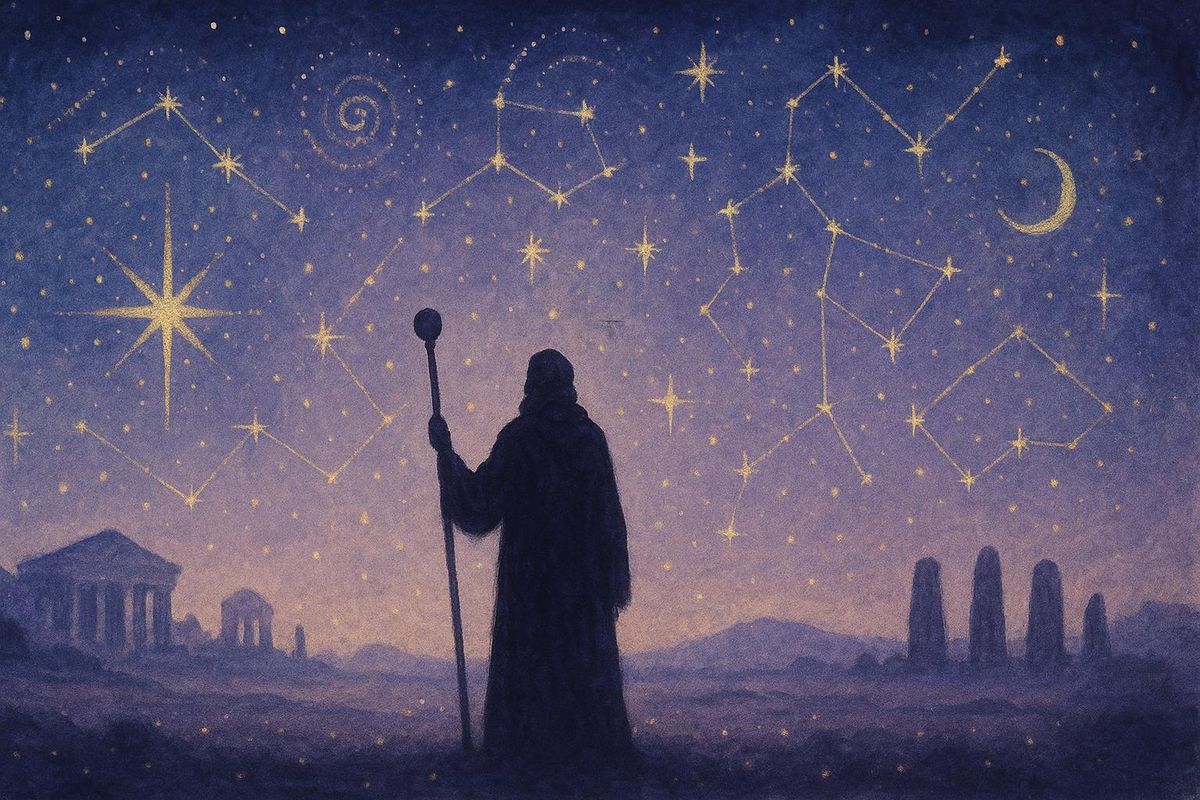
Long before telescopes, observatories and space probes, humans were watching the sky closely enough to recognise patterns that unfolded over years, decades and sometimes generations.
Ancient Egyptians connected calendars and religious festivals with the movements of the Sun, Moon and stars. Babylonian scholars recorded eclipses and planetary phenomena on clay tablets. Maya astronomers tracked the cycles of Venus. Pacific navigators crossed enormous stretches of ocean using stars alongside waves, winds and other natural signs. At Stonehenge, monumental architecture was deliberately aligned with the extreme positions of the Sun.
None of this requires a lost civilisation equipped with forgotten technology.
It required something humans are extremely good at when survival, religion and political power depend upon it: watching carefully, remembering patterns and passing knowledge from one generation to the next.
The real history of ancient astronomy is more impressive than many of the myths built around it.
The sky was a calendar before it was a science
For most of human history, the movements of the heavens were not remote scientific curiosities.
They affected everyday life.
The changing height of the Sun helped mark seasons. Lunar cycles divided time into recognisable periods. The appearance of particular stars could accompany seasonal changes. Farmers needed some way of anticipating planting and harvesting periods, rulers needed calendars for administration and religious communities needed to know when festivals should occur.
Astronomy, religion and practical timekeeping therefore developed together.
Our modern distinction between astronomy, which studies celestial bodies scientifically, and astrology, which assigns earthly meaning to their positions, would not always have made sense in the ancient world.
A Babylonian scholar recording an eclipse could be making a meticulous astronomical observation while also asking what that eclipse meant for the king.
Observation and interpretation belonged to the same intellectual system.
Egypt: Sirius, the calendar and the Nile
One of the best-known examples comes from ancient Egypt.
The brightest star in the night sky, Sirius, was known to the Egyptians as Sopdet and later to the Greeks as Sothis.
For part of each year Sirius disappears into the Sun's glare. Its heliacal rising, the moment when it becomes visible again shortly before dawn, occurred around the same broad period as the beginning of the annual Nile inundation.
That made it a particularly important celestial marker.
Egyptian New Year appears originally to have been associated with this reappearance of Sirius, and surviving texts connect Sopdet with the year itself.
It is sometimes said that Egyptian priests used Sirius to predict the exact Nile flood. That goes further than the evidence.
What we can say is that the star's appearance, the Egyptian calendar and the seasonal cycle of inundation became closely associated.
Sky and river were part of the same rhythm.
Egyptian astronomy went far beyond Sirius
Egyptians also developed systems for measuring time during the day and night.
They used shadow clocks and sundials, while groups of stars known as decans helped organise the night into periods of time.
An extraordinary astronomical ceiling from the tomb of Senenmut, dating to the reign of Hatshepsut, includes constellations, planets, decans and divisions connected with months and hours.
This was not astronomy separated from religion.
Stars could also be gods or connected with divine beings, while the afterlife itself had celestial dimensions. Early royal funerary texts imagine the dead king joining imperishable stars in the heavens.
Egyptians could observe the sky accurately while simultaneously understanding it as sacred.
Those two ways of seeing were not contradictory within their worldview.
Babylon: generations of watching the heavens
If Egypt gives us one extraordinary astronomical tradition, ancient Mesopotamia gives us another.
Babylonian scholars created some of the most extensive surviving records of celestial observation from the ancient world.
Clay tablets record lunar eclipses, planetary movements and astronomical predictions across long periods.
One British Museum tablet, for example, preserves a lunar eclipse table covering observations between roughly 609 and 447 BCE. Another records eclipses spanning an even longer period.
These observations allowed Babylonian astronomers to identify repeating patterns.
A British Museum eclipse table is organised around intervals of approximately eighteen years, after which similar kinds of lunar eclipse can recur.
This is serious cumulative science.
It depended not on one genius looking at the sky for a few years, but on a culture preserving observations long enough for patterns to emerge across generations.
Could the Babylonians predict eclipses?
To an important extent, yes. Once recurring eclipse patterns had been recognised, scholars could identify periods during which an eclipse was possible.
That did not mean ancient astronomers possessed the same physical model of the solar system that modern astronomy uses.
Prediction can develop before complete theoretical explanation.
You can notice that something repeats without knowing every underlying mechanism causing it.
Babylonian astronomy became increasingly mathematically sophisticated, eventually producing numerical methods for predicting celestial phenomena.
This work would later influence Greek astronomy and, through a much longer chain of transmission, the development of Western mathematical astronomy.
No lost technology is needed. Written records and sustained observation are powerful technologies in their own right.
But Babylonian astronomy was also astrology
The same scholars who recorded eclipses could interpret them as omens.
Celestial events might contain information about rulers, kingdoms, war, harvests or political change.
The great omen series known as Enuma Anu Enlil contains interpretations of events involving the Moon, Sun, planets and weather. Surviving Babylonian tablets preserve eclipse omens alongside astronomical observations.
To modern eyes this can look like science mixed with superstition. From inside the ancient worldview, the division was not so simple.
If the cosmos formed an interconnected divine order, then accurately observing the heavens was also a way of reading messages within that order. The accuracy of the astronomy does not scientifically validate the omen interpretation.
But neither should the presence of astrology cause us to underestimate the quality of the observation.
Stonehenge: architecture facing the Sun
Stonehenge has accumulated almost every kind of astronomical theory imaginable. Some are much better supported than others. The strongest is its relationship with the solstices.
The central stone arrangement was carefully constructed around a north-east to south-west solar axis. Around the summer solstice, the Sun rises towards the Heel Stone when viewed from within the monument. In the opposite direction, the midwinter Sun originally set between the uprights of the tallest trilithon.
That alignment is not accidental.
The builders deliberately placed the monument in relationship with the extreme annual positions of the Sun. What that meant to them is harder to establish.
Stonehenge was probably not an ancient observatory in the modern sense
Calling Stonehenge an observatory can create the wrong picture. There were no Neolithic astronomers sitting inside it producing scientific tables equivalent to Babylonian eclipse records.
The monument seems to have been deeply connected with ceremony, gatherings, burial and the ritual landscape surrounding it.
Its solar alignment may have helped structure those ceremonies.
Midwinter may have been particularly important. Archaeological evidence from nearby Durrington Walls suggests that people gathered from considerable distances, and the wider Stonehenge landscape contains monuments oriented towards different solstitial events.
Here, astronomical knowledge becomes architecture. The people who constructed Stonehenge knew where the Sun would rise and set at key moments of the year and built that knowledge permanently into stone.
What about the equinox?
This is a useful example of how modern ideas can become attached to ancient sites.
Stonehenge is now visited at the spring and autumn equinoxes as well as at the solstices.
But English Heritage notes that there is no evidence the builders deliberately marked the equinoxes, and archaeo-astronomers generally consider the solstitial relationship much stronger.
That distinction matters. The fact that a modern spiritual community finds meaning in celebrating the equinox at Stonehenge is one claim.
The claim that Neolithic people built Stonehenge to mark the equinox is a historical claim. They require different evidence.
The Moon may have mattered too
There is an intriguing second astronomical possibility at Stonehenge.
The Moon does not always rise and set in the same places. Over an approximately 18.6-year cycle, its extreme rising and setting positions reach what astronomers call a major lunar standstill.
Features at Stonehenge, including the orientation of the rectangle formed by the Station Stones, may relate to one of these lunar extremes.
Researchers are still investigating whether this was deliberate. English Heritage explicitly describes the lunar relationship as a possibility rather than settled fact.
This is a good reminder that archaeo-astronomers works through degrees of confidence.
Some alignments are obvious and strongly supported. Others remain fascinating hypotheses.
The Maya: time measured on enormous scales
Across the Atlantic, Maya civilisation developed a remarkably sophisticated tradition of calendars and astronomical observation.
Surviving Maya codices contain calculations involving the Moon, eclipses, planets and especially Venus.
The Dresden Codex includes a famous Venus table concerned with the appearances of Venus as Morning and Evening Star and with predicting its cycle. Smithsonian records of scholarship on the Maya codices document substantial astronomical material involving Venus, eclipses, lunar cycles, Mars, stars and the tropical year.
This knowledge was not simply recreational astronomy.
Celestial cycles interacted with ritual calendars, political life and religious interpretation.
Venus could carry profound significance in Maya cosmology.
Again, observation and meaning travelled together.
Were the Maya predicting the end of the world?
No. One of the largest modern distortions of Maya calendrical knowledge occurred around 2012, when the completion of a period in the Maya Long Count calendar was turned into predictions of apocalypse, dimensional transition and planetary transformation.
Those interpretations said considerably more about modern culture than ancient Maya astronomy.
Maya calendars worked through interlocking cycles.
The end of one period did not inherently mean the end of time.
This is precisely why ancient calendrical systems should be understood within their own traditions rather than treated as containers for whatever modern metaphysical idea happens to be fashionable.
The Maya really did possess impressive knowledge of celestial cycles.
They do not need an invented apocalypse to make that remarkable.
Chichén Itzá and the temptation to see alignments everywhere
Maya architecture is also frequently interpreted through astronomy.
Some alignments are well supported, while others remain disputed or have acquired layers of modern folklore.
This is a general problem in archaeo-astronomy. Given enough architectural lines, celestial bodies and dates, coincidences can be found.
The strongest claims therefore require repeated patterns, clear cultural significance and archaeological or textual support rather than a photograph in which the Sun appears near a particular corner once a year.
Ancient people absolutely built structures with celestial relationships.
That does not mean every unusual shadow was deliberately engineered as a secret astronomical code. Wonder works better when we allow evidence to decide which alignments deserve it.
Pacific navigation: a map carried in memory
Perhaps one of the most impressive examples of human star knowledge never required monumental buildings at all.
Pacific navigators crossed enormous areas of ocean without modern instruments.
Traditional wayfinding could use the rising and setting positions of stars, but stars were only part of a much larger environmental system. Navigators also observed ocean swells, winds, clouds, birds and other signs.
A modern Hawaiian star compass, developed within the revival of traditional wayfinding, organises the horizon according to where constellations rise and set. But it works alongside constant attention to the movement of the sea and other natural cues.
This was not a crude substitute for navigation.
It was a highly developed body of environmental knowledge carried through memory, training and experience.
Navigation reminds us what “ancient knowledge” really means
We sometimes hear the phrase ancient wisdom and immediately imagine secret texts.
Much knowledge was never primarily textual. It lived in trained bodies and memories. A navigator learned how a star moved relative to the horizon. A farmer noticed seasonal relationships. A priest knew when a celestial appearance marked a festival. A Babylonian scribe inherited tables compiled by predecessors.
Knowledge could accumulate through repeated observation even without telescopes, computers or precision instruments.
The crucial technologies were attention, memory, teaching and time.
How accurate could naked-eye astronomy become?
Very accurate indeed. The human eye cannot detect everything modern instruments reveal, but celestial movements are often remarkably regular.
The Sun changes its rising and setting positions predictably through the year. The Moon follows recognisable cycles. Bright planets move against the background stars.
Eclipses repeat according to patterns that can be detected over long records. Venus has a distinctive and highly noticeable cycle as Morning and Evening Star.
A culture that observes these phenomena carefully for hundreds of years possesses something no individual observer can obtain: long-term data.
That is the real advantage ancient astronomical traditions accumulated.
Why were monuments aligned with the heavens?
Sometimes for practical reasons. Sometimes for religious ones. Frequently both. A solar alignment can mark an important point in the year while also transforming architecture into ritual theatre.
Imagine entering a sacred space at exactly the moment a beam of sunlight reaches somewhere normally dark. The astronomical knowledge makes the experience possible. The religious culture gives it meaning. This is why the phrase “ancient observatory” can be inadequate.
A temple or monument might interact with the sky without existing primarily as a scientific instrument.
The heavens could organise ritual space.
Were ancient people more connected to cosmic cycles than we are?
In one very ordinary sense, almost certainly. Artificial lighting has radically changed modern relationships with the night sky.
Many people living in cities can see only a small fraction of the stars visible under dark conditions. Modern clocks and calendars also mean that we rarely need to determine the season or time from direct observation of the heavens.
An ancient farmer, sailor or priest could therefore possess forms of practical celestial awareness that many modern people simply never develop.
That does not automatically mean they had access to hidden cosmic truths.
It means the sky mattered more directly to daily life.
Did the ancients understand precession?
This is another area where strong claims need careful separation.
Axial precession is the slow wobble of Earth's rotational axis, causing the positions of the celestial poles and equinoxes relative to the stars to shift over roughly 26,000 years.
The Greek astronomer Hipparchus, working in the second century BCE, is generally credited with recognising precession by comparing observations from different periods.
Modern alternative histories sometimes argue that much earlier cultures already possessed detailed knowledge of the full precessional cycle.
Particular monuments and myths are then interpreted as encoded references to a 26,000-year “Great Year”. Some of these ideas are interesting.
But showing that an ancient structure is astronomically aligned is not the same as demonstrating that its builders knew the full mathematical cycle of axial precession.
Different claims require different evidence.
Astronomy did not need advanced lost technology
Ancient astronomical achievements are sometimes presented as impossible without telescopes, advanced mathematics or assistance from an earlier civilisation.
That underestimates ancient people. You do not need a telescope to observe the solstices. You do not need modern computers to record eclipse dates. You do not need satellites to navigate by the stars.
And you do not need extraterrestrial tutors to notice that Venus follows a repeating pattern. What these accomplishments require is patience, institutional continuity and cultures that consider celestial knowledge important enough to preserve.
Ancient civilisation had all three.
The spiritual sky
None of this means we have to drain spirituality from ancient astronomy. Quite the opposite. The evidence shows repeatedly that people connected the sky with gods, ancestors, kingship, fate, ritual and the afterlife.
The stars were not simply balls of plasma measured at enormous distances.
They participated in cultural worlds of meaning.
We can respect that without pretending those beliefs have been scientifically demonstrated.
There is a difference between saying the Egyptians associated Sirius with divine and calendrical meaning and saying Sirius emits a spiritual frequency that affects human consciousness.
The first is historical evidence. The second is a modern metaphysical claim.
What about astrology today?
Astrology is one of the most obvious descendants of humanity's ancient attempt to connect celestial patterns with earthly experience.
Its history is genuinely ancient, particularly in Mesopotamia and the Hellenistic world. Modern astrology, however, is not simply a perfectly preserved system handed down unchanged from Babylonian priests.
It developed dramatically across different cultures and historical periods.
Scientific testing has also not established astrological birth charts as reliable predictive mechanisms in the way astronomy predicts planetary motion or eclipses.
That does not prevent people using astrology as symbolism, reflection or spiritual practice. It simply places the claim in the right category.
What the ancients really knew
They knew the sky was patterned. They knew that those patterns could be observed, recorded and sometimes predicted.
They knew the Sun marked seasonal extremes.
They recognised lunar cycles.
Babylonian scholars developed mathematical methods for celestial prediction.
Egyptian calendars drew meaning from relationships between stars and seasonal rhythms.
Maya specialists modelled complex calendrical and planetary cycles.
Pacific navigators turned the night sky and ocean into a navigational system.
Neolithic builders incorporated the Sun into monumental architecture.
Those achievements are not evidence of a vanished technological civilisation.
They are evidence of how extraordinarily sophisticated sustained human observation can become.
The part we may have lost
Perhaps what modern people have lost is not secret astronomical knowledge but intimacy.
We know vastly more about the universe than ancient people did. We know what stars are made from, how far away they are and how galaxies evolve. We can detect planets orbiting stars that no unaided human eye could ever distinguish.
Yet it is possible to know all of that without knowing where the Moon will rise tonight.
Ancient cultures often knew less about the physical universe while paying more attention to its visible rhythms. There is something worth recovering in that, without pretending we need to recover their entire cosmology.
Go outside. Learn a few stars. Notice how the place of sunset changes across the year. Watch Venus appear and disappear.
See how different the Moon looks from one week to the next. Not because the heavens necessarily contain a coded personal message. Because human beings spent thousands of years learning that looking upwards changes how we understand our place in the world.
That part of ancient star knowledge remains available to anyone.