Who Were the Magi - and What Did They Really Know?
Matthew never says there were three Magi, never calls them kings and never gives their names. So who were these mysterious star-readers from the East?

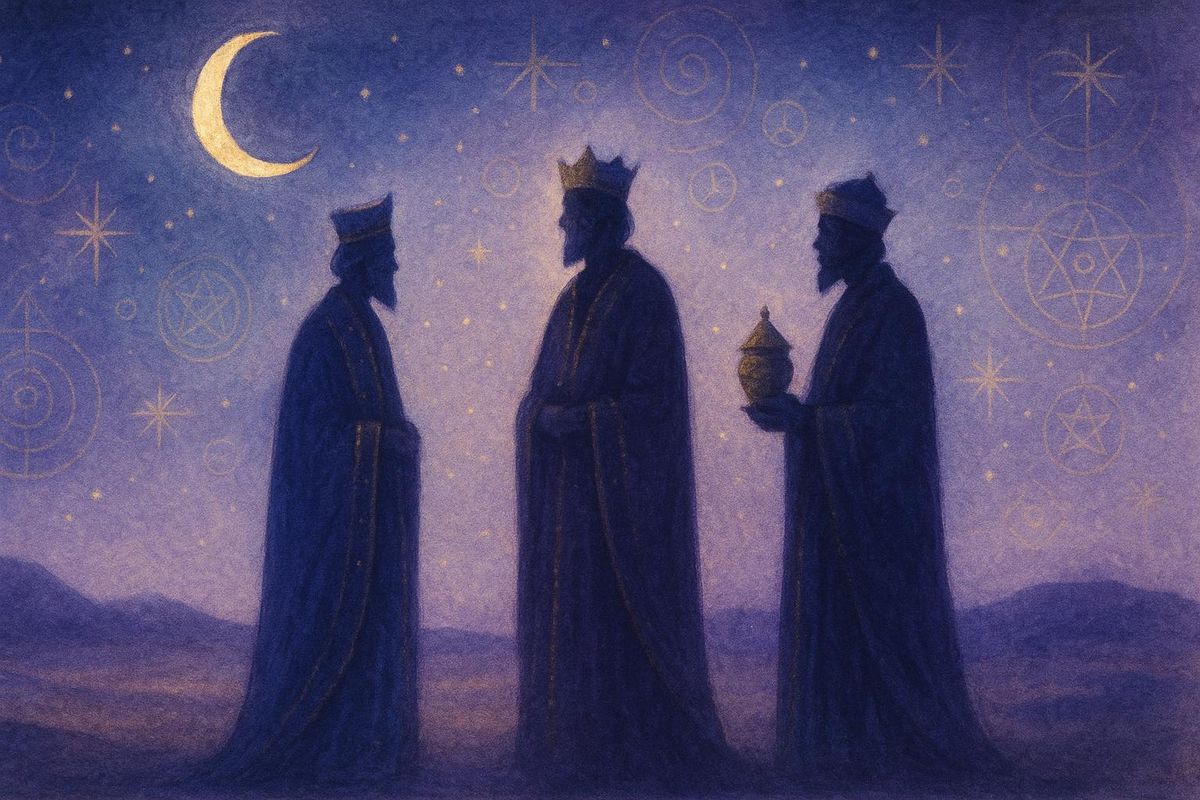
Three kings follow a miraculous star across the desert. They arrive at a stable, kneel before the infant Jesus and offer gold, frankincense and myrrh.
It is one of the most recognisable scenes in Christianity.
There is also something peculiar about it: much of what we think we know about the Magi is not actually in the Gospel of Matthew.
Matthew does not say there were three of them. He does not call them kings. He does not name them Caspar, Melchior and Balthasar, and he does not explicitly say they came from Persia.
What Matthew gives us is more mysterious. A group called magoi arrive “from the East” because they have observed an astronomical or astrological sign that they interpret as announcing the birth of a new king.
That single word, magoi, opens a door into the religious world of ancient Persia, astrology, priesthood, divination and the long history of humans reading meaning in the sky.
What does Matthew actually tell us?
The Magi appear only in the Gospel of Matthew's account of Jesus's birth.
They arrive in Jerusalem asking where they can find the newly born “king of the Jews”, explaining that they have seen his star. Their arrival troubles King Herod, who consults religious authorities and learns that Jewish prophecy associates the expected ruler with Bethlehem.
The Magi continue their journey and eventually find Jesus with Mary. They offer gold, frankincense and myrrh, and after being warned in a dream not to return to Herod, they leave by another route.
That is essentially the biblical story.
Matthew never gives their number.
The idea of three Magi probably developed because three gifts are listed.
Nor does Matthew describe them as kings. That tradition appears to have developed partly through interpretations of Hebrew scriptures describing kings bringing gifts and tribute to a divinely favoured ruler.
Their famous names appeared still later.
The familiar Christmas-card version therefore combines Matthew with centuries of Christian interpretation, art and legend.
So what does Magi mean?
The Greek word Matthew uses is magoi, plural of magos.
It has a complicated history.
The word was associated in Greek and Persian sources with a priestly group from the Iranian world. Greek writers had been discussing the Magi and Zoroaster centuries before Christianity, and Persia developed an enduring reputation in the Greek and Roman imagination as a source of unusual religious, astrological and magical knowledge.
Over time, however, magos became broader.
It could refer to a Persian priest, but also to someone associated with astrology, divination, dream interpretation or magic. Our English words magic and magician ultimately belong to the same linguistic family.
That means translating Matthew's visitors simply as “wise men” hides something.
These were not necessarily elderly philosophers carrying books of wisdom.
Matthew's first readers may have imagined people whose expertise included reading celestial signs.
Were the Magi Zoroastrian priests?
Possibly, but we should stop just short of stating it as fact.
Historically, Magi were associated with Iranian religion and eventually strongly with Zoroastrian priesthood. The connection is therefore far from arbitrary.
But Matthew tells us only that his Magi came from the East.
That could point towards Persia or Mesopotamia, regions with sophisticated traditions of celestial observation and astrology. Later Christians proposed several different homelands for them, including Persia, Babylon and Arabia.
Even the religious identity of early Iranian Magi is complicated by the development of Zoroastrianism itself. We should be cautious about imagining one unchanged priestly order extending neatly across many centuries.
The strongest formulation is therefore that Matthew's word would have carried Persian and astrological associations, making an Iranian background plausible without proving precisely who these particular figures were.
Astrology or astronomy?
For the ancient world, that distinction is slightly artificial.
People observed the sky with extraordinary precision because celestial movements mattered for calendars, agriculture, navigation and timekeeping.
But the heavens could also be read for meaning.
Planets, conjunctions, eclipses, comets and unusual stellar appearances might be connected with political events, the fortunes of kingdoms or the births and deaths of rulers.
This was not fringe behaviour.
Astrological interpretation could operate at the courts of powerful rulers throughout the ancient Near East.
The Magi therefore make sense as people able to look at something in the heavens and interpret it not merely as an astronomical event but as a message about events on Earth.
The real mystery is what they thought they saw.
What was the Star of Bethlehem?
Almost every generation seems to produce a new answer.
Proposals have included a comet, a nova or supernova, unusual planetary conjunctions and astrological arrangements involving Jupiter, Saturn and other planets.
None has achieved universal agreement.
A recent scholarly proposal has again investigated a cometary interpretation, illustrating that attempts to connect Matthew's star with an identifiable astronomical event remain very much alive.
There is another possibility too.
Matthew may be writing theological narrative rather than preserving a straightforward astronomical observation.
In the story, the star identifies a royal birth, leads outsiders towards Jesus and places the heavens themselves within Matthew's account of who this child is.
The star can have theological meaning whether or not we eventually identify a specific celestial event behind it.
Would ancient astrologers have looked for the birth of kings in the sky?
Absolutely.
This is one of the most historically plausible aspects of Matthew's story.
Astrology in the ancient Mediterranean and Near East was deeply interested in rulers, kingdoms and political change. Celestial phenomena could be interpreted as announcing the rise of kings or changes in earthly power.
Matthew's Magi therefore do something entirely intelligible within their cultural world.
They observe a sign.
They interpret it politically.
Then they travel to the obvious place to look for a new Jewish king: the court of the existing king in Jerusalem.
That decision nearly proves disastrous.
Herod and the problem of reading signs correctly
There is an interesting irony in the story.
The Magi know enough to recognise that something important has happened, but not enough to know exactly where.
Their celestial knowledge takes them to Jerusalem.
Scripture then points towards Bethlehem.
Matthew brings two systems of knowledge together: the outsiders can read the heavens, while Jewish religious scholars can read the prophetic texts.
Neither system alone completes the journey.
That makes the Magi more interesting than simple embodiments of ancient wisdom.
They are seekers whose knowledge is significant but incomplete.
Were they magicians?
The answer depends heavily on what we mean by magic.
The Greek magos could certainly acquire the meaning of magician or sorcerer. Elsewhere in early Christian literature, related terminology is used much less positively.
But separating ancient astrologer, ritual expert, priest and magician into completely different professions imposes modern boundaries on a world that did not necessarily share them.
If Matthew intended his readers to hear something exotic or even slightly uncomfortable in the word magoi, that could be significant.
The first people from outside the Jewish world to recognise Jesus in Matthew's gospel are not Roman officials or Greek philosophers.
They are mysterious eastern interpreters of the stars.
Why did they become kings?
The biblical text left space that later tradition eagerly filled.
Christian interpreters connected the story with older scriptural passages in which kings and nations bring gifts to a divinely chosen ruler.
Eventually the Magi themselves became kings.
This also strengthened an important theological interpretation of the story: rulers from the nations come to recognise Christ.
By the medieval period, the three kings had become richly developed characters in Christian culture.
What began as unnamed magoi from the East had acquired crowns, biographies, individual appearances and names.
Were there really three?
Again, Matthew does not say.
Three became standard in Western Christianity because there are three gifts: gold, frankincense and myrrh.
Other Christian traditions imagined different numbers. In some Eastern traditions there were twelve Magi, and early artistic representations varied.
The number three therefore belongs to tradition rather than the original text.
That does not make the tradition meaningless.
It tells us something about how stories grow.
Once three gifts existed, three gift-bearers created a satisfying symmetry.
Where did Caspar, Melchior and Balthasar come from?
Not from Matthew.
The names developed centuries later and differed between Christian cultures.
The Western names usually rendered Caspar or Gaspar, Melchior and Balthasar became established during the medieval period, while Syrian and Armenian traditions preserved entirely different names.
Over time the three Magi were also used symbolically to represent different ages of man and eventually different regions or peoples of the known world.
The story expanded from mysterious eastern visitors into an image of humanity itself arriving to recognise Christ.
Again, this is theology and tradition developing around the text, not lost biographical information about three historical men.
What did their gifts mean?
Matthew specifies three gifts: gold, frankincense and myrrh.
They were genuinely valuable commodities.
Gold requires little explanation. Frankincense and myrrh were prized aromatic resins traded over long distances and used in religious, medicinal and funerary contexts.
Later Christian interpretation gave each gift increasingly specific symbolism.
Gold represented kingship.
Frankincense represented divinity or priesthood because incense was used in worship.
Myrrh became associated with suffering, burial and death.
These interpretations fit the later Christian understanding of Jesus remarkably well, but we should distinguish them from Matthew explicitly explaining what each Magus intended.
The gospel tells us what they offered.
Later Christians explained what the gifts meant.
Could the gifts tell us where the Magi came from?
Possibly, but not conclusively.
Frankincense and myrrh were especially associated with trade routes running through Arabia and the wider Near East. That has helped fuel suggestions that the travellers could have come from Arabia rather than Persia.
Biblical imagery concerning rulers bringing gold and incense from distant lands may also have shaped Matthew's literary presentation.
Once again, the evidence refuses to settle neatly.
Persian associations fit the word magoi.
Arabian associations fit some of the gifts and scriptural imagery.
Mesopotamia fits the broader world of ancient astrology.
“From the East” remains frustratingly broad.
Did the Magi predict Jesus?
Claims are sometimes made that Zoroastrian prophecy specifically predicted Jesus and that the Magi were priests who had been waiting for his birth.
That goes beyond what we can establish.
Zoroastrian tradition did develop important ideas about future saviour figures, particularly the Saoshyant, and scholars have investigated possible relationships between Iranian religious traditions and Matthew's presentation of the Magi.
There are interesting parallels.
But similarity does not prove that a group of Zoroastrian priests possessed a specific prophecy saying that Jesus would be born in Bethlehem and were waiting for his star.
That is a much stronger claim than the evidence allows.
Why would Matthew include astrologers in the story?
This may be the most interesting question.
The Magi are outsiders.
They do not belong to Israel.
They apparently practise a form of celestial interpretation that later Christian attitudes towards astrology would often regard with suspicion.
Yet in Matthew's story, they see something that Herod does not.
They recognise significance beyond their own religious and cultural world and travel towards it.
Meanwhile Herod, who possesses political power and access to scriptural experts, responds with fear and violence.
The contrast is striking.
The strangers are looking.
The king is defending his position.
Matthew's message is theological, but the structure is almost archetypal.
Sometimes the person furthest from the centre notices what the centre itself cannot see.
The Magi and the ancient relationship with the sky
The story also comes from a world in which the boundary between heaven and Earth was more permeable than modern Western culture often assumes.
The sky was not merely empty physical space.
Celestial events could possess meaning.
The movements of the heavens shaped calendars, rituals, agricultural life and political prediction. Gods and cosmic order were connected with celestial bodies across many ancient cultures.
We should be careful not to romanticise that world as possessing some lost scientific truth.
But neither should we underestimate the seriousness with which ancient people observed the heavens.
The Magi stand at that meeting point between observation and interpretation.
They look at the same sky everyone else sees.
What distinguishes them is what they believe it means.
Does their story validate astrology?
Not scientifically.
Matthew's theological story is not evidence that modern natal astrology or predictive astrology has been scientifically demonstrated.
It does, however, provide fascinating historical evidence of something else: humans have been reading meaning into celestial patterns for a very long time.
Those systems were often sophisticated.
They could influence rulers.
They moved between cultures.
And they show how difficult it once was to separate observation of the physical universe from questions about divine intention.
Whether celestial events actually carry personal messages is a further metaphysical question.
The history alone is remarkable.
Were the Magi part of a mystery school?
The Magi are sometimes presented as members of an ancient Mystery School possessing secret universal knowledge.
There is no evidence for that specific claim.
They represent an ancient type of specialist interpreter: somebody trained to notice patterns ordinary people might overlook and to connect celestial events with human affairs.
Priest.
Astrologer.
Diviner.
Adviser.
Perhaps magician, depending on who was describing them.
Those categories overlapped in the ancient imagination in ways our modern labels can obscure.
The Magi remind us that knowledge was not always divided into religion, science, astronomy and magic as neatly as it is today.
What did the Magi really know?
Historically, we cannot know exactly who Matthew's Magi were, where they lived or what training they possessed.
We can say that the term had strong associations with the Iranian world and with specialists in religion, astrology and divination. We can say that ancient people genuinely interpreted celestial events as signs concerning kings and kingdoms. And we can say that Matthew deliberately makes these eastern outsiders the people who recognise a royal birth written in the heavens.
Beyond that, the story moves into interpretation.
Were they Persian priests?
Possibly.
Did a real astronomical event provoke the journey?
Possibly.
Did they possess a Zoroastrian prophecy of Jesus?
We cannot establish that.
Were they three kings named Caspar, Melchior and Balthasar?
That belongs to the magnificent afterlife of the story rather than Matthew's original account.
And perhaps that distinction gives us the most interesting version of the Magi.
Not three perfectly documented sages carrying a secret doctrine across the desert, but a group of unidentified eastern star-readers who appear briefly in one ancient gospel, recognise something extraordinary, offer their gifts and disappear again.
For two thousand years, people have been trying to fill in the space they left behind.