Chalice Well & the White Spring: Sacred Waters of Glastonbury
Two springs rise beneath Glastonbury Tor: one red with iron, one white with calcite. Explore their history, symbolism, legends and enduring sacred significance

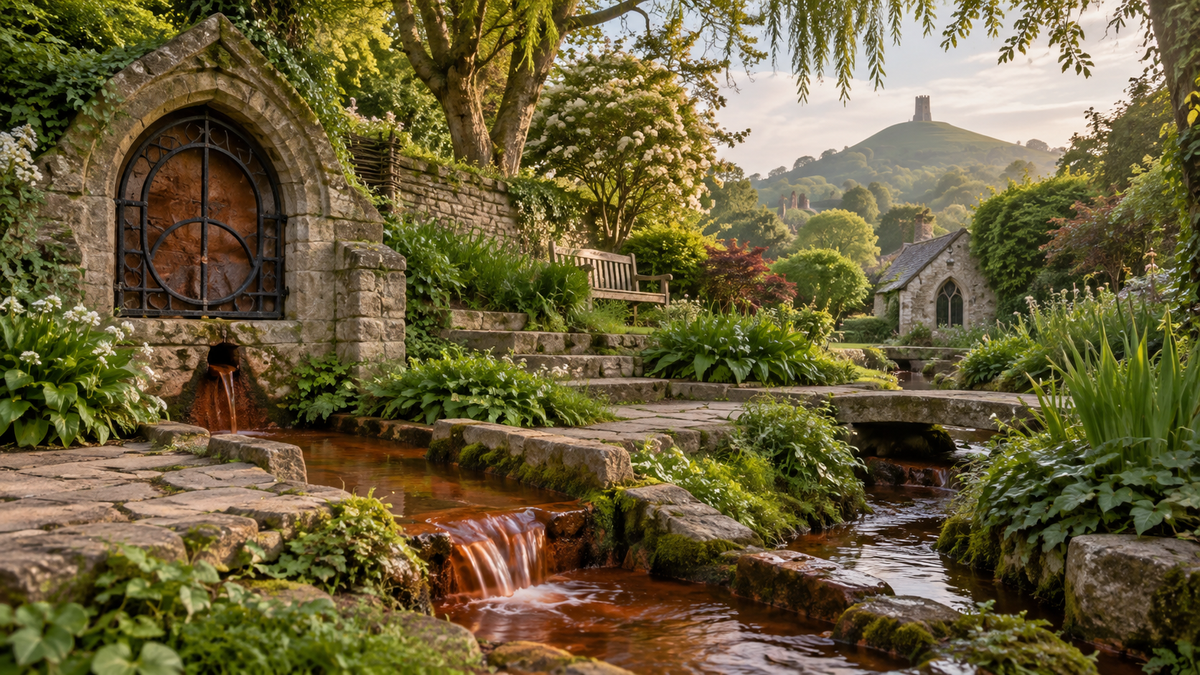
At the foot of Glastonbury Tor, two springs emerge astonishingly close to one another. One runs red. The other runs white.
Chalice Well carries iron-rich water that stains stone orange and rust-red. A short distance away, the White Spring flows through calcite-rich rock, leaving pale mineral deposits.
That physical contrast has become something much larger.
For generations, visitors have interpreted the two springs as complementary forces: red and white, sun and moon, masculine and feminine, blood and milk, fire and water.
Those meanings belong to spiritual tradition rather than geology. But the springs themselves are very real.
And so is the long history of human attention around them.
Two springs beneath the Tor
Chalice Well rises on the southern slope beneath Glastonbury Tor.
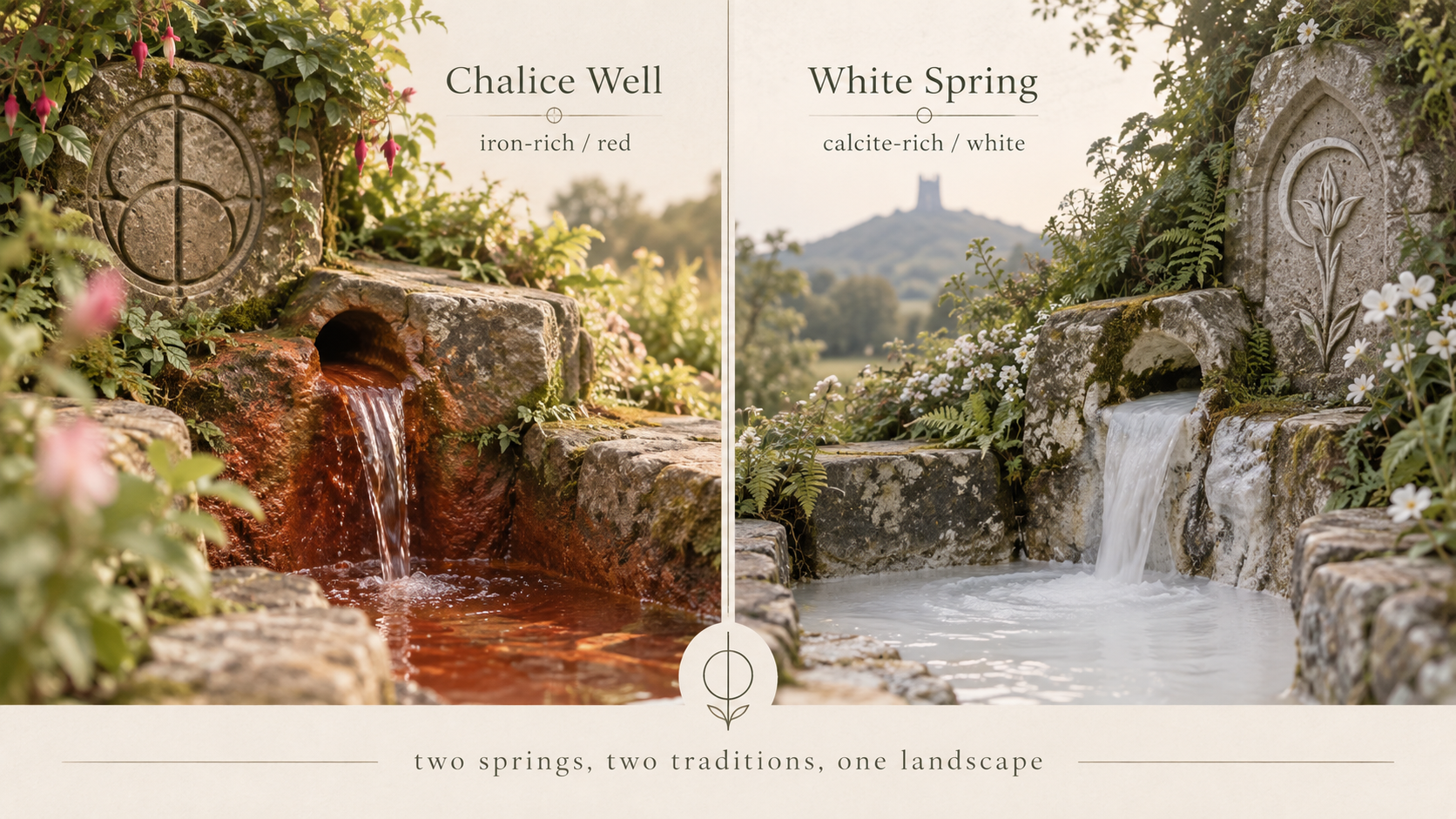
It is a chalybeate spring, meaning the water contains dissolved iron.
When the iron-rich water reaches the air, oxidation produces the distinctive orange-red staining visible throughout the gardens.
The White Spring, nearby on Wellhouse Lane, has a very different mineral character.
Its water is associated with calcite deposits and appears pale or white against the stone.
The White Spring's own community describes the two springs as rising within a few feet of one another beneath the Tor. (whitespring.org.uk)
Geologically, different underground water routes can pass through different rock layers and emerge with different mineral compositions.
Spiritually, the contrast was almost irresistible. Two waters. Two colours. One hill.
Chalice Well
Chalice Well is the more formally preserved of the two sites.
The spring sits within four acres of gardens managed by the Chalice Well Trust, founded by Wellesley Tudor Pole in 1959.
The site is Grade I listed, and Historic England records the well as a chalybeate spring with a stone-built structure, underground chambers and an eighteenth-century courtyard and bathing area. (historicengland.org.uk)
The gardens are deliberately quiet. Water moves through pools, channels and fountains. Visitors sit beneath trees, walk through planted terraces or drink from the spring at the Lion's Head fountain.
The overall effect is less dramatic than Glastonbury Tor. That may be part of its power. Chalice Well asks people to slow down.
How old is Chalice Well?
This is one of those questions where archaeology and legend need separating.
The spring itself is natural and has almost certainly flowed for far longer than any surviving human structure around it.
Archaeological investigation has found evidence of human activity in the area stretching back into prehistory, including worked flints and later Iron Age, Roman and medieval material.
The existing well structure, however, is much later.
Archaeologist Philip Rahtz's excavations in 1960–61 suggested that the spring was enclosed in a substantial well house in the late twelfth century.
The Somerset archaeological assessment records evidence that the water source had been used earlier and that the medieval enclosure altered the immediate landscape around the spring. (somersetheritage.org.uk)
So the careful version is: the spring is ancient; the surviving built structure is medieval and later.
That is more interesting than trying to force everything into one date.
The Grail legend
Chalice Well's most famous story links it to Joseph of Arimathea and the Holy Grail.
According to later Glastonbury tradition, Joseph travelled to Britain after the crucifixion of Jesus. Some versions of the story say he brought the cup used at the Last Supper. Others say he carried vessels containing Christ's blood and water.
In the Chalice Well tradition, those sacred fluids become symbolically connected with the red spring. The iron-rich water makes the association visually compelling. But the Grail connection belongs to medieval and later legend.
There is no contemporary historical evidence that Joseph of Arimathea travelled to Glastonbury or buried the Grail here. That does not make the legend unimportant.
Glastonbury has spent centuries accumulating stories around itself. The Grail story is now part of the cultural and spiritual landscape of the town.
Avalon
The springs are also inseparable from Glastonbury's association with Avalon. Medieval writers connected Glastonbury with the legendary burial place of King Arthur. Later antiquarians, mystics and spiritual seekers expanded that identification until "Glastonbury" and "Avalon" became almost interchangeable in modern esoteric culture.
Chalice Well sits directly within that imaginative landscape. Water emerges from beneath the Tor. The Abbey lies nearby. Arthurian stories surround the town.
The land itself once sat amid marshes and wetlands, making the higher ground around Glastonbury appear island-like in earlier periods.
History and myth reinforce one another here.
The result is not evidence that Glastonbury literally was the Avalon of Arthurian romance. It is evidence that landscapes can become powerful containers for story.
The Vesica Piscis
One of the most recognisable features of Chalice Well is the wrought-iron cover over the wellhead.
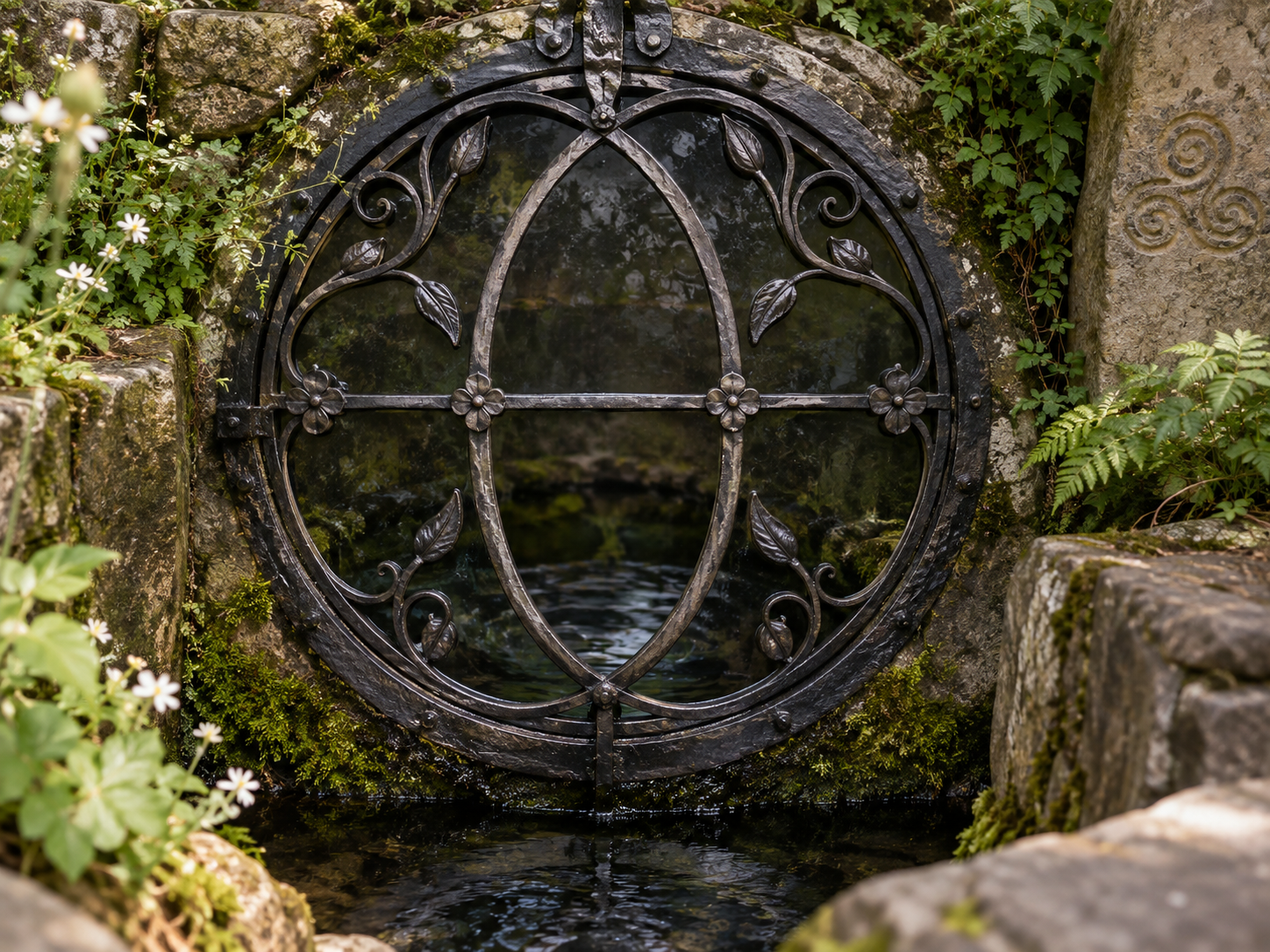
Its central motif is the vesica piscis: two overlapping circles creating an almond-shaped form where they intersect.
The design was created by architect and archaeologist Frederick Bligh Bond with Alice Buckton and dedicated in 1919. Within the Chalice Well tradition, the symbol represents the meeting of complementary opposites.
- Heaven and Earth.
- Masculine and feminine.
- Visible and invisible.
- Potential and manifestation.
The symbolism is modern in its specific Chalice Well form, even though the geometry itself is ancient and appears widely in Christian art and architecture.
This distinction is useful. A symbol can have a long history without every modern interpretation being equally ancient.
Alice Buckton and the modern sanctuary
The sacred identity of Chalice Well today owes a great deal to Alice Buckton. Buckton purchased Chalice Well and its surrounding land in 1913.
She was a playwright, educator and supporter of women's emancipation who became deeply involved in the spiritual and cultural revival developing around Glastonbury in the early twentieth century.
She established educational and craft activities at the site and supported performances and events drawing on Arthurian and spiritual themes.
This matters because Chalice Well is not simply an untouched survival from antiquity. The sanctuary visitors experience today was consciously shaped by people who believed Glastonbury could become a renewed spiritual centre.
Wellesley Tudor Pole
Another crucial figure was Wellesley Tudor Pole.
He first visited Chalice Well in the early twentieth century and later founded the Chalice Well Trust in 1959 to preserve the site.
Tudor Pole was deeply involved in twentieth-century British mysticism and believed certain places acted as spiritual centres where the boundary between ordinary and sacred experience became unusually thin.
His influence helped establish the modern identity of Chalice Well as a place open to many spiritual traditions rather than one defined exclusively by Christianity.
The Trust still describes its ethos as "Many Paths, One Source." (chalicewell.org.uk)
That phrase captures the modern character of the place surprisingly well.
The White Spring
Walk only a short distance from Chalice Well and the atmosphere changes completely. The White Spring is housed within a dark Victorian well house on Wellhouse Lane.
Where Chalice Well is gardens, daylight and carefully cultivated beauty, the White Spring is stone, echo, candlelight and running water.
The contrast is dramatic. The building contains three vaulted chambers and pools fed by the spring. The current White Spring community has deliberately created a temple-like sacred space within the former Victorian waterworks.
Shrines honour figures and traditions associated with Avalon, including Brigid and Our Lady of Avalon.
Visitors may sit quietly, meditate or enter the water when conditions allow.
Photography and mobile phones are prohibited inside, which helps preserve the atmosphere. (whitespring.org.uk)
Is the White Spring ancient?
The water source is natural. The building around it is not. The current well house is Victorian. Its identity as a contemporary spiritual temple has developed much more recently.
This is important because online descriptions can sometimes give the impression that visitors are entering an ancient pagan sanctuary unchanged for thousands of years.
They are not. They are entering a modern sacred space built around an old natural feature. That does not make it less meaningful. It simply tells us where the different layers of history actually belong.
Red and white waters
Modern Glastonbury spirituality often interprets Chalice Well and the White Spring as paired opposites.
The red spring may be associated with:
- blood
- iron
- Earth
- masculine energy
- the Sun
The white spring may be associated with:
- milk
- calcite
- Moon
- feminine energy
- purification
These correspondences vary depending on the tradition. There is no scientific evidence that the two waters possess masculine or feminine energetic properties. What we do have is a striking natural contrast that invites symbolism.
Human beings have always made meaning from colour. Here, geology provides the palette. Spiritual tradition paints the picture.
Are the waters healing?
Both springs are frequently described as healing waters. Historically, holy wells throughout Britain acquired healing reputations, and mineral springs were often valued medicinally.
Chalice Well's own tradition strongly emphasises healing, contemplation and spiritual renewal. The White Spring likewise describes its waters within a healing and sacred framework.
Those are traditions and reported experiences. They should not be confused with medical evidence that drinking or bathing in either spring cures illness.
If you drink untreated spring water anywhere, follow current site guidance.
Natural does not automatically mean medically safe.
Ley lines and the Michael line
The Glastonbury landscape is central to modern British ley-line and Earth-energy traditions.
Dowsers and Earth Mysteries writers have identified claimed energy alignments crossing the area, most famously the Michael and Mary lines associated with Hamish Miller and Paul Broadhurst.
The White Spring community describes the Michael line as passing through the site. (whitespring.org.uk)
These are modern dowsing and spiritual interpretations rather than scientifically measured energy pathways. They nevertheless form a major part of Glastonbury's contemporary sacred geography.
This is a useful example of how different traditions become layered onto one landscape. Natural springs. Medieval Christianity. Arthurian legend. Modern dowsing. Goddess spirituality. New Age pilgrimage.
All of them now meet beneath the Tor.
Why water matters here
Even without Grail legends or ley lines, water explains much of the importance of this place.
Springs attract settlement. Reliable water matters. Mineral-rich water appears unusual. A spring emerging apparently from inside a hill can feel mysterious.
Water also carries unusually strong symbolic associations across cultures: life, purification, rebirth, healing, crossing and renewal
The two Glastonbury springs intensify those themes simply because they are different. One stains the land red. One leaves pale mineral deposits. It is easy to understand why people saw meaning in that contrast.
For a wider look at this pattern, see Water, Ley Lines and Sacred Landscape.
Practical differences
Chalice Well is a managed garden and heritage site with admission charges and regular opening hours.
The White Spring is a volunteer-run sacred space. Entry is free, although opening depends on volunteer availability.
The White Spring may permit bathing in its pools, subject to current conditions and guidance.
Chalice Well allows paddling in designated areas but is not primarily a bathing site.
Opening arrangements can change, so check both official websites before travelling specifically for access.
What is documented and what belongs to tradition?
This pair of springs is a perfect example of why we should separate different kinds of claims.
Documented
- Chalice Well is a natural iron-rich spring.
- The surviving well structure is substantially medieval and later.
- Archaeology shows long-term human activity around the site.
- The White Spring has a contrasting mineral character and is housed within a Victorian well building.
- Chalice Well became a major modern spiritual sanctuary through figures including Alice Buckton and Wellesley Tudor Pole.
Tradition and interpretation
- Joseph of Arimathea is said to have brought the Grail or Christ's blood to Glastonbury.
- The springs are associated with Avalon.
- Red and white waters are interpreted as complementary masculine and feminine energies.
- Modern dowsing traditions place ley lines through the landscape.
- Visitors describe both sites as spiritually powerful and healing.
All of those traditions matter. They simply do not carry the same evidential weight.
Why the two springs belong together
It would be easy to turn Chalice Well and the White Spring into competing spiritual brands. That misses what makes them interesting. They are two responses to the same underlying landscape.
Chalice Well expresses sacred water through gardens, peace, symbolism and interfaith spirituality. The White Spring expresses it through darkness, immersion, ritual and a deliberately elemental atmosphere.
Perhaps that is why the modern idea of complementary opposites fits them so easily. The symbolism may be interpretation. The contrast is undeniable.
Frequently asked questions
Why is Chalice Well water red?
The spring contains dissolved iron. When the water reaches the air, oxidation produces the characteristic orange-red staining.
Why is the White Spring white?
The White Spring is associated with calcite-rich water, which leaves pale mineral deposits.
Are Chalice Well and the White Spring the same spring?
No. They are separate water sources located very close to one another beneath Glastonbury Tor.
Is Chalice Well connected to the Holy Grail?
Glastonbury tradition links the spring with Joseph of Arimathea and the Holy Grail, but there is no historical evidence proving that the Grail was brought to or buried at Chalice Well.
Can you drink Chalice Well water?
Visitors can normally access the water at designated points, but always follow the site's current guidance regarding drinking untreated spring water.
Can you bathe in the White Spring?
The White Spring currently permits visitors to enter designated pools when conditions allow. Check its current guidance and opening arrangements before visiting.
Are the springs on ley lines?
Modern dowsing traditions identify claimed ley lines through Glastonbury, including the Michael line. These remain spiritual or dowsing interpretations rather than scientifically demonstrated energy pathways.
Continue exploring
Glastonbury Tor
Next in our Sacred Places series: the hill above the springs, its archaeology, Arthurian traditions and modern reputation as one of Britain's great spiritual landmarks.
Water, Ley Lines and Sacred Landscape
Why holy wells, springs and underground water appear so frequently in sacred landscapes.
How to Recognise an Energy Node
Explore why certain places accumulate unusual spiritual traditions and reports of powerful experience.