Water, Ley Lines and Sacred Landscape: Why Springs, Wells and Rivers Matter
From holy wells to underground streams, explore why water appears so often in sacred landscapes and what ley-line traditions claim about its energy.

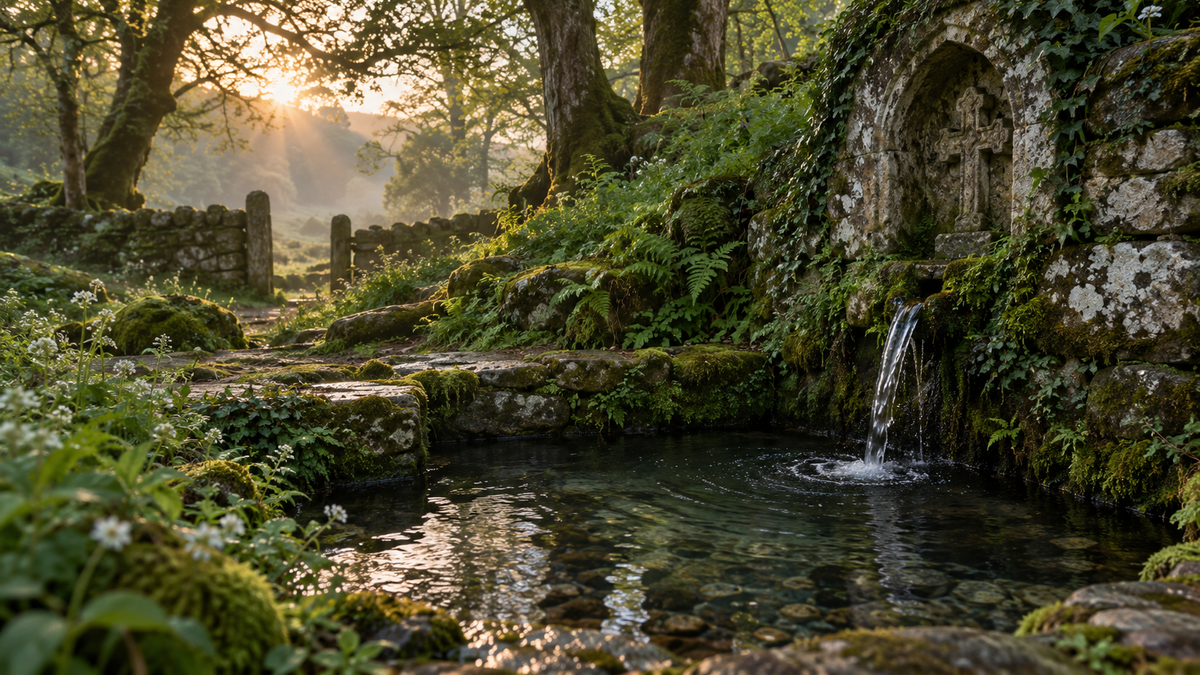
Water appears again and again in sacred landscapes.
Holy wells. Springs. Rivers. Confluences. Lakes. Fountains. Underground streams. Pilgrimage routes that end at water, and sacred buildings placed beside it.
In modern Earth-energy traditions, water is sometimes said to strengthen ley lines, concentrate subtle energy or mark the presence of an energetic node. Dowsers have also long associated underground water with changes in rod movement.
But there is a much bigger story here.
Water shapes landscapes physically, attracts settlement, creates boundaries and routes, supports life and carries unusually powerful symbolic meanings. Across many traditions it is associated with cleansing, healing, rebirth, prophecy and transition.
So when sacred places and water repeatedly appear together, several explanations may be operating at once.
Some are historical. Some are geological. Some are psychological. And some belong firmly to spiritual tradition.
Why water becomes sacred
Human beings have always needed water, so springs, rivers and wells naturally became important places.
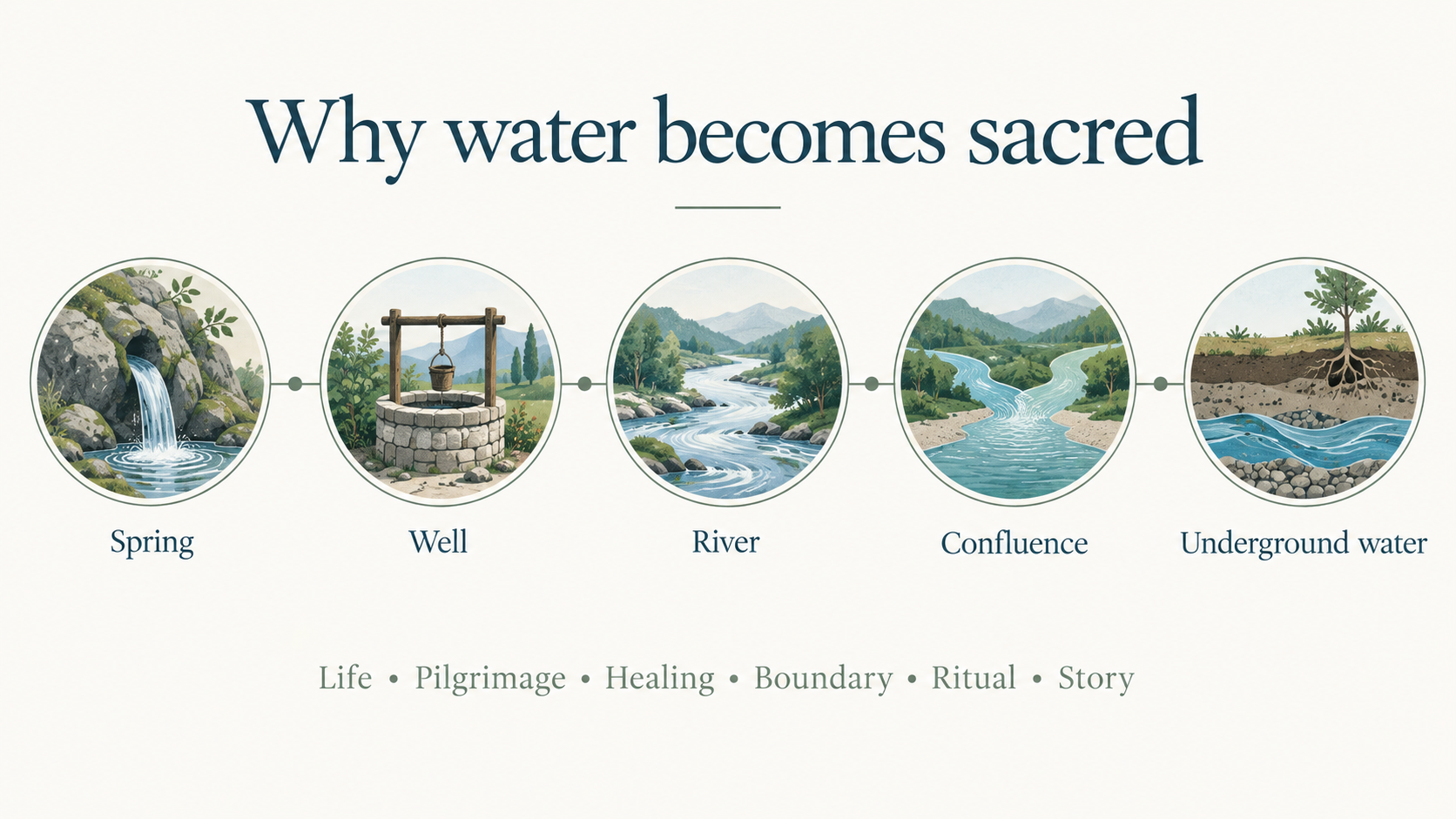
But practical importance does not fully explain the extraordinary amount of ritual and folklore that accumulated around them.
In Britain, the veneration of springs and wells predates Christianity in some places. Historic England notes that although Christian holy wells are known from at least the early medieval period, some appear to have developed from earlier sacred traditions. Medieval wells were associated not only with baptism and saints but also with healing beliefs, divination and the giving of coins or other offerings.
Water was useful, but it was also liminal.
It emerged mysteriously from the ground. It disappeared underground. It reflected the sky. It changed form. It sustained life and could also destroy it.
Those characteristics made water a natural focus for sacred meaning.
Springs and holy wells
Springs are particularly potent sacred places because they seem to emerge directly from the Earth.
Before modern hydrology, the origin of a spring could be mysterious. Water simply appeared from rock, soil or hillside and continued to flow. That made springs easy to understand as gifts, thresholds or points of contact with something beneath the visible landscape.
Britain still contains hundreds of documented holy wells. Their traditions vary, but recurring themes include healing, saints, fertility, prophecy and pilgrimage. Some remain simple springs. Others gained stone structures, chapels or pools around them.
The sacredness may have changed language over centuries while the place itself endured.
Rivers, boundaries and crossings
Rivers work differently.
They create movement through a landscape and divide one territory from another. Crossing a river can therefore have both practical and symbolic significance.
Bridges, fords and confluences often become important places because they concentrate movement. Rivers can also mark thresholds: between settlements, territories, worlds or stages of a journey.
This helps explain why spiritual traditions so often use rivers as metaphors for transition, purification and passage. A river does not have to emit subtle energy to profoundly organise the sacred geography around it.
Why water appears in ley-line traditions
Modern ley-line and Earth-energy traditions frequently connect water with energetic movement.
Some practitioners believe underground streams intensify ley lines or create additional energetic crossings. Others describe springs and wells as natural nodes where water and Earth energy emerge together.
Dowsing traditions are especially important here. For centuries, dowsers have used rods or forked sticks in attempts to locate underground water. Later Earth-energy practitioners applied similar methods to claimed ley lines and power places.
That creates an obvious conceptual bridge: underground water + dowsing + sacred landscape + ley lines
But those ideas should not be collapsed into a single proven mechanism.
Controlled research has not established dowsing as a reliable method for detecting either underground water or ley-line energy under blinded conditions.
Practitioners nevertheless continue to use it as part of personal fieldwork.
Does moving water create electromagnetic fields?
Water can certainly participate in physical electrical processes.
Moving fluids containing dissolved ions can generate extremely small electrical effects under certain conditions, while groundwater also interacts with minerals, rock structures and the wider geophysical environment.
But that is very different from saying: “Underground streams amplify spiritual energy.”
There is currently no established scientific evidence that ordinary flowing groundwater creates a measurable field corresponding to the subtle-energy systems described in ley-line traditions.
This distinction matters. Real geology can be fascinating without being recruited as proof of metaphysics.
Water and geology
Water profoundly shapes the physical character of sacred places. Springs occur because of geology.
Where permeable and impermeable rock layers meet, groundwater may emerge at the surface. Faults, limestone systems and underground channels can create springs, caves and unusual water features.
Those geological processes also shape vegetation, sound, humidity and the appearance of a place.
A sheltered spring beneath trees feels very different from an exposed hilltop. A cave containing running water creates a completely different sensory environment from the land above it. Those effects are real.
They may contribute to why certain places feel charged, peaceful, eerie or sacred.
Does water amplify a sense of place?
Almost certainly.
Running water changes sound. Reflections alter light. Humidity affects smell and temperature. Vegetation becomes denser. Movement attracts the eye.
The body may relax in response to the environment long before the conscious mind decides that a place feels special. There is also expectation.
When you approach a place called a holy well, healing spring or sacred river, you arrive within a story. That story changes what you notice. None of this invalidates spiritual experience.
It simply shows how many layers can contribute to it.
The spiritual idea of water as an energetic conductor
Within modern metaphysical traditions, water is often understood as more than a physical substance.
It may be described as:
- storing intention
- carrying subtle information
- amplifying ritual
- cleansing energetic residue
- connecting energetic sites
- responding to consciousness
These ideas occur widely in contemporary spiritual practice.
They should, however, be treated as spiritual or metaphysical interpretations rather than demonstrated properties of water. That still leaves room to explore them.
A ritual does not stop being meaningful because its mechanism cannot be measured.
Holy wells and healing traditions
Healing is one of the strongest recurring themes around sacred water.
Historic English well traditions include waters associated with particular illnesses, fertility, eyesight and general blessing. Offerings might be left, prayers spoken or specific rituals performed.
Historically, people did not divide physical, spiritual and social healing as neatly as modern medicine tends to.
A pilgrimage to a well could therefore involve faith, community, landscape, ritual and bodily expectation all at once.
Some waters also contain unusual mineral concentrations, although that should never be assumed from a healing tradition alone.
And naturally occurring water is not automatically safe to drink.
Chalice Well and the White Spring
Glastonbury gives us a particularly useful example because two famous springs emerge close together beneath the Tor.
Chalice Well is associated with iron-rich water, which gives the spring its distinctive reddish staining. Nearby, the White Spring carries water through a very different ritual environment.
Both have accumulated layers of Christian, Arthurian, pagan and modern spiritual interpretation. For some visitors, the two springs represent complementary energetic qualities.
For others, they are primarily sacred places shaped by history, water and pilgrimage.
They are also an excellent reminder that different cultural stories can accumulate around a physical feature without requiring us to choose one single explanation.
Water beneath sacred buildings
Claims that temples, churches or stone circles were deliberately positioned above underground water appear frequently in Earth Mysteries literature.
Sometimes water genuinely is present. That is hardly surprising. Settlements and religious communities needed access to water, while springs themselves could already be sacred.
But finding underground water beneath an old religious site does not demonstrate that its builders selected the location in order to manipulate Earth energy.
That requires historical or archaeological evidence. This is one of those areas where an interesting correlation can too easily turn into a universal rule.
What about polluted or stagnant water?
The older Sacred Illusion article suggested that polluted water could weaken ley-line energy and create harmful energetic zones.
There is no established evidence for that mechanism. What we can say with confidence is simpler and more important.
Polluted water damages ecosystems, threatens health and changes the sensory character of a landscape. A contaminated river or neglected spring is physically degraded.
For people who understand sacred landscape as relational rather than purely energetic, protecting water can still be a spiritual act.
You do not need to believe pollution disrupts an invisible grid to believe that caring for water matters.
How to investigate water in a sacred landscape
If you are exploring a sacred site, water should be one of the things you actively look for.
Start with a map.
Look for:
- springs
- wells
- rivers
- streams
- lakes
- marshes
- old watercourses
- river crossings
- confluences
- place names associated with wells or water
Then research the history.
- Was the water used for pilgrimage?
- Was it associated with a saint?
- Were offerings recorded?
- Was there a chapel nearby?
- Did the settlement depend upon the spring?
- Is the current folklore ancient, medieval or surprisingly modern?
Then visit the site. Notice what the water actually does to the place. Listen before interpreting. Observe temperature, sound, vegetation, geology, movement and visibility.
If you use dowsing or other spiritual methods, record those separately from your physical observations.
That separation makes the investigation more interesting, not less.
Water and the Sacred Illusion Node Quest method
Water fits naturally into our five-layer approach.
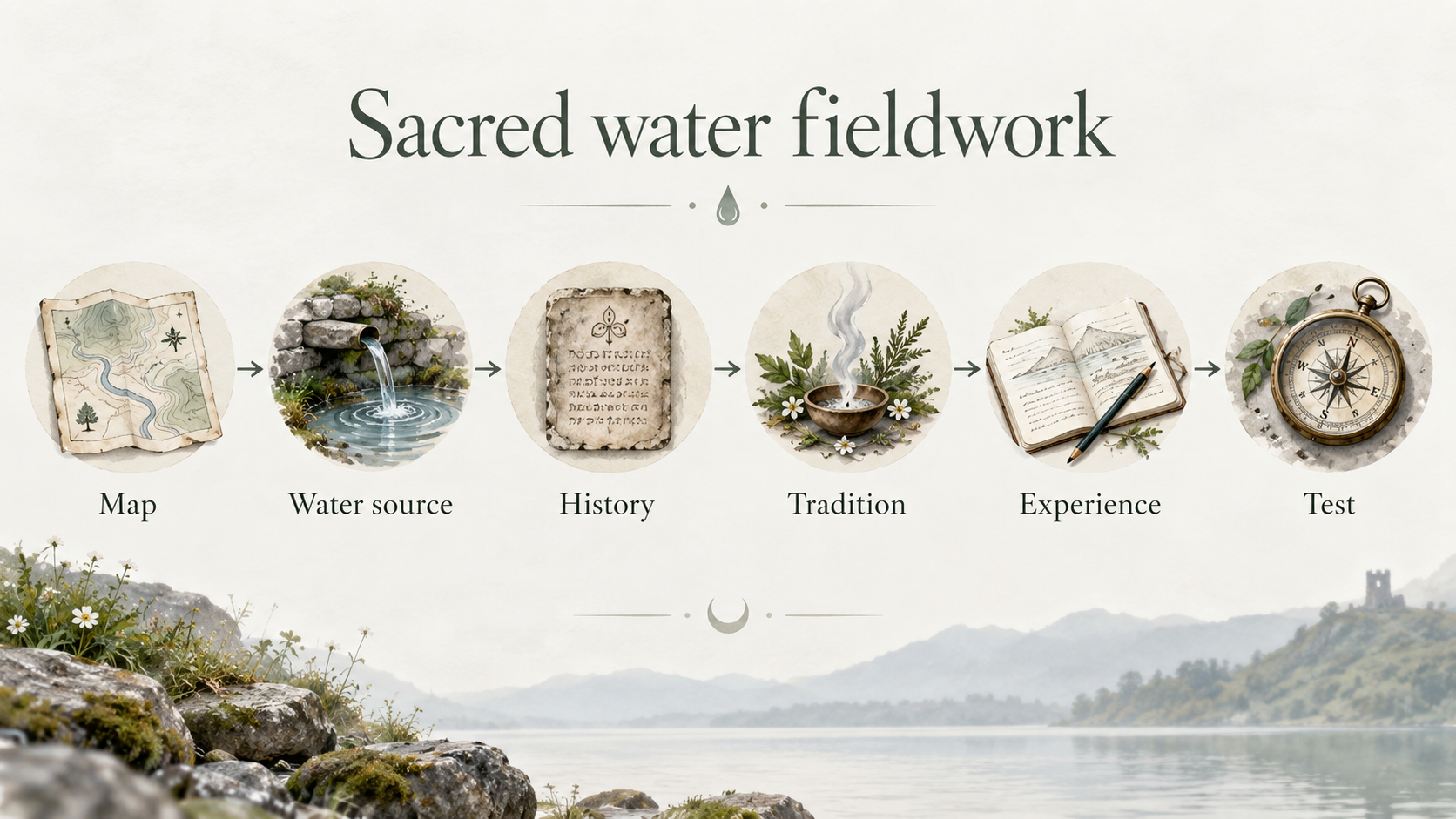
- Place - Where does the water come from? How does it move through the landscape? What geology surrounds it?
- History - What is documented about the spring, river or well?
- Tradition - What stories, healing claims, rituals or supernatural associations belong to it?
- Experience - How does the place actually feel to you?
- Test - What alternative explanations could account for what you noticed? Does the experience repeat? How does a nearby non-sacred water source compare?
The aim is not to prove or disprove the sacred. It is to understand more precisely what makes the place compelling.
So, does water amplify ley-line energy?
There is no established scientific evidence that water amplifies a physical ley-line energy field.
But that is not the whole story.
Water repeatedly appears in sacred landscapes because it shapes both land and human life. Springs and wells became places of healing and ritual. Rivers formed boundaries and pilgrimage routes. Water created sensory environments capable of producing awe, stillness and attention.
Modern Earth-energy traditions add another layer: the belief that water interacts with ley lines, nodes and subtle fields.
That belief remains unproven. The relationship between water and sacred place does not.
Perhaps that is the more interesting mystery.
Frequently asked questions
Are ley lines connected to underground water?
Some dowsing and Earth-energy traditions claim that underground water interacts with or intensifies ley lines. There is no scientifically established evidence that groundwater amplifies a ley-line energy field.
Why are holy wells considered sacred?
Holy wells may be associated with saints, healing, pilgrimage, earlier sacred traditions or local folklore. Some British examples appear to preserve customs that developed over many centuries.
Can water carry spiritual energy?
Many spiritual traditions believe water can cleanse, carry intention or hold sacred qualities. These are spiritual interpretations rather than scientifically established properties.
Is spring water safe to drink?
Not necessarily. Natural-looking water can contain microorganisms, pollutants or unsafe mineral concentrations. Follow local guidance and never assume a holy well or spring is potable.
Why are sacred sites often near water?
Water supports settlement, shapes routes and landscapes, and has deep symbolic associations with life, purification and transformation. In some traditions it is also interpreted as part of a site's subtle-energy system.
Continue exploring
What Are Ley Lines? History, Evidence and the Mystery of the Old Straight Track
Explore how modern ley-line theory developed and why sacred places became central to it.
How to Find Ley Lines Near You: Maps, Methods and Fieldwork
Learn how to investigate alignments using maps, landscape history and field observation.
How to Recognise an Energy Node: Sacred Sites, Power Places and What to Look For
Explore why some places feel unusually powerful and how to investigate them carefully.
Chalice Well & the White Spring: The Alchemical Waters of Avalon
Explore one of Britain's most compelling sacred-water landscapes.
Sacred Earth
Explore sacred places, pilgrimage, landscape mysteries and future Sacred Illusion Node Quests.