Chartres Labyrinth: History, Meaning and How to Walk It
The Chartres labyrinth is one of the world's most famous sacred paths. Discover its medieval origins, design, symbolism and modern walking tradition.

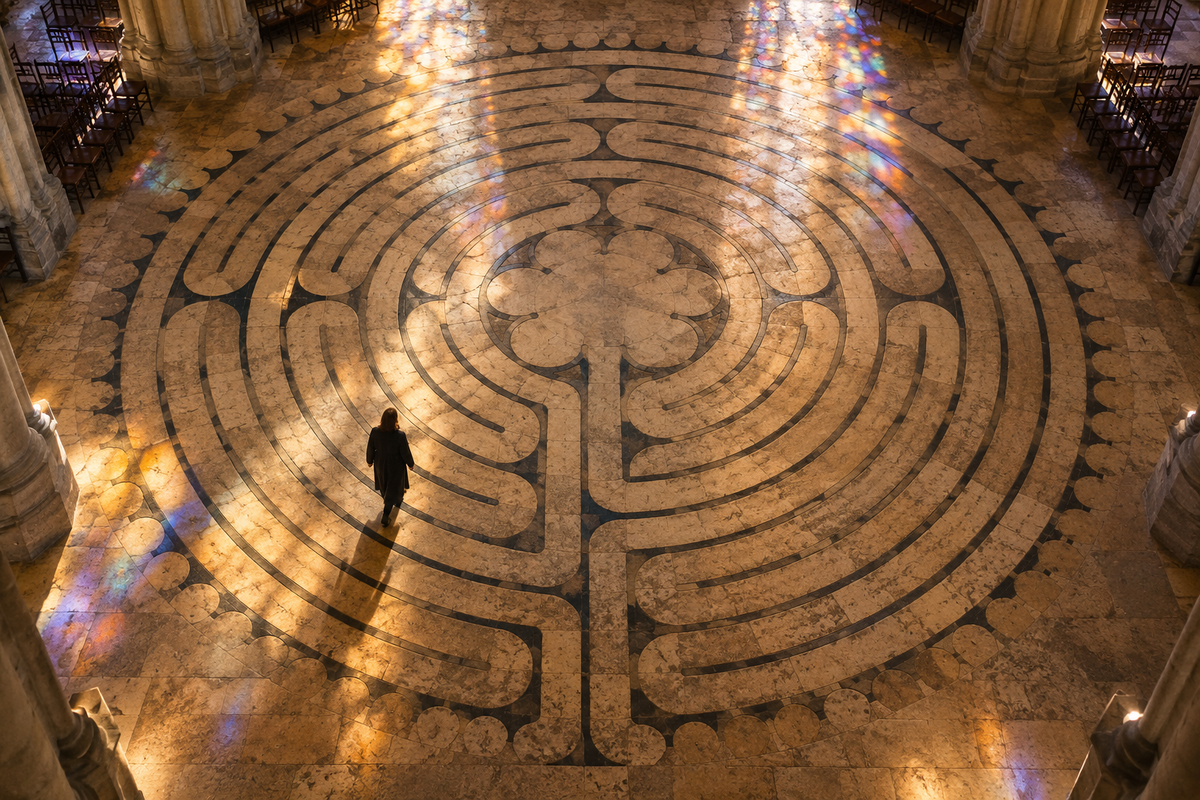
The labyrinth in the nave of Chartres Cathedral is one of the most famous sacred paths in Europe. At first glance it looks like an intricate circular puzzle. It is not.
There are no dead ends and no choices to make. One continuous path winds slowly towards the centre. That single distinction changes everything.
A maze asks you to solve it. A labyrinth asks you to walk it.
The Chartres labyrinth has become a symbol of pilgrimage, meditation and spiritual journeying far beyond the cathedral itself. Replicas now appear in churches, retreat centres, gardens and public spaces around the world.
But the original is more interesting than many of the modern stories attached to it.
What is the Chartres labyrinth?
The labyrinth is set directly into the stone floor of the cathedral's nave.
It dates from the period of the Gothic rebuilding, around the beginning of the thirteenth century.
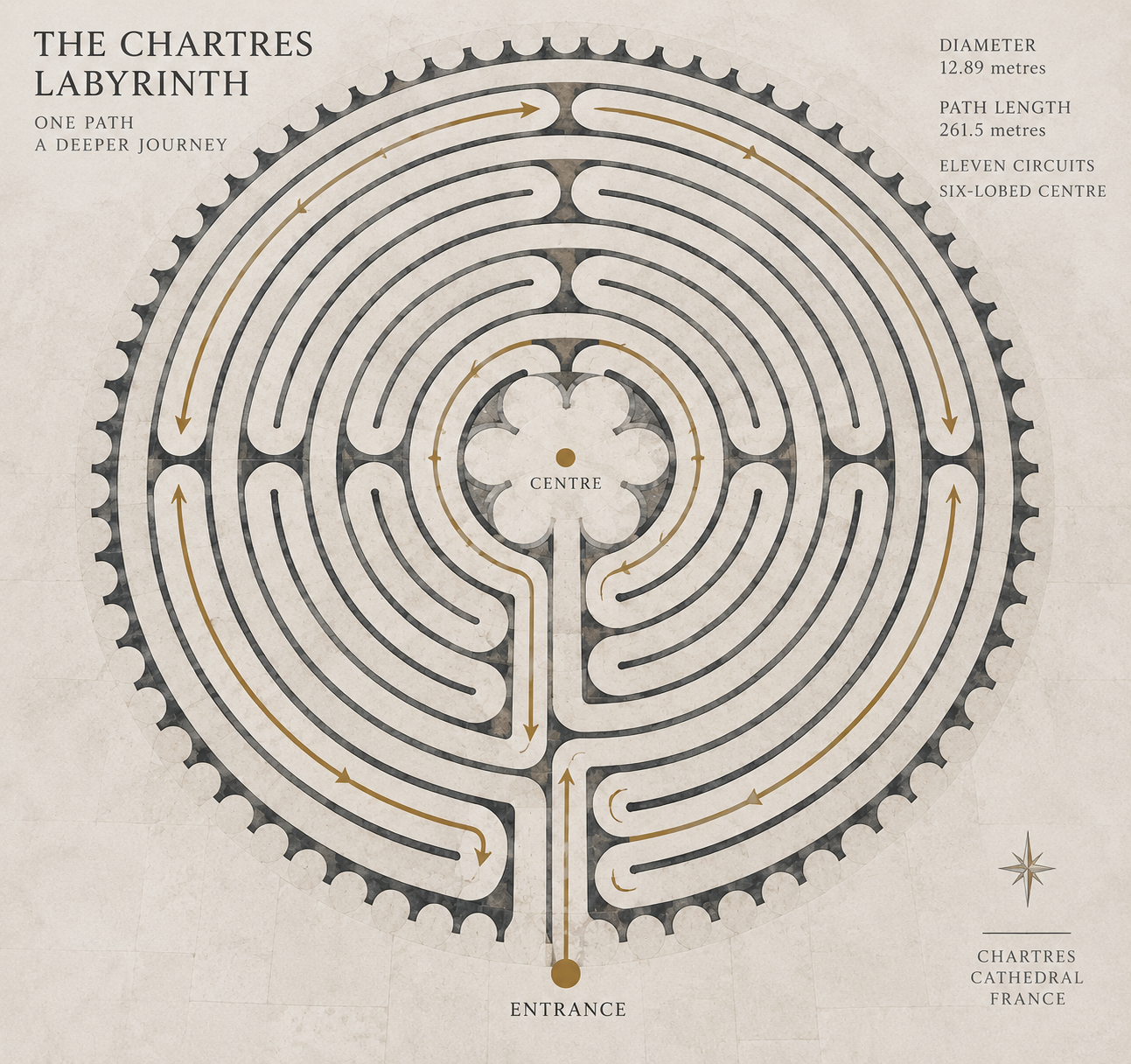
Its diameter is approximately 12.89 metres.
The path itself is only around 34 centimetres wide, but because it folds back on itself repeatedly, the full route measures roughly 261.5 metres.
The design contains eleven concentric circuits leading towards a six-lobed central space.
From above, the pattern looks intensely complex. From the floor, it becomes a slow physical journey. You simply follow the path.
Labyrinth or maze?
The words are often used interchangeably, but they describe different experiences.
A maze contains branches, choices and dead ends. A labyrinth is unicursal: there is only one route. That means there is nothing to solve.
The walker may appear to move towards the centre, then suddenly be carried away from it again. At other moments the path seems to circle close to the destination before moving outward once more.
That rhythm is one reason labyrinths work so effectively as metaphors. Progress is not always linear. A route can feel wrong while still being the route. The destination can be close without being reached.
Why was it built?
The precise medieval use of the Chartres labyrinth has been debated for generations.
What is clear is that it belonged to the religious architecture of the cathedral rather than being decorative floor patterning. The cathedral's own current interpretation connects it with pilgrimage, meditation on human life, repentance and Christian ideas of death and eternal life.
More recent historical work highlighted by the cathedral also suggests the labyrinth may originally have played a role in the liturgy of Easter Vespers, when the Church celebrated Christ's victory over death.
That provides a very different context from many modern New Age interpretations. The medieval labyrinth was fundamentally Christian. Its symbolism belonged to a world of pilgrimage, salvation, sin, death and resurrection.
That does not prevent modern walkers finding other meanings in it.
But those meanings should not automatically be projected backwards onto the people who built it.
The labyrinth as pilgrimage
The strongest idea associated with the labyrinth is journey. Chartres has been a major pilgrimage destination for centuries. Pilgrims travelled towards the cathedral itself.
Within the cathedral, the labyrinth offered another kind of journey: one compressed into a few square metres of floor.
Instead of crossing hundreds of kilometres, the walker follows a long and deliberately indirect route within a single sacred space.
The cathedral today describes it as an inner pilgrimage. That phrase captures the form particularly well. The body moves. The destination is known. But the route refuses to be hurried.
The six-lobed centre
At the centre of the labyrinth is a six-lobed form sometimes described as a flower or rose. Modern writers have given those six petals many symbolic meanings: love, Mary, creation, divine harmony, the human soul.
Some of those associations may be spiritually meaningful. But the historical evidence for any single definitive medieval interpretation is limited.
What we can say is that the centre was deliberately designed as a distinct destination. The pattern changes there. After more than 260 metres of movement, the walker arrives at a still point. That contrast may be enough.
Sacred geometry at Chartres
The labyrinth is often described as an example of sacred geometry. In a broad sense, that is reasonable.
Its construction is highly ordered and geometric, and the cathedral itself points to significant relationships between the labyrinth and the wider architectural plan.
For example, the centre of the labyrinth occupies an important position within the cathedral's geometry. The cathedral's own research notes relationships between the labyrinth, the façade, the apse and other structural reference points.
Where we should be more careful is with claims that every measurement encodes hidden cosmic laws. Modern interpretations often connect Chartres to the Golden Ratio, astrology, planetary harmonics or universal mathematical codes.
Some of those ideas are fascinating. They are not all historically demonstrated. The geometry is real. The more elaborate meaning attached to it may belong to later interpretation.
The Minotaur and the Christian labyrinth
The medieval labyrinth inherited an older symbolic history. Classical mythology told of the labyrinth built by Daedalus to contain the Minotaur.
Theseus entered it and escaped using Ariadne's thread. Christian Europe reused the form but transformed its meaning. The monster could become sin, death or spiritual confusion. The centre could represent salvation, Jerusalem or Christ.
The journey through the labyrinth became a spiritual drama rather than a heroic puzzle. Chartres belongs to that medieval Christian transformation of an older image.
Did medieval pilgrims walk the Chartres labyrinth?
This is one of the most interesting questions. The labyrinth clearly had religious meaning. But we should be careful about imagining medieval visitors using it exactly as modern labyrinth walkers do.
Evidence for how often individuals physically walked the Chartres labyrinth in the Middle Ages is less complete than popular accounts sometimes suggest.
Its liturgical context may have been at least as important as private devotional walking. This is a useful reminder that sacred practices change. A symbol can survive while the way people interact with it evolves.
Today's labyrinth walk is both an encounter with a medieval object and a modern spiritual practice.
The modern revival
Labyrinth walking has undergone a major revival in recent decades. Replicas of the Chartres pattern can now be found internationally. People use them for prayer, contemplation, grief, decision-making, meditation and simply slowing down.
Some describe a three-part process:
- Release while walking inward.
- Receive in the centre.
- Return while walking outward.
That is a modern contemplative framework rather than a documented medieval ritual. But it works because it uses the physical structure of the labyrinth intelligently. The path gives thought a shape.
Is there an energetic effect?
Some modern spiritual traditions describe labyrinths as devices for concentrating or balancing subtle energy.
At Chartres, these ideas are sometimes combined with theories about sacred geometry, underground water or Earth energy. There is no established scientific evidence showing that the labyrinth itself generates a unique measurable spiritual field.
The cathedral's own position is notably clear: it explicitly rejects the idea of the labyrinth as a magical object or physical energy phenomenon and instead places the emphasis on the people walking it and the spiritual meaning they bring to the experience.
That does not make the experience less interesting. If anything, it places the focus back on the relationship between person, movement and place.
When can you walk the Chartres labyrinth?
For much of the year, the labyrinth is normally covered by chairs as part of the functioning cathedral.
It is currently opened for meditative walking on Fridays, usually from the beginning of Lent until the end of October, subject to religious services and cathedral events. Schedules can change.
If walking the labyrinth is the main reason for your visit, check the cathedral's official timetable before travelling. Chartres Cathedral remains an active place of worship. That takes priority over visitor access.
If you cannot visit Chartres
You do not need the original cathedral floor to experience labyrinth walking. The Chartres pattern has been recreated around the world.
There are also many other labyrinth designs, from simple classical forms to contemporary garden labyrinths. You can even create a temporary one with rope, stones or chalk.
The experience will not be identical to walking the medieval path at Chartres. But the essential mechanism remains the same: one path inward, one centre, one path outward.
Why the Chartres labyrinth still matters
The labyrinth survives because it can hold several meanings without collapsing under them.
It is medieval architecture. Christian symbolism. Pilgrimage. Geometry. Movement. Modern meditation.
For some people it is prayer. For others it is psychology. For others still it is simply an extraordinarily elegant piece of design. The power of the form may lie precisely there.
It gives structure without prescribing exactly what must happen. You enter. You follow the path. You reach the centre. You return. The meaning comes partly from the labyrinth. And partly from what you bring into it.
Frequently asked questions
How old is the Chartres labyrinth?
It dates from the period of the Gothic rebuilding of Chartres Cathedral around the beginning of the thirteenth century.
How long is the Chartres labyrinth path?
The full route is approximately 261.5 metres long, folded into a circle around 12.89 metres in diameter.
Is the Chartres labyrinth a maze?
No. It has one continuous path and no dead ends.
Can you walk the labyrinth at Chartres?
Yes, on selected Fridays for much of the year, subject to cathedral services and events. Check the official schedule before visiting.
What does the centre of the labyrinth mean?
The six-lobed centre has attracted many symbolic interpretations. The exact medieval meaning is not known with certainty, although the labyrinth as a whole had a clear Christian and pilgrimage context.
Is the labyrinth connected with sacred geometry?
Yes in the broad sense that it is a carefully constructed geometric design integrated into the cathedral's architecture. More elaborate claims about hidden universal codes belong to later interpretation.
Continue exploring
Chartres Cathedral: Labyrinth, Light and the Sacred Landscape Beneath the Stone
Explore the cathedral itself: its stained glass, crypt, ancient well, Marian pilgrimage and the layers of history beneath the Gothic structure.
Water, Ley Lines and Sacred Landscape
Why water, wells and springs appear so often around sacred places.
How to Recognise an Energy Node
A broader look at why certain locations are interpreted as spiritually powerful.