Druidic Wisdom: Trees, Stars, and the Memory of the Land
The Druids left no writings of their own, yet became guardians of one of Europe’s most powerful ideas of ancient wisdom. What do we actually know about their trees, stars, teachings and relationship with the land?

Few figures from ancient Europe have accumulated as much mythology as the Druids.
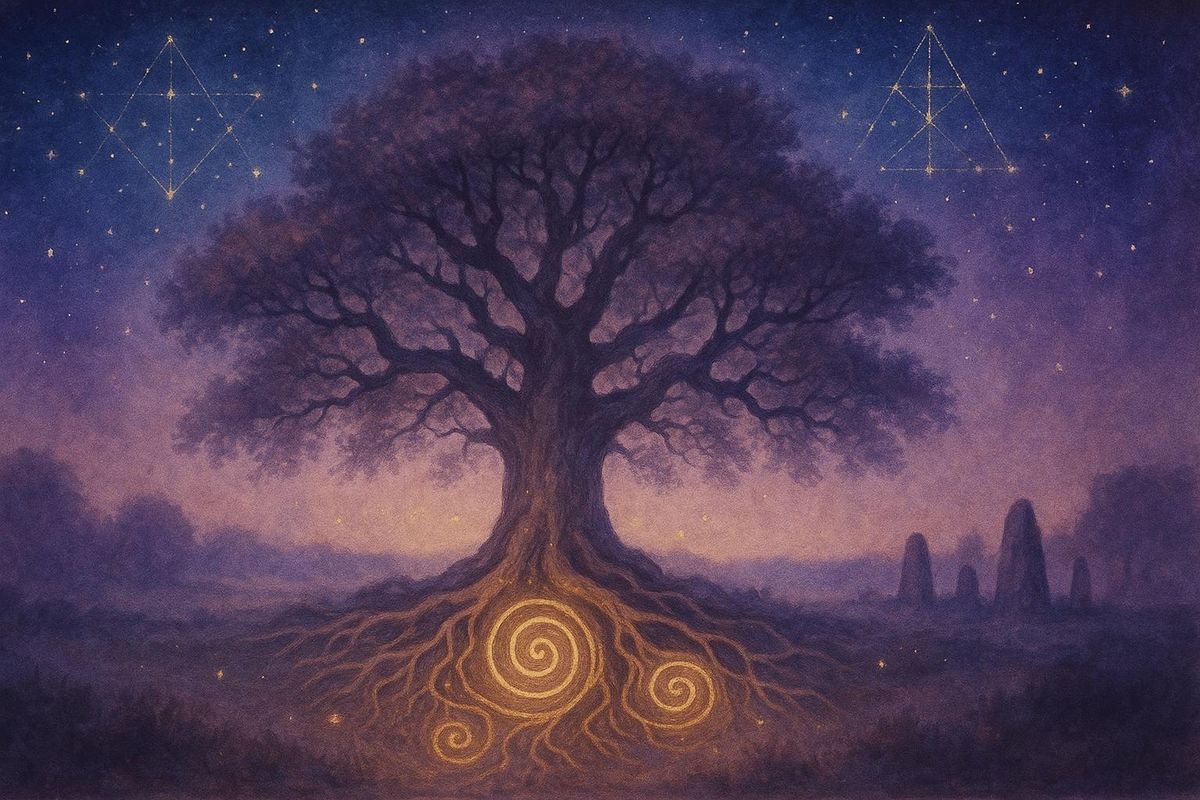
They appear in popular culture as white-robed priests moving through oak groves, astronomers reading messages in the stars, keepers of a secret tree alphabet and guardians of sacred landscapes crossed by invisible lines of energy.
Some of that imagery has roots in ancient sources.
Much of it does not.
The historical Druids left us no surviving books written in their own voices. Almost everything we know directly comes from Greek and Roman writers describing the Celtic-speaking societies of Gaul and Britain, often while Rome was conquering them. Centuries later, medieval Irish literature preserved another body of stories about druids, poets, seers and magicians, but those texts were written within a Christian culture looking backwards towards a pre-Christian past.
Then, from the seventeenth and eighteenth centuries onwards, antiquarians, poets, nationalists and spiritual revivalists created another Druid tradition again.
All three layers matter.
The ancient Druids were real.
The legends around them are historically important.
And modern Druidry has become a genuine spiritual tradition in its own right.
The interesting task is working out which layer we are looking at.
Who were the Druids?
Our most detailed ancient description comes from Julius Caesar, writing in the first century BCE during his conquest of Gaul.
According to Caesar, Gaulish society contained two particularly prestigious groups: warriors and Druids.
The Druids, he says, were concerned with religious worship, sacrifices and questions of ritual. They also acted as judges in disputes involving crime, inheritance and boundaries, and people travelled to them for instruction.
This is already rather different from the modern image of a solitary nature mystic.
If Caesar's description is broadly reliable, Druids were part priest, part teacher, part legal authority and part philosopher.
Their power rested not merely on private spiritual insight but on a recognised social role.
Caesar even describes an annual gathering of Druids in the territory of the Carnutes in central Gaul where disputes were heard and decisions made.
That sounds less like an informal woodland spirituality and more like an organised intellectual and religious class.
How much should we trust Caesar?
Carefully.
Caesar was not an anthropologist neutrally documenting another culture.
He was the Roman general conquering Gaul.
His account of Gallic religion appears inside a work designed partly to explain and justify his campaigns to a Roman audience. Describing conquered peoples as exotic, violent or strange could serve political purposes.
This becomes particularly important when Caesar describes human sacrifice.
Other classical writers make similar accusations, and there is archaeological evidence that ritual killing occurred in parts of Iron Age Europe. But connecting individual archaeological remains directly with Druids is much harder.
Ancient writers remain indispensable because they preserve information available nowhere else.
They are also interested outsiders.
Druidic history therefore begins with an awkward fact: the people who described the Druids most fully were also participating in the destruction of the societies in which they operated.
The twenty-year education
One of Caesar's most remarkable claims concerns Druidic training.
He says some students remained in training for as long as twenty years, learning a great number of verses by heart.
The Druids deliberately avoided committing their teachings to writing, according to Caesar, even though writing was used for other purposes in Gaul.
He thought there were two reasons.
Keeping the teachings unwritten prevented them from becoming common property, and memorising them trained the student's memory instead of allowing dependence upon texts.
Whether every Druid really studied for twenty years is impossible to know.
But the description is significant.
Druidic knowledge was imagined as something that had to be carried within a person.
The student did not possess the teaching because a book sat on a shelf.
The student became its repository.
A culture built around memory
That gives the phrase “memory of the land” a more interesting meaning than the modern claim that landscapes literally store energetic information.
In an oral culture, memory is infrastructure.
Law survives because somebody remembers it.
Genealogy survives because somebody recites it.
Religious knowledge survives because somebody has learned the ritual.
Stories preserve relationships between people and particular rivers, hills, springs, groves and territories.
Knowledge therefore becomes inseparable from people and place.
This may help explain the enduring association between Druids and landscape.
The land did not need to function as a supernatural hard drive.
It could hold memory because stories, ceremonies and identities were repeatedly attached to particular places.
A grove remembered because people kept returning to it.
A hill remembered because generations told stories about what happened there.
A boundary remembered because somebody knew its history.
Landscape and memory continually reinforced one another.
Did the Druids study the stars?
According to Caesar, yes.
Among the subjects discussed by Druids he lists the stars and their movements, the size of the universe and Earth, the nature of things and the powers of the gods.
That is an extraordinary description.
It places celestial observation alongside religion and natural philosophy.
We should not immediately turn this into evidence of a lost advanced astronomy. Caesar provides no technical astronomical tables and no suggestion that Druids possessed knowledge beyond what naked-eye observers of their period could develop.
But he does tell us something important.
The intellectual world of the Druids apparently extended far beyond ritual.
They were interested in how the cosmos worked.
What might Druidic astronomy have looked like?
We do not know.
Iron Age communities across Britain and Gaul certainly lived within landscapes already filled with monuments oriented towards celestial events.
Stone circles, passage tombs and other structures constructed thousands of years earlier demonstrated that prehistoric societies had been paying close attention to the Sun and Moon long before the historical Druids appeared.
The Druids would have inherited those ancient landscapes.
They may have developed their own interpretations of them.
What we cannot do is assume continuity.
A monument can remain sacred while its meaning changes completely.
A medieval church might be built near an ancient sacred site without its builders possessing the original religion of the people who used the place thousands of years earlier.
The same principle applies to Druids.
The Druids did not build Stonehenge
This is one of the most important corrections in Druidic history.
Stonehenge is far older than the historical Druids.
Construction at Stonehenge began around 3000 BCE, with its famous large stone settings developing around the middle of the third millennium BCE.
The classical sources describing Druids belong to the final centuries BCE and first century CE.
We are dealing with a gap of well over a thousand years.
The Druid connection with Stonehenge arose much later.
In the seventeenth century the antiquarian John Aubrey correctly recognised that Stonehenge was older than Roman Britain. Because Druids were among the few pre-Roman British religious specialists then known from written sources, he proposed that they had constructed it.
The eighteenth-century antiquarian William Stukeley developed the theory further.
Archaeology eventually showed that they were wrong.
But culturally, the association stuck.
Why Stonehenge still matters to modern Druids
The historical correction does not mean Stonehenge is irrelevant to Druidry today.
Modern Druids have gathered there for more than a century and many consider it a sacred site.
This creates an important distinction between historical origin and contemporary meaning.
Stonehenge was not constructed by Iron Age Druids.
Modern Druid communities can still legitimately experience it as spiritually significant.
Religious landscapes are constantly reinterpreted.
The fact that a tradition develops later does not make the experience of its practitioners unreal.
It simply means we should not rewrite the site's original chronology to validate it.
Trees and sacred groves
The association between Druids and trees has much stronger ancient roots.
Classical writers connect Celtic religious activity with sacred groves, and later Roman accounts repeatedly place Druids within wooded ritual landscapes.
Even the word Druid has often been interpreted as containing an element associated with the oak, although its precise linguistic history remains debated.
Whatever the etymology, Roman writers clearly believed trees mattered within Druidic religion.
The most famous account comes from Pliny the Elder.
Writing in the first century CE, Pliny describes Druids in Gaul gathering mistletoe from an oak in an elaborate ceremony.
The oak and the mistletoe
According to Pliny, the Druids regarded nothing as more sacred than mistletoe and the oak on which it grew.
When rare mistletoe was discovered on an oak, it was gathered ceremonially.
A priest dressed in white climbed the tree and cut the plant with a golden sickle while preparations were made for sacrifice and a feast.
Pliny also reports beliefs that mistletoe could promote fertility and act against poison.
It is one of the most vivid surviving descriptions of a supposedly Druidic ritual.
It is also only one Roman author's account.
We do not know whether it describes a widespread Druidic ceremony, a particular Gaulish practice or something Pliny understood imperfectly.
His own language makes clear that he regarded these beliefs with disdain.
Still, the passage establishes an important point.
The modern relationship between Druids, oak and mistletoe was not invented completely from nothing.
Were particular trees sacred?
Almost certainly some were.
Sacred groves are widely documented in ancient European religion, and particular species could acquire ritual significance.
But the modern idea of a complete Druid tree wisdom system, in which each native tree possesses a fixed spiritual meaning and corresponds neatly to a letter, month and personality type, is much harder to project backwards.
Those systems often blend later Irish literature, medieval Ogham scholarship, folklore, Romantic-era reconstruction and modern Pagan practice.
They can function beautifully as contemporary spiritual systems.
They should not automatically be labelled the secret botanical curriculum of Iron Age Druids.
Ancient reverence for trees is well supported.
The modern tree oracle is a later development.
What about Ogham?
The Ogham alphabet is another genuine historical tradition around which Druidic mythology has grown.
Ogham is an early writing system used primarily for the Irish language.
Its most recognisable inscriptions consist of groups of strokes cut along the edge of standing stones.
The earliest surviving inscriptions generally date from around the fourth and fifth centuries CE, with the script probably developing somewhat earlier.
That chronology matters.
The inscriptions belong largely to the period when Christianity was arriving and expanding in Ireland, centuries after Caesar's Druids in Gaul.
Most surviving early Ogham inscriptions are also remarkably practical.
They tend to record personal names and ancestry.
They do not contain surviving manuals of Druidic tree magic.
Is Ogham a tree alphabet?
This is where several historical layers have become compressed.
Later medieval Irish scholars produced elaborate discussions of Ogham, including alternative classifications and associations involving trees.
Those traditions became enormously influential in modern Druidry.
But the idea that each Ogham character originally represented one sacred tree and that Druids used the alphabet as a divinatory system is not demonstrated by the earliest inscriptions.
Ogham itself is real.
Later arboreal symbolism around Ogham is real.
Modern divination systems using Ogham are real.
They simply belong to different periods in the story.
The temptation to merge them into one timeless Druid alphabet should be resisted.
The medieval Irish Druids
Ireland presents another challenge.
Medieval Irish literature contains many figures described as druí, generally translated as druid.
They can appear as advisers, prophets, ritual specialists, magicians or opponents of Christian saints.
These stories are enormously valuable.
They also survive primarily in manuscripts produced within Christian Ireland, sometimes many centuries after the period they claim to describe.
Recent scholarship stresses how strongly the literary image of the druid could be shaped by biblical, classical and Christian ideas about magicians and pagan religious specialists.
That does not mean every memory of pre-Christian religion was invented.
It means medieval Irish druids cannot simply be treated as documentary interviews with Iron Age priests.
They are figures preserved through layers of cultural memory.
Druids, bards and poets
Modern Druidry often distinguishes Bards, Ovates and Druids as stages or roles within a spiritual path.
Ancient Celtic-speaking societies certainly possessed respected poetic and learned specialists, and classical writers distinguish Druids from other figures such as bards.
The preservation of knowledge through poetry makes obvious sense in an oral culture.
Rhythm, story and structured language make information easier to remember and transmit.
The bard therefore becomes more than an entertainer.
Song can preserve ancestry.
Poetry can carry history.
Story can encode social values and relationships with place.
The modern Druidic emphasis on creativity and storytelling has meaningful ancient precedents even if today's formal training systems should not automatically be projected backwards unchanged.
Did Druids believe in reincarnation?
Caesar gives us one of the most provocative claims about their philosophy.
He says the Druids taught that the soul does not perish at death but passes from one body to another.
He believed this teaching encouraged courage by reducing fear of death.
Other classical writers also associated Celtic thinkers with beliefs concerning the soul's survival.
Whether this maps precisely onto what we now call reincarnation is difficult to establish.
Caesar may be translating an unfamiliar Celtic belief through concepts his Roman audience could understand.
But the survival or movement of the soul appears to have been important enough to attract ancient attention.
That makes Druidic thought relevant to a recurring Ancient Wisdom question: what part of a person, if anything, survives death?
Sacred land without ley lines
The Druids probably did understand some landscapes as sacred.
That does not mean they believed in ley lines.
The modern term ley was introduced by Alfred Watkins in the twentieth century after he noticed apparent straight alignments between ancient sites on maps and landscapes.
Watkins originally interpreted these as old trackways.
The idea that leys were channels of invisible Earth energy developed later through occult and New Age interpretations.
There is no ancient source describing Druids mapping Britain through a planetary network of ley-line energy.
That distinction is especially important because Druidic sacred geography is interesting enough without it.
Groves, rivers, springs, boundaries and particular landscapes could possess religious meaning through myth, ritual and community memory.
A place can be sacred without sitting on an invisible power cable.
The later history of ley lines is fascinating in its own right, explored in How to Find Ley Lines: Mapping the Earth's Hidden Network.
The living Earth
Did ancient Druids believe the Earth itself was literally a conscious being?
We do not have surviving Druidic texts telling us.
Celtic religious worlds clearly contained sacred landscapes, divine beings associated with natural places and ritual relationships with rivers, springs, forests and other features of the environment.
That is not quite the same claim.
Modern Druidry frequently develops a stronger ecological spirituality in which the Earth is understood as living, sacred or ensouled.
For many contemporary Druids, environmental responsibility follows naturally from that worldview.
This is one of the places where modern Druidry has developed ancient fragments into a spirituality suited to contemporary questions.
It does not need a false claim of perfect continuity to be meaningful.
What does “memory of the land” mean?
Taken literally as the claim that stones and landscapes physically record human thoughts or spiritual energy, it remains a metaphysical idea rather than established ancient Druid teaching.
Taken culturally, the phrase becomes extremely powerful.
Land remembers through archaeology.
Burial mounds remain.
Offerings survive in wetlands.
Paths persist.
Ancient trees outlive generations.
Place-names retain fragments of forgotten languages.
Stories gather around hills, wells, caves and stones.
Communities revisit the same places until layers of meaning accumulate.
Landscape becomes an archive because human lives repeatedly leave traces within it.
That form of land memory is not mystical speculation.
We walk through it constantly.
The sacred grove as an alternative to the temple
One feature of the classical accounts is particularly striking.
Druidic religion is repeatedly associated with groves rather than monumental buildings.
This should not be turned into a simplistic claim that Celtic peoples had no temples or architecture. Archaeology shows ritual activity in many different settings.
But the prominence of sacred woodland in the literary sources suggests a religious imagination in which a living landscape could itself form the sanctuary.
That changes the relationship between worshipper and sacred space.
The columns grow.
The roof moves in the wind.
The light changes with the season.
The boundaries are less absolute.
A grove is architecture created partly by human selection and partly by the living world.
It is easy to understand why that image proved so powerful to later spiritual movements.
Did Druids celebrate the solstices and equinoxes?
Modern Druidry places strong emphasis on the seasonal cycle, often marking solstices, equinoxes and festivals such as Samhain, Imbolc, Beltane and Lughnasadh within the modern Wheel of the Year.
The history here is layered.
Some Celtic seasonal festivals have genuine early Irish evidence behind them.
Solstitial observation clearly existed in prehistoric Britain long before the historical Druids.
But the neat eightfold Wheel of the Year used by many contemporary Pagan traditions is a modern synthesis, shaped during the twentieth-century development of Druidry and Wicca.
It creates a coherent spiritual calendar by combining different historical elements.
That makes it a meaningful modern ritual cycle.
It does not prove Iron Age Druids everywhere observed precisely the same eight festivals in precisely the same way.
The stars, seasons and sacred time
What seems much safer is that Celtic religious specialists paid attention to time and celestial movement.
Caesar explicitly associates Druidic learning with the stars and their motions.
He also describes Gaulish traditions of reckoning periods through nights rather than days.
Agricultural communities necessarily lived through seasonal rhythms in ways that modern industrial society often obscures.
The sky, landscape and calendar were interconnected because they had practical consequences.
This places Druidic interest in astronomy within a wider ancient pattern explored in What the Ancients Knew About the Stars.
Celestial observation could be simultaneously practical, philosophical and religious.
What happened to the Druids?
Roman expansion dramatically changed the cultures in which classical Druids operated.
Roman authorities appear at times to have actively suppressed Druidic practice.
The most famous episode comes from Tacitus, who describes a Roman assault on the island of Mona, modern Anglesey, in the first century CE.
He portrays Druids and religious women confronting the Roman troops while sacred groves were subsequently destroyed.
Again, Tacitus is constructing a dramatic Roman narrative, so the details must be handled cautiously.
But Roman hostility towards Druids is historically significant.
By the later Roman period, the Druid as a recognisable religious institution largely disappears from the written record.
Did the Druids go underground?
There is no good evidence for an unbroken secret Druid order surviving underground from the Iron Age to modern Britain.
Learned traditions certainly continued in Ireland and Wales.
Poets, storytellers, legal specialists and other cultural elites preserved bodies of knowledge after Christianisation.
Elements of older mythology survived within medieval literature and folklore.
That is cultural continuity.
It is not the same thing as a hidden organisation secretly maintaining the complete initiatory system of the ancient Druids.
The romantic appeal of an uninterrupted lineage is obvious.
History usually travels by messier routes.
Fragments survive.
Meanings change.
Old stories acquire new frameworks.
Then later generations begin reconstructing what they believe has been lost.
The rebirth of the Druids
The modern Druid story accelerates during the seventeenth and eighteenth centuries.
Antiquarians such as John Aubrey and William Stukeley became fascinated by Britain's prehistoric monuments and connected them with the Druids described by classical authors.
Their chronology was wrong.
Their cultural influence was enormous.
During the Celtic and Romantic revivals that followed, Druids became symbols of indigenous wisdom, ancient British spirituality, poetry and resistance to a purely industrial or material understanding of the world.
Friendly societies adopted Druidic names and imagery.
Later groups developed ceremonies and initiations.
Eventually new religious and spiritual forms of Druidry emerged.
Modern Druidry therefore has a real history.
It simply begins much later than its oldest inspirations.
Modern Druidry is not fake Druidry
Calling modern Druidry modern is not an insult.
Religions evolve continuously.
The Christianity of a medieval monastery is not identical to the earliest Jesus movement.
Contemporary Buddhism looks different in London, California, Tokyo and Tibet.
Religious traditions interpret older material through changing cultural conditions.
Modern Druids work with fragments from classical descriptions, Celtic mythology, folklore, archaeology, poetry, Romanticism, environmental thought and personal spiritual experience.
Some attempt historical reconstruction.
Others make little claim to reproduce ancient religion exactly.
Both approaches can exist without pretending we possess a secret handbook written by Iron Age Druids.
Why nature became central again
Modern Druidry developed during periods of enormous social and environmental change.
Industrialisation transformed landscapes.
Urbanisation changed relationships with the natural world.
Later ecological crises made environmental questions even more urgent.
Against that background, the Druid became a powerful symbol of knowledge rooted in place.
The ancient sources gave enough support to make the symbol plausible: groves, oak, mistletoe, astronomy, oral teaching and a learned religious class.
Modern culture then extended those fragments into a wider nature spirituality.
Perhaps this tells us something about why lost wisdom traditions become attractive.
We do not only ask what ancient people believed.
We ask what they possessed that we feel we have misplaced.
The danger of inventing the ancient past we need
There is a temptation whenever ancient traditions feel spiritually appealing.
If we value ecology, we imagine the Druids as perfect environmentalists.
If we value feminism, we imagine an egalitarian Druid priesthood.
If we believe in ley lines, we make Druids guardians of Earth's energy grid.
If we practise astrology, we reconstruct an elaborate Druid zodiac.
The ancient evidence is rarely strong enough to carry all of that.
This does not mean those modern spiritual ideas are worthless.
It means the ancient Druids should not become ventriloquist's figures through whom modern people make their own beliefs sound thousands of years old.
Respect for the past sometimes requires allowing it to remain unfamiliar.
What can we actually say about Druidic wisdom?
We can say that Druids were recognised by classical writers as important religious and intellectual specialists in parts of Iron Age Gaul and Britain.
We can say that teaching and oral transmission were central to Caesar's description of them.
We can say that he associates them with questions about the stars, the cosmos, nature, divinity and the survival of the soul.
We can say that sacred groves and, in Pliny's account, oak and mistletoe had genuine Druidic associations.
We can say that later Irish literature preserves culturally important memories and reinventions of druid figures.
We can also say that Stonehenge predates the historical Druids, Ogham is not demonstrably their secret tree alphabet and ley lines belong to a much more recent history.
The surviving picture is incomplete.
But incomplete does not mean empty.
Trees, stars and memory
The title of this article survives the historical clean-up surprisingly well.
Trees genuinely belong to the story.
Stars genuinely belong to the story.
And memory may belong most of all.
The Druids are remembered partly because they seem to have entrusted so much to memory in the first place.
Their refusal, if Caesar is correct, to write down sacred teachings helped create the mystery that now surrounds them.
No Druidic theological library survives.
No handbook explains their ceremonies.
No initiate left us a complete curriculum.
Instead we have fragments preserved by outsiders, archaeological landscapes and later literary echoes.
Modern Druidry has grown within those gaps.
The land remembers differently
Perhaps there is a final irony here.
We do not need to prove that landscapes possess a paranormal memory field to recognise that land remembers human beings.
Britain and Ireland are covered with physical memory.
Fields follow ancient boundaries.
Roads trace older routes.
Churches stand near places that were sacred before Christianity.
Burial mounds remain visible after thousands of years.
Oak trees can survive several human lifetimes.
Stone circles continue attracting ceremonies long after the cultures that built them disappeared.
The land does not preserve one unchanged meaning.
It accumulates meanings.
Neolithic builders, Iron Age communities, medieval storytellers, eighteenth-century antiquarians and twenty-first-century Druids can all encounter the same place and understand it differently.
That may be a more interesting kind of memory than an invisible archive waiting to be decoded.
It reminds us that relationship with place is always unfinished.
The Druids we know historically are fragmentary.
The Druids we imagine are partly creations of the centuries that followed them.
Somewhere between those two stands the enduring idea that wisdom can come from paying close attention to place, season, story, memory and sky.
That idea does not require an invented ancient lineage.
It has survived perfectly well on its own.