Embodied Ritual Without a Teacher
You do not need an elaborate altar or a perfect script to mark a meaningful transition. Learn how to create a personal ritual through intention, embodied practice and everyday action

Some moments deserve more than a passing thought. You have made a difficult decision. A chapter of life has ended. A new one is beginning, but the change has not yet settled into your understanding of who you are.
Perhaps nothing visible has happened at all. You have simply recognised that something within you needs to change.
Ordinary life rarely provides a ceremony for these moments. We may announce a decision, make a plan or tell someone what has happened, then carry on with the next task.
Yet part of us may still be waiting to acknowledge the transition.
This is where personal ritual can become meaningful.
A ritual gives an intention a physical form. We mark a beginning, move through a sequence of actions and create a recognisable ending. We may use sound, movement, symbolic objects, words or silence to bring our attention to something that matters.
You do not need an elaborate altar, expensive tools or a perfectly memorised script.
Nor do you need to claim membership of a mystery school or spiritual lineage to create a ceremony for your own life.
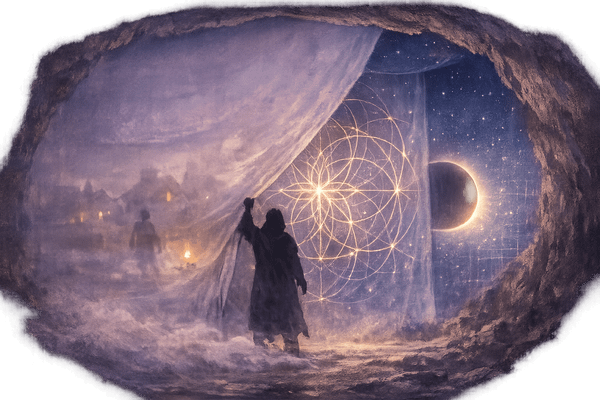
An embodied ritual can be as simple as standing at a doorway, speaking an intention, holding a meaningful object and taking a deliberate step forward.
The value lies not in performing the correct gestures for an invisible audience, but in what the practice helps you recognise and how you carry that recognition into the world.
What is an embodied ritual?
An embodied ritual is a deliberate sequence of actions that brings together meaning, attention and physical experience.
Rather than keeping an intention entirely within thought, you express it through something you can do.
You might walk around a space, wash your hands, touch the ground, speak aloud, hum a note, write a sentence or place an object somewhere significant.
The body becomes part of the language of the ceremony.
A wedding ring, graduation walk or moment of silence illustrates how physical action can carry meaning beyond its mechanical function.
The gesture matters because people understand what it represents.
Personal ritual works with this same human capacity for symbolism, although it does not necessarily involve a community or an established religious ceremony.
It can help us acknowledge an ending, welcome a beginning, remember someone, clarify a commitment or create a pause in an otherwise crowded life.
That does not mean every ritual causes a profound transformation.
Sometimes you finish feeling moved. Sometimes you feel calm, uncertain or entirely ordinary.
The meaning of a ceremony may become clearer through what happens afterwards.
Ritual is more than a routine
A routine helps organise repeated activity. You brush your teeth, make a morning drink or close your laptop at the end of work. A ritual can involve similar actions, but it gives them a deliberate symbolic purpose.
You might make tea every evening as a habit. On a particular evening, you may prepare it slowly to mark the end of a difficult period, remembering what you have carried and what you want to approach differently.
The physical action has not changed much.
Its significance has.
Researchers have examined how rituals may help regulate emotion, support performance-related goals and reinforce social connection. A 2018 integrative review of the psychology of ritual explores these functions and the relationship between physical actions and their psychological meaning.
This does not establish that a personal ceremony alters external reality through hidden energy.
It suggests that the way we structure an action, and the meaning we attach to it, can matter to our experience.
Can you initiate yourself?
The original appeal of self-initiation is the idea that spiritual development does not always need an external authority to give it permission.
There is something valuable in that.
You can decide to begin a personal practice, honour a commitment or mark a significant transition without waiting for another person to declare you ready.
But personal self-initiation is not equivalent to formal initiation into an established tradition.
Within particular religious, ceremonial and esoteric communities, initiation may involve specific teachings, relationships, obligations and recognition by authorised practitioners.
A private ceremony cannot automatically confer that status.
You can create a personal rite of passage inspired by your own values without claiming to have undergone a traditional initiation.
The distinction respects both your freedom and the integrity of the traditions from which ritual practices may come.
If you want to follow a particular lineage, learning from knowledgeable practitioners and understanding its context may be important.
If you want to mark a personal transition, you are free to create an original ceremony that belongs to your life.
Why the body matters
An intention can remain abstract.
I want to become more confident.
I am ready to begin again.
I need to leave an old pattern behind.
These statements may be meaningful, but they can also become phrases we repeat without knowing what they ask of us.
A physical action gives the intention a form.
You might step across a threshold to mark a decision, open your hands to represent willingness or place an old written belief inside a closed envelope.
The gesture becomes something you can remember.
Embodied ritual also involves ordinary sensory attention. You feel the weight of an object, hear your voice, notice the floor or experience the transition between movement and stillness.
That experience is different from thinking about the intention alone.
It need not be interpreted as proof that an invisible energy field has shifted.
The action can be meaningful because it gives the intention a distinct place in memory and experience.
Begin with the purpose, not the props
Before choosing candles, crystals or music, ask what the ritual is for.
Are you marking a beginning? Acknowledging an ending? Expressing gratitude? Recommitting to something? Exploring a question that has been difficult to approach?
Try to describe the purpose in one sentence.
For example:
I want to honour the end of this chapter and make room for what comes next.
Or:
I want to recognise my need for rest and change one commitment that has become unsustainable.
The intention does not need to sound mystical.
It needs to mean something to you.
Then ask what kind of action would express it.
A beginning might be represented by opening a door. A commitment might involve placing an object on a small altar. An ending might be marked by closing a notebook or putting away something associated with the previous stage.
Choose the symbolism because it fits the experience, not because a chart claims that a particular gesture guarantees a result.
For more on this process, explore How to Set Intentions for Sacred Manifestation.
Create a sacred space with what you have
A ritual space does not need to resemble a temple. It may be a corner of a room, a table beside a window, a garden or a familiar place outdoors.
The purpose is to establish a setting in which you can give the practice your attention. Begin by making the space comfortable and reasonably free from interruption.
You might move a few objects, open a window, place a cloth on a table or set out your journal. Choose one or two items that relate to the intention.
A photograph may represent someone you wish to honour. A stone collected during an important walk may stand for a decision. A small bowl of water can symbolise reflection or renewal.
You may also use a candle or a piece of music if you enjoy them. None is required.
Crystals and other objects can carry personal symbolic significance, but there is no established evidence that their advertised energetic properties will amplify an intention or cause an external event.
The most meaningful object may be something you already own.
The five elements of a personal ceremony
A useful self-directed ritual has a clear shape.
It does not have to be elaborate, but a recognisable sequence helps you know when the practice begins and when it has ended.
1. Opening: mark the threshold
Begin with an action that distinguishes the ceremony from ordinary activity.
Place your phone aside. Open your notebook. Sit down in a particular place or ring a small bell.
Notice your surroundings and the support beneath your body.
Then state the purpose in your own words.
You might say:
I am making time to acknowledge this transition and consider how I want to move forward.
There is no requirement to invoke a deity, spirit or unseen force unless doing so is part of your own established belief and practice.
The opening simply declares that you are choosing to attend.
2. Embodiment: give the intention a gesture
Choose a movement that expresses what the ritual represents.
If the ceremony concerns a beginning, you might stand and take one deliberate step.
If it concerns an ending, you might close an old notebook or place an object into a box.
If it concerns self-respect, you could stand comfortably and speak a boundary you want to practise.
Make the gesture accessible to your body.
A seated movement, a change in hand position or simply touching an object may be just as meaningful as walking, kneeling or standing.
You do not need to perform physical discomfort to prove sincerity.
3. Expression: use words, sound or silence
Give your intention a voice if you wish.
You could read a short statement, speak a few words of gratitude, hum gently or listen to a piece of music associated with the occasion.
Sound can shape the atmosphere of a ritual and help mark its stages.
But there is no requirement to chant an unfamiliar sacred syllable or reproduce a ceremony from a tradition you do not understand.
Your own words may be more appropriate.
Silence is also an option.
A ceremony does not become less meaningful because it is quiet.
4. Stillness: allow the experience to settle
After the action, pause.
Notice what the ritual has brought to mind.
You may experience relief, uncertainty, sadness, anticipation or very little.
There is no correct response.
Some experiences require time before their meaning becomes clear.
Avoid searching for a dramatic sensation to prove that something has shifted.
You are allowed simply to recognise the importance of what you have done.
5. Closing: return to ordinary life
End with a deliberate gesture.
Close the notebook, extinguish a candle safely, put the object away or speak a final sentence of acknowledgement.
Then notice the actual room around you.
You might drink some water, stretch comfortably or take a short walk.
The closing matters because a personal ritual should not leave you feeling obliged to remain in a special state of consciousness.
You have marked something meaningful.
Now you return to the life in which that meaning will be expressed.
A complete fifteen-minute self-initiation ritual
This ceremony is designed for a personal transition.
It may be appropriate when beginning a creative project, recommitting to a value or acknowledging that an old way of living no longer fits.
It is not an initiation into a formal religious or esoteric order.
You will need a notebook, a pen and one object that represents the change you want to mark.
Choose somewhere comfortable and allow yourself enough time to finish without rushing.
Minutes 1–3: Prepare the threshold
Place the object in front of you.
Notice your surroundings and take a few ordinary, comfortable breaths.
Consider the chapter of life you are marking.
What is changing? What do you want to acknowledge?
Write one sentence describing the purpose of the ceremony.
Minutes 4–6: Recognise what has brought you here
Reflect on the experiences, decisions and people that have shaped this moment.
You may want to express gratitude for something that has supported you.
You may also need to acknowledge disappointment or difficulty.
There is no obligation to reinterpret everything painful as a blessing.
Write down what you have learned and what you want to carry forward.
Minutes 7–9: Make the embodied gesture
Hold your chosen object.
Notice its weight, shape and texture.
Then perform one action that represents your intention.
You might move the object from one side of the table to the other, stand and step across a doorway, or place a written commitment beneath it.
Let the gesture be simple enough that you could explain its meaning in one sentence.
If you wish, speak that sentence aloud.
Minutes 10–12: Enter stillness
Sit comfortably and allow the action to settle.
Ask:
What does this commitment require of me in ordinary life?
You may find that it suggests a conversation, a change of routine, a request for support or a small practical beginning.
Do not force an answer.
Minutes 13–15: Close and integrate
Write down one action you will take in the coming days.
Choose something realistic and within your influence.
Then close the notebook and return the object to an appropriate place.
The ceremony is complete.
Its meaning will develop through the choices that follow.
Three personal rituals for different moments
Not every occasion calls for the same symbolic action.
A useful practice responds to the specific kind of transition you are experiencing.
A beginning ritual
Choose an object associated with the new direction.
Place it somewhere visible and write down what you are beginning.
Then identify the first practical step.
This might involve starting a journal, making contact with someone or setting aside time for a project.
The object becomes a reminder of the commitment.
It does not need to be charged with an invisible force to serve that purpose.
An ending ritual
Choose an object or piece of writing associated with a chapter that is closing.
Spend a few minutes acknowledging what happened and what it has meant.
Then place the object somewhere appropriate.
You might keep it, archive it or dispose of it responsibly.
There is no need to destroy something or force yourself to feel released.
The ceremony marks your decision to relate differently to the experience.
An ending can remain emotionally complicated.
A recommitment ritual
Return to a value or intention that has become neglected.
Write down why it still matters and what has interrupted your practice.
Choose a small gesture to mark your return.
You might reopen a notebook, revisit a place or place a familiar object on your table.
Then make a practical adjustment.
Recommitment is not proof that you previously failed. It recognises that life changes and attention needs renewing.
Breath, movement and sound
The original article places breathwork and movement at the centre of embodied ritual.
They remain useful elements, but they should be approached gently.
Breath: Allow yourself to breathe comfortably. You may notice the rhythm of the breath or choose a few unforced, slower breaths. There is no need for prolonged breath retention, hyperventilation or an exercise that makes you dizzy.
Movement: Use a gesture appropriate to your mobility and comfort. A small movement of the hands can express an intention as effectively as walking around an altar.
Sound: Hum softly, speak an affirmation or listen to a recording at a comfortable volume. You do not need a particular frequency to validate the ritual.
Touch: Hold a meaningful object, feel the support beneath you or place your hands comfortably on your lap.
These practices may help create a recognisable sensory experience.
They should not be described as techniques guaranteed to cure illness, clear trauma or activate a measurable energetic system.
Research into meditation and other mind-body practices suggests possible wellbeing benefits in particular contexts, but the evidence varies, and some people experience unwanted effects. The National Center for Complementary and Integrative Health provides an overview of both benefits and safety considerations.
The ritual should accommodate the person practising it, not demand that their body conform to a script.
The five koshas as a contemplative lens
Some modern embodied rituals draw on the five koshas, a model associated with Vedantic teaching.
The term refers to five sheaths or layers through which the self is discussed in particular philosophical contexts.
They are commonly described as relating to the physical body, vital breath, mind, discernment and bliss.
A contemporary practitioner might use them as prompts for considering different dimensions of experience.
What does my body need? What is occupying my mind? What do I understand about this decision? What brings a sense of deeper meaning?
But the koshas belong to a specific philosophical tradition.
They are not scientifically established layers of an aura, and they do not prove that a simulated universe can be altered through a ceremony.
If you choose to explore them, approach the framework with respect for its original context rather than treating it as a universal technical diagram.
Read The Vedic Schools: Sound, Breath and the Science of Consciousness for a wider exploration of related ideas.
Ritual through the lens of simulation theory
Within the wider Sacred Illusion framework, ritual raises an interesting philosophical question.
If reality were simulated, what would it mean to perform a ceremony inside it?
The temptation is to imagine ritual as a hidden command: a sequence of actions that instructs the underlying programme to deliver a desired result.
But simulation theory does not establish that such commands exist.
Nor is there evidence that a ceremony can rewrite the rules of physical reality by accessing hidden code.
A more useful thought experiment concerns agency within experience.
Even in a hypothetical simulated world, our choices and relationships would matter to the beings living through them.
A ritual could still mark a commitment, change how someone approaches a situation or help them recognise something important.
Its personal authenticity need not depend on demonstrating that it altered the simulation's underlying machinery.
Perhaps the ceremony's most consequential effect is the way you return to your ordinary life.
For the philosophical background, explore Simulation Theory 101.
Solitary ritual and the value of community
Creating your own ceremonies offers genuine freedom.
You can choose the time, place, language and degree of privacy. You can adapt the practice to your circumstances and revise it as you learn what is useful.
You also avoid the pressure to perform for an audience.
But a solitary practice has limits.
Without other perspectives, it can become difficult to recognise when an interpretation is becoming rigid, when a ritual is no longer helping or when a problem needs more than reflection.
Community can offer shared meaning, encouragement and accountability.
That does not mean every personal ceremony needs a facilitator. It means that independence and connection need not be opposites.
You might maintain a private ritual practice while also learning from reputable teachers, participating in an appropriate community or speaking with trusted people about significant decisions.
Your inner life belongs to you.
It does not need to become an isolated world.
Borrowing symbols without borrowing authority
A contemporary ritual may draw inspiration from many sources: a family tradition, a seasonal observance, a religious text, a landscape or an object with personal significance.
There is a difference between learning from a tradition and presenting its protected or lineage-specific practices as something you invented or are entitled to perform.
Some ceremonies have particular cultural, religious or communal meanings. They may require initiation, instruction or permission within their own traditions.
A personal ritual does not need to imitate them.
You can create original gestures and use language that reflects your values.
If an established tradition genuinely interests you, seek reliable sources and, where appropriate, knowledgeable practitioners from within it.
Respecting context does not diminish personal creativity.
It encourages a more honest kind of spiritual exploration.
When the ritual becomes a substitute for action
It is possible to create a beautiful ceremony and then avoid the decision it was meant to support.
You may repeatedly perform a release ritual without changing the boundary that needs attention.
You may dedicate a project beneath the new Moon but never give it time in your calendar.
You may ask for guidance when what you need is information, a conversation or practical help.
This is one way ritual can become spiritual bypassing.
The answer is not to abandon the symbolic practice.
It is to connect it with the next step.
After a ceremony, ask what the intention means in behaviour.
If you have marked a new beginning, what have you begun?
If you have honoured a boundary, how will you express it?
If you have acknowledged grief, what support or space might you need?
Read The Shadow Side of Manifesting for a wider examination of spiritual practices that become ways of avoiding difficult realities.
When to stop or change a ritual
A ceremony should not require you to tolerate distress because a practitioner or online guide describes it as an energetic breakthrough.
If meditation, imagery, chanting or breathwork becomes overwhelming, stop or adapt the exercise.
Open your eyes, notice your surroundings and return to ordinary activity.
You can replace an imagined scene with a written reflection, shorten the ceremony or leave out an element entirely.
Take particular care with fire, smoke, strong scents and loud instruments. Never leave candles unattended, and choose practices that are suitable for the space and the people using it.
If a ritual repeatedly intensifies distress, disrupts sleep or leads you to feel frightened of missing a prescribed action, consider stepping back.
A personal practice should support agency, not create another system of obligation.
And where a concern involves significant psychological or physical symptoms, an unregulated ritual is not a replacement for appropriate professional care.
How to know whether your ritual was meaningful
You do not need visions, intense sensations or a dramatic emotional release.
A meaningful ritual may leave you with a clearer sense of what matters.
You may notice that an ending still brings sadness, but you have acknowledged it honestly. You may recognise that a commitment requires more support than you expected.
Or perhaps the ceremony simply gives you a remembered moment to return to.
Ask what changed in your understanding or behaviour.
Did the practice help you name something?
Did it clarify an action?
Did it create room for reflection that you had been avoiding?
These are useful questions without being a universal scorecard for spiritual success.
A ceremony can also feel incomplete. You may need another conversation, a different kind of support or more time.
There is no requirement to manufacture closure.
A personal ritual that grows with you
The most sustainable ritual practice is one you can adapt.
You may begin with a simple opening and closing, then add elements that become meaningful through experience.
Perhaps a particular sound marks the start. A small notebook becomes a record of transitions. An object is brought out only when you make a significant commitment.
Over time, the sequence may acquire a sense of familiarity.
That familiarity is part of its value.
But it should remain flexible enough to change with your life.
You are allowed to practise in a different room, miss a date, use fewer objects or decide that a previous ritual no longer belongs to you.
The meaning does not depend on flawless repetition.
It depends on the relationship between the action and what you are seeking to acknowledge.
Returning to the world
A personal rite of passage can feel like entering a different kind of time.
For a few minutes, ordinary demands recede. An object becomes a symbol. A gesture carries an intention, and a private decision receives the attention it deserves.
Then the ceremony ends.
You return to the kitchen, the street, the inbox and the people who share your life.
That return is not an interruption of the sacred work.
It is where the commitment begins to take shape.
A promise to value rest becomes meaningful when you reconsider a demand. A ritual of courage becomes meaningful when you begin the conversation. A ceremony marking a new chapter becomes meaningful through the choices that follow.
You do not need to claim an ancient title or unlock a hidden programme to make a moment matter.
You can create a threshold, cross it deliberately and recognise that you are entering the next part of your life with a different intention.
The ritual marks the passage.
You are the one who walks forward.