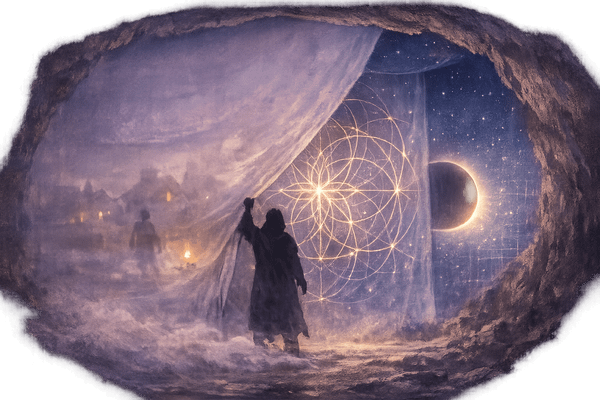
How to Read Synchronicities: Coincidence, Pattern or Something More?
A coincidence can be random, psychologically meaningful or genuinely difficult to explain. Here is how to explore synchronicity without believing every sign or dismissing the mystery.


You are thinking seriously about leaving your job when a stranger starts talking to you about the exact industry you have been considering. A book falls open at a passage that answers a question you wrote in your journal that morning. You dream about someone you have not seen for years and they contact you the next day.
Any one of these could be coincidence.
They can also feel completely different from ordinary coincidence because the external event seems to arrive at exactly the point where something similar is happening internally.
That experience has a name: synchronicity.
Carl Jung developed the concept to describe meaningful coincidences in which events appear connected by significance rather than by an obvious chain of cause and effect. He called synchronicity an acausal connecting principle.
Nearly a century later, we still do not know whether synchronicity reveals an objective organising principle in reality, an extraordinary feature of human meaning-making, or some interaction between the two.
What we can do is learn to read these experiences more carefully.
What is synchronicity?
Synchronicity is not simply a surprising coincidence.
The basic structure involves something happening within your psychological world and an external event that seems to correspond with it in an unusually meaningful way, despite there being no obvious mechanism connecting the two.
You think intensely about a forgotten friend and they telephone. You dream about a particular symbol and unexpectedly encounter it the following day. You are wrestling with a decision and several independent events suddenly seem to reflect the same question back at you.
For Jung, the significance lay in the combination of coincidence and meaning.
The external event did not necessarily cause the inner one, and the inner event did not obviously cause the external one. Yet to the person experiencing them, they belonged together.
That is a subtler idea than saying, "The universe sent me a sign."
Jung's scarab
Jung's most famous example came from his work with a patient whom he described as highly rational and psychologically resistant.
During a session, she told him about a dream in which she had been given a golden scarab.
At that moment Jung heard something tapping against the window. He opened it and caught a rose-chafer beetle, an insect whose appearance resembles the scarab closely enough for the coincidence to be striking.
He handed it to her.
The importance of the event for Jung was not merely that a beetle had appeared. The image already carried psychological significance within the patient's dream, and its unexpected physical counterpart arrived at a moment when Jung believed something was needed to disrupt her fixed way of thinking.
The coincidence became meaningful because of its context.
That idea remains useful even if we never accept Jung's wider metaphysics.
Meaning is not the same as proof
This is the first principle for reading synchronicities well.
An event can be profoundly meaningful without proving what caused it.
A coincidence may genuinely change how you understand a problem. It may expose a feeling you had not acknowledged, make a decision suddenly clearer or mark an important point in your life.
None of that establishes that an external intelligence arranged it.
This distinction actually gives synchronicity more room rather than less.
You do not have to choose immediately between "meaningless accident" and "message from the universe". You can ask what an event means to you while leaving its ultimate origin unresolved.
That is often the most interesting position.
Why synchronicities feel different from ordinary coincidence
Most coincidences disappear almost immediately.
You wear the same colour as someone else. Two people order the same meal. You hear a name twice during one day. You notice the connection and move on.
Synchronicities tend to have greater psychological charge. They often arrive during periods of uncertainty, transition or emotional intensity. Research into synchronicity experiences has similarly found connections with meaning-making, and studies have examined their occurrence around significant life circumstances.
The event seems to meet something already alive within you.
That is why the same external coincidence could be trivial to one person and extraordinary to another.
A white feather means very little in isolation. To someone who had just been thinking about a deceased parent who used white feathers as a personal symbol, finding one in an unexpected place may feel completely different.
The meaning comes partly from the relationship between the event and the person experiencing it.
Start with what actually happened
Synchronicity becomes difficult to examine once interpretation takes over the memory. Suppose you say, "I asked the universe whether I should move to Scotland and then Scotland appeared everywhere."
That already contains an interpretation. What actually happened?
Perhaps you wrote the question in a journal on Monday. On Tuesday, someone at work unexpectedly mentioned St Andrews. On Wednesday, a novel arrived that happened to be set in Edinburgh. On Thursday, a friend you had not discussed the move with sent you an article about Scottish schools.
That is much more useful information. The details allow us to examine timing, specificity, possible causal links and probability.
They also stop the story quietly becoming more extraordinary each time we tell it.
The frequency illusion comes first
Before deciding that a repeated symbol or theme is synchronicity, consider the frequency illusion.
Once something becomes significant, attention begins detecting it more readily. You notice the car you are thinking about buying, the unusual name you recently learned or the number you have decided is important.
We explored this in The Frequency Illusion: Once You Notice It, It's Everywhere.
The mechanism is powerful enough to produce experiences that feel as though the outside world has suddenly changed.
This does not automatically invalidate synchronicity. It gives us a baseline explanation.
If you start noticing owls after deciding owls are your spiritual sign, increased attention is likely to account for at least some of the increase.
The more interesting events are those containing features attention alone does not easily explain.
Coincidences are more common than intuition suggests
Probability creates another problem.
Human life contains enormous numbers of events, thoughts, encounters and observations. Across a lifetime, some spectacular coincidences are inevitable simply because there are so many opportunities for them to occur.
Statisticians Persi Diaconis and Frederick Mosteller explored this problem in their classic work on coincidences. One of their central observations is sometimes called the law of truly large numbers: with enough opportunities, events that look astonishingly improbable can be expected to happen somewhere.
This does not mean every coincidence is insignificant.
It means that "What were the chances?" is harder to calculate than it looks.
Often we calculate the improbability after the event while ignoring all the other possible surprising events that might have impressed us instead.
Specificity makes a synchronicity more interesting
Compare two examples. You are thinking about changing career and later see an advert about careers. That is hardly surprising.
Now imagine you are privately considering retraining in an obscure profession you have never discussed with anyone. The following day a stranger sits beside you on a train, starts a conversation for an unrelated reason and turns out to work in that exact profession.
That still does not prove that something arranged the meeting.
It is simply more specific. Specificity reduces the number of ways an event can be made to fit the story afterwards. Timing can strengthen that effect. So can several independent elements converging around the same subject.
A synchronicity becomes more interesting when the match is unusually precise rather than vaguely symbolic.
Independence is important
Suppose three apparent signs all came from Instagram after you spent the previous evening searching for the subject. They are not really independent. An algorithm may have generated the cluster.
Similarly, if you tell five friends you are considering moving to Greece and then three of them send you Greece-related articles, you have created an obvious causal pathway.
Compare that with three people who do not know about your question independently mentioning the same unusual subject. Again, that does not prove a paranormal mechanism.
It does remove one ordinary route by which the pattern could have been generated. When reading synchronicity, always ask whether the events really arose independently.
Repeating numbers are a special case
11:11, 222, 333, 444 and other repeated numbers are probably the most common contemporary form of reported synchronicity.
They are also especially vulnerable to selective attention. Numbers surround us constantly on clocks, receipts, prices, addresses, screens, registration plates and notifications. Once one sequence becomes meaningful, it becomes extremely easy to notice.
This does not mean repeating numbers must be meaningless. They may become useful personal symbols. Seeing 11:11 might remind someone to stop, become present or reconnect with an intention.
The difficulty begins when a general numerical pattern is treated as carrying a universal message with a fixed meaning.
There is no reliable evidence that 444 objectively means one specific thing for everyone who encounters it.
Personal context is usually more revealing than an online angel-number dictionary.
Animal encounters work in the same way
Animals have carried symbolic meanings across human cultures for thousands of years.
An unexpected fox, owl, raven, butterfly, deer or other animal can therefore feel charged with significance, particularly when it appears at an emotionally important moment.
Start with the ecology.
- Is this animal actually unusual here?
- Is this the season when it normally appears?
- Have changes in habitat or weather made encounters more likely?
Then ask about the symbolism. What does the animal mean within your own associations? What does it represent in the tradition you are drawing from? Are you importing a symbolic meaning only after searching online?
An ordinary biological encounter can still acquire genuine personal meaning.
The interesting question is not simply whether the animal "was a sign", but why this particular encounter became significant now.
Songs, books and overheard conversations
Some of the most affecting synchronicities arrive through language.
You are thinking about a sentence and hear somebody say almost the same words. A song closely associated with someone begins playing at an improbable moment. You open a book to a passage that speaks directly to a problem you have not discussed.
These experiences feel intimate because language carries precise meaning. But they also need context.
Popular songs play frequently. Books contain thousands of sentences. We hear fragments of conversation constantly.
The question is how specific the correspondence is and whether anything unusual accompanied it.
Sometimes a random line simply becomes the catalyst that allows you to articulate something you already knew.
That does not make the experience less valuable.
Dreams can create powerful synchronicities
A dream recorded before a later event creates a particularly interesting category.
You dream about an unusual place, person, phrase or situation and encounter something remarkably similar afterwards.
Ordinary explanations remain available. Dreams contain vast amounts of material, and we remember successful matches more readily than dreams that correspond with nothing.
Yet recording the dream beforehand removes one significant problem: retrospective reconstruction.
You can compare what was actually dreamed with what actually happened.
The match may turn out to be weaker than it felt.
Occasionally, it may be stronger.
We explore this more deeply in What Dreams Might Reveal About the Source Code.
Synchronicity often appears around decisions
Many people begin noticing coincidences when facing a major decision. That makes psychological sense.
Attention becomes heightened because the issue is important. Relevant information stands out. Anxiety or hope can make patterns feel especially significant.
It may also be that periods of transition genuinely produce more of the experiences we call synchronicity. Research into synchronicity has examined its relationship with meaning-making and major life events, although this does not establish a paranormal cause.
Either way, coincidences can become valuable prompts for reflection.
The danger comes when they replace judgement.
A sequence of unusual events might encourage you to investigate an opportunity. It should not automatically override financial facts, medical advice, safety concerns or everything you already know about the situation.
A sign can open a question. It does not have to answer it for you.
How to read a synchronicity
If an event feels synchronistic, work through it before deciding what it means.
- Record the event accurately. Write down what happened, when it happened and what you were thinking or feeling beforehand. Keep the observation separate from your interpretation.
- Identify the connection. What exactly links the external event with your inner state? Avoid broad statements such as "everything felt aligned". Name the actual correspondence.
- Check obvious causal routes. Did you search for the subject, mention it to someone, change your behaviour or interact with an algorithm that could have increased its appearance?
- Consider attention and probability. Could the frequency illusion explain why you noticed it? Are you remembering the hits while ignoring many misses?
- Look at specificity and independence. The more precise the match and the fewer ordinary links between the events, the more interesting the coincidence becomes.
- Interpret rather than obey. Ask what the event brings to mind, what it highlights and whether it changes your understanding. You do not have to assume something external issued an instruction.
- Watch for convergence. A single coincidence may be charming. Several independent, specific correspondences around the same issue can be more worthy of attention, particularly when recorded as they occur.
- Take proportionate action. If the apparent message is "read this book", reading the book costs little. If it seems to say "leave your marriage tomorrow", a coincidence is nowhere near enough evidence on its own.
This method allows spiritual curiosity and ordinary judgement to coexist.
Ask what the symbol means to you first
Suppose a stag keeps appearing during an important period of your life.
Before searching "stag spiritual meaning", write down your own associations.
Strength? Scotland? A particular childhood memory? Masculinity? A specific place? An encounter with someone? Only afterwards look at wider cultural symbolism.
This prevents somebody else's interpretation from colonising the experience.
Traditional symbolism can add another layer, especially when the same associations recur across a culture or spiritual system. But synchronicity is inherently contextual.
Jung's scarab was significant because of the patient's dream and psychological situation, not because every beetle encounter carries the same universal instruction.
Emotion is information, but not proof
A powerful synchronicity often produces a distinctive feeling. Recognition. A jolt. A sudden stillness.
Sometimes laughter at the absurd precision of what has happened.
That emotional charge is worth noticing because it tells you the event has intersected with something psychologically important.
It does not tell you why the event occurred.
Recent research into meaningful coincidences confirms that people differ substantially in how frequently they perceive them, and studies have found relationships with attention, working memory, affect, creativity and pattern detection.
That makes emotional intensity an interesting part of the phenomenon, but not a test of supernatural origin.
Something can feel destined and still be coincidence. Something can also be coincidence and still alter the course of your life.
Synchronicity is not the same as intuition
Intuition is usually an internal judgement or feeling that arrives without conscious access to all of the reasoning behind it. Synchronicity involves an apparent correspondence between inner experience and an external event.
The two can interact. You may have an intuition about a decision and subsequently encounter a coincidence that seems to reflect it. That can strengthen the feeling that something is guiding you.
But neither should automatically validate the other. Unconscious pattern recognition can produce excellent intuitions. It can also produce anxiety, bias and mistaken certainty.
Synchronicities deserve curiosity rather than automatic obedience for the same reason.
What if the universe really is communicating?
This is the possibility many people are actually interested in.
What if synchronicities are not merely psychologically meaningful coincidences?
Perhaps consciousness and the world are connected more deeply than our everyday model assumes. Jung himself believed synchronicity might point towards a reality in which psyche and matter were not completely separate domains.
Other metaphysical systems offer their own explanations. A spiritual worldview might interpret synchronicity as guidance. An idealist philosophy might regard mind and world as expressions of a deeper common reality.
A simulation model might imagine synchronicities as information appearing through the architecture of the system. A manifestation model might propose that states of consciousness influence which possibilities become actual.
A religious interpretation may understand the event as providence.
None of these interpretations has been established as the scientific explanation for synchronicity.
They are different metaphysical ways of answering the same strange question: why does the outer world occasionally appear to rhyme so precisely with the inner one?
Simulation theory gives synchronicity an interesting twist
If reality is generated through some deeper informational system, synchronicity need not look like a software error. It could look like information being connected across parts of the system in ways that are invisible from inside it.
That is considerably more interesting than imagining repeating numbers as secret cheat codes.
A sophisticated simulation could contain correlations that inhabitants experience without understanding the architecture producing them. There is no evidence that this is what synchronicity actually is.
But if we are already asking whether reality is informational or simulated, meaningful coincidence becomes relevant because it appears to connect events through information and significance rather than obvious physical cause.
That possibility belongs beside, not instead of, the psychological explanations.
Could manifestation create synchronicities?
Manifestation practices often produce an apparent increase in synchronicity.
Someone forms a clear intention and suddenly relevant people, information and opportunities seem to appear.
Part of this effect is exactly what we explored in The Frequency Illusion. Attention shifts towards information relevant to the goal, which changes behaviour and increases the chance of useful encounters.
That process alone can be surprisingly powerful.
The metaphysical claim goes further: perhaps intention alters not only what is noticed but which events actually occur. Current evidence does not establish that stronger claim.
But recording manifestations prospectively gives us a much better way to explore it. Specify the intention before the apparent synchronicities happen, rather than constructing the connection afterwards.
If reality is responsive to consciousness, disciplined observation should make that easier to see rather than harder.
Sometimes the synchronicity is telling you about yourself
One of the most useful ways to approach synchronicity requires no theory about cosmic intervention. Ask why this event has captured your attention. Suppose you repeatedly encounter references to leaving relationships while privately wondering whether yours is working.
Perhaps the universe is telling you to leave. Perhaps the frequency illusion is showing you material that was always around. Either way, your reaction reveals something.
The pattern has exposed a question that already has psychological energy.
Synchronicity can therefore function like a dream. Its value may lie partly in what it brings into consciousness.
You can listen without assuming literal instruction.
Beware of turning life into a code-breaking exercise
Once people become interested in synchronicity, there is a temptation to interpret everything. Every number becomes a message. Every bird is a guide. Every delay means "not yet". Every unexpected meeting is fate.
At that point the practice becomes less useful because almost any event can be forced into the theory.
Reality is full of coincidence. Your brain is a pattern-detection machine. A useful synchronicity should generally make something clearer rather than forcing you into increasingly elaborate decoding.
If the interpretation requires eleven assumptions and an online chart explaining why 638 means your twin flame is approaching, the pattern has probably stopped helping.
Mystery does not require credulity.
The danger of confirmation bias
Once you decide that a particular event is a sign, confirmation bias can rapidly build a supporting case.
Evidence that fits becomes memorable. Contradictions become exceptions. Ambiguous events are interpreted in favour of the theory. This can be harmless when the subject is a personal symbol.
It becomes more consequential when signs are used to justify major financial decisions, relationships, medical choices or beliefs about other people's intentions.
A good synchronicity practice therefore includes disconfirming evidence. If you ask for a sign and receive nothing, record that too. If you predict that an event will follow a synchronicity and it does not, keep the miss.
A theory that can interpret every possible outcome as confirmation is impossible to test.
Synchronicity can still change a life
None of this requires us to flatten these experiences into cognitive bias. A coincidence can arrive with extraordinary precision. It can connect two parts of a life that had seemed separate.
It can prompt someone to make a phone call, visit a place, investigate an idea or finally admit something to themselves.
Research has started examining synchronicity as a psychological process of meaning-making and its possible relationship with well-being. That work does not establish Jung's proposed acausal principle, but it confirms that meaningful coincidences can have genuine psychological consequences.
The meaning is real because people act from it. The metaphysical origin remains the mystery.
When several different channels converge
Some synchronicities are more compelling because the same theme arrives through genuinely different routes.
A dream contains an unusual phrase. The next day a stranger uses it. A book chosen for unrelated reasons contains the same image. Later, an unexpected message connects the phrase with a problem you had been considering.
No individual component is impossible. The sequence may still be chance.
But this kind of convergence is more interesting than repeatedly noticing the same number because the events are less obviously generated by one attention loop.
Record them carefully. Do not improve them in retrospect. See whether the pattern develops or disappears.
Sometimes the most useful response to synchronicity is simply to keep watching.
What would count as stronger evidence?
If synchronicity reflects something objective about reality rather than human meaning-making alone, we would eventually want evidence extending beyond personal interpretation.
Predictions made before events occur would be stronger than retrospective matches. Independent observers encountering related information without being primed would help. Repeatable effects would be stronger again.
Jung himself attempted to move beyond anecdote, although his evidence did not establish synchronicity as a generally accepted scientific principle. His original work remains philosophically influential rather than empirical proof of an acausal mechanism.
Modern psychology has instead studied the experience of meaningful coincidence: why people notice it, how individuals differ and what effect those experiences have.
That leaves the larger metaphysical question open.
How I read synchronicity
I do not assume every coincidence is a message. I also do not assume meaning exists only inside the person observing it.
The sensible place to begin is with the event itself. Record it accurately, examine ordinary explanations, understand how attention and probability work, and notice what remains after those possibilities have been considered. Then allow yourself to ask the larger question.
Perhaps the coincidence happened randomly and became meaningful because consciousness recognised something important within it. Perhaps unconscious processes identified a connection before your conscious mind did. Perhaps your behaviour helped create the conditions for the event. Perhaps reality contains relationships that do not fit easily into our usual categories of cause and effect.
Perhaps consciousness participates in those relationships.
We do not currently know. That uncertainty is not a failure. It is where the subject becomes interesting.
Frequently asked questions
What is synchronicity?
Synchronicity is Carl Jung's term for meaningful coincidences in which an inner psychological event and an external event appear significantly connected despite having no obvious causal relationship.
What is an example of synchronicity?
Thinking intensely about someone you have not contacted for years and unexpectedly receiving a message from them shortly afterwards is a classic example. Whether it represents chance, attention, hidden causation or something deeper cannot be determined from the coincidence alone.
How do I know if something is synchronicity or coincidence?
There is no definitive test. Specificity, timing, independence and personal relevance can make a coincidence more striking, while selective attention, confirmation bias and ordinary probability should also be considered. Synchronicity describes the experience of meaningful connection rather than a scientifically established mechanism.
Are repeating numbers synchronicities?
They can be experienced that way, but repeating numbers are especially susceptible to the frequency illusion because numbers appear around us constantly. Their personal symbolic meaning is separate from evidence that an external intelligence caused them to appear.
Did Carl Jung believe synchronicity was real?
Yes. Jung developed synchronicity as an acausal connecting principle and believed meaningful coincidences could reflect a deeper relationship between psyche and the external world. His proposal remains philosophically influential but is not established scientific theory.
Can synchronicity predict the future?
Synchronicity itself does not necessarily involve prediction. Some reported experiences include dreams, intuitions or symbols that appear to anticipate later events, but claims of precognition require stronger evidence, particularly records made before the event occurs.
Is synchronicity connected with manifestation?
The two can overlap. Setting an intention changes attention and behaviour, which can increase apparently synchronistic encounters through ordinary mechanisms. Some metaphysical approaches propose an additional influence of consciousness on external events, but that stronger claim remains unproven.
Is synchronicity evidence that we live in a simulation?
No. A simulated-reality model can provide an interesting interpretation of meaningful coincidence, but synchronicities by themselves do not distinguish a simulation from psychological, statistical, spiritual or other metaphysical explanations.
Should I act on a synchronicity?
Treat it as information rather than an instruction. Low-risk exploration may be reasonable, but major decisions should still take account of evidence, consequences and ordinary judgement rather than relying on signs alone.
Continue exploring
The Frequency Illusion: Once You Notice It, It's Everywhere
Before deciding something is a sign, understand how dramatically attention can change what appears in your world.
What Dreams Might Reveal About the Source Code
Dreams sometimes create some of the most extraordinary apparent correspondences between inner experience and later events.
Glitches in the Matrix: Cognitive Errors or Cracks in Reality?
How do we separate something strange in perception from something strange in reality?
Simulation Theory 101
Could meaningful patterns look different if reality itself emerged from a deeper informational system?