Moon Phases and Manifestation: Timing the Field
The Moon offers a recurring rhythm for intention, action, reflection and rest. Explore the eight lunar phases, their symbolic meanings and practical rituals for each stage.

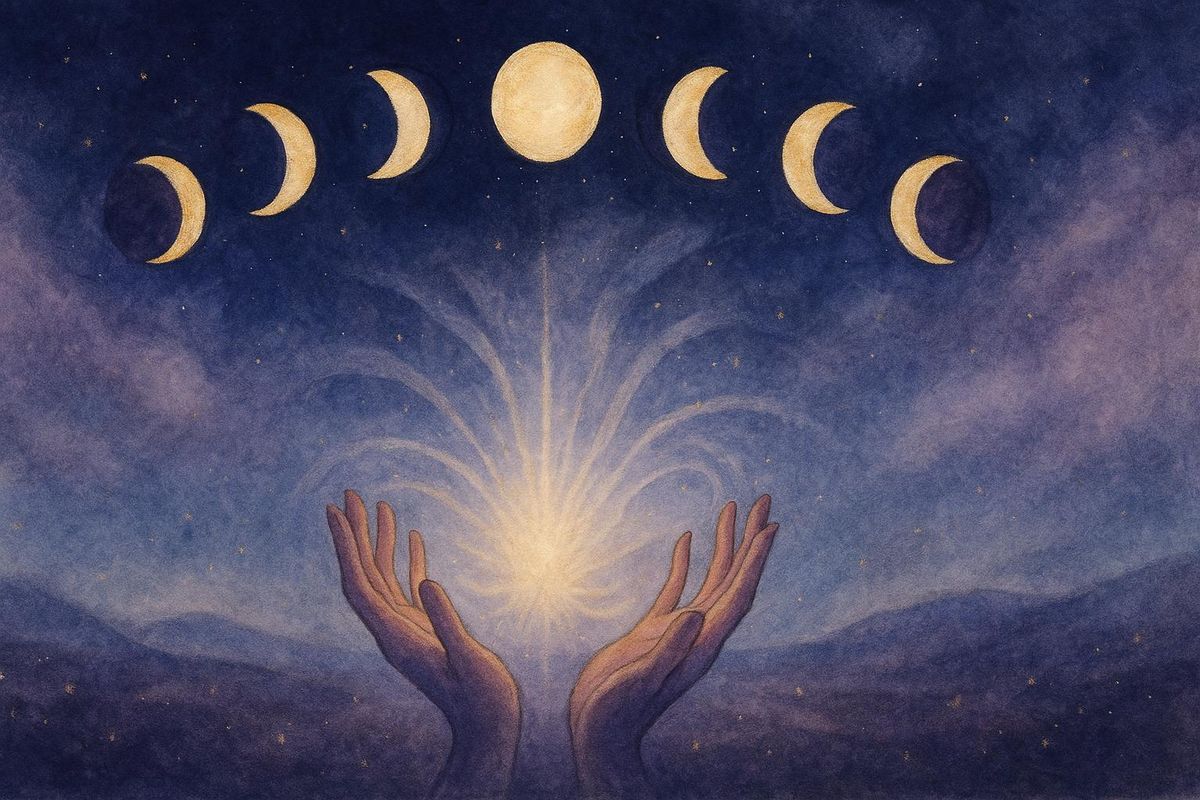
There is a particular kind of darkness that belongs to the new Moon.
The sky seems quieter. The familiar silver presence has disappeared, although the Moon itself remains exactly where it should be, travelling through its orbit around Earth.
Then, a few evenings later, a narrow crescent appears. Night by night, the illuminated portion grows. The Moon reaches its fullness, begins to diminish and eventually returns to darkness. The cycle continues whether or not we are watching.
For thousands of years, people have used the Moon to mark time, organise calendars and give shape to religious and cultural observances. Contemporary spiritual practitioners have also made the lunar cycle a framework for manifestation, associating its changing light with intention, action, reflection and release.
A new Moon becomes a moment for beginnings. The waxing Moon invites movement. The full Moon offers a pause for recognition, while the waning Moon creates a space for completion and rest.
There is something deeply appealing about this rhythm.
Yet there is an important difference between observing an astronomical cycle and claiming that a particular phase can make an intention come true.
The Moon's movements are measurable. Its spiritual meanings are interpreted through culture, tradition and personal practice. Research into lunar effects on human life is more complicated than many manifestation guides suggest.
We can explore all three without losing the beauty of the experience.
Perhaps the Moon does not need to control our destiny to help us pay attention to how we are living.
What is lunar manifestation?
Lunar manifestation is a contemporary spiritual practice that uses the Moon's changing phases as a structure for working with intentions.
Rather than setting a goal once and forgetting about it, you return to it at different points in a repeating cycle.
You might begin with an intention at the new Moon, take practical steps as the light grows, assess your progress around the full Moon and reconsider your commitments during the waning phases.
The practice can involve meditation, journalling, visualisation, candles, symbolic objects or time spent beneath the night sky.
Some practitioners interpret the phases as periods of distinct energetic influence. Others approach the Moon as a symbol of change, impermanence and renewal.
Those approaches can produce similar rituals while resting on different beliefs.
The most useful distinction is that lunar timing can organise a practice without guaranteeing its outcome.
An intention may become clearer because you revisit it. A project may progress because you take sustained action. A ritual may help you acknowledge a feeling or make a decision.
The Moon provides a recurring moment to pause.
What happens next still involves the choices and circumstances of ordinary life.
How the Moon's phases actually work
The Moon does not generate its own visible light. What we call moonlight is sunlight reflected from its surface.
As the Moon orbits Earth, the proportion of its sunlit half that we can see changes.
That changing appearance produces the lunar phases.
The cycle from one new Moon to the next is called a synodic month and lasts approximately 29.5 days.
According to NASA's guide to the Moon's phases, the eight principal phases occur in a predictable sequence:
| Phase | What we see | Common contemporary ritual theme |
|---|---|---|
| New Moon | The sunlit face is turned away from us | Intention and beginnings |
| Waxing crescent | A thin illuminated crescent grows | Commitment and first steps |
| First quarter | Half of the visible disc is illuminated | Decisions and action |
| Waxing gibbous | More than half is illuminated and growing | Refinement and perseverance |
| Full Moon | The visible face is fully illuminated | Recognition and reflection |
| Waning gibbous | The illuminated area begins to decrease | Gratitude and integration |
| Last quarter | Half of the visible disc is illuminated | Reassessment and release |
| Waning crescent | A narrowing crescent remains | Rest and preparation |
The astronomical descriptions are physical facts. The ritual themes are modern spiritual associations.
There is no established scientific rule assigning a psychological state or manifestation outcome to each phase.
But the sequence provides an elegant way to give different kinds of attention to a goal rather than remaining permanently in the mode of striving towards it.
The new Moon: the art of beginning
The new Moon occurs when the Moon lies approximately between Earth and the Sun.
Its sunlit side faces away from us, so the Moon is normally lost in the daytime glare.
The absence of visible moonlight has made this phase an evocative symbol of potential.
In contemporary lunar manifestation, the new Moon is associated with setting intentions, identifying desires and beginning a fresh cycle.
It is the moment before something becomes visible.
A seed beneath the soil offers a familiar image. Nothing appears to be happening above ground, yet the possibility of growth has been established.
That does not mean every new Moon physically amplifies our thoughts.
Its value lies in the invitation to begin deliberately.
A new Moon intention ritual
Choose a quiet moment, ideally when you will have time to reflect without rushing.
Place a notebook beside you and, if you wish, an object that represents the intention you want to explore.
Begin with the present rather than the imagined future.
What is happening in your life? What feels unresolved? What would you like to cultivate?
Write one intention in language that is meaningful to you.
It might be:
I want to create more space for writing and reflection.
Or:
I want to approach an important relationship with greater honesty.
You may write in the present tense if that feels natural, but there is no rule requiring you to pretend the outcome has already happened.
Next, consider why the intention matters and what may stand in its way.
End by choosing one action you can take during the coming week.
The ritual is complete when you have identified both a direction and a beginning.
For more on this distinction, explore How to Set Intentions for Sacred Manifestation.
The waxing crescent: give the intention a foothold
A few evenings after the new Moon, the first thin crescent becomes visible.
The growing light makes a natural symbol for a beginning that has started to take form.
Within modern lunar practice, this phase is often associated with commitment, hope and the first practical movement towards an intention.
But beginnings are not always comfortable.
The initial excitement may have passed. An ambition that felt inspiring in the journal now asks for time, effort or a difficult conversation.
This is where manifestation becomes participation.
If the intention involves creative work, begin a draft. If it concerns wellbeing, identify a sustainable habit. If you want greater connection, make the invitation rather than merely visualising a perfect relationship.
You do not need to take a dramatic leap.
A crescent is small.
Its symbolism invites you to respect the importance of small, repeated actions.
Reflection prompt: What is the smallest meaningful step I can take before the next phase?
The first quarter: decision and action
At the first quarter, half of the Moon's visible disc appears illuminated.
The name refers to the Moon having completed approximately a quarter of its phase cycle, not to the amount of its surface that appears lit.
Contemporary ritual frameworks often associate this phase with decision, effort and the obstacles that emerge once an intention meets reality.
This can be a useful point for a practical review.
Perhaps the plan is more demanding than expected. Perhaps you have discovered that the goal requires help or that its original shape no longer fits.
Instead of interpreting resistance as evidence that the universe is testing your vibration, look at what is actually happening.
What information has become available?
What needs to change?
What is within your influence?
There is a useful difference between abandoning something because it has become difficult and adapting it because you have learned something important.
A first-quarter action check
Return to your new Moon intention and write a short answer to three questions.
What have I done so far?
What is the most important obstacle now?
What will I do when that obstacle appears?
For example, if you intend to build a regular creative practice but struggle to begin after work, you might decide that on particularly tiring evenings you will spend ten minutes making notes rather than abandoning the session entirely.
The Moon has not solved the obstacle.
It has given you a recurring reason to address it.
The waxing gibbous: refinement rather than perfection
The Moon is now more than half illuminated and approaching fullness.
Its growing light can symbolise a project or intention becoming more developed.
This phase is sometimes described in manifestation circles as a period of adjustment, perseverance and alignment.
The language is appealing, but alignment need not mean forcing every feeling into a positive state.
It can mean checking whether your actions remain consistent with what matters to you.
A plan may need adjusting. An ambition may reveal a neglected practical constraint. You may discover that the thing you thought you wanted was a symbol for something deeper.
A desire for a different home, for instance, might represent more space, community or a sense of belonging.
Understanding that underlying quality could open possibilities you had not previously considered.
The waxing gibbous phase offers a useful moment to ask whether your approach still serves the intention.
Reflection prompt: What needs refining before I assess the results?
The full Moon: illumination and honest reflection
The full Moon occurs when Earth lies approximately between the Sun and Moon, allowing us to see the Moon's sunlit face.
A full Moon generally rises around sunset and remains visible through the night, weather and local conditions permitting.
Its brightness has made it a particularly powerful spiritual symbol.
Modern lunar manifestation often treats it as the peak of the cycle, a time of heightened energy, revelation, celebration and release.
There is no reliable evidence that a full Moon automatically magnifies intention or exposes hidden emotional truths.
But its visibility creates a compelling occasion for reflection.
Something that began in the dark can now be examined in the light.
What has developed? What surprised you? What is complete, and what requires more time?
A full Moon reflection ritual
Choose a comfortable place where you can see the sky, or sit indoors with a view of the night.
You may light a candle, play quiet music or simply open your notebook.
Read the intention you wrote at the new Moon.
Notice what has changed, including the things that did not unfold as expected.
Record what you have actually done. Acknowledge progress without inventing it, and disappointment without turning it into failure.
Then ask whether there is something you want to stop carrying.
Perhaps you are maintaining an unrealistic timetable, postponing a necessary decision or judging yourself for an outcome outside your control.
Write one sentence describing what you are ready to reconsider.
You can fold the paper, place it in a journal or simply close the notebook.
There is no need to burn it or perform a dramatic act of release.
The ritual is an acknowledgement, not a guarantee that an emotion or habit will vanish.
The waning gibbous: gratitude and integration
After the full Moon, the illuminated portion begins to shrink.
This phase is sometimes called the disseminating Moon in modern astrological practice.
Within lunar manifestation, it is associated with gratitude, sharing and integrating what has been learned.
The symbolism offers a helpful counterpoint to the constant pursuit of the next result.
Instead of immediately setting another ambition, consider what the previous weeks have given you.
Did you learn a skill? Recognise a limitation? Have a conversation that matters? Discover that an intention needs more time?
Not every gain is a completed goal.
Some are changes in understanding.
Gratitude can be a meaningful practice when it is freely chosen. It should not become a demand to feel thankful for harm or to disguise disappointment.
You can acknowledge something valuable while recognising what has been difficult.
Reflection prompt: What have I learned that I want to carry into the next cycle?
The last quarter: reassess and let go
At the last quarter, also called the third quarter, the Moon again appears half illuminated.
The visible light is now diminishing rather than increasing.
Contemporary lunar rituals often associate this phase with release, reassessment and the clearing of unfinished business.
This is a useful moment to examine commitments.
Is there a project that no longer reflects your priorities? An expectation that has become too rigid? An obligation you accepted without considering what it would cost?
Releasing something does not always mean abandoning a goal.
Sometimes it means changing how you pursue it.
You might decide to stop working towards an unrealistic deadline while preserving the larger intention. You might end an unhelpful habit and replace it with something more sustainable.
A ritual can mark the choice, but the practical change matters.
A last-quarter release exercise
Draw two columns in your journal.
In the first, write What I want to retain.
In the second, write What I am ready to change.
Include ordinary things: habits, commitments, assumptions or approaches to your time.
Choose one item from the second column and decide what action would make the change real.
If you are releasing an obligation, that might mean sending an honest message.
If you are releasing an unrealistic expectation, it may mean revising a plan.
The act of choosing is more significant than the appearance of the Moon when you make it.
The waning crescent: rest before renewal
The waning crescent is the final visible sliver before the next new Moon.
It appears in the early morning sky, approaching the Sun as the cycle draws towards conjunction.
In modern lunar practice, this phase is associated with rest, quiet and preparation.
It is perhaps the most neglected part of manifestation culture.
Much of the language surrounding conscious creation encourages constant attention to desire: visualise, affirm, align, act, repeat.
But a life lived entirely in pursuit of the next outcome leaves little room to notice what is already present.
The waning crescent offers a different rhythm.
Finish what you reasonably can. Allow unfinished things to remain unfinished where necessary. Make space for sleep, relationships, ordinary pleasure or time outdoors.
You do not need to produce a new revelation before the next cycle begins.
Sometimes the appropriate practice is simply to stop.
Reflection prompt: What would genuine rest look like for me now?
A lunar manifestation calendar you can actually use
You do not need to perform a ritual every evening.
The full eight-phase framework is useful for understanding the cycle, but a manageable practice might involve four brief check-ins each lunar month.
| Lunar moment | Approximate place in cycle | Your practice |
|---|---|---|
| New Moon | Beginning | Set one intention and choose a first step |
| First quarter | About one week later | Review actions and address an obstacle |
| Full Moon | About two weeks after the new Moon | Recognise progress and reassess |
| Last quarter | About three weeks after the new Moon | Complete, simplify or release |
The intermediate phases can provide optional prompts rather than additional obligations.
You can follow the cycle in a notebook, diary or ordinary calendar. NASA's Moon phases guide is a useful astronomical reference, while a local lunar calendar can provide the exact dates and times of each principal phase.
Remember that a phase occurs at a specific instant worldwide, although the displayed clock time and sometimes calendar date depend on your location and time zone.
You do not need to catch the exact minute.
A quiet evening close to the phase is entirely suitable for a personal ritual.
What does the science say about lunar influence?
The Moon has real physical effects on Earth.
Its gravitational relationship with our planet is fundamental to ocean tides. The Sun also contributes to tidal forces, producing larger average tidal ranges around the new and full Moon and smaller ranges around the quarter phases.
The US National Oceanic and Atmospheric Administration explains these patterns in its guide to spring and neap tides.
But those effects should not be confused with the claim that lunar phases control human emotion or manifestation.
The fact that our bodies contain water does not mean that ocean-tide behaviour can be directly applied to blood, cells or personal energy.
A human body is not a miniature ocean.
And there is no established physical mechanism by which writing an intention under a particular phase makes an external event more likely to occur.
Does the full Moon affect sleep?
This is one of the more interesting research questions.
A 2013 study published in Current Biology reported that, around the full Moon, participants in a laboratory dataset showed less deep-sleep activity, took longer to fall asleep and slept for a shorter period.
The study attracted considerable attention.
But later research has not consistently reproduced the same findings. A 2014 analysis of 1,265 volunteers reported no significant association between sleep and lunar phase.
A separate 2021 field study found that participants tended to sleep later and for shorter periods in the days leading up to the full Moon, including in settings with access to electric light.
The findings suggest a subject worth investigating, especially in relation to the timing and brightness of natural moonlight.
They do not establish that everyone sleeps poorly at the full Moon, or that the phase heightens spiritual perception.
Does the Moon affect mood and behaviour?
The popular belief that a full Moon causes unusual behaviour has been studied repeatedly.
Results have not established a reliable general effect.
For example, a large study of psychiatric emergency consultations in France examined 69,764 consultations recorded between 2016 and 2023 and found no statistically significant relationship between lunar phases and consultation or admission rates.
That does not mean every question about lunar biology has been settled.
It does mean we should not present full-Moon emotional instability as an established medical fact.
If you notice a recurring pattern in your own experience, recording sleep, stress, routine and other relevant circumstances may help you understand it more clearly.
What about the Moon and menstrual cycles?
The approximate similarity between lunar and menstrual cycles has inspired spiritual symbolism for centuries.
But menstrual cycles vary substantially between people and across a person's life. There is no universal requirement that they follow the Moon.
Research into possible synchronisation remains contested.
A 2025 study of long-term menstrual records reported patterns of temporary lunar synchronisation under particular conditions, while emphasising that lunar influence on human reproductive behaviour remains controversial.
That does not justify promising that lunar rituals will regulate menstruation or restore hormonal balance.
Nor does it mean that a person must menstruate to have a meaningful relationship with lunar symbolism.
The Moon can represent renewal, change and continuity for anyone.
Lunar calendars, tradition and contemporary ritual
The Moon has a long and varied cultural history.
Its changing appearance offers a readily observable way of marking time. Lunar and lunisolar calendars have shaped religious festivals, agriculture and social life across different societies.
For example, the Islamic calendar uses lunar months associated with the sighting of the new crescent. Importantly, the first visible crescent is not the same astronomical event as the invisible new Moon.
The Royal Observatory Greenwich's explanation of crescent sighting makes this distinction clear.
Other traditions organise festivals through different combinations of lunar and solar reckoning.
There is not one universal ancient tradition in which all societies used the new Moon for manifestation and the full Moon for release.
Those familiar correspondences largely belong to contemporary spiritual practice, although they draw on much older human relationships with the night sky.
Knowing that history allows us to create personal rituals without claiming them as unchanged ceremonies from cultures to which they do not belong.
The Moon, astrology and zodiac signs
Contemporary lunar manifestation frequently combines the phase of the Moon with its astrological sign.
A new Moon in Aries may be interpreted as a time for courage and initiative, for example, while a full Moon in Pisces might be associated with imagination or emotional reflection.
These meanings belong to astrology.
The Moon's position against the background of the sky is astronomically measurable. The personal and spiritual qualities assigned to zodiac signs are interpretive traditions rather than established causal effects.
You can incorporate an astrological theme if it enriches your practice.
But you do not have to master planetary charts, houses and aspects before setting an intention.
A notebook and a willingness to reflect are enough.
Should you manifest during an eclipse?
An eclipse is a particular alignment of the Sun, Earth and Moon.
A solar eclipse can occur at a new Moon, while a lunar eclipse can occur at a full Moon. Eclipses do not happen every month because the Moon's orbit is tilted relative to Earth's orbit around the Sun.
NASA explains the geometry in its guide to why eclipses happen.
Some spiritual practitioners regard eclipse periods as unusually significant and prefer reflection to intention-setting. Others incorporate them into ritual.
There is no scientific evidence that an eclipse makes manifestation more powerful or dangerous.
You may choose to mark the event as a moment of wonder, observe it safely when relevant, or continue your ordinary practice.
The spectacle does not impose a spiritual obligation.
Moon water, crystals and lunar altars
The physical objects associated with lunar ritual often matter because they create an atmosphere and anchor attention.
A bowl of water may represent reflection. A stone might represent stability. A candle can mark the beginning and end of a session.
Some practitioners leave water beneath the night sky as moon water, intending to use it symbolically in a later ritual.
There is no established evidence that moonlight charges water with a medicinal property or turns it into an effective treatment.
If you use water as part of a ritual, maintain ordinary hygiene and use suitable containers. Do not place unknown minerals directly into drinking water.
The same principle applies to crystals.
They can be meaningful personal objects without being required to produce a measurable healing field.
A lunar altar can be beautifully simple: a notebook, a small object and a view of the sky.
Its purpose is to create a place where you return to your intentions.
A complete new Moon to new Moon practice
If you would like to work through one full cycle, choose an intention that can be explored through manageable actions.
It might concern a creative project, a relationship with your time, an important decision or a quality you wish to cultivate.
At the new Moon, write the intention and identify why it matters.
During the waxing crescent, begin with one achievable action.
At the first quarter, address a practical obstacle. Decide how to respond if it appears again.
During the waxing gibbous, refine your approach rather than demanding perfection.
At the full Moon, review what has happened. Recognise progress and acknowledge disappointment honestly.
During the waning gibbous, record what you have learned.
At the last quarter, simplify one commitment or revise an assumption that no longer serves the goal.
During the waning crescent, allow room for rest and decide whether the intention should continue into the next cycle.
When the new Moon returns, begin again with the knowledge you now have.
There is no guarantee that a meaningful goal will be completed within a single lunar month.
Some intentions may continue for months or years. Others will change as life changes.
The repeating cycle provides a rhythm for returning to them.
What if you miss a phase?
Nothing has gone wrong.
You have not missed a cosmic deadline or invalidated your intention.
The Moon will continue its cycle, and you can resume your practice whenever it is useful.
If an important conversation needs to happen today, you do not have to postpone it until the waxing Moon. If you are ready to stop an unhealthy habit, you need not wait for the last quarter.
Lunar timing should support your life rather than govern it.
The phase is a reminder, not a permission slip.
The Moon as a mirror
There is another way to approach lunar practice that deserves its own exploration.
The Moon changes appearance without becoming a different object.
Its illuminated face grows and diminishes, while the Moon itself continues its journey.
As a metaphor, this can help us consider the changing visibility of our own experiences.
Some qualities feel obvious at one point in life and difficult to access at another. Some ambitions develop while others recede. We may need different kinds of attention at different times.
The image does not mean the Moon is literally measuring our inner energy.
It offers a way to reflect on change without treating every fluctuation as a failure.
Explore The Moon as Mirror: What Lunar Phases Really Reflect in You for that more personal and contemplative perspective.
Timing the field without surrendering your agency
The phrase timing the field suggests a hidden relationship between our intentions and the larger patterns of the universe.
For some, it is a spiritual belief about cosmic participation.
For others, it is a metaphor for working with time rather than demanding that every moment serve the same purpose.
There is value in both beginnings and endings.
We need periods of action, but also opportunities to reconsider. We need imagination, but also the willingness to meet reality. We need ambitions, but we also need to recognise what life has already given us.
The lunar cycle offers a recurring structure for all of these movements.
It cannot promise that a particular outcome will arrive.
What it can offer is an invitation to notice where you are, decide what matters and return to that decision with greater awareness.
The Moon does not ask us to remain perpetually full.
Perhaps that is one of the most useful things we can learn from watching it.
Explore more
- Manifestation 101: A Beginner's Guide to Creating Change
- How to Set Intentions for Sacred Manifestation
- Why Visualisation Works: Science and Spirit
- The Moon as Mirror: What Lunar Phases Really Reflect in You
- Cosmic Alignment: Tuning Yourself to the Rhythm of the Universe
- Manifestation Ethics: Balancing Desire and Impact
- Explore Manifestation & Practice