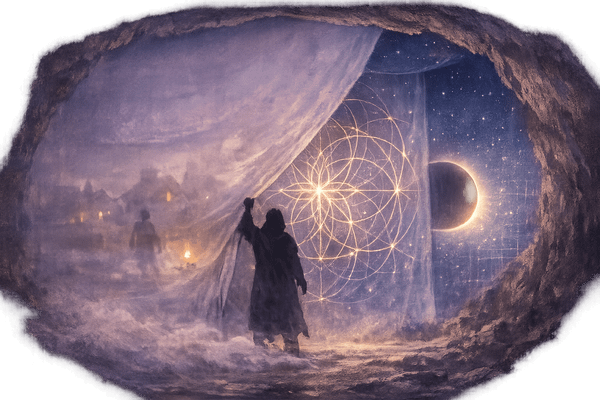
The Quantum Field and Manifestation: What Physics Actually Says
Quantum physics reveals a stranger universe than we once imagined. But does it prove that thoughts create reality? Explore the science, the interpretations and the spiritual possibilities.


There is something profoundly unsettling about the idea that the solid world around us may not be quite what it seems.
The desk beneath your hands, the air around you, the light entering the room: all are part of a physical reality whose smallest structures behave in ways that resist ordinary intuition.
At the quantum scale, familiar ideas about objects, positions and certainty become difficult to sustain. Particles exhibit wave-like behaviour. Measurements yield probabilities. Systems can become entangled in ways that challenge our everyday understanding of separation.
It is little wonder that quantum physics has become a powerful source of inspiration for modern spirituality.
And few ideas have travelled further than the quantum field.
In manifestation culture, it is often described as an invisible realm of possibility through which consciousness, intention and emotion shape the reality we experience. Focus on a desired outcome, the story goes, and you begin to draw it from the field into material existence.
The image is compelling.
But is it what quantum field theory actually says?
The answer requires us to distinguish three things: the physical fields studied by scientists, the unresolved philosophical questions surrounding quantum mechanics, and the spiritual interpretation that consciousness can participate in the creation of reality.
They can be explored together without being treated as interchangeable.
What is a quantum field?
Begin with a familiar kind of field: temperature.
At every location in a room, we can assign a temperature. It can vary from place to place and change over time. The field describes how a physical quantity is distributed through space.
A quantum field is considerably more sophisticated, but the central idea is that fields are fundamental to the description of nature.
In quantum field theory, particles are understood as excitations of underlying fields.
An electron is associated with the electron field. Photons are excitations of the electromagnetic field. The Higgs boson is associated with the Higgs field.
These are not simply poetic descriptions. Quantum field theory provides the mathematical framework underlying the Standard Model of particle physics, whose predictions have been tested through decades of experiments.
CERN offers an accessible introduction in What’s So Special About the Higgs Boson? and its wider explanation of the Standard Model.
One way to imagine a particle is as a ripple within a field.
The analogy has limits, because a quantum field is not literally an ocean or an ordinary vibrating substance. Nevertheless, it captures an important change in perspective: what appears to us as an individual object is described at a more fundamental level through fields and their interactions.
And there is more than one field.
The scientific theory does not describe a single universal reservoir of intention into which every thought is deposited.
Is everything energy?
The phrase appears everywhere in spiritual discussions of quantum physics.
There is a physical basis for recognising the relationship between matter and energy. Einstein's equation, (E = mc^2), expresses the equivalence of mass and energy.
But the scientific meaning of energy is precise.
Energy is a physical quantity associated with the state of a system and its capacity to undergo changes or perform work. It is not a synonym for consciousness, emotion, spiritual significance or an invisible atmosphere surrounding a person.
A thought involves physical processes within the brain and body. Those processes require energy.
It does not follow that a thought possesses a special frequency capable of instructing distant quantum fields to produce a desired external event.
Likewise, the fact that a person and a distant star are both described by fundamental physics does not mean they can deliberately influence one another through intention alone.
The language of energy can be useful in everyday experience. We know what it means to feel energised, depleted or moved by another person's presence.
But these are different uses of the same word.
Understanding the distinction makes it easier to appreciate both the science and the metaphor.
What is superposition?
Quantum mechanics allows a physical system to be described by a combination of possible measurement outcomes.
This is known as superposition.
In popular explanations, a particle is sometimes said to occupy every possible state until someone looks at it.
That shorthand can be misleading.
A superposition is a mathematically defined quantum state. It allows scientists to calculate the probabilities of different measurement outcomes and the interference effects that distinguish quantum systems from ordinary classical objects.
It does not mean every future event you can imagine exists as an equally available outcome waiting to be selected.
Consider the difference between a quantum experiment and a personal decision.
An experiment may have a set of measurable outcomes governed by a specific physical system and a precise mathematical description.
A decision to change careers involves personal circumstances, other people's actions, economics, timing and countless interacting processes.
Both involve uncertainty. But they are not the same kind of uncertainty.
Quantum probabilities are not an unrestricted catalogue of possible lives.
The double-slit experiment: where the mystery begins
The double-slit experiment is one of the best-known demonstrations of quantum behaviour.
Imagine sending individual particles towards a barrier containing two narrow openings, with a detecting screen behind it.
Over time, the recorded arrivals can form an interference pattern associated with wave-like behaviour.
Now arrange the experiment so that information becomes available about which slit each particle passed through.
Under the appropriate conditions, the interference pattern disappears.
This is often condensed into an extraordinary claim:
Reality changes when someone watches it.
But a conscious person does not have to stare at the apparatus for the relevant effect to occur.
The physical interaction involved in obtaining path information matters. Detectors and the surrounding environment can become correlated with the quantum system.
A National Institute of Standards and Technology paper on measurement and the double-slit experiment explains the relationship between path information, measurement and the loss of interference.
The experiment challenges our intuitive picture of definite particle trajectories.
It does not establish that a person can stare at an imagined future until it becomes real.
For the full exploration, read Double-Slit Experiment: What It Reveals About Reality.
Does the observer create reality?
The word observer causes an extraordinary amount of confusion.
In ordinary language, an observer is someone who watches an event.
In quantum physics, observation generally refers to a measurement or physical interaction that produces information about a system.
That interaction can involve a detector, an apparatus or the environment. Conscious awareness is not a required ingredient in the standard experimental description.
The distinction does not make measurement uninteresting.
Quantum mechanics still raises difficult questions about the relationship between the mathematical description of a system and the definite outcomes we experience.
But those questions cannot be answered simply by replacing the measuring apparatus with a human mind.
A person's attention can influence their own behaviour and the information they collect. It does not follow that their attention independently chooses the result of a quantum measurement.
The phrase consciousness collapses the wavefunction therefore goes beyond what ordinary quantum experiments establish.
What is the measurement problem?
Quantum theory is extraordinarily successful at predicting the results of experiments.
Yet physicists and philosophers continue to debate what its mathematical structure tells us about reality itself.
This debate includes the measurement problem.
A quantum state can evolve according to one mathematical rule, while a measurement is associated with an observed outcome. How should these descriptions fit together?
Different interpretations answer that question differently.
Some approaches use collapse as part of the account. Others describe a continuing quantum state, with definite outcomes understood through additional structure or interpretation.
Decoherence helps explain how interactions with the environment suppress observable interference between certain components of a quantum state.
It is an important part of the story, but it does not, by itself, settle every interpretive question.
The Stanford Encyclopedia of Philosophy's discussion of decoherence offers a deeper treatment of what the theory explains and what remains contested.
This is where genuine mystery survives.
Not because physicists have proved that wishes produce physical events, but because the relationship between a quantum description and the world of definite experience remains philosophically rich.
Quantum entanglement: are we all connected?
Entanglement describes quantum systems whose joint state cannot be fully understood as a collection of independent states.
When entangled particles are measured, their results can display correlations that cannot be explained by certain classical models.
Experiments testing Bell inequalities have provided powerful evidence for these distinctively quantum correlations.
In 2022, the Nobel Prize in Physics recognised Alain Aspect, John Clauser and Anton Zeilinger for foundational experiments involving entangled photons and quantum information science.
The Nobel Prize's accessible explanation shows why these findings are so significant.
But entanglement does not provide a method for sending a chosen message faster than light.
Nor does it demonstrate that two people can influence one another's thoughts or circumstances simply by directing intention towards each other.
The spiritual image of interconnectedness may resonate with the physics, but it is an interpretation rather than a result established by an entanglement experiment.
Does empty space contain energy?
Quantum field theory also changes our understanding of a vacuum.
An ordinary vacuum is a region from which matter has been removed as far as possible. In quantum theory, even a field's lowest-energy state can possess quantum properties and fluctuations.
This is associated with the idea of zero-point energy.
In manifestation literature, the vacuum is sometimes described as an infinite source of energy or an unlimited storehouse of every desired reality.
That description does not follow from the physics.
The quantum vacuum is not simply a spiritual bank account from which thoughts can withdraw events.
Nor does the existence of vacuum fluctuations establish that usable energy can be extracted without physical constraints.
Words such as potential, field and energy have acquired an additional metaphysical life beyond their scientific meanings.
We can appreciate the imagery while remembering which claims have been measured.
What about the many-worlds interpretation?
One of the most intriguing interpretations of quantum mechanics is the many-worlds interpretation, associated with physicist Hugh Everett's work in 1957.
In broad terms, it treats the quantum state as evolving without a fundamental collapse, with different outcomes represented in a branching structure.
This is an interpretation of quantum theory, not an experimentally verified map of alternative personal lives.
Its philosophical implications are substantial. The Stanford Encyclopedia of Philosophy's account of many-worlds explores its assumptions, attractions and outstanding questions.
Modern quantum-jumping practices borrow the language of parallel realities.
A practitioner may imagine moving towards a version of themselves who has made different choices or developed different qualities.
That can be an evocative way of exploring possibility.
But neither Everett's interpretation nor the experiments supporting quantum mechanics establish that meditation transfers consciousness between branches or allows someone to choose a preferred universe.
The image of a parallel self is best understood as a spiritual or imaginative practice unless independent evidence demonstrates otherwise.
Is consciousness fundamental to reality?
This is a different question from whether consciousness affects a quantum measurement.
In philosophy, idealism proposes that mind or experience is fundamental in some sense. Panpsychist approaches explore whether consciousness, or something related to it, is a basic feature of nature.
Other approaches understand consciousness through the organisation and activity of physical systems.
These positions raise profound questions about what consciousness is and how it relates to the world.
They are not settled merely by invoking the double-slit experiment.
Some researchers have also proposed quantum-based theories of consciousness, including Roger Penrose and Stuart Hameroff's orchestrated objective reduction model.
Such proposals remain debated. They do not provide an established mechanism through which an intention summons money, changes another person's feelings or selects a desired timeline.
It is possible to be interested in consciousness as a fundamental philosophical mystery while remaining careful about what current experiments show.
That position leaves room for wonder without asking physics to authenticate every metaphysical belief.
Why manifestation adopted quantum language
Manifestation and quantum mechanics share an attractive vocabulary.
Both speak of possibilities, observation, uncertainty and change.
Quantum theory also displaced some familiar assumptions about the physical world. It showed that nature could not be understood entirely through the classical image of separate objects following predictable paths.
For writers exploring consciousness, that intellectual revolution offered powerful new metaphors.
The leap occurs when a metaphor is presented as a laboratory result.
| Scientific concept | Common spiritual interpretation | What the evidence establishes |
|---|---|---|
| Quantum field | A universal reservoir of intention | Fields and their interactions underpin particle physics |
| Superposition | Every desired future already exists | Quantum states can produce distinct measurement probabilities and interference |
| Observation | Conscious focus creates outcomes | Measurement involves physical interactions and information |
| Entanglement | Thoughts can influence anything at a distance | Entangled systems exhibit distinctive correlations |
| Zero-point energy | Unlimited energy available to intention | Quantum fields have non-trivial lowest-energy states |
| Many-worlds | Meditation can select another timeline | A debated interpretation of quantum mechanics, not a demonstrated jumping technique |
These differences do not make spiritual experience insignificant.
They tell us which claims belong to physics and which belong to a broader metaphysical story.
So can thoughts shape reality?
They can shape parts of reality through identifiable pathways.
Thoughts influence what we notice, how we interpret events, which possibilities we consider and how we respond.
An intention may lead someone to learn a skill, make a connection or take an action they previously avoided.
Mental imagery may help rehearse a difficult task. Reflection may expose an assumption. A new plan can alter the sequence of events that follows.
These effects are neither imaginary nor trivial.
Research into mental contrasting with implementation intentions, for example, suggests that imagining a desired future, identifying an obstacle and planning a response can help with goal pursuit. A 2021 meta-analysis found a small-to-moderate overall benefit, while noting limitations including possible publication bias.
None of this proves that thoughts directly influence distant quantum outcomes.
It shows how inner experience can participate in changes that unfold through behaviour and circumstance.
For a deeper exploration, read Why Visualisation Works: Science and Spirit and The Science and Spirituality of Manifestation.
The spiritual idea of a field of possibility
What remains if we set aside the claim that quantum field theory proves manifestation?
A remarkably useful image.
Imagine life as a landscape containing more paths than the one you are currently following.
You cannot control every feature of that landscape. Some routes depend on circumstances, resources and decisions beyond your reach.
But you may have more room to move than your habits allow you to recognise.
The field of possibility can become a spiritual name for that openness.
Within a contemplative practice, it might represent uncertainty, creativity, potential or a sense of connection with something larger than the individual self.
There is no need to mistake the image for a physical quantum field.
Its value may lie in what it helps you ask.
What future have I stopped considering? Which assumptions make my present life feel inevitable? Where could a different choice create a new direction?
The mystery remains, but it no longer depends on misrepresenting a scientific experiment.
A field-of-possibility meditation
This exercise uses quantum language as a symbolic framework, not a method for controlling quantum systems.
Allow around ten to fifteen minutes. Sit comfortably somewhere quiet.
Enter the imagined field
Picture a wide space without a fixed edge.
It might appear as darkness, stars, mist, open sky or simply a sense of spaciousness. There is no need to produce a vivid image if visualisation does not come naturally.
Imagine that the space represents possibilities you have not yet explored.
You are not looking at literal parallel universes. You are allowing your mind to step beyond the version of the future it habitually assumes.
Notice one possibility
Let a direction emerge that matters to you.
Perhaps it concerns a relationship, creative project, working life or way of being.
Rather than imagining a flawless completed outcome, notice the qualities that make the possibility attractive.
Is it freedom? Belonging? Courage? A greater sense of purpose?
Meet the version of yourself who acts differently
Imagine a future self who has begun moving towards that possibility.
They do not need to be wealthier, enlightened or immune to difficulty.
They have simply made some different choices.
Ask what they started doing, what they stopped doing and what they learned to tolerate while change was uncertain.
Treat any answer as a prompt for reflection, not a guaranteed message from another timeline.
Return to the present
Let the imagined space fade.
Notice where you are and what is actually available to you today.
Choose one modest action that reflects the quality you explored.
If you imagined greater creative freedom, perhaps that means reserving time for a project. If you imagined a better relationship, it may mean initiating a conversation or recognising a boundary.
The meditation ends with an action you can take in this life.
That is enough.
For a fuller guided experience, explore Quantum Jumping Meditation.
Intention without control
One of the more difficult aspects of manifestation culture is its suggestion that every event reflects the quality of a person's thoughts.
If the desired outcome arrives, the person is said to have aligned correctly. If it does not, they may be told that doubt, fear or resistance prevented it.
That reasoning can turn uncertainty into self-blame.
Neither quantum physics nor psychology establishes that a person causes illness, injustice, bereavement or another person's harmful behaviour through imperfect thinking.
People act within conditions they do not fully control.
An intention can be meaningful without becoming a claim of unlimited responsibility.
A spiritual practice may help someone meet uncertainty with greater clarity, sustain hope or recognise where action is possible.
It should not require them to believe that every unwanted outcome was secretly chosen by their consciousness.
What science cannot yet answer
It would be equally simplistic to claim that quantum physics has resolved every important question about reality.
The interpretation of quantum mechanics remains contested. The relationship between consciousness and physical processes continues to attract scientific and philosophical investigation.
Fundamental physics also has major unfinished work, including the problem of reconciling quantum theory with gravity.
But an unanswered question is not evidence for whichever explanation feels most appealing.
The scientific unknown and the spiritual unknown are invitations to investigate. They are not interchangeable proofs.
We can remain curious about whether consciousness occupies a deeper place in the structure of reality without declaring that a manifestation technique has already demonstrated it.
Where thought meets reality
Perhaps the most compelling insight is not that consciousness controls a hidden field.
It is that the universe described by modern physics is already more remarkable than ordinary appearances suggest.
The familiar world emerges from structures and processes that cannot be understood simply by imagining tiny solid objects moving through empty space.
That discovery invites humility.
And within our own lives, imagination remains a genuine part of how change begins.
We picture possibilities. We question assumptions. We rehearse choices and create plans. Sometimes an inner image becomes a conversation, a journey, a piece of work or an entirely different direction.
Other outcomes remain beyond us.
Between those truths lies a more grounded understanding of manifestation: the practice of meeting possibility with intention, attention and action, without claiming command over everything that follows.
The quantum field does not need to become a cosmic wish machine to inspire wonder.
Reality is strange enough already.
Explore more
- Manifestation 101: A Beginner’s Guide to Creating Change
- The Science and Spirituality of Manifestation
- Why Visualisation Works: Science and Spirit
- Double-Slit Experiment: What It Reveals About Reality
- Timeline Jumping 101
- Quantum Jumping vs Manifestation
- Quantum Jumping Meditation
- Explore Manifestation & Practice