Sacred Rituals for Collective Intentions
What changes when people enter ritual with the same intention? Explore synchrony, shared focus, group energy and a practical collective ritual.

There is something unmistakably different about doing something together.
A room becomes quiet at the same moment.
A hundred voices begin the same song.
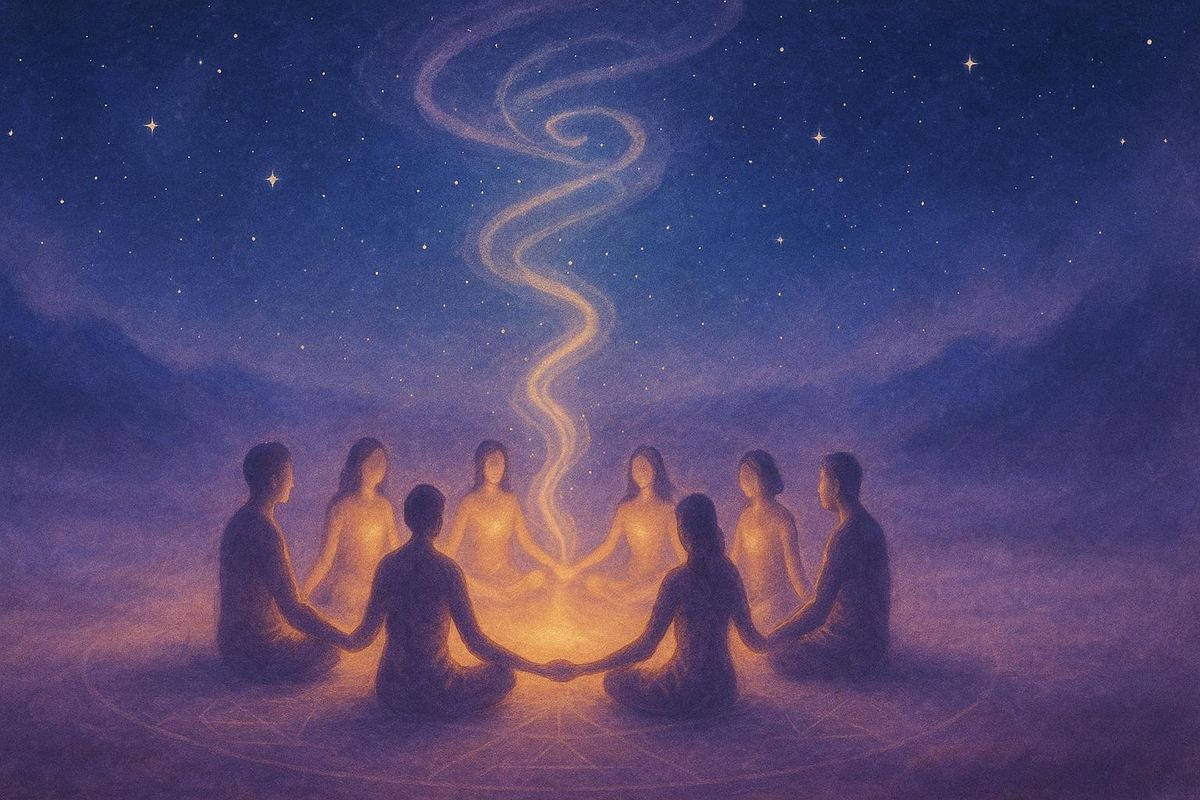
A circle of people closes their eyes and holds the same thought.
A crowd moves in rhythm.
You can call it atmosphere, synchrony, collective energy or simply the strange human effect of knowing that other minds are turned towards the same thing.
Whatever language you use, group ritual changes the experience of intention.
Spiritual traditions have understood this for thousands of years. Prayer circles, chanting, pilgrimage, communal meditation, ceremony, dance, drumming and shared silence all bring individuals into a common pattern.
The harder question is what that pattern actually does.
Does collective intention simply change the people participating?
Or can a group somehow influence reality beyond itself?
Those are two very different claims. We can explore both without pretending we already know the answer.
What is collective intention?
An intention is a conscious direction for attention and action.
A collective intention is an intention deliberately held by more than one person.
That might be:
- healing and support for someone who is ill
- reconciliation within a family or community
- courage before a difficult period
- remembrance after a death
- protection of a place
- peace during conflict
- gratitude
- a shared manifestation goal
- commitment to a collective action
The purpose matters.
"I want £1 million" is an individual desire.
"We intend to support this community through the coming winter" begins to organise a group around something shared.
Ritual gives that intention a structure.
It creates a beginning, a shared focus, symbolic actions and an ending. Instead of twenty people merely thinking about the same issue, twenty people deliberately enter a moment together.
That changes the psychology of the group immediately.
The metaphysical question is whether it changes anything else.
Why group ritual can feel so powerful
Humans synchronise remarkably easily.
We match pace while walking. Audiences clap together. People singing in groups align breathing and timing. Conversation itself contains tiny patterns of coordination.
Ritual takes that natural tendency and strengthens it.
People may breathe together.
Repeat the same phrase.
Move in the same rhythm.
Listen to the same drum.
Hold silence simultaneously.
Focus on the same symbol.
Research into behavioural synchrony has found that doing things in time with others can increase feelings of connection, cooperation and positive social behaviour.
That gives us a grounded explanation for at least part of what spiritual traditions describe as group energy.
Something really does change.
The people begin behaving more like a group.
So is a "collective field" real?
This is where language becomes slippery.
People often describe a strong gathering as having a field.
You walk into a room after an intense conversation and feel the atmosphere immediately.
A concert crowd can feel almost electrically alive.
A vigil can hold a depth of silence that would feel impossible in an ordinary meeting.
Meditation groups sometimes describe a sense that settling becomes easier when everyone around them is doing the same thing.
Calling that a collective field can be a useful description of experience.
We know several mechanisms contribute to it: attention, expectation, emotional contagion, synchronised behaviour, shared symbolism, social cues and physiological arousal.
Whether there is also a separate measurable energetic field created by shared consciousness has not been established.
Those two possibilities don't have to be collapsed into each other.
You can feel something profound in a room without needing to prove a new form of physics before you're allowed to take the experience seriously.
What happens when a group synchronises?
One of the strongest ideas from the older language of "energy alignment" survives very well once we translate it more carefully.
Groups develop rhythm.
Imagine ten people arriving for a ritual.
One has rushed straight from work.
Another is grieving.
Someone is excited.
Someone feels sceptical.
One person has done this a hundred times.
Another has never sat in a circle before.
They do not arrive in one shared state.
A good ritual helps them arrive together.
This is why traditions use bells, chanting, breath, music, processions, repeated movement and opening words.
They are threshold technologies.
They shift the group from:
many separate experiences
towards:
one shared moment.
What spiritual language might call "aligning the energy" can therefore include very concrete processes: settling attention, reducing distraction, establishing safety, clarifying purpose and synchronising behaviour.
The group does not need everyone to feel the same
This matters.
Collective ritual should never require emotional conformity.
A grieving person does not damage the group's energy.
An anxious person does not lower everybody's vibration.
Someone who feels uncertain has not failed to align.
A meaningful ritual can hold difference.
The aim isn't to manufacture identical emotional states. It is to create enough shared structure that people can participate while remaining themselves.
Someone may hold hope.
Someone else may hold sorrow.
Both can light the same candle.
That is often what makes ritual powerful.
The role of the ritual leader
A facilitator doesn't need to control the emotional state of the room.
Their job is to create a reliable container.
That means making the purpose clear.
Explaining what will happen.
Giving people permission not to participate in something that feels wrong for them.
Keeping time.
Watching the emotional temperature of the group.
Avoiding pressure, manipulation or grand promises.
Closing the ritual properly.
In spiritual circles, authority can become blurred surprisingly quickly. Someone who appears confident, intuitive or spiritually experienced can begin being treated as though they know what other people need.
Healthy ritual leadership leaves people with agency.
The facilitator holds the structure.
They do not own anyone else's inner experience.
Symbols work because we give them meaning
Collective rituals often use objects.
Candles.
Stones.
Water.
Flowers.
Crystals.
Written intentions.
Photographs.
Sacred geometry.
Religious icons.
None of those objects need to possess scientifically demonstrated powers to function within ritual.
A candle can represent remembrance.
Water can represent release.
A stone can represent something being carried.
A circle can represent equality and containment.
Symbols compress meaning.
When everybody understands the symbol, one simple act can carry a surprising amount of emotional weight.
This is one reason ritual can communicate things ordinary conversation struggles to reach.
A simple collective intention ritual
You can do this with three people or thirty.
It can take twenty minutes.
You need a candle or another object to place in the centre of the group and somewhere people can sit comfortably.
1. Agree the intention
Do this before beginning.
Keep it short enough for everybody to understand.
For example:
May we meet the coming change with courage, wisdom and care for one another.
Or:
We hold Sarah in love as she moves through treatment, and we commit to supporting her in the ways she actually needs.
Notice the difference between intention and control.
"Sarah will be completely healed" attempts to dictate an outcome no group can guarantee.
"We hold Sarah in love and commit to supporting her" expresses hope while respecting reality.
2. Create the threshold
Put phones away.
Sit in a circle if possible.
Light the candle.
Take three slow breaths together.
Let the room become quiet.
You don't need elaborate cleansing rituals unless they hold genuine meaning for the people involved.
The transition itself matters more.
3. Name why you are there
One person reads the shared intention aloud.
Then leave several seconds of silence.
Allow everybody to arrive at it in their own way.
4. Synchronise
For two or three minutes, use something simple that the group can do together.
Slow breathing.
A repeated word.
A short chant.
Gentle humming.
A simple rhythm.
Silence held for an agreed period.
This isn't about generating a magical frequency.
It helps the group move from individual attention into shared attention.
5. Hold the intention
Spend several minutes quietly focusing on the purpose of the gathering.
You might visualise the desired state.
You might pray.
You might simply repeat the intention.
You might imagine the people involved surrounded by support.
If the intention concerns something the group itself can influence, picture the actions as well as the outcome.
A ritual for community connection should eventually produce phone calls, meals, meetings and practical help.
Intention becomes stronger when it enters behaviour.
6. Let everybody contribute
Move around the circle.
Each person can say one word, sentence or prayer.
Passing should always be allowed.
Nobody needs to perform spirituality for the group.
7. Close
Read the intention once more.
Then say something simple:
We release what we cannot control and carry forward what is ours to do.
Blow out the candle.
Take one breath together.
End.
The closing matters.
Ritual should return people to ordinary life rather than leave them suspended in an emotional state.
What happens afterwards matters most
A collective intention should leave some trace in behaviour.
If the group gathers for peace, how do members handle conflict afterwards?
If the ritual concerns someone who is struggling, who checks on them tomorrow?
If the intention concerns environmental protection, what action follows?
If everyone gathers around a shared manifestation, what practical work becomes possible because people are now connected?
This is where ritual can genuinely reshape reality.
A group changes its attention.
Attention changes conversation.
Conversation changes decisions.
Decisions change behaviour.
Coordinated behaviour can change families, workplaces, communities and institutions.
No supernatural mechanism is required for collective intention to have consequences.
That does not settle every metaphysical question.
It simply gives us one pathway we know exists.
Can collective intention affect events at a distance?
This is where we need intellectual honesty.
Spiritual traditions across cultures have long practised intercessory prayer, healing intention and remote blessing.
People also report striking personal experiences around them.
Scientific attempts to demonstrate reliable effects on external outcomes have produced mixed and generally unconvincing results. Controlled research on distant intercessory prayer, for example, has not established a consistent measurable effect on people who do not know they are being prayed for.
That doesn't tell us that prayer, blessing or intention is meaningless.
It tells us that science has not demonstrated the specific external causal effect sometimes claimed for it.
Prayer may change the person praying.
It may change a community.
It may create comfort, meaning and commitment.
A spiritual person may also believe it does something beyond those mechanisms.
Belief belongs in that final sentence.
Evidence belongs in the ones before it.
What about manifestation?
Collective ritual can easily slide into the idea that enough people wanting something makes the universe deliver it.
Sacred Illusion takes a more careful position.
Shared intention can sharpen focus.
It can strengthen motivation.
It can reinforce expectation.
It can create accountability.
It can connect people with resources, knowledge and opportunities.
It can make action coordinated rather than isolated.
Those mechanisms can dramatically increase the probability of some outcomes.
But people cannot control every event through intention, individually or collectively.
Reality includes other people, chance, biology, economics, politics, physical limits and forces far beyond one group's control.
A sacred practice becomes more meaningful when it doesn't need to deny those things.
A stranger metaphysical possibility
There is still a question worth leaving open.
Consciousness remains poorly understood.
We know remarkably little about why subjective experience exists at all.
Spiritual traditions repeatedly describe consciousness as relational rather than isolated. Mystical experiences frequently include a dissolution of the boundary between self and other.
Group ritual can sometimes produce something that feels similar: the individual remains present, but the sense of separateness softens.
Perhaps that experience is entirely generated by nervous systems interacting socially.
Perhaps consciousness has dimensions we have not yet understood.
At present, the evidence cannot settle that question.
Which makes it a good Sacred Illusion question.
Not:
How do we prove that collective consciousness controls reality?
But:
Why does consciousness behave differently when we deliberately turn towards something together?
When collective ritual goes wrong
Groups can amplify unhealthy things too.
Synchrony and belonging are powerful partly because they soften individual separateness.
That can create generosity and solidarity.
It can also increase conformity.
A strong group atmosphere can make someone ignore their own discomfort because everyone else appears convinced.
Ritual leaders can exploit emotional intensity.
Shared belief can become certainty.
Certainty can become pressure.
This is why good collective practice protects dissent.
Nobody should be told that questioning the ritual damages the energy.
Nobody should be blamed if the desired outcome doesn't happen.
Nobody's illness, grief or fear should be treated as a vibration contaminating the group.
Nobody should be pushed into physical contact, disclosure or altered-state practices without consent.
A sacred circle should make it easier to remain fully human.
Collective intention in digital spaces
The group doesn't necessarily need to share a physical room.
People can breathe together over a video call.
Meditate simultaneously in different countries.
Light candles at the same agreed time.
Gather around grief, prayer or intention through screens.
The embodied experience changes, but many ingredients of ritual remain: shared time, shared attention, symbolism, repetition and participation.
That takes us directly into Digital Rituals in Virtual Spaces: Can a Screen Become Sacred?.
The technology carries the connection.
The people create the ritual.
The real power of gathering
Perhaps the phrase collective energy survives because ordinary language doesn't quite capture what happens when people stop behaving as isolated individuals for a moment.
Breathing changes.
Attention narrows.
Bodies synchronise.
Emotion travels.
Symbols become shared.
People feel connected.
Sometimes they leave ready to do things they would not have done alone.
That is already powerful.
You can believe there is more happening.
Sacred Illusion leaves room for that possibility.
But we don't need to exaggerate what we know to preserve the mystery of what we don't.