Avebury: Inside Britain's Living Sacred Landscape
Avebury is not simply a stone circle but an entire sacred landscape of stones, avenues, tombs and earthworks that people have entered for more than 4,500 years.

Avebury does not behave like most ancient monuments.
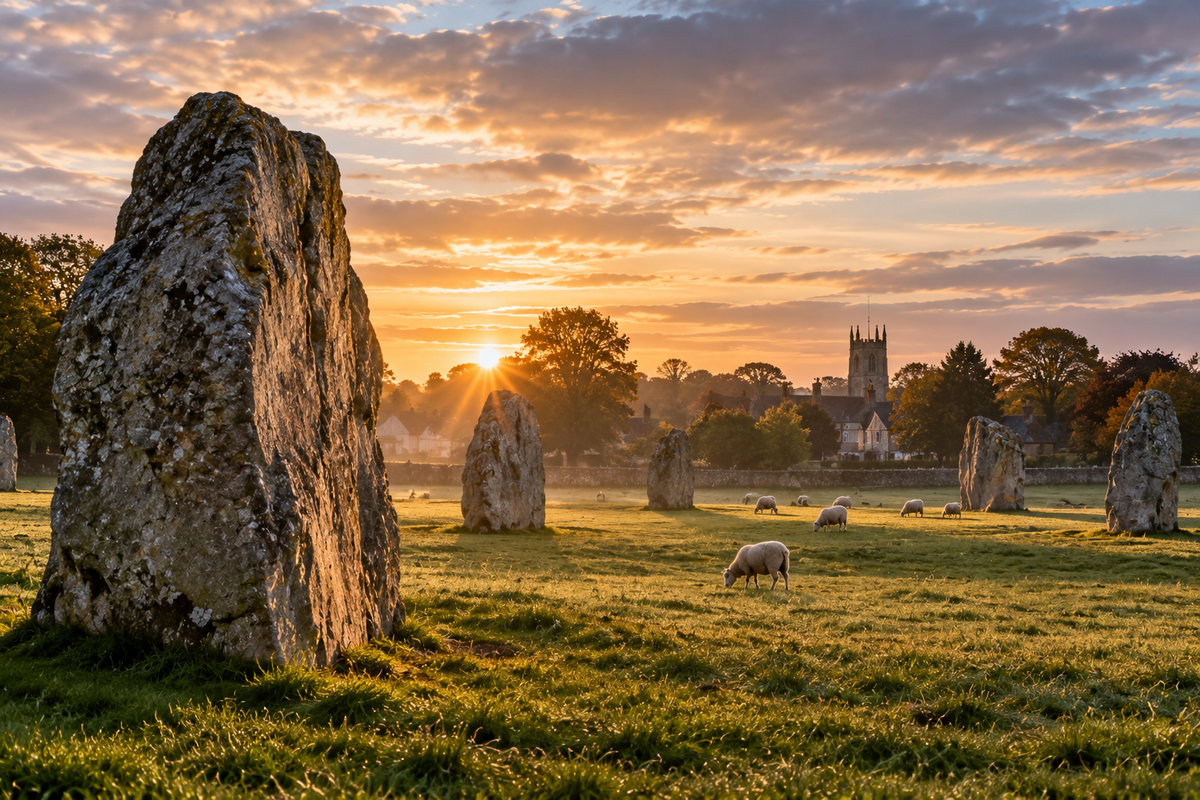
There is no dramatic reveal behind a visitor-centre gate. Roads pass through it. Houses and a pub sit inside it. Sheep graze between the stones, people walk their dogs through the henge, and you can stand directly beside sarsens that were raised more than four thousand years ago.
That openness changes the relationship between visitor and place. At Avebury you are not looking across a barrier at prehistory. You are inside it.
For me, Avebury is more personal than most of the sacred places on Sacred Illusion. It is what I think of as a home node, somewhere I return to and know through repeated experience rather than a single visit. That does not give me a definitive explanation for whatever Avebury is, but it does mean I am reluctant to flatten the place into either archaeology alone or an unquestioned story about Earth energy.
Avebury can hold more than one possibility at once.
More than a stone circle
Calling Avebury a stone circle is technically accurate and completely inadequate.
The Great Henge encloses around 11.5 hectares, or 28.5 acres, surrounded by a vast bank and internal ditch. Within it once stood an outer stone circle of roughly 100 sarsens, itself enclosing two smaller stone circles with distinctive central settings.
But even that is only the centre of a much larger prehistoric landscape.
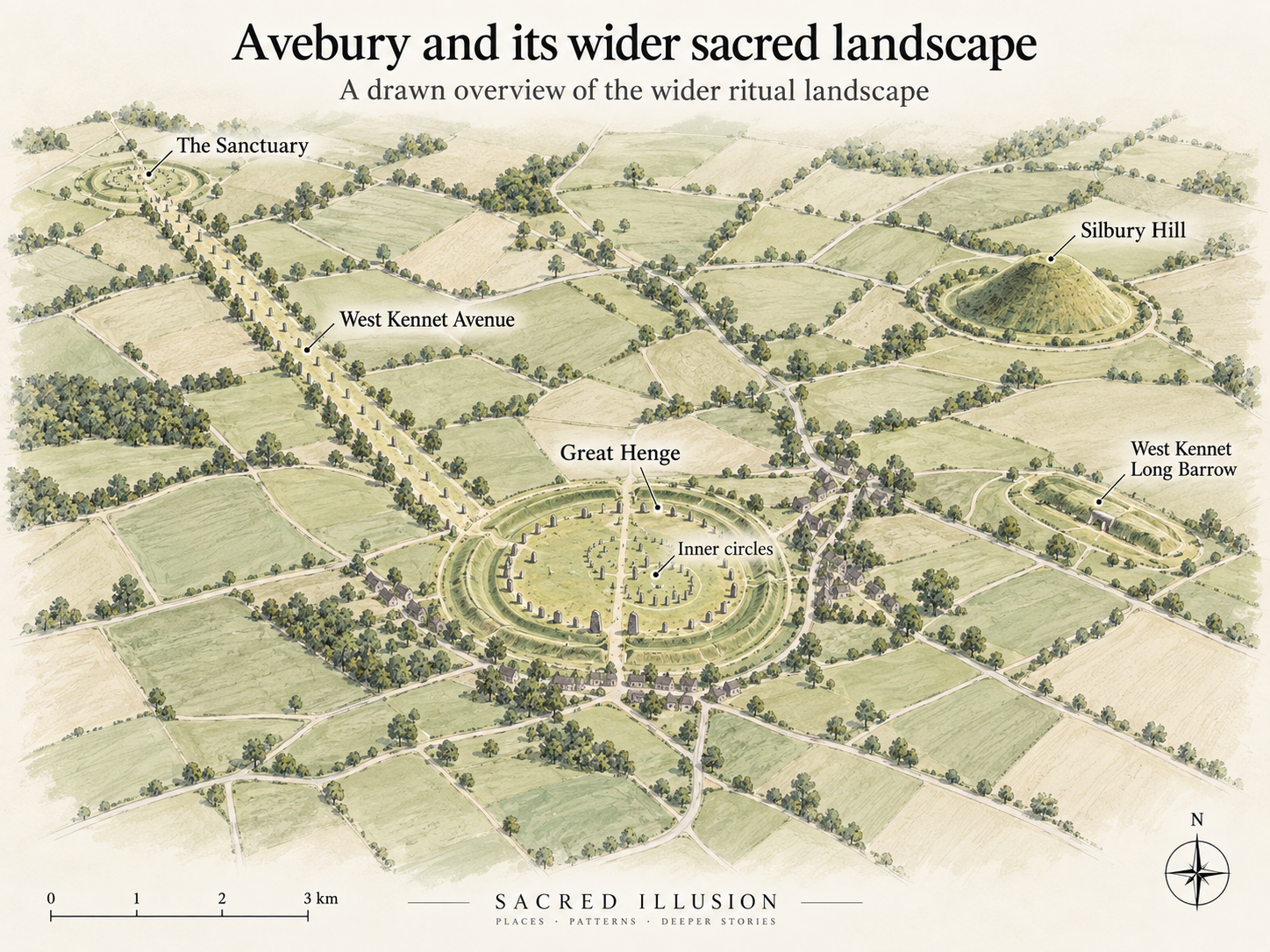
The surrounding area includes West Kennet Avenue, the Sanctuary, West Kennet Long Barrow, Windmill Hill and Silbury Hill, alongside lost or buried monuments that archaeology and geophysics continue to reveal. UNESCO treats Avebury and its associated landscape, together with Stonehenge, as an internationally important record of around two thousand years of prehistoric ceremonial and monument building.
To understand Avebury, it helps to stop imagining a single monument and start imagining a system of places.
A landscape built over generations
Avebury was not designed once and completed according to a single master plan.
Its landscape developed over centuries.
People were gathering at Windmill Hill from around the fourth millennium BC. Long barrows were constructed for communal burial. Later came the henge, stone circles, timber structures, avenues and other monuments, with major activity continuing through the later Neolithic.
English Heritage describes Avebury as one of the most complex surviving Neolithic ceremonial monuments in Britain, built and altered over many centuries. The scale of labour involved is difficult to imagine: enormous ditches dug into chalk, banks raised, sarsens moved and erected, and routes deliberately marked through the landscape. :
Whatever the exact beliefs of the builders, this was not casual construction.
People cared very deeply about this place.
The circle you can enter
One reason Avebury feels so different from Stonehenge is physical access.
You can walk among the surviving stones, approach them closely and experience their individual size, texture and shape. Some are relatively slender while others are massive, weathered blocks that seem almost sculptural despite being natural sarsen.
The circle is also entangled with the modern village. That can initially feel incongruous, but after a while it becomes part of Avebury's character. The sacred landscape was not frozen at the end of the Neolithic. People kept living here, building here, farming here, destroying stones, rediscovering them and eventually protecting them.
Avebury is ancient, but it is not dead.
Stones with character
Spend enough time walking the circle and individual stones stop feeling interchangeable. Some lean. Some appear angular and forceful.
Others are broad, rounded or deeply weathered.
Modern visitors often develop favourite stones or feel drawn repeatedly to particular parts of the circle. Some describe differences in atmosphere or bodily sensation from one stone to another, while dowsers report energetic responses around particular settings.
It is possible to approach those experiences psychologically, spiritually or both. The important thing is not to decide what you ought to feel before you arrive.
Avebury rewards attention.
What was Avebury for?
We do not know. That simple answer is easy to overlook because so many explanations have accumulated around the site.
Archaeologists generally interpret the Avebury complex as a ceremonial landscape used for gathering, procession, ritual and the expression of relationships between communities, ancestors, landscape and cosmology. English Heritage describes a landscape shaped for rites involving movement, inclusion and exclusion, possibly giving physical form to ideas about society and world order.
That is already a profound proposition.
Thousands of years ago, people transformed an entire landscape because something about gathering, walking, remembering, burying, celebrating or encountering the sacred mattered enough to justify extraordinary collective effort.
We may never recover the exact theology behind it.
Walking the Avenue
West Kennet Avenue extends south-east from Avebury towards the Sanctuary.
Today only part of the original avenue survives, but walking it gives a much better sense of how movement may have mattered within the prehistoric landscape. The stones do not merely mark a line on a map. They create a route.
English Heritage notes that the avenue linked older ceremonial locations and that some burials were later placed beside its stones.
The landscape was therefore not simply a collection of destinations. It contained journeys between them.
That makes Avebury especially interesting from a sacred-geography perspective because the connection between places is physically built into the archaeology.
The Sanctuary
At the far end of the Avenue lies the Sanctuary on Overton Hill. Very little of the original monument remains above ground, but excavation revealed concentric rings of both stoneholes and postholes, suggesting a complex timber-and-stone structure used during the late Neolithic. English Heritage interprets its layout as carefully controlling movement, visibility and access within the space.
The Sanctuary is easy to overlook because it lacks Avebury's surviving drama.
But conceptually it matters enormously. Avebury was connected to another circular ceremonial space by a monumental avenue of standing stones.
Again we find relationship, movement and pattern.
Silbury Hill
A short distance away stands Silbury Hill, the largest prehistoric artificial mound of its kind in Europe.
It was constructed in phases during the same broad period in which the Avebury landscape was being transformed. Despite centuries of excavation and speculation, no definitive explanation for its purpose has emerged.
That uncertainty gives Silbury a peculiar power. It required an extraordinary investment of labour. It clearly mattered. Yet the people who built it left us no straightforward explanation of what it was for.
Sometimes the mystery is genuine rather than manufactured.
West Kennet Long Barrow
West Kennet Long Barrow belongs to an earlier phase of the landscape.
It was built centuries before the great stone circles and contained the remains of at least 36 people. Long after active burial appears to have ceased, people continued returning to the monument and depositing material there.
That tells us something important about Avebury.
The later builders did not begin with empty ground.
They created new sacred architecture among places already associated with ancestors and memory.
The landscape accumulated meaning before the stone circle ever existed.
Ley lines and Avebury
Avebury is almost inevitably part of the ley-line story.
Alfred Watkins' original idea of landscape alignments developed in western England, while later Earth Mysteries writers and dowsers placed Avebury within much larger networks of sacred sites and energetic pathways.
In modern spiritual traditions, Avebury is often described as an important node within the British Earth-energy system. Dowsers have traced lines through the stones, surrounding monuments and wider Marlborough Downs, while some practitioners describe the circle itself as concentrating or circulating subtle energy.
This is not something archaeology can currently confirm or disprove in the metaphysical sense. There is no accepted scientific measurement of a ley-line field running through Avebury.
But Avebury is unusually interesting because connection is not purely a modern invention here.
The Neolithic builders genuinely did connect monuments through avenues, sightlines, movement and shared landscape.
Whether modern energetic interpretations are detecting another dimension of that connectedness is an open question rather than one I feel compelled to close.
For the wider story, see What Are Ley Lines?.
Is Avebury an energy node?
This is where my relationship with Avebury becomes more personal.
I think of it as a home node because it is a place I return to, orient around and experience as having a particular quality that is difficult to reduce to one individual stone or archaeological feature.
That is not a scientific measurement.
It is an experience of place.
Other visitors describe something similar in different language: grounding, expansion, calm, charge, familiarity, emotional intensity or simply the sense that the landscape feels unusually alive.
Could expectation contribute? Of course.
Could landscape, scale, history, touch, walking and repeated ritual all contribute? Absolutely.
Could there also be something about particular places that our existing categories do not fully capture? Sacred Illusion exists partly because I think that possibility deserves room.
Touching the stones
Avebury offers a physical relationship with ancient stone that relatively few famous prehistoric sites allow. Touch changes things.
A photograph tells you very little about how rough a sarsen feels, how wide it is compared with your body, how warm one face becomes in sunlight or how cold and damp another remains.
People have touched these stones for generations. Modern Pagans leave flowers or perform rituals around them. Dowsers work beside them. Families picnic nearby. Tourists lean against them. Sheep scratch themselves on them.
Some of that is spiritual and some of it wonderfully ordinary.
Perhaps a living sacred place needs both.
Modern Pagan and Druid relationships
Avebury is now an important gathering place for contemporary Pagans, Druids and other nature-based spiritual communities.
Seasonal festivals, especially around the solstices and other points in the ritual year, bring people together within the circle. Practices vary enormously and should not be presented as direct survivals of whatever Neolithic people did here.
Modern Druidry is modern. The stones are ancient.
But a tradition does not have to be prehistoric to create a meaningful relationship with an ancient place.
The fact that Avebury still supports ceremony thousands of years after its builders disappeared is itself remarkable.
Alexander Keiller and the Avebury we see today
The Avebury visible today is partly ancient and partly reconstructed.
Over centuries, stones were buried, broken or removed as Christianity, farming, road building and village development changed the landscape.
In the 1930s, archaeologist and businessman Alexander Keiller purchased substantial areas of Avebury, excavated parts of the site and re-erected a number of fallen or buried stones. English Heritage credits his work with shaping much of the appearance visitors now recognise.
This is worth remembering when walking the circle.
We are not looking at a landscape preserved untouched since 2500 BC.
We are encountering archaeology, destruction, memory and restoration layered together.
John Aubrey and William Stukeley
We know much more about the former arrangement of Avebury because early antiquarians recorded it before even more stones disappeared.
John Aubrey visited Avebury in the seventeenth century and recognised its antiquity, while William Stukeley documented the complex in considerable detail during the eighteenth century.
Stukeley also interpreted the landscape through his own fascination with Druids, sometimes projecting ideas onto the prehistoric past that modern archaeology would not accept.
Yet without those early records, much would have been lost.
Avebury's history is partly a history of people repeatedly trying to understand it.
Why Avebury feels alive
Avebury does not produce its effect through isolation. It does almost the opposite. Life continues inside the monument. Cars cross the henge. Smoke rises from chimneys. Sheep move between stones. People drink in the pub. Rain sweeps across the bank.
Someone sits quietly against a sarsen while twenty metres away somebody else is trying to stop a child jumping in a puddle. None of this diminishes the sacred. For me, it strengthens it.
Avebury suggests that sacred landscape does not have to exist outside ordinary life. It can contain it.
Visiting Avebury
Avebury is unusually accessible for a monument of its significance.
There is no admission barrier around the stone circle itself, and you can move freely through much of the henge and among the stones. The National Trust currently publishes the Stone Circle as open from dawn to dusk, while the museum, manor and visitor facilities keep conventional opening hours.
In lived terms, the landscape feels far more open than most major heritage attractions, which is part of its appeal. If you are planning a very early, late or overnight visit, check current National Trust access guidance rather than assuming that visitor-facility hours and landscape access are identical.
Parking, cafés, toilets and the Alexander Keiller Museum are centred near the village.
How I would explore it
Do not simply walk around the outer circle and leave. Start inside the henge and understand its scale. Walk part of the bank and look back down into the enclosure.
Spend time with individual stones. Then follow West Kennet Avenue away from the village.
If you have time, extend the day into the wider landscape: the Sanctuary, West Kennet Long Barrow, Silbury Hill and Windmill Hill all change the meaning of the central circle once you understand how they relate to it.
Avebury gets larger the more you explore it.
Go more than once
This is one of the few pieces of advice I feel strongly about. If you can, do not treat Avebury as a one-off attraction.
See the stones in winter when the landscape is exposed and in summer when the grass is high and everything feels softer.
Repeated encounters let you distinguish the character of the place from the mood of a single day.
That matters whether you are approaching Avebury spiritually, psychologically or archaeologically.
What we know and what remains open
There is plenty about Avebury that does not require speculation.
- It was constructed and altered over many centuries.
- It was part of a vast Neolithic ceremonial landscape.
- Its builders deliberately linked monuments and structured movement through avenues and entrances.
- Ancestors, burial, gathering and ritual played important roles within the wider complex.
What those people believed at the deepest level remains inaccessible to us.
Modern traditions add other possibilities: Earth energy, ley lines, nodes, landscape consciousness, ritual geometry and spiritual encounter.
I do not think we need to pretend those ideas are archaeological facts.
But nor do I think we need to apologise for asking whether ancient people understood aspects of landscape, consciousness and place differently from us.
That question is worth keeping open.
A place that refuses to become a museum
Perhaps this is the quality I value most about Avebury. It refuses to sit politely in the past.
The stones remain inside a village. People continue to gather around them. Old rituals have disappeared and new ones have emerged. Archaeologists map buried structures while dowsers trace invisible ones. Visitors touch the same sarsen and come away with completely different explanations for why the encounter mattered.
For some, Avebury is one of the greatest archaeological landscapes in Europe. For others, it is a temple. For others, an Earth-energy centre. For me, it is a place I return to.
Those descriptions do not have to cancel one another out.
Perhaps the deeper mystery of sacred places is not whether one interpretation eventually defeats all the others. Perhaps it is why certain pieces of landscape continue to call people back, century after century, and why some places seem capable of carrying far more meaning than their physical boundaries should allow.
Avebury is one of those places.
Frequently asked questions
Is Avebury the largest stone circle in the world?
UNESCO describes Avebury as the largest prehistoric stone circle in the world. The outer stone circle probably originally contained around 100 standing stones.
How old is Avebury?
The main henge and stone-circle complex developed during the Neolithic, with major construction taking place during roughly the third millennium BC. The wider sacred landscape contains monuments that are several centuries older.
Can you touch the stones at Avebury?
Visitors can normally walk directly among the stones, making Avebury a much more physically accessible experience than Stonehenge. Always follow current National Trust guidance and treat the stones and surrounding archaeology with care.
Is Avebury open all year?
The landscape is extraordinarily open compared with most major heritage sites. The National Trust currently lists the Stone Circle as open dawn to dusk, while the museum, manor and facilities have separate opening hours.
Is Avebury on a ley line?
Avebury features prominently in modern ley-line, dowsing and Earth-energy traditions. These interpretations are not established geophysical science, but the prehistoric landscape itself genuinely contains intentional connections between monuments through avenues, routes and ceremonial geography.
What else should I see around Avebury?
West Kennet Avenue, the Sanctuary, Silbury Hill, West Kennet Long Barrow and Windmill Hill are all part of the wider prehistoric landscape. Seeing several of them makes the central henge much easier to understand.
Why is Avebury spiritually important today?
Different communities understand Avebury differently. Contemporary Pagans, Druids, dowsers, meditators and other spiritual visitors continue to use the landscape for ritual, seasonal gatherings and personal practice, while many visitors simply experience the place as unusually powerful or affecting.
Continue exploring
What Are Ley Lines?
Explore how ancient landscape alignments became part of the modern Earth-energy tradition.
How to Recognise an Energy Node
A guide to the landscape, history, tradition and experience that can make certain places feel unusually powerful.
Glastonbury Tor
Another major British sacred landscape where archaeology, pilgrimage, legend and modern Earth-energy traditions converge.