Glastonbury Tor: Avalon, Arthur and the Mysteries of the Sacred Hill
Rising above the Somerset Levels, Glastonbury Tor holds layers of archaeology, Christian pilgrimage, Arthurian legend and modern Earth-energy tradition.
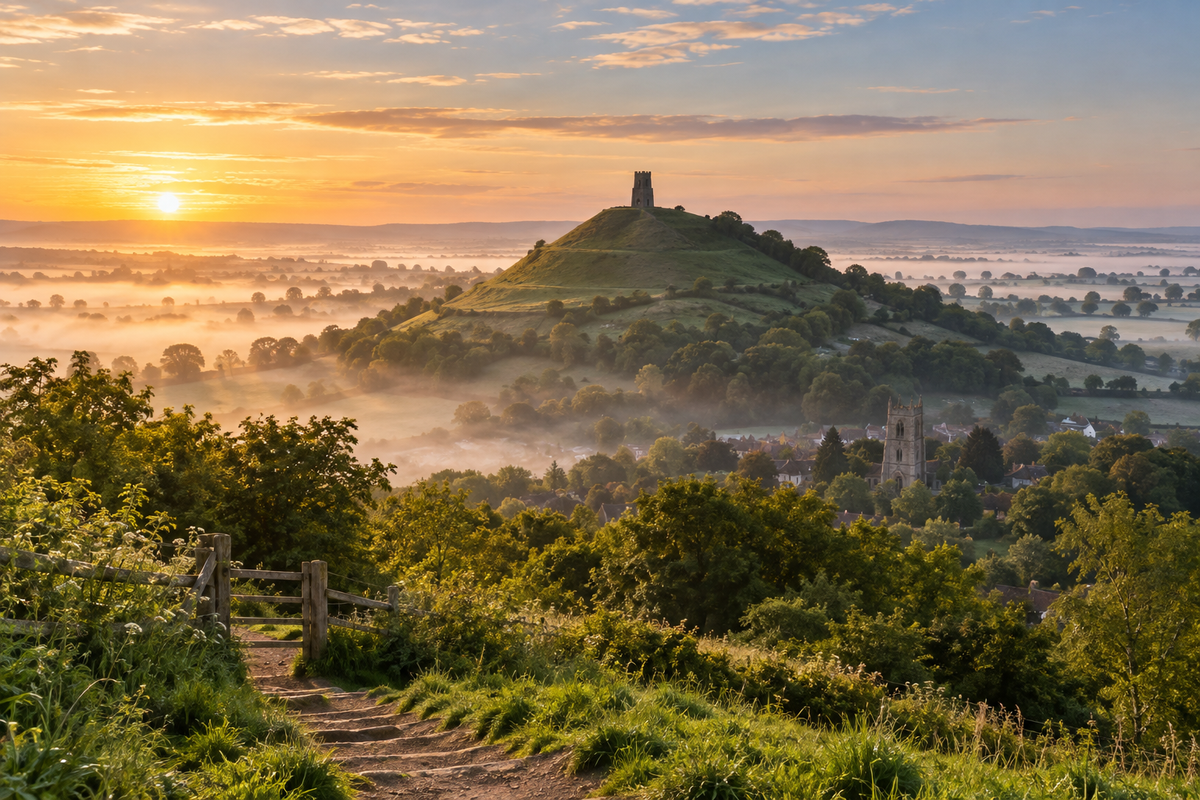
Glastonbury Tor rises so abruptly above the Somerset Levels that it seems to belong to a different landscape from everything around it. At 158 metres above sea level, with the ruined tower of St Michael's Church on its summit, it can be seen from miles away across country that was once much wetter and more marsh-like than it is today.
That physical prominence goes a long way towards explaining why the Tor has attracted so many layers of meaning. Archaeology shows occupation and religious activity stretching back more than a thousand years, while later traditions connect the hill with King Arthur, Avalon, the Holy Grail, fairies, ley lines and even the idea that Glastonbury forms the heart chakra of the Earth.
Some of those stories are historically grounded. Others belong to legend or modern spiritual tradition, and Glastonbury becomes more interesting when we allow those layers to remain distinct.
A hill above the Somerset Levels
The Tor is a natural hill formed from resistant geological layers that stand above the flatter surrounding landscape. Before extensive drainage transformed the Somerset Levels, seasonal flooding and wetlands would have made the higher ground around Glastonbury appear far more island-like than it does today.
That older geography matters because it helps explain one of Glastonbury's most persistent identities: the Isle of Avalon. A prominent hill rising above wetland can easily become an island in both physical memory and mythic imagination.
From the summit today, the view stretches across the Levels towards Wells, the Mendips and far beyond. Even without any spiritual tradition attached to it, the Tor is a powerful landmark.
What archaeology tells us
Glastonbury Tor was not simply an empty hill waiting for medieval monks or modern spiritual seekers. Excavations carried out in the twentieth century uncovered evidence of occupation dating from around the fifth or sixth centuries AD, including timber structures, metalworking hearths and high-status material.
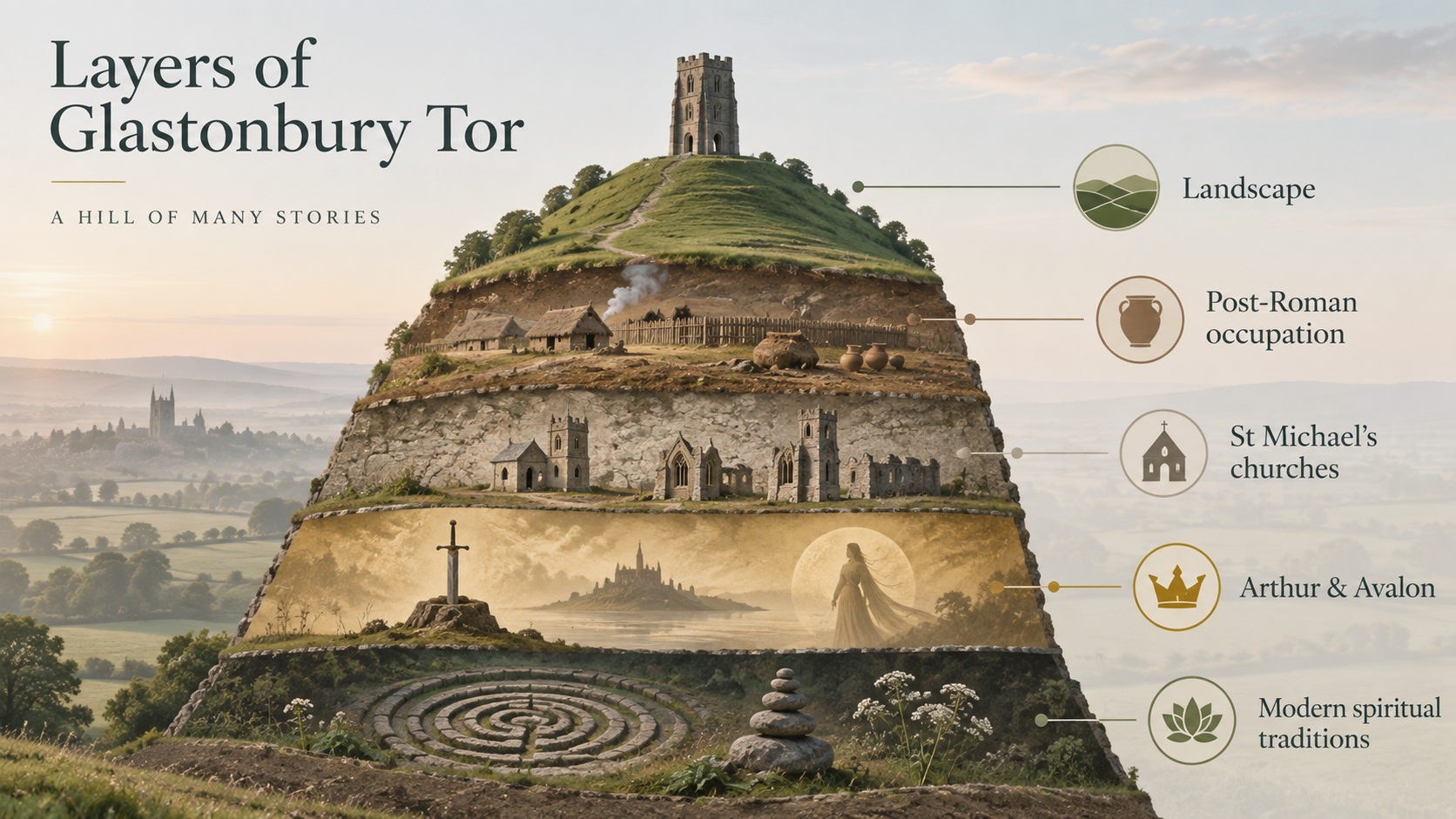
Archaeologists have debated exactly what this early settlement represented. Historic England suggests it may have been a high-status secular stronghold, while the possibility of an early Christian community cannot be ruled out.
By at least the tenth century, the Tor appears to have supported a more clearly religious presence. Medieval evidence points towards a monastic retreat and later a pilgrimage centre associated with St Michael.
That long occupation gives the Tor a genuine historical depth without requiring claims of undocumented Druid temples or prehistoric initiation centres.
St Michael's Tower
The ruined tower on the summit is the surviving part of a medieval church dedicated to St Michael.
An earlier stone church stood here by the twelfth century but was reportedly destroyed by an earthquake in 1275. A replacement church was constructed during the fourteenth century, and its tower is the structure that survives today.
The dedication to St Michael is significant. Across medieval Europe, churches dedicated to the archangel were often placed in elevated or dramatic locations, reflecting Michael's role as a heavenly warrior and protector.
The tower therefore belongs to a broader Christian sacred geography of high places rather than being an isolated curiosity.
A place of medieval pilgrimage
The Tor developed into a recognised religious destination during the Middle Ages. Historic England records buildings associated with the medieval church that suggest a permanent presence on the summit, probably supporting pilgrims and the celebration of Mass.
That makes the Tor's modern identity as a pilgrimage landscape less of an invention than it can sometimes appear. People were deliberately climbing this hill for religious reasons long before contemporary pagan, Goddess or Earth-energy movements arrived.
What has changed is the language through which visitors interpret the journey.
The death of Glastonbury's last abbot
One of the darkest documented episodes in the Tor's history came with the Dissolution of the Monasteries.
Richard Whiting, the last Abbot of Glastonbury, was executed with two monks in 1539 after resisting Henry VIII's suppression of the abbey. They were hanged, drawn and quartered on the Tor, bringing the long medieval relationship between the hill and Glastonbury Abbey to a violent end.
The tower survived after the church fell into ruin and now dominates the summit alone.
King Arthur and Avalon
Glastonbury's association with Arthur is one of the most enduring threads in its mythology.
Medieval tradition increasingly identified Glastonbury with Avalon, the mysterious island to which Arthur is taken after his final battle. In 1191, monks at Glastonbury Abbey announced that they had discovered the graves of Arthur and Guinevere, a claim recorded by contemporary chronicler Gerald of Wales.
The supposed remains were later reburied prominently within the abbey church and became an important focus for pilgrimage. Historians remain highly sceptical that the bones were genuinely those of a historical Arthur, and the discovery came at a convenient moment when the abbey needed money to rebuild after a major fire.
The story nevertheless transformed Glastonbury's identity. For more than eight centuries, Arthur and Avalon have been woven into the landscape surrounding the Tor.
Was the Tor itself Avalon?
There is no historical evidence proving that Glastonbury Tor was the Avalon described in medieval Arthurian literature.
The idea works powerfully at the level of landscape, however. Before the drainage of the Somerset Levels, the Tor and surrounding high ground could appear as islands rising from marshland, making the association far easier to imagine than when looking at the modern countryside.
Modern Glastonbury spirituality has taken the identification much further, sometimes treating Avalon almost as a parallel spiritual reality accessible through the landscape.
That belongs to contemporary spiritual interpretation rather than archaeology, but it has become an important part of the Tor's living mythology.
Gwyn ap Nudd and the entrance to Annwn
Another tradition connects the Tor with Gwyn ap Nudd, a figure from Welsh mythology associated with the Otherworld.
Modern retellings often describe a hidden entrance beneath the Tor leading into Annwn, the Celtic Otherworld, where Gwyn rules over a realm beyond ordinary human perception. The National Trust includes this among the legends that have accumulated around the hill, while making clear that these are stories rather than archaeological findings.
The idea fits the Tor remarkably well. A hill rising from mist and marsh, containing imagined caves and hidden pathways, naturally lends itself to stories about crossing between worlds.
Joseph of Arimathea and the Holy Grail
The Grail belongs more securely to the wider Glastonbury legend than specifically to the Tor.
During the Middle Ages, the abbey increasingly promoted a tradition that Joseph of Arimathea, the biblical figure associated with the burial of Jesus, had travelled to Britain and founded the earliest Christian community at Glastonbury. Later Grail literature connected Joseph with the cup of the Last Supper and brought the Grail tradition into the same Arthurian landscape.
There is no early historical evidence that Joseph visited Glastonbury. The story developed centuries after the period in which he would have lived, but by the later Middle Ages it had become an important part of the abbey's identity and pilgrimage culture.
Today the Grail story links the Abbey, Tor and nearby Chalice Well and White Spring into one of Britain's richest mythic landscapes.
The mysterious terraces
One of the Tor's strangest physical features is the series of terraces circling its slopes.
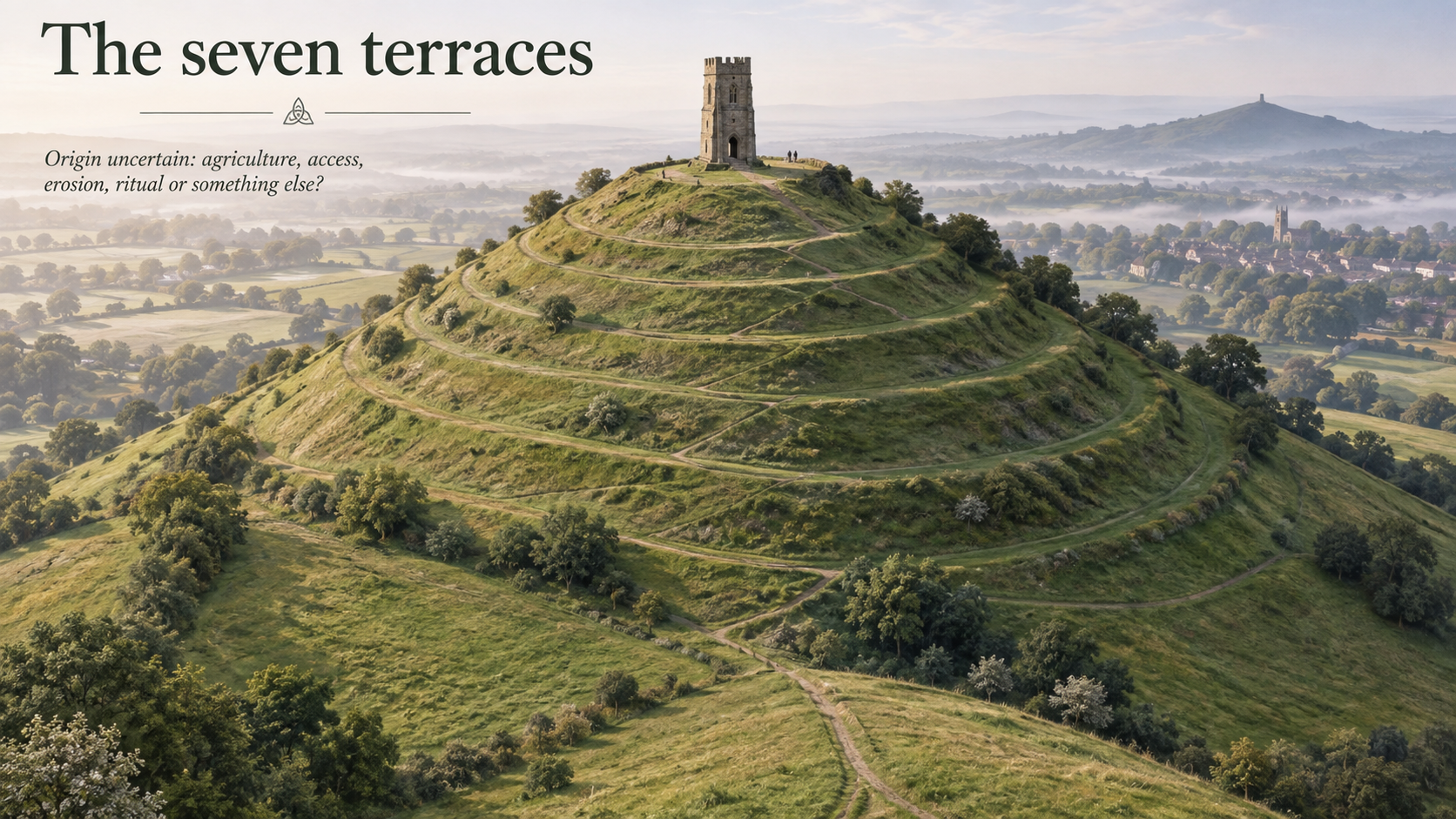
From certain angles they are unmistakable, giving the hill a stepped or spiralling appearance. Their origin remains uncertain.
Possible explanations include medieval or earlier agriculture, paths, natural erosion subsequently altered by people, and practical management of the hillside. Other writers have proposed much more elaborate explanations, including a ritual processional route or three-dimensional labyrinth.
No interpretation has been conclusively demonstrated.
That uncertainty makes the terraces genuinely interesting. We do not need to decide that they form an ancient initiation maze to acknowledge that their appearance has helped generate the Tor's modern reputation as a landscape designed for ritual movement.
Is Glastonbury Tor a labyrinth?
The idea that the terraces form a giant labyrinth has become popular within modern Earth Mysteries and Goddess spirituality.
In this interpretation, a pilgrim could once have followed a long winding route around the slopes before reaching the summit. The ascent becomes symbolic, with movement through successive levels representing transformation or initiation.
There is currently no archaeological consensus that the terraces were constructed as a ritual labyrinth. Their form has nevertheless inspired modern pilgrimage practices, and some visitors deliberately walk sections of the slopes as a contemplative journey.
This is a good example of a modern ritual developing around an unresolved archaeological feature.
Michael and Mary ley lines
Glastonbury occupies a central place in modern British ley-line traditions.
In the late twentieth century, dowsers Hamish Miller and Paul Broadhurst traced what they described as two complementary Earth-energy currents crossing southern Britain. They named them Michael and Mary, associating them with masculine and feminine energetic qualities and connecting churches, prehistoric monuments and sacred landscapes along their routes.
Glastonbury Tor became one of the most prominent locations within that system.
These lines are products of modern dowsing and Earth Mysteries practice rather than scientifically measured geophysical structures. They remain influential, however, and have helped shape how thousands of contemporary spiritual visitors interpret the Tor.
For the wider history of these ideas, see What Are Ley Lines?.
The Tor as Earth's heart chakra
Another modern spiritual interpretation describes Glastonbury as one of the Earth's planetary chakras, usually identifying the Tor and surrounding landscape with the heart chakra.
The idea applies the human chakra system to the planet, suggesting that particular sacred places function as major energetic centres. Glastonbury is commonly associated with love, healing, compassion and the balancing of masculine and feminine forces.
There is no scientific evidence that Earth possesses a chakra system or that the Tor emits a measurable heart-chakra energy.
As a spiritual metaphor, though, the association makes sense within modern Glastonbury culture. The town has become a meeting place for Christian mysticism, paganism, Goddess spirituality, New Age practice and many other traditions that emphasise connection and spiritual transformation.
Why people report feeling something here
Visitors frequently describe Glastonbury Tor as unusually atmospheric or energetically powerful.
There are many possible contributors to that experience. The Tor is physically demanding enough to alter breathing and attention, the summit has an exceptional panoramic view, weather changes quickly, wind can be intense, and the visual isolation of St Michael's Tower gives the landscape a striking symbolic focus.
Expectation also matters. Few visitors arrive unaware that Glastonbury is considered sacred, magical or spiritually charged, and those stories influence what people notice once they are there.
None of that invalidates spiritual experience. It simply means that a powerful response to place may arise from several layers at once: body, landscape, history, story, expectation and perhaps something the visitor interprets in a more metaphysical way.
The Tor and the springs below
The sacred geography of Glastonbury does not stop at the summit.
At the base of the Tor, Chalice Well and the White Spring bring water into the landscape. One carries iron-rich water that leaves red staining, while the other is associated with pale calcite deposits.
Modern spiritual traditions often interpret these two springs as complementary forces and connect them with the Michael and Mary currents.
Whether or not one accepts the energy model, the relationship between hill and water is physically striking. The Tor rises above the landscape while two distinctive springs emerge below it, creating exactly the kind of geography around which sacred traditions tend to accumulate.
A Christian, pagan and modern sacred place
Trying to label Glastonbury Tor as exclusively Christian, pagan or New Age does not really work.
There is strong archaeological evidence for medieval Christian worship and pilgrimage. There are later legends drawing on Celtic and Arthurian material, while modern pagan, Goddess and Earth-energy traditions have developed their own relationships with the hill.
Those traditions do not all have the same historical depth, and they should not be blended into one invented ancient religion.
What they do show is that the Tor continues to function as a sacred place because successive communities keep finding meaning there.
Visiting Glastonbury Tor
The Tor is managed by the National Trust and is normally accessible during daylight hours. There is no visitor car park directly at the summit, so reaching the tower requires a walk and a fairly steep climb.
Weather can change quickly and the summit is exposed, particularly in strong wind. Wear sensible footwear, carry water and expect the climb to take longer if you want to stop and look at the landscape rather than simply reach the top.
The Tor is also used for spiritual gatherings and seasonal celebrations. If other people are praying, meditating or conducting personal ritual, give them space rather than treating the activity as part of the attraction.
When is the best time to visit?
Early morning can be particularly atmospheric because the Somerset Levels may still hold mist while the summit rises above it. Evening light can also make the shape of the terraces and surrounding landscape easier to see.
Solstices and other seasonal dates attract larger numbers of visitors, particularly those involved in pagan and alternative spiritual traditions. Those occasions can be meaningful if you want shared ritual and community, but less suitable if you are looking for solitude.
There is no established time when the Tor's supposed energy becomes objectively stronger.
What to notice when you climb
Rather than rushing directly to the tower, pay attention to how the landscape changes during the ascent.
Notice the terraces, the relationship between the Tor and the town below, and how the view opens across the Somerset Levels. From the summit, consider how dramatically this one hill would have dominated a wetter, flatter landscape in earlier centuries.
Inside and around St Michael's Tower, look for the surviving medieval carvings and remember that the summit was once occupied by a functioning church and pilgrimage community.
The Tor makes more sense when experienced as a complete landscape rather than simply a viewpoint.
What is documented and what belongs to tradition?
Glastonbury Tor has enough genuine history that we do not need to turn every legend into fact.
Documented
- Archaeology shows occupation on the summit from around the fifth or sixth centuries onwards.
- The Tor later supported a monastic and pilgrimage community.
- Successive churches dedicated to St Michael stood on the summit, with the surviving tower belonging to the later medieval church.
- The terraces are real, but their original purpose remains uncertain.
- The Tor rises dramatically above land that was historically much wetter than the modern Somerset Levels.
Tradition and interpretation
- Glastonbury is identified with Avalon and the stories of King Arthur.
- Legends connect the landscape with Joseph of Arimathea and the Holy Grail.
- Modern dowsing traditions identify the Michael and Mary energy lines through Glastonbury.
- Some spiritual systems describe Glastonbury as the heart chakra of the Earth.
- The terraces are sometimes interpreted as a ritual labyrinth.
These traditions are important parts of Glastonbury's identity. They simply belong to different categories of evidence.
Why Glastonbury Tor remains compelling
The Tor works because no single story quite contains it.
It is a geological landmark, an archaeological site, a medieval pilgrimage destination and a place around which Arthurian and Christian legends gathered. It is also a living spiritual landscape used today by pagans, Christians, Goddess practitioners, dowsers, meditators and visitors who simply want to climb a remarkable hill.
Some of its mysteries are probably products of later storytelling, while others remain genuinely unresolved. The terraces still provoke questions, the post-Roman occupation is intriguing, and the transformation of a Somerset hill into Avalon tells us something profound about the way human beings create sacred geography.
You do not have to believe that Glastonbury Tor is a planetary chakra or portal to another dimension to understand why people experience it as extraordinary. The place already contains enough landscape, history and accumulated meaning to make the climb worthwhile.
Frequently asked questions
How high is Glastonbury Tor?
The summit is approximately 158 metres, or 518 feet, above sea level. Its prominence is especially striking because it rises above the comparatively flat Somerset Levels.
What is the tower on Glastonbury Tor?
It is the surviving tower of the medieval Church of St Michael. An earlier church was reportedly destroyed by an earthquake in 1275, and the later church eventually fell into ruin after the Reformation.
Is Glastonbury Tor really Avalon?
Glastonbury has been associated with Avalon since the Middle Ages, particularly through traditions surrounding King Arthur. There is no historical evidence proving that the Tor was the literal Avalon of Arthurian legend.
Was King Arthur buried at Glastonbury?
The monks of Glastonbury Abbey announced in 1191 that they had found the graves of Arthur and Guinevere. The identification became an important medieval pilgrimage tradition, but historians do not regard it as proof that a historical Arthur was buried there.
Are the terraces a labyrinth?
Some modern spiritual writers interpret the terraces as a giant ritual labyrinth. Archaeologists have not established this as their original purpose, and agricultural, practical and natural explanations have also been proposed.
Is Glastonbury Tor on a ley line?
Modern dowsing traditions, particularly the Michael and Mary line system, identify Glastonbury as an important Earth-energy location. These lines are spiritual and dowsing interpretations rather than scientifically demonstrated energy structures.
Why is Glastonbury called the Earth's heart chakra?
Some modern planetary-chakra systems associate Glastonbury with the heart centre and qualities such as love, healing and balance. This is a contemporary metaphysical interpretation rather than a scientifically measurable feature of the Tor.
Continue exploring
Chalice Well & the White Spring: Sacred Waters of Glastonbury
Explore the two contrasting springs beneath the Tor, their history, Grail traditions and modern spiritual meanings.
What Are Ley Lines?
Discover how Alfred Watkins' landscape alignments developed into modern ideas about Earth energy and sacred geography.
How to Recognise an Energy Node
A wider guide to why certain places accumulate spiritual traditions and reports of unusual experience.