Simulation Theory 101: Are We Living in a Simulated Reality?
Could reality be simulated? Start with Nick Bostrom's real argument, then explore the science, philosophy, consciousness and older ideas that make the question so difficult to dismiss.


Suppose everything around you is real in the sense that you can touch it, love people within it, make choices and experience consequences, but it is not the deepest level of reality.
The stars are real to us. Your body is real to you. The chair beneath you behaves like a chair. Yet the physical universe itself could be generated by processes occurring somewhere beyond it, just as a virtual world can contain apparently solid objects created by something outside the world itself.
That is the central idea behind the simulation hypothesis.
It sounds like science fiction because science fiction got there first. Yet the modern philosophical case is not based on finding glitches, strange coincidences or pixels hidden inside atoms. Its most famous version comes from philosopher Nick Bostrom, whose 2003 simulation argument turned a familiar fictional idea into a serious question about probability, technology and consciousness.
More than twenty years later, we still do not know the answer. But the possibility opens some extraordinary questions about what reality is, what consciousness is doing here and whether we are simply observers of the universe or participants in something far stranger.
What is simulation theory?
Simulation theory proposes that the reality we experience could exist within an artificial or generated environment created by an intelligence or civilisation operating at another level of reality.
The simulation would not necessarily resemble a computer game running on a machine like ours. A civilisation capable of creating conscious simulated worlds could possess technology so far beyond our own that words such as computer, program and code may be crude metaphors.
Nor would every detail necessarily need to be calculated in the way we imagine computation today.
The fundamental proposition is simpler: the reality we experience may be generated by something more fundamental than the reality we can directly observe.
That immediately creates another question. If an apparently physical world were simulated perfectly enough, how could anyone living inside it know?
Nick Bostrom's simulation argument
Philosopher Nick Bostrom gave simulation theory its most influential modern formulation in 2003.
His argument begins with a future technological possibility.
Imagine that some civilisations eventually become enormously advanced. They possess enough computing capacity to simulate detailed histories containing conscious beings who experience their world much as we experience ours.
Bostrom called these ancestor simulations.
If advanced civilisations created huge numbers of them, there could eventually be vastly more simulated people having human-like experiences than original biological people.
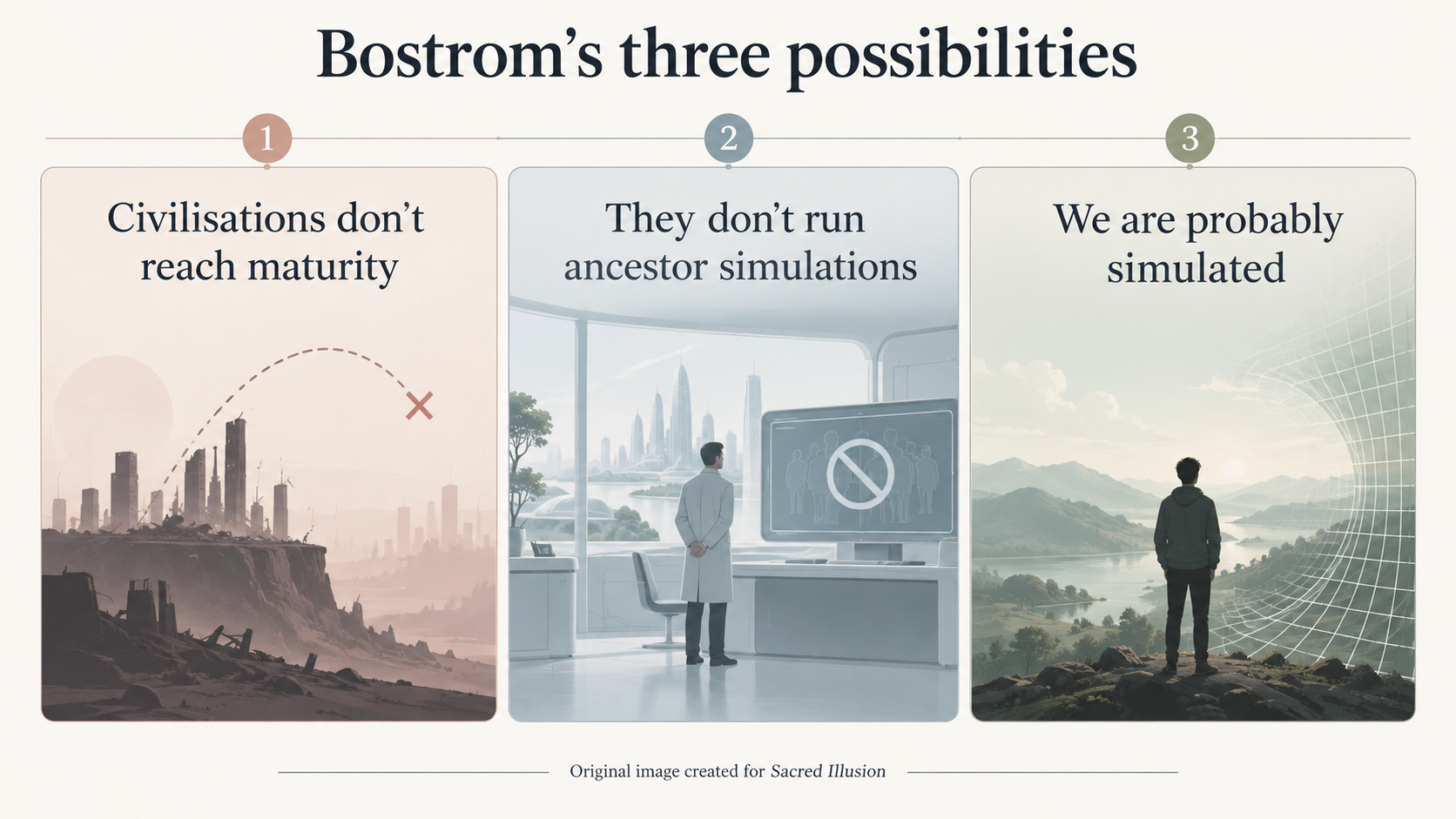
From there, Bostrom argued that at least one of three broad propositions must be true:
- Civilisations like ours almost never survive long enough to become capable of creating vast numbers of conscious ancestor simulations.
- Civilisations that do reach that stage almost never choose to run many such simulations.
- If they do run enormous numbers of them, beings with experiences like ours are probably simulated rather than members of the original civilisation.
The argument is often shortened online to: "Bostrom proved we are probably living in a simulation."
He did not.
What he gave us was a three-way problem. We currently do not know which branch describes reality.
That uncertainty is part of what makes simulation theory so interesting.
The assumptions underneath it
The argument depends on several large assumptions.
One is technological. A future civilisation must be capable of producing enormous simulations containing minds with experiences comparable to ours.
Another concerns consciousness.
If consciousness depends entirely on biological brains made from particular materials, then simulating the behaviour of a brain might not create an experiencing mind at all.
Bostrom's argument assumes some form of substrate independence: the possibility that the processes producing consciousness could occur in something other than a biological human brain.
We do not know whether that is true.
Science still does not have an agreed explanation for why consciousness exists in us, never mind whether sufficiently sophisticated computation would produce it elsewhere.
Simulation theory therefore leads very quickly away from computers and towards the deeper mystery of consciousness itself.
Would a simulated world be fake?
Not necessarily.
Philosopher David Chalmers has argued that a simulated or virtual reality could still be a genuine reality.
If you discovered tomorrow that your world existed within a simulation, the people you loved would not suddenly become meaningless. Your memories would still have happened within the reality available to you. Pain would still hurt. Choices would still produce consequences.
The underlying substance of reality would have changed.
Reality itself would not simply disappear.
That gives simulation theory a more interesting philosophical edge than the familiar claim that "nothing is real".
A simulated universe could be completely real at its own level while still depending on a deeper one.
And that possibility begins to sound surprisingly familiar.
An old question in modern language
Human beings were questioning the apparent solidity of reality long before computers existed.
Plato's Allegory of the Cave imagined people mistaking shadows for the whole of reality because they had never seen what produced them.
Indian philosophical traditions explored maya, although translating it simply as "the world is fake" badly oversimplifies a much richer idea concerning appearance, perception and ultimate reality.
Gnostic traditions described a material cosmos separated from a higher divine reality, sometimes created by a lesser being known as the Demiurge.
Mystical traditions across cultures have repeatedly suggested that ordinary perception shows us only a limited layer of what exists.
These traditions are not ancient versions of Bostrom's simulation argument. They come from completely different cultures and metaphysical systems.
But the resemblance is intriguing.
Again and again, human beings have wondered whether the visible world is the whole world.
Computing has simply given that ancient suspicion a new metaphor.
Does modern physics suggest a simulation?
This is where simulation theory can easily slide from fascinating speculation into claims that go further than the science allows.
Several genuine features of modern physics sound computational when translated into everyday language.
Nature contains fundamental limits. Quantum systems behave in ways that resist classical intuition. Information has become increasingly important within physics. Space and time themselves may turn out to have structures very different from the smooth background our senses appear to show us.
None of those discoveries proves that the universe is software.
Quantum mechanics does not demonstrate that reality is simply "rendered when someone looks". Nor does discovering a minimum physical scale automatically mean we have found pixels in space.
But modern physics has unquestionably weakened the old intuitive picture of reality as a collection of solid objects moving predictably through an independent background of space and time.
At the deepest levels we can currently investigate, reality is already much stranger than everyday experience suggests.
Simulation theory is one possible interpretation of that strangeness.
It is not the only one.
What about the holographic universe?
Another idea often pulled into simulation discussions is the holographic principle.
Very broadly, some approaches to fundamental physics suggest that information describing a region of space may be represented on a lower-dimensional boundary.
This has produced the irresistible popular phrase that "the universe is a hologram".
That does not mean somebody is projecting our world from a cosmic laptop.
The holographic principle emerged from attempts to understand gravity, black holes and quantum theory. It may eventually tell us something extraordinary about how spacetime and information relate.
If our everyday three-dimensional experience arises from information organised in a fundamentally different way, however, it does add another challenge to our assumption that reality must be exactly what it appears to be.
Are there pixels in the universe?
One possible route to testing simulation ideas is to ask whether spacetime contains detectable signs of a computational lattice or resolution limit.
The attraction is obvious.
A digital image eventually reveals pixels. Perhaps an artificial universe would eventually reveal its grid.
So far, no accepted observation has demonstrated such a structure as evidence of simulation.
Even if physics eventually discovers that spacetime is discrete rather than continuous, there would still be another step between "reality has a smallest scale" and "reality was programmed by someone".
The first could simply be a property of fundamental physics.
The deeper question remains open.
Consciousness may be the bigger mystery
Simulation theory initially sounds as though it is about computers.
Eventually it becomes a question about consciousness.
If you are simulated, what exactly is the thing having this experience?
Is consciousness produced entirely by processes within the simulation?
Is it instantiated by computation occurring at another level?
Could consciousness exist independently and somehow interact with physical or simulated reality?
Or could consciousness itself be more fundamental than either matter or computation?
Science does not currently give us a final answer even for ordinary human consciousness.
That gap leaves room for very different models, from strict physicalism to idealism, panpsychism and spiritual theories in which consciousness is not something matter accidentally produces but one of the fundamental features of reality.
Simulation theory does not prove any of them.
It does make consciousness impossible to ignore.
Could consciousness influence the simulation?
This is where simulation theory becomes more than an abstract argument about computers.
If reality is generated rather than simply existing as a fixed collection of objects, could consciousness have some role in how that reality unfolds?
We do not know.
But it opens a fascinating possibility.
A simulated universe might operate through probabilities, information, feedback and interaction. Conscious observers may simply experience whatever the system produces, or consciousness could be more deeply involved in the process.
If the second possibility were true, ideas usually placed under the heading of manifestation start to look rather different.
Intention might be more than wishful thinking.
Attention might affect which possibilities we notice, pursue or perhaps strengthen.
Synchronicities might be meaningless coincidences, or they might occasionally represent patterns produced by a reality more responsive than we currently understand.
Meditation, prayer and ritual might change only the mind of the practitioner. Or changing consciousness might also change the way that practitioner interacts with whatever generates experience.
None of this has been demonstrated scientifically.
But simulation theory removes one assumption that often sits beneath objections to manifestation: that reality must be entirely fixed, external and indifferent to consciousness.
If reality is informational, participatory or generated, the relationship between mind and world becomes a much more open question.
Manifestation as an interface
One of the possibilities we explore on Sacred Illusion is that manifestation may be less like magically demanding things from the universe and more like learning how to participate consciously in reality.
The simulation metaphor gives us a useful way of thinking about this.
Every system has rules.
Every interface has inputs.
Every game contains possibilities that become available through particular choices, actions and states.
What if attention, belief, emotional state and intention are part of our interface with reality?
That does not mean thinking about a Ferrari causes one to materialise outside the house.
It suggests something more subtle and potentially more interesting.
Our inner state already changes what we perceive, which opportunities we recognise, how confidently we act, what relationships we enter and the decisions we make. Psychology can account for a great deal of this.
The unanswered question is whether the relationship goes further.
Could consciousness interact with reality at a level we do not yet understand?
Could sustained intention influence probability?
Could synchronicity sometimes represent feedback rather than coincidence?
Could altered states allow us to perceive information normally filtered out?
Could consciousness itself be part of whatever system generates the reality we experience?
These remain possibilities rather than established mechanisms.
But if consciousness turns out to be fundamental rather than merely produced by the brain, those possibilities become considerably harder to dismiss.
Synchronicity and a responsive reality
Synchronicity is one of the places where this becomes personally interesting.
You think about someone you have not seen for years and they contact you.
A book falls open to the exact idea you have been wrestling with.
A series of apparently unrelated events forms a pattern so precise that ordinary coincidence begins to feel like an unsatisfactory description.
Most coincidences probably are coincidences.
Human brains are extraordinary pattern-detection machines, and we notice meaningful events more readily than the thousands of events that go nowhere.
But that does not necessarily explain every experience.
Carl Jung's concept of synchronicity proposed that some coincidences might be connected through meaning rather than ordinary cause and effect.
Simulation theory gives us another metaphor for the same possibility.
What if reality sometimes produces feedback?
What if consciousness and circumstance participate in a deeper informational relationship?
We cannot establish that from a single uncanny event.
But neither do we need to pretend that the question is absurd.
What about glitches in the Matrix?
Déjà vu. Impossible coincidences. Objects apparently moving. Shared false memories. Strange repetitions. Moments when reality seems to skip.
Popular simulation culture has grouped all of these under the idea of glitches in the Matrix.
Many have plausible explanations involving memory, attention, perception and coincidence.
Some remain personally uncanny even after those explanations are considered.
Sacred Illusion takes these experiences seriously without automatically converting them into proof.
A strange event can remain genuinely strange before we know what caused it.
And there is an important difference between saying "this proves reality glitched" and asking "what if our current explanation is incomplete?"
We explore that further in Are Glitches in the Matrix Just Cognitive Errors?.
The Mandela Effect
The Mandela Effect pushes the question further.
Large groups of people sometimes remember a detail differently from the documented record.
Psychology offers powerful explanations involving reconstructive memory, social reinforcement, expectation and the spread of shared mistakes.
Simulation interpretations suggest something much more exotic: perhaps timelines changed, realities merged or the underlying system was altered.
There is currently no reliable evidence demonstrating that Mandela Effects result from changes to reality.
Yet the phenomenon remains fascinating because it reveals how uncertain our apparently solid experience of the past can be.
Memory is one of the interfaces through which we construct reality.
That alone makes it worth investigating.
And for someone who has experienced a memory that feels absolutely, viscerally real while the documented world insists otherwise, "your memory was wrong" does not always feel like the end of the story.
Dreams and altered states
Simulation theory also gives us a different way to think about dreams, meditation, psychedelics and other altered states of consciousness.
Ordinarily, the brain filters an overwhelming amount of information and presents us with a manageable model of reality.
What happens when those filters change?
The conventional explanation is that altered states change brain activity and therefore alter subjective experience.
That is almost certainly part of what happens.
The more speculative possibility is that ordinary waking consciousness may itself be a constrained interface, and altered states sometimes reveal aspects of reality normally excluded from it.
Mystical traditions have made versions of that claim for centuries.
Simulation language gives us a modern metaphor: perhaps consciousness usually operates inside a tightly controlled user interface, while certain states allow us to glimpse more of whatever sits underneath.
Again, possibility is not proof.
But it is a possibility worth exploring.
Who would create a simulated universe?
If our reality is simulated, the creators need not be gods.
They could be descendants of beings like us.
They could be researchers reconstructing history.
They could be running evolutionary experiments, cultural simulations, entertainment or scenarios whose purpose we could not understand.
They might not even know we are conscious.
There is also no reason to assume that the level above ours is itself ultimate reality.
A simulated civilisation could eventually develop simulations of its own.
Those simulations could do the same.
Reality could contain layers within layers.
At some point, "Who created the simulation?" becomes another version of the much older question: Why is there something rather than nothing?
Simulation theory changes the vocabulary without removing the mystery.
Could we ever prove it?
Perhaps.
Probably not by spotting repeating numbers or staring at quantum experiments until the code reveals itself.
Direct evidence is conceivable. A simulator could reveal itself. We might discover an unmistakable feature of reality best explained by external intervention.
Indirect evidence might also change how plausible the hypothesis seems.
If humanity eventually develops the ability to create conscious simulated worlds and chooses to run millions of them, one branch of Bostrom's argument becomes much more uncomfortable.
If we discover that advanced civilisations inevitably destroy themselves before reaching that point, another branch becomes more likely.
There may also be physical or computational limits that make particular forms of universe simulation impossible.
The interesting shift is that simulation theory may not remain forever in the realm of pure philosophy.
Specific versions of it can increasingly be questioned, modelled and potentially tested.
We explore that in much more detail in Can We Prove We're in a Simulation?.
Does AI make the idea more plausible?
Our own technological trajectory has changed how simulation theory feels.
We already build virtual worlds populated by autonomous agents. Generative AI can produce images, voices, environments and characters that would have seemed extraordinary only a few decades ago.
None of this shows that our universe is simulated.
It does make one of Bostrom's starting assumptions easier to imagine.
Humans clearly have an appetite for creating artificial worlds.
If technology continues to improve over centuries or millennia, what kinds of worlds might descendants of technological civilisation create?
At what point might the beings inside one of those worlds cease to be merely scripted characters?
And if artificial agents eventually develop subjective experience, how confidently could they determine whether the reality surrounding them was fundamental?
Those questions no longer feel entirely like science fiction.
Simulation theory and spirituality
The meeting point between simulation theory and spirituality is much richer than the claim that quantum physics proves manifestation.
Both ask whether ordinary perception reveals the deepest layer of reality.
Both raise questions about identity.
Both ask whether consciousness may be more important than materialism traditionally allows.
Spiritual traditions have repeatedly suggested that awakening involves recognising that the world is not quite what it appears to be.
Simulation theory reaches a similar territory through technology and philosophy.
If the universe is simulated, spiritual interpretations remain possible, but they do not automatically follow.
The simulator might be a posthuman scientist rather than God.
Consciousness might be generated internally rather than entering from outside.
There might be no spiritual purpose at all.
Or the simulation metaphor could turn out to describe something unexpectedly close to what older metaphysical traditions were trying to express in completely different language.
Perhaps "simulation" is not the answer.
Perhaps it is simply the latest metaphor humanity has developed for a reality whose deeper architecture remains hidden from us.
Would life have less meaning?
I think the opposite question is more interesting.
Why should a deeper layer of reality make this one meaningless?
A novel is made from ink or pixels, but the story can still move you.
A dream may not share the same physical status as waking life, but the fear or insight experienced within it can be genuine.
A simulated world containing conscious beings would still contain relationships, suffering, joy, decisions and consequences.
Meaning does not necessarily depend on being made from the most fundamental substance in existence.
If anything, discovering that reality had another layer would give us a larger mystery to explore.
And if consciousness can influence that reality in ways we have not yet understood, it might also change how we think about responsibility, intention and the possibilities available to us.
How Sacred Illusion approaches simulation theory
We are not going to treat every coincidence as a system message or every strange feature of quantum physics as proof of code.
But nor are we going to dismiss extraordinary possibilities simply because they sit beyond what can currently be measured.
Simulation theory occupies an unusually fertile territory between philosophy, technology, consciousness, physics and metaphysics.
Some parts can be examined logically.
Some may eventually be tested scientifically.
Others remain philosophical or spiritual possibilities.
And some may involve aspects of consciousness we do not yet have the language or instruments to understand.
The interesting work is learning which is which without closing the door too early.
So, are we living in a simulation?
We do not know.
But perhaps that is not the most interesting part of the question.
Simulation theory asks us to consider that physical reality may not be the final layer. Consciousness may occupy a stranger role than we currently understand. The universe may be informational, participatory or responsive in ways that our existing models only partly describe.
If that is true, some ideas that currently sit at the edges of accepted knowledge become worth examining again.
Manifestation.
Synchronicity.
Altered states.
Intuition.
The strange relationship between attention and experience.
The possibility that consciousness participates in reality rather than merely observing it.
Simulation theory does not prove any of these things.
It gives us permission to ask better questions about them.
And perhaps that is where the real fascination begins.
If reality is constructed, generated or coded at some deeper level, discovering that fact would not make life less magical.
It might tell us that the magic was structural all along.
Frequently asked questions
What is simulation theory in simple terms?
Simulation theory is the idea that the reality we experience could be generated within a sophisticated artificial or information-based system existing at another level of reality.
Did Nick Bostrom say we definitely live in a simulation?
No. Bostrom's simulation argument says that at least one of three possibilities must be true: civilisations rarely become capable of large-scale ancestor simulations, advanced civilisations largely choose not to run them, or simulated observers eventually become much more numerous than original ones.
Is simulation theory scientifically proven?
No. There is currently no accepted scientific evidence demonstrating that our universe is simulated.
Does quantum physics prove we live in a simulation?
No. Quantum physics challenges everyday assumptions about reality, but it does not demonstrate the existence of an external simulator.
Could manifestation work if reality is simulated?
Possibly, but simulation theory does not prove that it does. If consciousness turns out to play a participatory role in an informational or generated universe, intention and attention could be more important than a strictly material model assumes. That remains an open metaphysical question rather than an established scientific mechanism.
Could synchronicity be feedback from the simulation?
It is one possible interpretation. Psychological explanations can account for many meaningful coincidences, while more metaphysical models suggest consciousness and circumstance may sometimes be linked in ways we do not yet understand.
Is simulation theory the same as The Matrix?
No. The Matrix presents one fictional version of simulated reality in which biological humans exist outside the simulation. Simulation theory allows much broader possibilities, including realities in which every person and physical object exists entirely within the simulated world.
Would we know if we were simulated?
Possibly not. A sufficiently coherent simulation might be indistinguishable from fundamental reality to anyone living inside it. Clear external intervention or an unmistakable artefact of simulation could potentially provide stronger evidence.
Does simulation theory mean nothing is real?
No. A simulated world could still be genuinely real to the conscious beings within it. Its underlying structure would simply exist at another level.
Continue exploring
Can We Prove We're in a Simulation?
What would genuine evidence look like, and could beings inside a simulated universe ever detect the system containing them?
Are Glitches in the Matrix Just Cognitive Errors?
Déjà vu, coincidences, memory errors and uncanny events through psychological and simulation lenses.
Simulation Theory and the Demiurge
Why a modern technological hypothesis has such striking echoes in ancient Gnostic ideas about a constructed material world.