Iona: The Thin Place at the Edge of Scotland
For more than 1,400 years, people have crossed the sea to Iona in search of prayer, stillness and something harder to name.

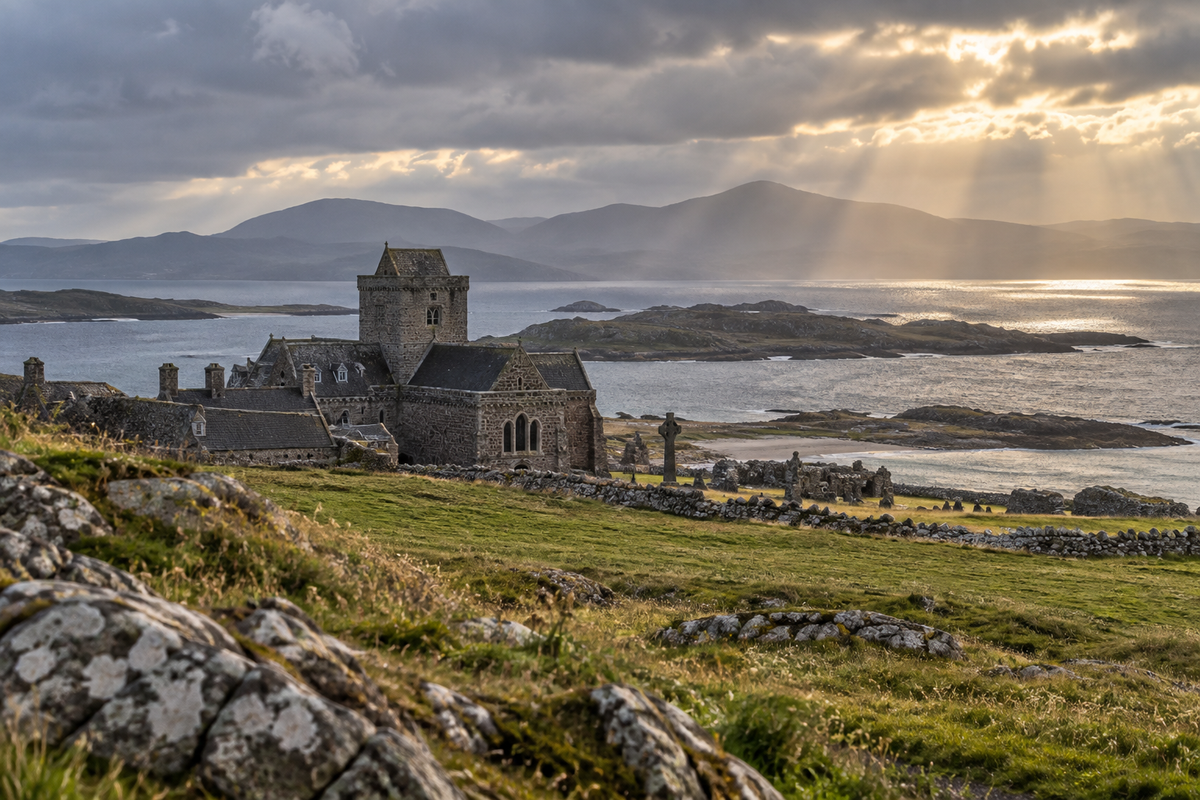
Iona is small enough to walk across, but it has carried an extraordinary amount of spiritual weight for more than fourteen centuries.
The island lies just off the south-west coast of Mull in Scotland's Inner Hebrides. You reach it by water, crossing the Sound of Iona from Fionnphort, and that short journey already creates a sense of separation from ordinary life.
Then the island itself is quiet, low and exposed to weather. There are beaches of pale sand, old stone, grazing land, distant islands and an abbey whose history reaches back to one of the most important early Christian communities in Britain.
Iona is often described as a thin place, somewhere the boundary between the physical and spiritual worlds seems unusually permeable.
That is not a scientific category. It is a way of describing experience.
And Iona is one of the places where the phrase makes immediate sense.
Columba arrives on Iona
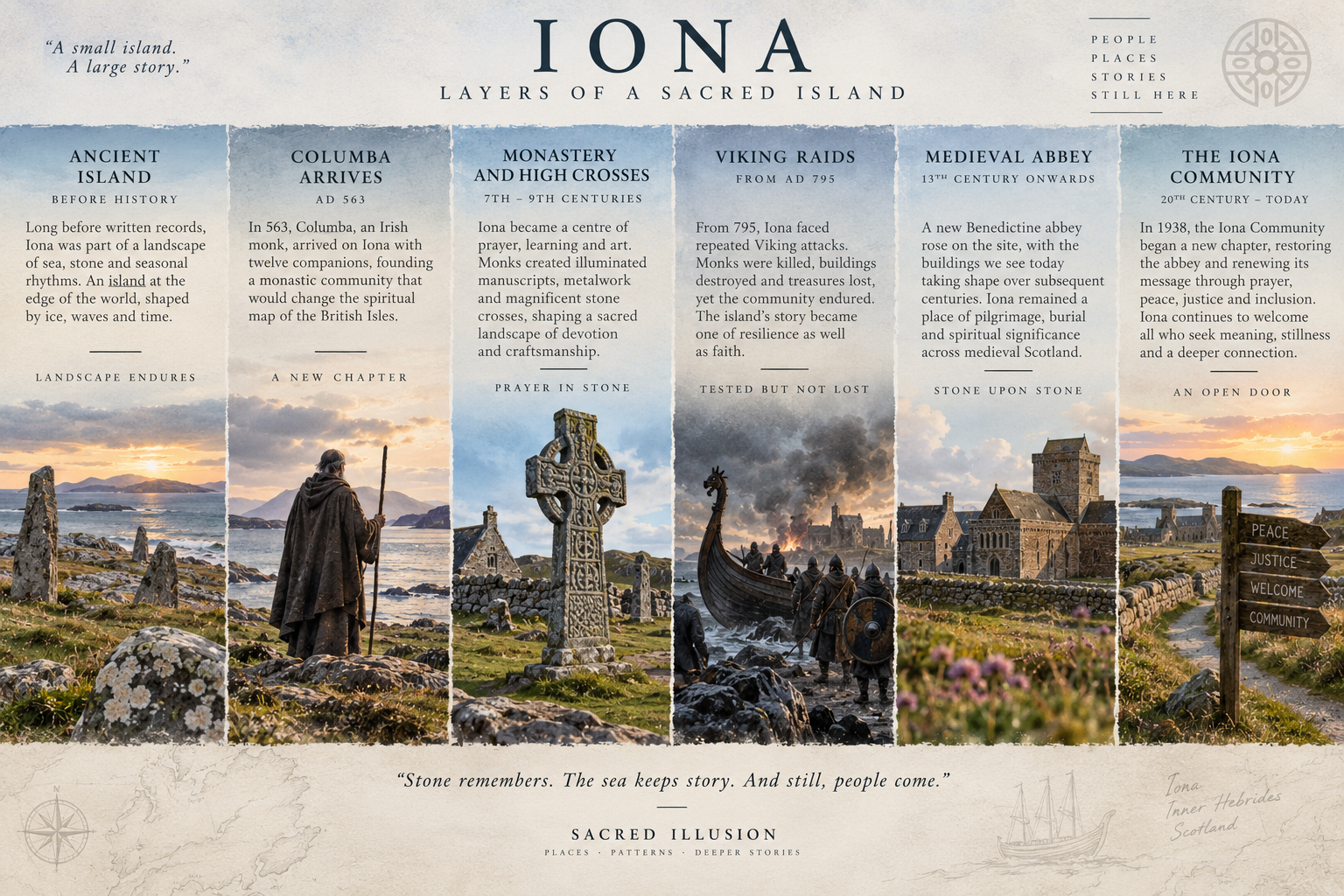
The story begins in AD 563, when Columba, an Irish monk, arrived on Iona with twelve companions.
Historic Environment Scotland describes the monastery he founded here as one of the most important religious centres in the British Isles. From Iona, missionaries travelled into northern Britain, helping establish Christian communities across what would become Scotland. :contentReference[oaicite:1]{index=1}
Columba himself became one of the most influential figures in early Scottish Christianity.
His monastery would have looked very different from the stone abbey we see today. The earliest buildings were probably timber, organised around communal prayer, study, craft and practical work.
Over time, Iona developed into a centre of learning, manuscript production, metalwork and sculpture.
It became a place people travelled towards deliberately.
That pattern has never completely stopped.
A centre of art and learning
By the eighth and ninth centuries, Iona had become a major artistic centre.
Highly skilled sculptors produced monumental stone crosses, while metalworkers and manuscript illuminators were also active on the island. Several of Iona's great carved crosses survive, including St Martin's Cross, while others are now displayed in the Abbey Museum.
Iona is also closely connected with the world that produced the Book of Kells, one of the masterpieces of early medieval manuscript art.
Scholars have long argued that work on the manuscript may have begun at Iona before the monastic community moved to Kells in Ireland following Viking attacks.
We cannot point to a desk and say exactly where a particular page was painted.
But the kind of artistic culture capable of producing such work unquestionably existed here.
Viking raids
Iona's remoteness could not protect it forever.
From the late eighth century onwards, Viking raiders attacked the monastery repeatedly. Historic Environment Scotland records raids beginning in 795, with further attacks over the following centuries.
Some monks were killed. Relics and valuables were moved. The monastic community gradually became less secure, and links with Ireland grew stronger.
Yet Iona was not simply abandoned.
Its reputation remained powerful enough for people to return, rebuild and continue the religious life of the island.
That pattern of destruction followed by renewal appears again and again in Iona's history.
The medieval abbey
Around the beginning of the thirteenth century, a new Benedictine monastery was established on the site.
The abbey buildings that dominate Iona today are largely medieval in origin, although they have been heavily restored and reconstructed over subsequent centuries. The complex includes the church, cloister, chapter house and other monastic buildings.
A nearby Augustinian nunnery was also founded around this period. By then, Iona was already an ancient sacred place. The medieval monks were not creating its reputation from nothing.
They were inheriting it.
The pilgrimage road
Pilgrims have been travelling to Iona since at least the seventh century.
Historic Environment Scotland notes that visitors still follow a route broadly corresponding to the old Sràid nam Marbh, the Street of the Dead, which once led pilgrims towards Columba's shrine and the monastic centre.
The great stone crosses were part of that sacred landscape. They were not simply monuments to be admired. They marked space, shaped movement and led people towards places of prayer and remembrance.
This is one of the qualities that makes Iona feel so coherent.
The island does not contain one sacred building surrounded by ordinary ground.
The paths, graveyard, crosses, shore and abbey all belong to the experience.
Reilig Odhráin
Beside the abbey lies Reilig Odhráin, one of Scotland's most evocative burial grounds.
Historic sources connect it with the burial of local clan chiefs and rulers of the Isles. Later tradition greatly expanded that story, claiming dozens of Scottish, Irish and even Norwegian kings were buried on Iona.
The exact numbers are difficult to establish. But the broader point stands. Iona became a place where powerful people wanted to be buried. That tells us a great deal about how the island was perceived.
Burial in a sacred landscape was not simply a question of prestige. It placed the dead within a geography already associated with saints, prayer and proximity to the divine.
St Oran and the older stories
Near Reilig Odhráin stands St Oran's Chapel, traditionally associated with one of Columba's companions.
Around St Oran grew one of Iona's stranger legends.
A later story says that when the first church walls repeatedly collapsed, Oran allowed himself to be buried alive beneath the foundations so the building would stand. When he later raised his head from the grave, he reportedly declared that heaven and hell were not as people imagined, whereupon Columba ordered the grave covered again.
The tale is not reliable history.
But it is an extraordinary piece of folklore.
It introduces an older, darker strand into the sacred story of Iona: sacrifice, burial, foundations and knowledge that crosses a boundary it perhaps should not.
That is a long way from the sanitised image of an island retreat.
Was Iona sacred before Christianity?
This is where speculation needs a little space without pretending we know more than we do.
The older version of this article described Iona confidently as a former Druidic sacred site. The evidence for a specific pre-Christian Druid sanctuary on Iona is not strong enough to state that as fact.
But Columba did not arrive in an empty cultural world.
Western Scotland and Ireland already possessed rich relationships with landscape, ancestors, islands, burial and sacred places before Christianity arrived.
Christian communities often established themselves within landscapes that already carried human significance.
Whether Iona itself had a defined pre-Christian sacred role remains uncertain.
It is reasonable to keep the possibility open without inventing a lost temple.
The island beneath the history
One of the easiest things to miss about Iona is how much of its spiritual atmosphere comes from the island itself rather than its buildings.
The landscape is relatively low and open. Sea is almost always present somewhere in the experience. Light changes quickly. Cloud can erase Mull and then reveal it again minutes later.
The western side of the island looks out towards open Atlantic water, while the eastern shore faces Mull across a narrow sound.
You never feel very far from an edge. That changes the way the island is experienced.
Old rock
Iona is also geologically ancient.
Parts of the island are formed from Lewisian gneiss, some of the oldest rocks exposed in Britain, alongside younger geological formations and the distinctive marble associated with the island.
The rocks have therefore existed for timescales that make even Iona's fourteen centuries of spiritual history feel brief.
Modern spiritual writing sometimes goes further and claims that crystalline rocks create or amplify a measurable spiritual energy.
We do not need to state that as established science.
But standing on rock formed billions of years ago can alter one's sense of time all by itself.
There is something psychologically powerful about knowing that the ground beneath you predates almost every familiar feature of the world.
What does "thin place" mean?
The phrase thin place is now widely used for locations where people experience the boundary between ordinary life and something sacred as unusually narrow.
It is often associated with Celtic Christianity, although the modern phrase is newer than many accounts imply.
The idea itself is much older.
Religious traditions across the world have recognised places where prayer, vision, silence or encounter seem easier.
Iona fits that pattern beautifully. The claim is not necessarily that there is a literal membrane hovering above the island. It is that some places alter attention.
They seem to make the unseen more imaginable.
Why might Iona feel different?
Several things happen at once. You have to cross water to arrive. There are very few of the usual signals of urban life. The horizon is wide. The weather is immediate. People have prayed here for centuries.
The island is full of physical reminders of death, pilgrimage and spiritual practice. And most visitors already know something of Iona's reputation before they arrive. All of that changes perception. It does not fully explain it away.
There is a tendency to assume that once we identify psychological or environmental influences, the sacred experience has somehow been debunked.
I do not think it works like that. If landscape, history, ritual and human consciousness combine to produce a profound encounter, that encounter is still real.
Prayer accumulated in place
One of the more interesting possibilities around sacred sites is the idea that repeated attention leaves something behind.
Thousands of people have prayed, mourned, sung, buried their dead, travelled, worked and sat in silence on Iona. Christian language might describe the island as sanctified by prayer. A psychologist might speak about cultural expectation and collective memory.
A metaphysical interpretation might suggest that repeated intention changes the quality of a place.
These are different ways of describing a phenomenon many people recognise instinctively: some spaces feel used in a deeper sense. Iona feels inhabited by attention.
The crosses
The great stone crosses are among the most powerful objects on the island.
St Martin's Cross still stands near the abbey, while other important crosses survive in fragments or have been reconstructed.
The crosses once helped structure the route towards Columba's shrine. St John's Cross stood directly in front of the shrine, and Historic Environment Scotland notes that its placement interacted deliberately with light and shadow.
These were not random devotional sculptures. They were part of a carefully organised sacred landscape. Stone, movement, memory and ritual all worked together.
The modern Iona Community
Iona's sacred life did not remain trapped in the medieval period. In 1938, the Reverend George MacLeod founded the Iona Community and began rebuilding the abbey's ruined living quarters with trainee ministers and unemployed craftsmen from Glasgow.
The restoration took place over many years.
For MacLeod, physical rebuilding was inseparable from rebuilding community and confronting social injustice. The Iona Community still describes its work through prayer, peace, justice, inclusion and common life.
That modern chapter prevents Iona from becoming simply an archaeological relic.
The Abbey remains a place of worship. People still live, work and pray there.
Silence and sound
Iona is not silent. Wind moves constantly. Birds are everywhere. Water works against the shore. People talk, bells ring and services take place at the Abbey.
But the island contains a different kind of acoustic space from most everyday environments. There is less mechanical noise. Sound travels across open ground and water. Small noises feel more distinct. That can make attention turn inward.
The phrase from the old title, "where the sea sings the soul", is a little more lyrical than the new editorial style we are developing, but it did recognise something important.
On Iona, the sea is not background. It is part of the experience.
Dun I
The highest point on the island is Dun I, a modest hill by Scottish standards but enough to give a panoramic view across Iona and towards Mull.
From there, the scale of the island becomes clear. You can see how close everything is to the sea. The Abbey no longer feels like an isolated destination. It becomes one point within a larger landscape.
If weather permits, Dun I is one of the best places to sit for a while rather than simply take a photograph and return downhill.
The western beaches
The quieter western side of Iona offers a different experience from the Abbey precinct. Beaches such as the Bay at the Back of the Ocean open towards the Atlantic.
The name alone has acquired a kind of spiritual poetry, but the geography earns it. There is little between this coast and the open ocean.
For visitors interested in Iona as a thin place, I would spend time here as well as around the Abbey. Sacred experience does not necessarily concentrate where the historic buildings are.
Visiting Iona Abbey
Iona Abbey is cared for by Historic Environment Scotland, while the Iona Community maintains an active worshipping and residential presence.
The Abbey currently has seasonal opening hours, with longer daily opening from April to September and reduced hours through winter. Check current arrangements before travelling specifically for the Abbey interior.
Daily worship also continues through the Iona Community, and visitors can join services.
The Abbey is not simply an attraction, so allow for the rhythm of worship as part of the place.
Getting to Iona
The journey usually involves travelling to Oban, crossing by ferry to Mull, continuing across Mull to Fionnphort and then taking the short passenger ferry to Iona.
Cars belonging to visitors generally remain on Mull, which helps preserve the island's scale and character. That multi-stage journey can feel inconvenient if you are in a hurry.
I would not rush it. Arriving gradually is part of what separates Iona from ordinary travel.
Stay if you can
Iona can be visited as a day trip, but staying overnight changes the experience.
Once the daytime visitors leave, the island becomes quieter. Light changes. The Abbey and village settle.
You begin to experience Iona less as somewhere you have come to see and more as somewhere you temporarily inhabit. If you can stay for two or three nights, even better.
Some places reveal themselves through accumulation rather than impact. Iona is one of them.
Do not spend the whole visit at the Abbey
The Abbey is central to the island's history, but it should not consume the entire visit.
Walk north. Walk west. Climb Dun I. Visit Reilig Odhráin. Spend time on the beaches. Notice the changing stone underfoot. Look back towards Mull. Watch how quickly weather changes the colour of the water.
The larger island helps explain why the monastery belonged here.
What to look for
A first visit could include:
- Iona Abbey and cloisters
- St Martin's Cross
- the Abbey Museum
- St Oran's Chapel
- Reilig Odhráin
- the ruined nunnery
- Dun I
- the western beaches
- the shoreline around the Sound of Iona
- the changing geology and stone across the island
Do not worry about collecting all of them.
A sacred place is not improved by turning it into a checklist.
Is Iona really a thin place?
There is no instrument that can measure the thinness of Iona's veil. That may be the wrong kind of question.
People have come here for more than a millennium because the island supports certain states of mind and spirit unusually well.
Prayer feels natural here. Silence feels less empty. Time can feel less hurried. The dead remain visibly part of the landscape. Sea and weather continually remind you that the world is larger than your own immediate concerns.
Perhaps that is all a thin place needs to be. Or perhaps there is more to it. Sacred Illusion leaves that door open.
Frequently asked questions
Why is Iona sacred?
Iona became one of Britain's most important early Christian centres after St Columba founded a monastery there in AD 563. It developed into a major centre of pilgrimage, art, learning and worship, and its spiritual life continues today.
What is a thin place?
A thin place is a spiritual idea describing a location where the boundary between ordinary experience and the sacred seems unusually close. Iona is one of the places most commonly associated with the idea.
Is Iona connected to St Columba?
Yes. Columba arrived with twelve companions in AD 563 and founded the monastery that established Iona as a major Christian centre.
Were Scottish kings buried on Iona?
Iona's Reilig Odhráin contains graves associated with clan chiefs and rulers of the Isles, while later tradition claims many Scottish and other kings were buried there. The grander traditional numbers are difficult to verify.
Is the Book of Kells connected with Iona?
Many scholars believe the manuscript may have been begun or developed within the artistic community associated with Iona before monks later moved to Kells in Ireland.
What should I see on Iona?
The Abbey, St Martin's Cross, Reilig Odhráin, St Oran's Chapel, the nunnery ruins, Dun I and the western beaches are all worth exploring.
Can you stay at Iona Abbey?
The Iona Community hosts residential programmes in the Abbey Centre, where guests share aspects of community life, worship, meals and practical work.
How long should I spend on Iona?
You can visit in a day, but staying overnight gives a much fuller sense of the island. Two or three nights allows time to experience the Abbey, beaches and wider landscape without rushing.
Continue exploring
Avebury
Another place where repeated ritual, landscape and long human attention have created a powerful sense of sacred presence.
Tintagel
Explore Cornwall's Arthurian headland, where history, myth, cliffs and sea continually overlap.
How to Recognise an Energy Node
A wider exploration of why some places seem to gather history, experience and spiritual significance more intensely than others.