Tintagel: Arthur, Merlin and the Sacred Edge of Cornwall
Tintagel is where archaeology, Arthurian myth and Atlantic landscape meet. Explore its Cornish rulers, castle ruins, Merlin legends and enduring sacred atmosphere.

Tintagel feels like a place built for legend.
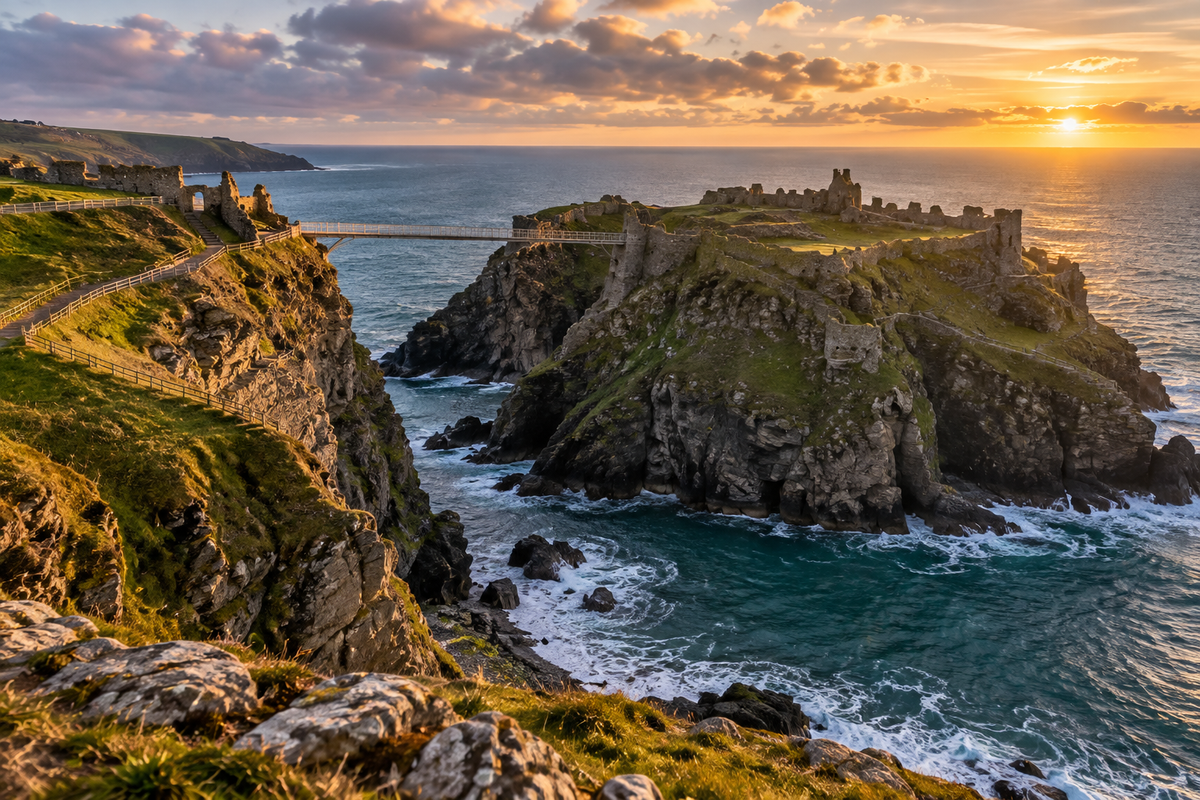
The cliffs are steep enough to make the sea seem far below. The Atlantic is constantly moving around the headland, and the ruined castle occupies both mainland and island as if the landscape itself has been split apart.
That drama would be enough to make Tintagel memorable even without King Arthur. But the mythology arrived early and never really left.
For nearly nine hundred years, writers and visitors have associated Tintagel with Arthur's conception, Merlin, King Mark, Tristan and Isolde. Later generations added Grail stories, dragon lines and the idea that this headland sits within a wider sacred geography running through Cornwall and beyond.
The archaeology gives those legends an unusually strong foundation. Tintagel really was an important high-status centre long before the medieval castle was built.
That does not make the Arthurian stories literally true.
It does make the landscape far more interesting.
Before the castle
The most important fact about Tintagel is that its history did not begin with the ruins visitors see today.
Between roughly the fifth and seventh centuries AD, the headland was a wealthy and significant settlement. Excavations have uncovered the remains of numerous buildings alongside imported pottery and glass from the Mediterranean world. English Heritage describes Tintagel during this period as a prosperous site probably associated with the rulers of the south-western kingdom of Dumnonia.
Tintagel was not simply a picturesque medieval castle later attached to a heroic story.
It was already a place associated with power, status and long-distance connections during the centuries in which stories of post-Roman British rulers were taking shape.
Wine and fine tableware arrived here from the Mediterranean. Important people lived or gathered here. The headland itself was naturally defensible and had extensive views over the surrounding coast.
We cannot identify an individual historical Arthur from those remains.
But we can understand why memories of powerful rulers at Tintagel might have survived.

Geoffrey of Monmouth and Arthur
Tintagel entered written Arthurian tradition in the twelfth century.
Around 1136, Geoffrey of Monmouth completed his enormously influential Historia Regum Britanniae, or History of the Kings of Britain.
In Geoffrey's account, Tintagel is the fortress of Gorlois, Duke of Cornwall.
King Uther Pendragon desires Gorlois's wife, Ygerna. With Merlin's magical help, Uther is disguised as Gorlois and enters Tintagel, where Arthur is conceived.
It is a disturbing story when read plainly, involving deception and sexual coercion rather than the romantic conception story later retellings often imply. English Heritage itself now makes this aspect of Geoffrey's narrative explicit.
The important point for Tintagel is what happened next.
Arthur became one of the defining figures of medieval European literature, and Tintagel became part of his geography.
A castle built because of a story
The ruins visible today largely belong to a castle built in the thirteenth century by Richard, Earl of Cornwall, younger brother of King Henry III.
Richard acquired Tintagel in 1233.
It was not an obvious strategic choice.
The site was remote, difficult to supply and of limited military value.
English Heritage argues that the most convincing explanation is Arthur. Richard knew Geoffrey of Monmouth's story and deliberately built at Tintagel because the place was already associated with legendary British kingship.
That makes Tintagel fascinating in a very modern way.
A story changed the landscape.
Richard built a real castle partly because a legend said an earlier castle had stood there.
Myth became architecture.
A castle that was already becoming ruin
Richard's castle did not enjoy a particularly long life as an important residence.
Within decades, parts were already deteriorating, and by the fourteenth century the site was described as ruinous. The exposed cliffs, unstable geology and coastal erosion all worked against the building.
Yet ruin may have helped Tintagel. An intact administrative castle would perhaps have remained historically interesting. A broken castle above the Atlantic became something else. It became romantic.
The missing walls gave imagination room to work.
The island and the bridge
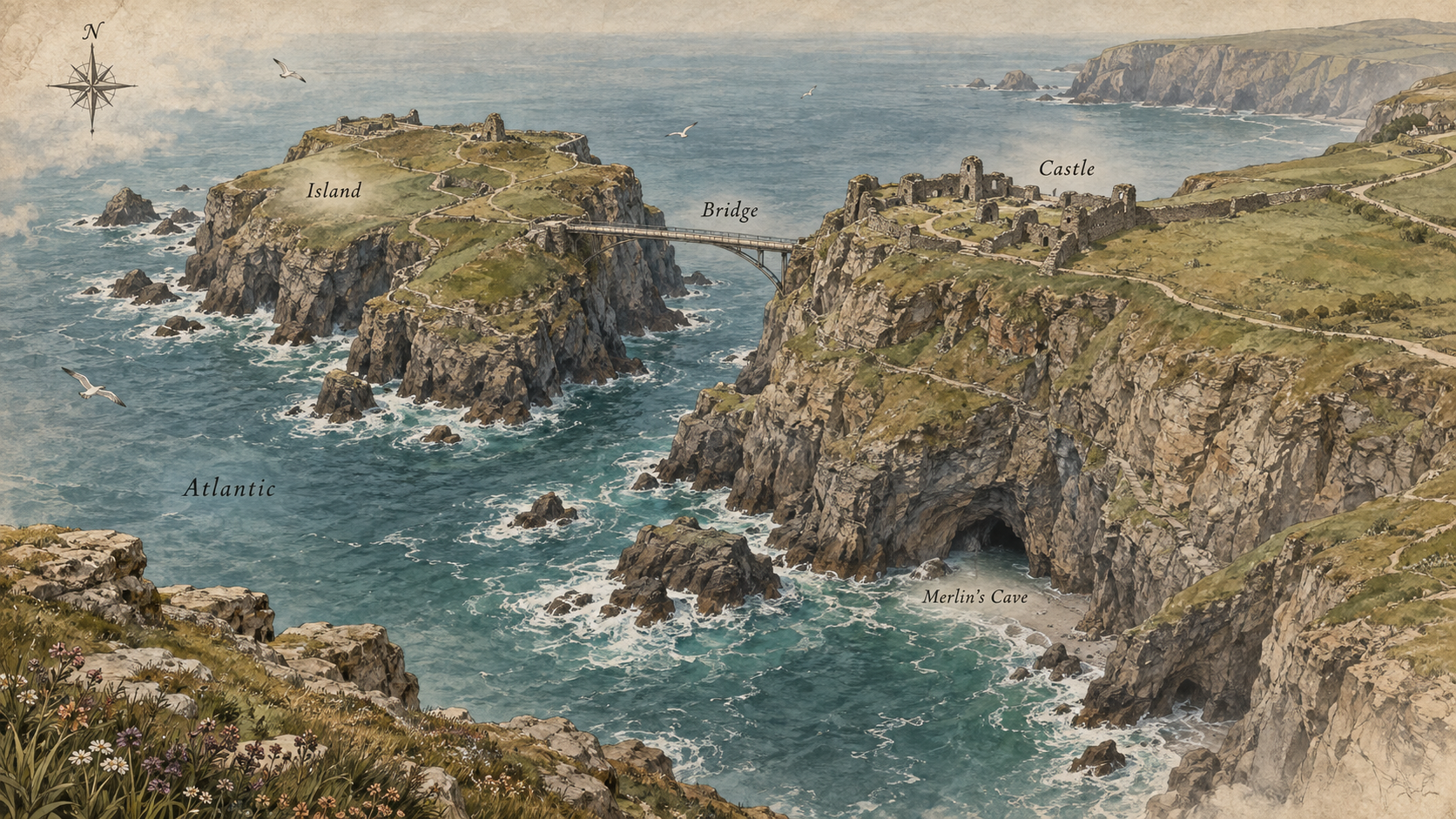
Tintagel's most striking physical feature is the divide between mainland and island. The medieval castle occupied both sides.
In earlier centuries, the narrow neck between them appears to have been much higher and more substantial. Erosion and landslips gradually widened the gulf, turning the headland into the dramatic island we recognise today.
The modern footbridge, opened in 2019, reconnects the two sides at approximately the level of the historic crossing.
Walking across it is unusually effective interpretation.
For a few moments, the missing piece of landscape becomes visible again.
You understand that the split is part archaeology, part geology and part absence.
Merlin's Cave
Beneath the castle lies the sea cave now known as Merlin's Cave.
The association with Merlin is later than the earliest Arthurian texts, but by the nineteenth century the cave had become firmly woven into Tintagel's mythic identity. Tennyson's Arthurian poetry helped popularise the connection, and modern interpretation at the site has continued it.
At low tide, the cave can sometimes be approached from the beach. It is easy to understand why the association took hold.
The sea moves through the rock beneath a place already linked with Merlin. The cave becomes a natural threshold between darkness and light, land and water, ordinary landscape and story.
Whether Merlin ever had anything to do with this particular cave historically is almost beside the point. The geography invites myth.
Tintagel and threshold places
Sacred landscapes often gather around edges. Tintagel contains several of these at once.
The castle sits on the boundary between land and sea. A bridge crosses a void. A cave opens beneath the island. The Atlantic horizon seems to erase any clear boundary between Earth and sky.
In folklore and spiritual traditions, liminal places are often interpreted as locations where the ordinary world becomes more permeable. Tintagel has exactly that quality.
You do not need to believe in literal portals to feel that this is landscape built around transition.
King Mark, Tristan and Isolde
Arthur is not Tintagel's only medieval story. The castle was also associated with King Mark of Cornwall and the tragic romance of Tristan and Isolde.
In medieval versions of the tale, Tristan serves King Mark but falls in love with Isolde, Mark's intended bride.
The story became one of Europe's great romances, and Tintagel formed part of its geography.
Richard of Cornwall may even have incorporated an island garden into his castle partly in reference to the legend. English Heritage's current interpretation uses the garden to retell the Tristan and Isolde story.
Again, the same process appears.
Landscape becomes story, and story returns to reshape the landscape.
Gallos
Modern Tintagel continues that tradition deliberately. On the island stands Gallos, an eight-foot bronze figure created by sculptor Rubin Eynon.
The name means "power" in Cornish.
The sculpture resembles an armed king but is intentionally incomplete, allowing sky and landscape to show through its body. English Heritage describes it as inspired by both Arthurian legend and Tintagel's real history as a centre of early Cornish rulers.
That ambiguity works. Gallos is not labelled "King Arthur".
He is history and legend occupying the same outline.
Dragon lines
Modern Earth Mysteries traditions often describe Tintagel as lying on dragon lines, a term used for powerful landscape-energy pathways.
The language echoes older traditions of dragons and serpents associated with Earth power, while modern British dowsers sometimes connect Tintagel with larger alignments running through Cornwall, Glastonbury and other sacred places.
There is no universally accepted dragon-line map, and different practitioners trace different routes.
That does not make the idea meaningless.
At Tintagel, dragon-line thinking offers another way of interpreting relationship: not just between monuments on a map, but between coast, headland, cave, island and places carrying strong mythic identity.
Whether these relationships are energetic in a literal sense remains open to personal interpretation.
What is clear is that Tintagel behaves like a node in Britain's imaginative geography. Stories connect to it. Pilgrims and seekers return to it.
Other sacred places seem to gather around it conceptually.
What does the geology contribute?
Tintagel's cliffs are physically dramatic, fractured and exposed to powerful coastal forces.
Geology shapes the entire experience of the site: the island, the chasm, caves, narrow approaches and erosion are all products of rock interacting with sea and weather.
Some spiritual traditions go further, suggesting that quartz or mineral content within rocks may amplify subtle energy.
That possibility is frequently stated much more confidently online than the evidence justifies.
A better question is whether unusual geology contributes to unusual experience. The answer to that is almost certainly yes. Rock determines shape. Shape determines movement. Movement determines perspective. The cliffs alter sound, wind, exposure and bodily sensation.
Whatever else may be happening, geology is already part of the sacred experience.
Arthur: history, memory or myth?
The question "Was Arthur real?" is much larger than Tintagel. There is no securely documented King Arthur matching the fully developed medieval legend.
Some historians have suggested that the stories may preserve memories of one or more post-Roman British military leaders. Others regard Arthur primarily as a literary and folkloric figure.
Tintagel cannot resolve that debate.
What it contributes is intriguing context.
The site genuinely was wealthy and politically important during the fifth and sixth centuries, precisely the broad period in which a historical figure behind the Arthur traditions would have lived.
That is not proof.
But it is one reason the Arthur connection here feels less arbitrary than many later attempts to attach legendary figures to picturesque ruins.
The sea as part of the place
It is difficult to write about Tintagel without underestimating the Atlantic. The sea is not scenery around the monument. It shapes everything.
Sacred places often become powerful because natural landscape and human meaning reinforce one another. Tintagel is one of the clearest examples.
Visiting Tintagel Castle
Tintagel Castle is managed by English Heritage and operates as a ticketed historic site rather than an open landscape like Avebury.
The site involves steep paths, steps and exposed coastal terrain. The modern bridge makes the island easier to reach, but the overall visit still requires reasonable mobility.
Opening hours vary seasonally, so check English Heritage before travelling. At present the site operates daytime opening rather than unrestricted access.
The weather is also part of the practical planning. Tintagel in rain and wind can be magnificent. It can also be slippery.
Merlin's Cave and the tide
If you want to visit the beach or approach Merlin's Cave, check tide times. The cave is affected by the sea and should not be treated casually. Do not enter simply because someone else has. Conditions change quickly along this coast.
At the right tide, however, standing beneath the cliffs offers a completely different perspective from the castle above. The mythology suddenly becomes vertical. Arthur belongs to the summit. Merlin belongs beneath it.
History and possibility
We know that Tintagel was an important early medieval centre linked to powerful Cornish rulers. We know Geoffrey of Monmouth placed Arthur's conception here.
We know Richard of Cornwall subsequently built a castle because that Arthurian identity mattered to him. We also know that the headland has continued to generate spiritual and mythic interpretations long after those historical phases ended.
What we cannot easily measure is why some landscapes are so unusually successful at holding meaning.
Maybe it is purely culture. Maybe dramatic natural environments change consciousness in ways we underestimate. Maybe old places accumulate psychological and ritual significance through repeated attention. Maybe sacred landscape contains other dimensions of relationship that our current language handles badly.
Tintagel leaves room for all of those possibilities.
Why Tintagel endures
Tintagel does not need us to choose between archaeology and Arthur. The archaeology tells us this really was a place of rulers.
The literature tells us medieval people believed it belonged to Britain's greatest legendary king. The castle tells us that belief became powerful enough to motivate one of Europe's richest men to build here. And the landscape explains why the story never quite became ridiculous.
Stand on the island with the Atlantic below and Cornwall stretching behind you and the myth feels geographically plausible, even when history remains uncertain. That may be Tintagel's real gift.
It reminds us that stories sometimes attach themselves to places because the landscape seems capable of carrying them.
Frequently asked questions
Was King Arthur born at Tintagel?
Geoffrey of Monmouth's twelfth-century account says Arthur was conceived at Tintagel. Later tradition sometimes describes him as born there. There is no historical evidence proving that a real King Arthur was born at the site.
Was Tintagel important before the medieval castle?
Yes. Between about AD 450 and 650 it was a wealthy high-status settlement involved in Mediterranean trade and probably connected with the rulers of Dumnonia.
Who built Tintagel Castle?
Richard, Earl of Cornwall, built the medieval castle in the 1230s. His choice of site appears strongly connected to Tintagel's existing Arthurian reputation.
Is Merlin's Cave really connected with Merlin?
The cave's association with Merlin belongs to later Arthurian tradition rather than early documented history. It became particularly prominent through nineteenth-century literary and romantic interpretations.
What are dragon lines?
Dragon lines are modern spiritual interpretations of landscape-energy pathways, related to ley-line and dowsing traditions. Tintagel is sometimes placed within these systems because of its mythic and geographic significance.
Can you visit Tintagel island?
Yes. English Heritage's modern footbridge connects the mainland with the island, allowing visitors to explore the medieval ruins and early settlement remains.
Can you visit Merlin's Cave?
Access depends on tide and sea conditions. Check current local guidance and tide times before attempting to reach the beach or cave.
Continue exploring
Glastonbury Tor
Explore another Arthurian landscape where archaeology, legend and modern Earth-energy traditions overlap.
Avebury
Step inside one of Britain's great prehistoric sacred landscapes and its modern ley-line traditions.
What Are Ley Lines?
Explore the history of landscape alignments, Earth-energy traditions and the modern search for connections between sacred places.