Rosslyn Chapel: Carvings, Codes and the Legends Beneath the Stone
Rosslyn Chapel is one of Scotland's strangest sacred buildings. Explore its carved stonework, hidden-code theories, Templar legends and documented medieval history.

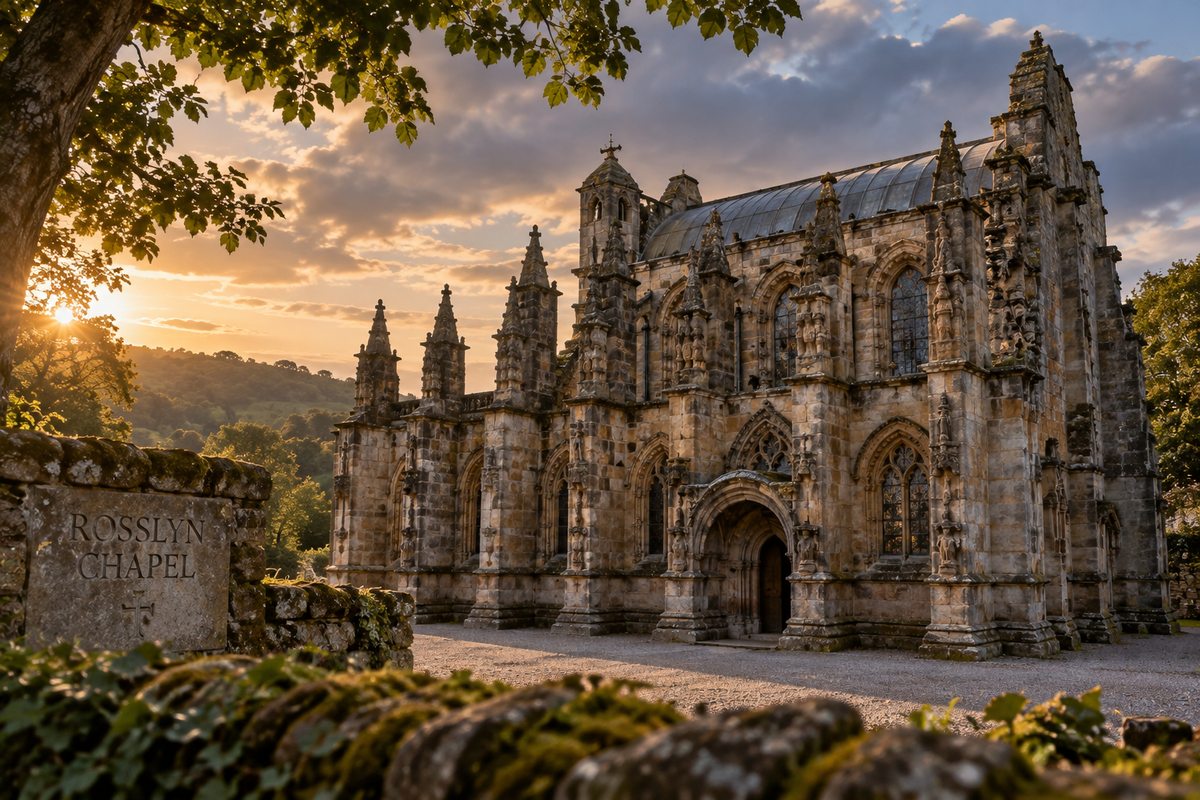
Rosslyn Chapel is one of those buildings that seems almost designed to generate theories.
Its interior is crowded with carved foliage, angels, biblical figures, Green Men, strange faces, musical instruments, patterned cubes and elaborate pillars. The stonework is so dense that it is easy to feel there must be some hidden system behind it all.
That instinct has fuelled centuries of speculation.
Rosslyn has been linked with the Knights Templar, the Holy Grail, Freemasonry, secret musical codes, hidden treasure and esoteric knowledge. Some of those stories are comparatively recent. Others have much older roots.
The documented history is already remarkable enough, but the legends are now part of the place too.
A chapel founded in 1446
Rosslyn Chapel was founded in 1446 by Sir William St Clair, 3rd Prince of Orkney, as the Collegiate Chapel of St Matthew.
A collegiate chapel was not a parish church. It supported a small community of clergy whose work included worship, education and prayers for the soul of the founder and his family.
Construction continued for decades.
Sir William appears to have intended something significantly larger than the building we see today. Archaeological evidence shows foundations extending beyond the existing chapel, suggesting a planned cruciform church with nave and transepts.
When William died in 1484, building work effectively stopped. What survives is therefore not quite a finished medieval church.
It is a fragment of a much more ambitious vision.
Why Rosslyn looks so unusual
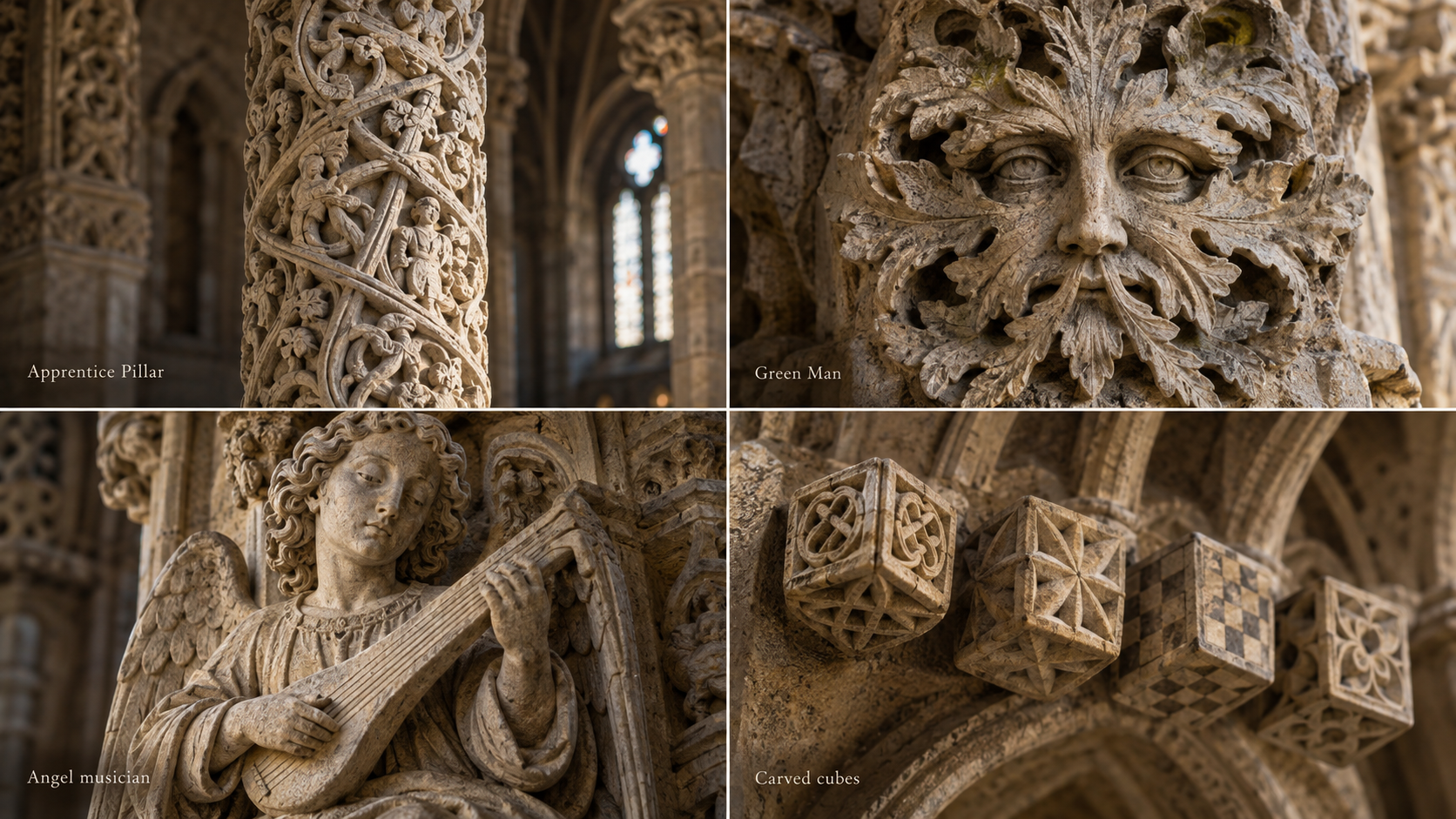
Almost every surface of the chapel carries carved decoration.
Historic Environment Scotland describes the interior as an exceptional mixture of religious and secular imagery, including saints, animals, foliate designs and mythical creatures.
That density of carving is one reason Rosslyn feels so different from many other churches of its size. There is very little empty visual space. Everywhere you look, something is happening.
- A face emerges from leaves.
- An angel plays an instrument.
- A plant coils around a column.
- A patterned block seems to invite decoding.
The building encourages close looking.
The Apprentice Pillar
The most famous carving inside Rosslyn is probably the Apprentice Pillar.
It stands in the Lady Chapel and is covered with elaborate spiral decoration.
A later legend claims that the master mason left Rosslyn to study a design elsewhere. During his absence, his apprentice completed the pillar himself.
When the master returned and saw that the apprentice had produced something more beautiful than his own work, jealousy overwhelmed him and he killed the young man with a blow to the head.
The story is dramatic. It is also legend. There is no evidence that the pillar was created through such a murder.
Yet the tale has become inseparable from the chapel, and carvings interpreted as the faces of the master, apprentice and grieving mother are often woven into the story.
This is a recurring feature of Rosslyn. The stonework encourages narrative.
More than one hundred Green Men
Rosslyn contains an extraordinary number of carvings usually described as Green Men.
A Green Man typically shows a human face emerging from or surrounded by leaves, sometimes with vegetation growing directly from the mouth.
The motif appears throughout medieval European churches. Its exact meaning remains debated. It may relate to renewal, fertility, nature, resurrection or simply the medieval delight in combining human and vegetal forms.
At Rosslyn, the repeated motif has become one of the chapel's defining visual themes. The chapel itself describes the Green Man as historically pagan while also placing the carvings within the wider Christian building.
That mixture is worth noticing. Medieval Christianity did not exist in a vacuum. Builders used symbols, stories and visual traditions drawn from a much wider cultural world.
Angels, bagpipes and ordinary life
Not every strange carving needs a hidden explanation. One of Rosslyn's most charming figures is an angel playing bagpipes. The carving is thought to be one of the earliest surviving representations of bagpipes in Scotland.
Other carvings include animals, plants, musicians and scenes that feel surprisingly domestic or playful.
That breadth matters because it reminds us that the chapel was not only a theological codebook. It was also the work of medieval craftspeople filling a sacred building with the visual vocabulary of their world.
Some symbols may have had precise meanings. Others may simply reflect imagination, humour, fashion or craftsmanship.
The mysterious musical cubes
Among the most intriguing features are the carved cubes projecting from arches in the Lady Chapel. Each carries a pattern made from lines and dots.
No accepted medieval key explains what those markings mean.
Modern researchers have suggested that the patterns might encode music, and one interpretation led to the composition known as the Rosslyn Motet.
The chapel itself presents this as one proposed solution rather than a proven decoding.
That distinction is important. The cubes are genuinely unusual. A musical interpretation is possible.
But a compelling modern pattern is not the same thing as knowing what the fifteenth-century builders intended.
Is Rosslyn full of secret codes?
Possibly in the broadest sense. Medieval churches were built from layers of symbolism that many modern visitors no longer immediately recognise.
Saints had attributes. Plants carried associations. Biblical scenes communicated theology. Heraldry identified patrons. Architectural forms themselves could carry religious meaning.
That means Rosslyn contains many things that functioned symbolically.
What is harder to establish is the stronger claim that its carvings form a single hidden code containing secret knowledge. There is currently no accepted evidence for one overarching cipher. The chapel may contain mysteries.
That does not mean every mystery belongs to the same system.
The Knights Templar
Rosslyn's association with the Knights Templar is one of its most persistent legends. The Templars were suppressed more than a century before Rosslyn Chapel was built.
The order was dissolved in the early fourteenth century, while Rosslyn's construction began in 1446. That timeline immediately creates a problem for claims that the chapel itself was built by or for the medieval Templars.
Later theories focus instead on the St Clair family. Some writers propose that Templar traditions survived secretly in Scotland and were preserved by the St Clairs, eventually emerging in Rosslyn's carvings and architecture.
Those theories became particularly popular in twentieth-century alternative history.
There is no firm documentary evidence demonstrating that Rosslyn Chapel was a Templar sanctuary. The association belongs to later interpretation.
The St Clairs and the Templar story
The St Clair family's long history and prominence in medieval Scotland has made them ideal characters in later esoteric narratives.
Sir William St Clair was wealthy, powerful and well connected. His family owned Rosslyn Castle and extensive lands. He also built an unusually elaborate religious structure. Those facts are real.
The leap from influential medieval family to secret guardians of Templar knowledge is much harder to establish. Part of Rosslyn's mystique comes from exactly this kind of gap.
Rosslyn and the Holy Grail
The Grail legend is even more powerful. Various modern theories claim that the Holy Grail, Templar treasure, sacred manuscripts or relics were hidden beneath Rosslyn Chapel.
The chapel itself acknowledges that stories of concealed treasure have circulated for centuries. An intriguing sixteenth-century letter from Mary of Guise refers to secrets connected with the St Clair family, though it does not identify a Grail or treasure.
That kind of fragment provides perfect fuel for mystery. Something secret existed. What that secret was is another question entirely. There is no evidence establishing that the Holy Grail lies beneath Rosslyn. But the absence of proof has never stopped the story.
Is there a hidden vault beneath Rosslyn?
The chapel contains crypts and burial spaces associated with the St Clair family. There are also long-running legends about deeper underground chambers or sealed vaults containing hidden material.
Modern surveys and conservation work have generated continued interest in what might lie beneath the structure. The difficulty is that ordinary medieval burial spaces can become something much grander in popular imagination.
Without direct evidence, those possibilities remain speculation.
The Da Vinci Code effect
Rosslyn's modern fame changed dramatically after the publication of Dan Brown's The Da Vinci Code in 2003 and the subsequent film adaptation.
The novel places Rosslyn within a fictional network of Grail secrets, secret societies and hidden bloodlines.
Visitor numbers rose sharply. Rosslyn Chapel itself openly acknowledges that The Da Vinci Code transformed international awareness of the site.
The irony is that Rosslyn was mysterious long before Dan Brown arrived. The book did not invent the legends. It amplified them.
Sacred geometry
Like many medieval churches, Rosslyn was constructed using sophisticated geometry.
The building's proportions, vaulting and carved forms reflect the practical and symbolic importance of geometry to medieval architecture. Modern esoteric writers sometimes go further and claim the chapel contains encoded sacred geometry pointing towards hidden cosmological knowledge.
Some interpretations connect shapes within the chapel to the Tree of Life, planetary symbolism or secret initiatory traditions. The underlying geometry is real. The stronger occult interpretation remains speculative unless supported by specific historical evidence.
What about ley lines?
Rosslyn also appears occasionally in modern ley-line and Earth-energy literature.
Its dramatic location above Roslin Glen, its religious significance and its reputation for mystery make it an obvious candidate for inclusion in sacred-geography systems.
There is no accepted scientific evidence that Rosslyn Chapel sits on a measurable Earth-energy line. If a claimed alignment is proposed, it should be examined using the same questions we apply elsewhere: which sites were selected, how precisely do they align, and was there any historical intention connecting them?
The spiritual interpretation can still be interesting.
It simply belongs in a different evidential category.
The chapel and the landscape
Rosslyn's setting is easy to underestimate if you focus only on the carvings. The chapel sits near Roslin Glen, above the River North Esk, with Rosslyn Castle nearby.
The landscape is steep, wooded and enclosed in a way that feels very different from the open setting of places such as Glastonbury Tor or Avebury.
Rosslyn Castle itself occupies a strong defensive position above the river gorge and preserves medieval fabric associated with the St Clair family. The chapel therefore belongs to a larger St Clair landscape of family power, defence, religion and memory.
That context is more historically useful than treating the chapel as an isolated mystical object.
The Reformation and decline
Rosslyn's medieval religious life ended with the Scottish Reformation. The chapel's endowments were seized, its clergy removed, and by the late sixteenth century its altars were ordered to be destroyed.
The building subsequently fell into disrepair. In 1650, during Cromwell's campaign in Scotland, troops attacked Rosslyn Castle and are said to have stabled horses inside the chapel.
The building survived, but its original religious community did not.
Victorian restoration
Rosslyn's revival began in the nineteenth century. The chapel attracted antiquarians, artists and writers fascinated by medieval architecture and romantic ruins.
Restoration work followed, and the building was rededicated for worship in 1862. Services continue today as part of the Scottish Episcopal Church.
That means Rosslyn is not simply a museum or mystery attraction. It is still a functioning Christian sacred space.
Conservation and the problem of survival
Rosslyn's carvings are made from sandstone and have suffered from centuries of weathering, moisture and previous conservation techniques. By the late twentieth century, high humidity and stone deterioration had become serious problems.
The Rosslyn Chapel Trust undertook a major conservation programme to allow the building to dry and to stabilise its stonework.
The greatest threat to Rosslyn's secrets may never have been exposure. It may simply have been water and time.
What is documented and what belongs to legend?
Rosslyn is one of the clearest examples of why it helps to separate categories of claim.
Documented
- Rosslyn Chapel was founded by Sir William St Clair in 1446.
- It was created as a collegiate chapel dedicated to St Matthew.
- A larger cruciform church appears to have been planned but was never completed.
- The chapel contains an unusually rich collection of fifteenth-century carvings, including Green Men, angels, foliage, animals and patterned cubes.
- The building declined after the Reformation and was restored and rededicated in the nineteenth century.
It remains a functioning place of worship.
Tradition and interpretation
- The Apprentice Pillar is associated with a murder legend.
- The musical cubes may encode music.
- Rosslyn has been linked to the Knights Templar.
- Some theories connect it to the Holy Grail or hidden treasure.
- Modern writers identify esoteric geometry, Masonic symbolism and secret codes within the carvings.
- Rosslyn sometimes appears in modern ley-line traditions.
- These interpretations are part of Rosslyn's cultural story.
They are not all supported equally by historical evidence.
Visiting Rosslyn Chapel
Rosslyn Chapel lies in the village of Roslin in Midlothian, a short journey south of Edinburgh. Visitors currently enter during timed sessions, and advance booking is recommended because capacity is managed.
Photography and video are not permitted inside the chapel. That restriction changes the experience in an interesting way because you are forced to look rather than immediately document. Allow enough time to examine the carvings slowly.
The density of detail means that a quick circuit misses much of what makes Rosslyn unusual.
What to look for
The most useful things to seek out include:
- the Apprentice Pillar
- Green Man carvings
- angels playing musical instruments
- the patterned musical cubes
- biblical figures and saints
- foliage and animal carvings
- the Lady Chapel
- blocked architectural features showing where the larger nave was intended
- the relationship between the chapel and nearby Rosslyn Castle
The chapel provides a carvings map and guided interpretation, which is worth using if you want to distinguish known medieval imagery from later theories.
Frequently asked questions
When was Rosslyn Chapel built?
Construction began in 1446 under Sir William St Clair and continued for around forty years. Work largely stopped after his death in 1484.
Was Rosslyn Chapel built by the Knights Templar?
There is no firm historical evidence that it was. The medieval Knights Templar had been suppressed more than a century before construction began.
Is the Holy Grail hidden beneath Rosslyn Chapel?
There is no evidence proving that the Grail is buried beneath the chapel. Stories of hidden treasure and secret chambers are part of Rosslyn's long-standing mythology.
What are the Rosslyn musical cubes?
They are carved stone blocks decorated with unusual line-and-dot patterns. Modern researchers have proposed that they may encode music, but no definitive medieval explanation has been established.
What is the Apprentice Pillar?
It is an elaborately carved column in the Lady Chapel. A later legend claims an apprentice created it and was murdered by his jealous master, though the story is not historically documented.
Why are there so many Green Men?
Rosslyn contains more than one hundred Green Man carvings. Their precise meaning is debated, but the motif was common in medieval European architecture and is often associated with vegetation, renewal and the natural world.
Can you take photographs inside Rosslyn Chapel?
No. Photography and video are currently prohibited inside the chapel.
Continue exploring
Glastonbury Tor
Explore another sacred place where documented medieval history, Arthurian mythology and modern spiritual traditions overlap.
Chartres Cathedral
Discover how another medieval sacred building accumulated stories around geometry, hidden water, pilgrimage and symbolism.
What Are Ley Lines?
A wider look at the history of sacred landscape alignments and the later idea of Earth-energy networks.