Sedona Vortexes: Sacred Landscape, Energy Claims and the Mystery of the Red Rocks
Sedona's red rocks have become one of the world's most famous vortex landscapes. Explore the four main sites, their spiritual traditions, geology and enduring mystery.

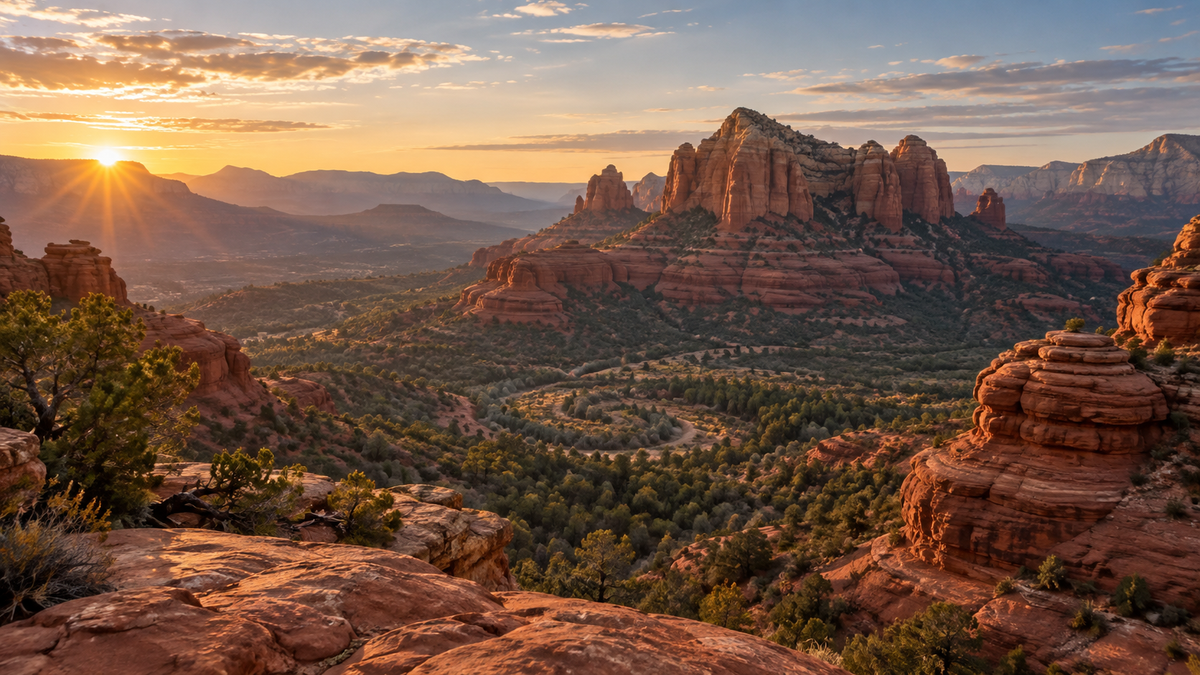
Few places have become as closely associated with the idea of an energy vortex as Sedona.
The red-rock landscape of northern Arizona already looks extraordinary before anyone tells you that it might also be energetic. Sandstone towers rise from desert vegetation. Narrow canyons disappear between cliffs. At sunrise and sunset the rock seems to change colour by the minute.
Then another layer is added.
Visitors are told that certain places around Sedona contain unusually concentrated energy. People meditate there, practise yoga, sit quietly on the rocks, join vortex tours and travel thousands of miles hoping to feel something.
Some report tingling, heat, emotional release, unusual calm, sudden clarity or a heightened sense of connection.
Others feel absolutely nothing.
That makes Sedona interesting for reasons that go far beyond the simple question of whether vortexes are "real".
This is a place where geology, beauty, modern spirituality, tourism, subjective experience and sacred landscape have become almost impossible to separate.
Why is Sedona famous for vortexes?
The modern Sedona vortex tradition is surprisingly recent.
Today, the idea is embedded deeply enough in the town's identity that vortex maps, guides, tours and spiritual practices are readily available. The four locations most commonly identified as major vortex sites are:
- Airport Mesa
- Bell Rock
- Cathedral Rock
- Boynton Canyon
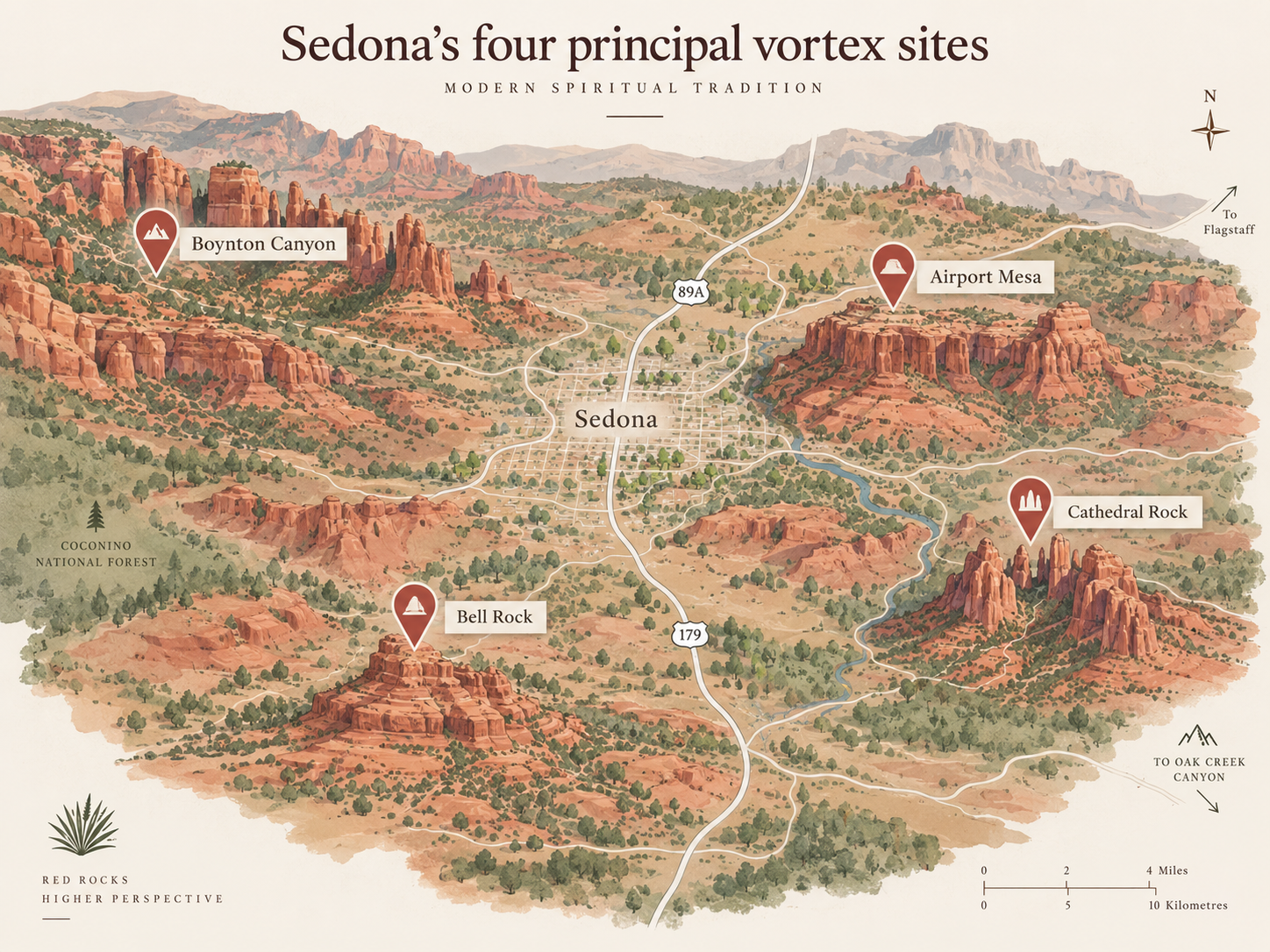
Modern practitioners often describe these locations as having different energetic qualities. Some traditions speak of upward or outward-flowing energy, inward or receptive energy, or a balance of the two.
Those classifications are spiritual interpretations rather than scientifically established properties of the sites.
The deeper question is how Sedona came to be understood this way in the first place.
The modern history of the Sedona vortex
Sedona's reputation as a spiritual centre grew substantially during the second half of the twentieth century.
Interest in metaphysics, Earth energies, meditation, alternative spirituality and sacred landscape expanded rapidly during the 1960s and 1970s. Sedona's dramatic scenery made it an obvious focus.
One important figure in the development of the modern vortex tradition was Page Bryant, an intuitive and spiritual teacher who identified and mapped energy centres around Sedona during the later twentieth century.
The terminology spread.
By the time thousands of people gathered around Sedona during the 1987 Harmonic Convergence, the area had become internationally associated with New Age spirituality and planetary transformation.
What had been a spectacular landscape became something more: a spiritual landscape with its own modern mythology.
That mythology continues to evolve.
The four best-known Sedona vortex sites
There is no official scientific map of Sedona vortexes because vortex energy is not a recognised geophysical category.
There is, however, a remarkably consistent modern spiritual map.
Airport Mesa
Airport Mesa is one of the easiest vortex locations to reach and offers wide views across Sedona.
Practitioners often describe it as an active or outward-moving site associated with clarity, perspective and mental energy.
But you do not need to accept any energetic interpretation to understand why the location affects people.
You are standing high above the surrounding landscape with a huge visual field opening around you. The town sits below. Red formations dominate the horizon. Light changes rapidly across the rocks.
That combination of altitude, distance and panoramic vision can create a profound psychological sense of perspective.
For someone arriving with a question, decision or problem in mind, that alone may feel transformative.
Bell Rock
Bell Rock is perhaps the image most readily associated with Sedona's vortex culture.
The distinctive sandstone formation rises beside Highway 179 and can be approached through a network of trails.
Different vortex traditions classify its energy in different ways, although it is commonly described as active, strengthening or outward-moving.
Many visitors walk only part of the way towards the formation. Others climb higher onto the rock.
The experience changes as you move.
Traffic and civilisation gradually fall away. The scale of the formation becomes more apparent. The surrounding red-rock landscape opens up.
Whether someone interprets what follows as geology, psychology or Earth energy depends partly on the framework they brought with them.
Cathedral Rock
Cathedral Rock is one of Sedona's most recognisable formations and one of its most photographed.
In modern vortex traditions, it is often associated with receptive or inward energy, emotional reflection and contemplation.
The symbolism is easy to understand. Even its modern name suggests a natural temple.
Tall sandstone formations rise like architectural towers above the landscape, while Oak Creek passes through the country below. For many visitors, this is exactly what a sacred landscape looks like.
The climb itself can be demanding, and that matters too. Physical effort changes breathing, attention and emotional state. Reaching a dramatic location after a difficult ascent can intensify any experience that follows.
It is worth separating that from the vortex claim without dismissing either.
Boynton Canyon
Boynton Canyon feels quite different.
Rather than being dominated by one exposed formation, the visitor moves into a canyon landscape enclosed by red-rock walls.
Modern vortex traditions frequently describe Boynton as containing both active and receptive qualities.
The canyon also contains substantial archaeological and cultural significance that predates modern vortex tourism by many centuries. This is important. Sedona was not an empty landscape waiting for twentieth-century spiritual seekers to discover that it was sacred.
Human relationships with this region stretch back far beyond the modern town and its vortex mythology.
Visitors should approach cultural sites, rock art and archaeological remains accordingly: as heritage, not as props for a contemporary spiritual story.
The geology beneath the mystery
Sedona really does contain extraordinary physical geology.
Its cliffs, pinnacles, mesas and canyons expose layers of sedimentary rock shaped over immense spans of geological time.
The famous red colouring is associated with iron oxides within the rocks.
One important unit is the Schnebly Hill Formation, named after Sedona's surrounding landscape. Sandstones and related rocks preserve evidence of environments that existed hundreds of millions of years ago.
The shapes visible today are the result of deposition, uplift, fracturing, erosion and differences in the resistance of individual rock layers.
Cathedral Rock, for example, has been shaped partly by regional joint systems within the sandstone.
Sedona therefore does not need an invisible mechanism to be geologically extraordinary.
It already is.
What about Sedona's magnetic anomalies?
This is where the vortex story becomes particularly interesting. Real magnetic variations occur in the Sedona region.
Geophysical surveys have identified a broad magnetic high around Sedona. Geological interpretation suggests that its source lies deep underground, probably within Precambrian crystalline rocks beneath the younger sedimentary formations.
That is genuine geophysics. But it does not demonstrate that the famous vortex sites correspond to spiritual-energy centres.
Magnetic anomalies occur because different rocks contain different amounts and types of magnetic minerals. They are useful to geologists because they can reveal buried structures, faults and rock units.
A magnetic anomaly and a spiritual vortex are therefore not interchangeable terms. It is entirely legitimate to ask whether unusual geology might contribute in some way to people's experience of a landscape.
It is not legitimate to say that the existence of magnetic variation proves the vortex tradition.
The interesting territory lies between those two statements.
What do people say they feel at a Sedona vortex?
Visitor accounts vary enormously. Common reports include sensations such as warmth, tingling, pressure, calm, emotional intensity, mental clarity or an unusual awareness of the surrounding landscape.
Some people describe synchronicities around their visit. Others report strong emotions emerging unexpectedly. Some experience meditation as easier or deeper.
And plenty of people visit the same places without detecting anything that they would call energy. If vortex energy were a straightforward physical phenomenon acting identically on everyone, we might expect much more consistent observations.
Instead, the experience appears strongly individual. That does not make it worthless.
It changes the question from: "Can everyone detect the vortex?" to: "What is happening when someone experiences a place as unusually powerful?"
Why Sedona can feel extraordinary without a vortex
Human perception is extremely sensitive to environment. Sedona combines a number of conditions capable of affecting mood and attention.

There is scale. There is intense colour. There are unusual geological forms. There is vast sky. There is altitude and physical exertion. There are stretches of relative silence. There is anticipation. And there is story.
If you arrive knowing that thousands of people regard a particular location as spiritually powerful, you do not arrive neutrally.
You pay attention differently. You may become quieter. You monitor bodily sensation. You notice coincidences. You give emotional responses more space. None of that means the experience is false.
It means that place and consciousness interact in complicated ways.
That may actually be more interesting than insisting upon a single explanation.
The twisted junipers of Sedona
One visual feature often associated with Sedona vortex sites is the presence of dramatically twisted juniper trees.
They are sometimes presented as physical evidence that vortex energy is acting upon the vegetation. The problem is that trees can twist for entirely ordinary biological and environmental reasons.
Growth patterns are affected by wind, exposure, slope, damage, competition, genetics and the search for light and water. A twisted tree therefore cannot by itself demonstrate the existence of a vortex. But visually, the trees are powerful.
A contorted juniper clinging to red sandstone fits almost perfectly into the mythology of spiralling energy. This is a good example of how landscape and interpretation reinforce one another.
Is Sedona on an Earth-energy grid?
Some modern Earth-grid systems place Sedona within wider networks of planetary energy, sacred sites or energetic nodes.
These systems vary considerably. There is no single universally accepted vortex or planetary-grid map. Some are constructed through geometry. Others through dowsing. Others through intuitive or spiritual practice.
Sedona frequently appears because it is already regarded as energetically significant. That introduces an obvious circular problem: a site may appear on modern spiritual maps partly because its existing reputation makes it likely to be selected. The possibility of meaningful patterns can still be explored.
But a map should not become evidence simply because it looks impressive.
If you want to understand the broader idea, read our guide to The Earth's Energy Grid.
Vortex, node or sacred place?
The language can become confusing.
A sacred place is the broadest category. It is somewhere that a culture, community, tradition or individual regards as spiritually significant.
An energy node is a modern metaphysical idea describing a place where subtle energy is believed to concentrate or intersect.
A vortex usually implies something more dynamic: energy described as spiralling, moving inward, moving outward or producing a particularly intense effect.
Sedona contains places described using all three ideas.
They do not mean the same thing.
For a fuller explanation, see What Is an Energy Vortex? and How to Recognise an Energy Node.
How to visit the Sedona vortex sites
The four best-known vortex sites are also popular hiking and recreation areas. That means practical considerations matter.
Conditions can be hot and exposed. Trails vary in difficulty. Parking at popular locations can become difficult, particularly at busy times. Check current Forest Service information before setting out and carry enough water. Some locations require a recreation pass for parking.
Do not leave crystals, stacked stones, written notes or other "offerings" in the landscape. Do not disturb archaeological material or rock art.
And remember that a sacred-place experience does not require leaving evidence that you were there. The best fieldwork often leaves nothing behind.
When is the best time to visit?
There is no scientifically established time when vortex energy becomes stronger.
For the landscape itself, however, early morning and late afternoon can be extraordinary.
Lower-angle light reveals the structure and colour of the rocks more dramatically, while cooler conditions can make walking more comfortable.
Early visits may also offer something spiritually useful that has nothing to do with energy levels: fewer people.
Silence changes a place. So does solitude.
If contemplation is part of the reason you are visiting, those may matter more than finding the supposedly perfect energetic hour.
Do you need a vortex guide?
No. The major vortex locations can be visited independently.
A knowledgeable guide may nevertheless add value if you are interested in the history of Sedona's modern spiritual culture, local landscape or specific contemplative practices.
Be more cautious when anyone claims they can guarantee healing, supernatural abilities, medical outcomes or dramatic personal transformation.
A place may support reflection. It cannot guarantee what happens next.
What I think Sedona really offers
Sedona makes the false choice between belief and scepticism particularly unhelpful. You can say: "There is no established scientific evidence that Airport Mesa or Cathedral Rock emits a special spiritual energy." That is fair.
You can also stand beneath the red-rock formations and understand instantly why human beings might experience the landscape as sacred. That is fair too.
Sedona's geology is real. Its magnetic geology is real. Its archaeological heritage is real. Its modern vortex culture is real.
The spiritual experiences people report there are real as human experiences. The mechanism used to explain those experiences remains uncertain. Those statements can coexist.
Perhaps the most useful question is therefore not: "Are Sedona's vortexes real?" but: "Why does this particular landscape produce such powerful experiences, stories and meanings for so many people?"
That question leaves much more room for discovery.
Frequently asked questions
What are the four main Sedona vortex sites?
The four most commonly identified modern vortex locations are Airport Mesa, Bell Rock, Cathedral Rock and Boynton Canyon.
Are Sedona vortexes scientifically proven?
No. There is no accepted scientific evidence showing that the recognised vortex sites emit a unique spiritual-energy field. Sedona does have genuine geological and magnetic features, but those do not prove the metaphysical vortex interpretation.
Can everyone feel vortex energy?
No. Some visitors report strong physical or emotional sensations, while others notice nothing unusual. Experience varies considerably.
Is Sedona actually magnetic?
Geophysical surveys have identified magnetic anomalies in the wider Sedona area. Geologists attribute these to buried rock structures and variations in magnetic minerals. A magnetic anomaly is not the same thing as a spiritual vortex.
Which Sedona vortex is easiest to visit?
Airport Mesa and the Bell Rock area are among the more accessible well-known vortex locations, although conditions, parking and trail access can change. Check current local and Forest Service information before visiting.
Is Sedona a sacred Indigenous landscape?
The wider region contains significant Indigenous cultural and archaeological heritage that long predates the modern vortex movement. Contemporary vortex traditions should not be treated as interchangeable with Indigenous beliefs or used to overwrite them.
Continue exploring
What Is an Energy Vortex?
Explore where the modern vortex idea comes from, what practitioners report and what the evidence actually shows.
How to Recognise an Energy Node
A wider look at sacred sites, power places and the factors that may make a location feel unusually significant.
The Earth's Energy Grid
Explore planetary-grid theories, ley lines, nodes and the idea of a connected energetic Earth.