The Earth's Energy Grid: Theories, Maps and the Search for a Hidden Network
What is the Earth energy grid? Explore ley lines, nodes, vortexes, planetary-grid theories and the evidence behind the idea of a hidden global network.

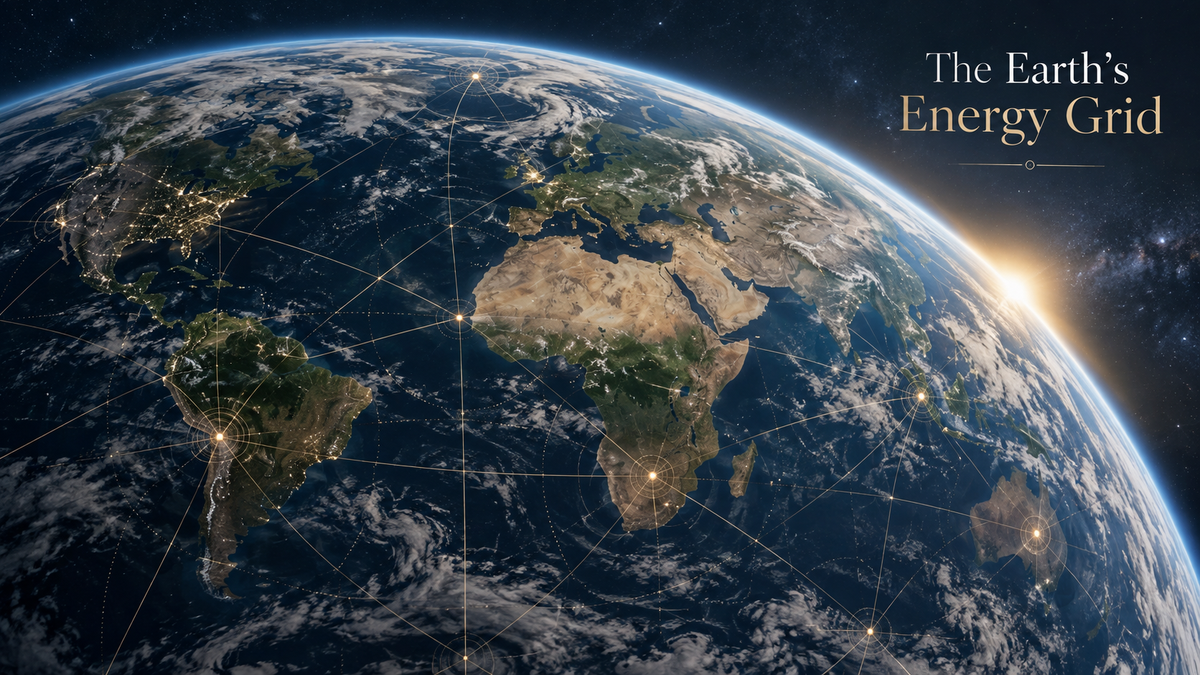
What if the Earth's most famous sacred places are not isolated at all? What if Stonehenge, Glastonbury, Giza, Delphi, Mount Shasta and countless other places belong to a larger pattern?
That idea sits at the heart of what is often called the Earth energy grid.
Depending on who is describing it, the grid may mean a network of ley lines, geometric alignments, energetic nodes, vortexes, sacred sites or even a hidden planetary architecture.
Some versions are geographical. Some are spiritual. Some borrow the language of magnetism, geometry and physics.
And some go much further, suggesting that the Earth behaves like a living energetic system whose significant places are linked together.
The problem is that these ideas are often bundled together as though they describe one established phenomenon. They do not.
There is no scientifically verified global energy grid connecting sacred sites.
But there are real magnetic fields, real geological structures, real sacred landscapes, documented systems of ritual geography, striking geometric models and more than a century of speculation about how they might connect.
That makes the subject more interesting, not less.
What do people mean by the Earth energy grid?
There is no single agreed Earth-grid theory.
The phrase is used as an umbrella for several overlapping ideas.
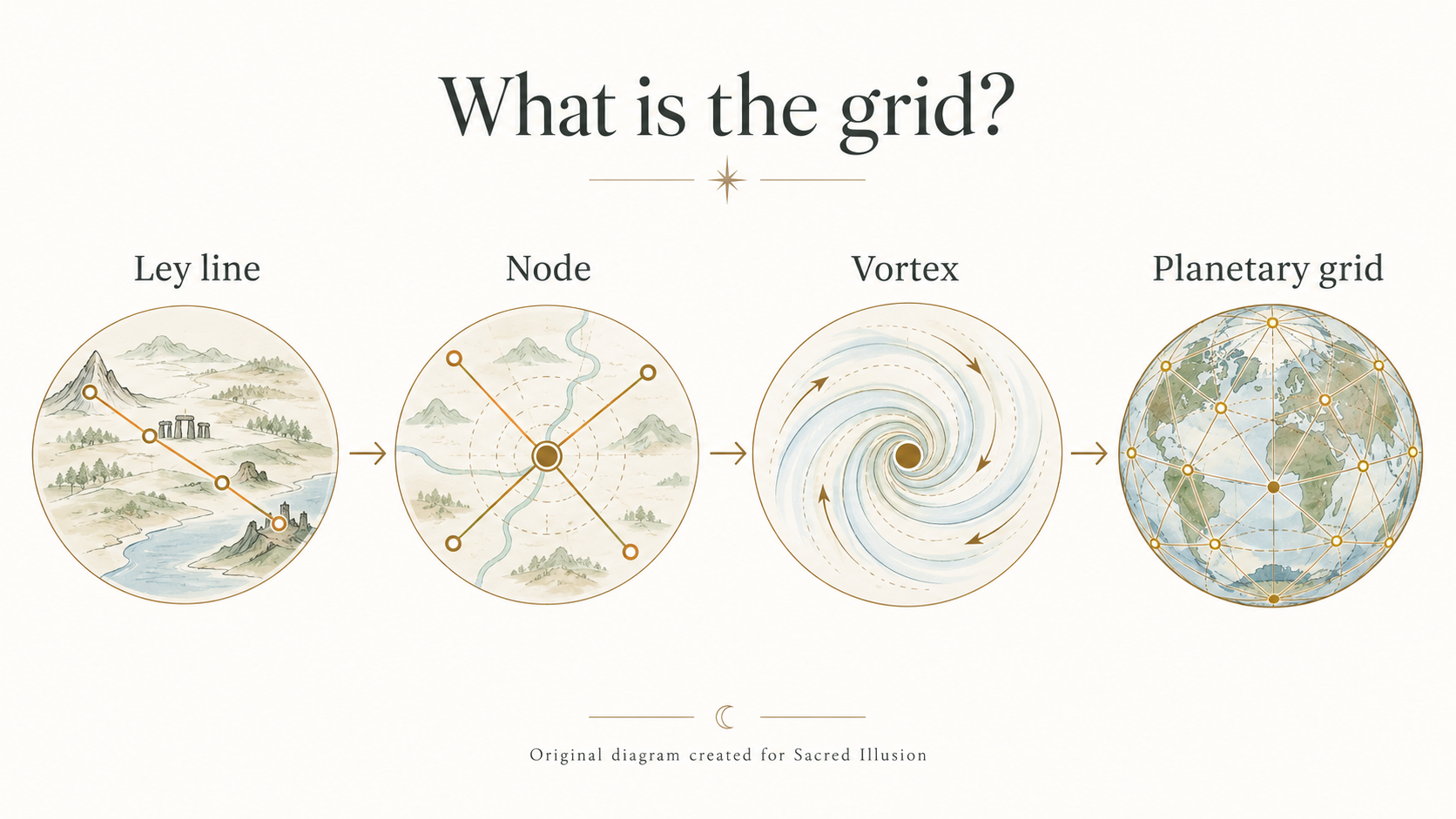
A typical modern Earth-grid model may include:
- Ley lines, proposed alignments between significant places
- Nodes, points where several claimed lines intersect
- Vortexes, places believed to contain spiralling or concentrated energy
- Sacred sites, temples, stone circles, mountains, wells and pilgrimage places
- Sacred geometry, geometric patterns projected across the Earth's surface
- Earth chakras, spiritual correspondences assigning energetic functions to particular locations
- Planetary grids, global geometric networks proposed by modern researchers and esoteric writers
These ideas do not all come from the same source. Nor do they carry the same evidential weight.
The Earth energy grid is best understood as a family of theories rather than a single discovered system.
Start with what we know: the Earth really does have invisible fields
One reason Earth-grid language feels plausible is that our planet genuinely does contain invisible physical systems.
The Earth has a measurable magnetic field.
More than 90 per cent of the magnetic field measured at the surface is generated inside the planet, primarily by movement in the liquid outer core. Other contributions come from magnetised rocks in the crust, electric currents in the atmosphere and magnetosphere, and even ocean currents.
Its direction and intensity vary with location and time.
The crust also contains measurable magnetic anomalies caused by variations in magnetic minerals such as magnetite. There are geological faults. There are underground water systems. There are gravity anomalies. There are electric currents.
There is a magnetosphere extending far into space and interacting continuously with the solar wind.
All of those things are real. But none of them, on their own, establishes the existence of a spiritual Earth-energy grid.
A magnetic anomaly near an ancient monument may be interesting. It does not automatically mean the monument sits on a ley line.
A geological fault beneath a sacred spring may help explain why water emerges there. It does not prove that the spring is an energetic node.
Physical phenomena and metaphysical interpretation can overlap in a story without being the same thing.
From ley lines to a planetary network
The modern Earth-grid story begins, in part, with ley lines.
In 1921, Alfred Watkins proposed that significant features in the British landscape sometimes formed straight alignments.
His theory concerned ancient routes and sightlines. He was not proposing a planetary energy system. During the 1960s and 1970s, however, ley lines were absorbed into the growing Earth Mysteries movement.
Writers began connecting old monuments and alignments with dowsing, sacred geometry, UFOs, astronomy, folklore and subtle energy.
John Michell was particularly influential in this shift.
His work presented ancient sacred landscapes as evidence of a lost or forgotten understanding of geometry, cosmology and the relationship between human beings and place.
By the 1970s, the Earth Mysteries movement had become a recognisable field in its own right, with ley lines increasingly interpreted as lines of power or spiritual force rather than merely old routes.
That is the historical bridge between Watkins' old straight tracks and today's idea of a planetary grid.
Ley lines, nodes and vortexes
Modern Earth-grid theories often use three related terms.
Ley line
A proposed line connecting significant places. Historically, this began with Watkins' landscape alignments. In later spiritual traditions, ley lines became interpreted as currents of subtle energy.
Node
A place where two or more claimed lines intersect. Within Earth-energy belief, nodes are often described as locations where energy becomes concentrated. Sacred sites are frequently mapped onto these intersections.
Vortex
A place believed to contain spiralling or rotational energy. Vortex language is particularly common in places such as Sedona in Arizona, where visitors and practitioners report strong subjective experiences at certain landscape sites.
There is no accepted scientific instrument that can identify a ley-line node or spiritual vortex as a distinct physical phenomenon. But these terms form an important part of modern sacred-geography practice.
Why sacred sites sit at the centre of the theory
The Earth-grid idea becomes compelling because so many cultures have treated particular places as special.
Mountains. Springs. Caves. Crossroads. Stone circles. Temples. Pilgrimage routes. Places associated with burial, initiation, prophecy or divine presence.
This is historically undeniable.
What is not established is that all such places were selected because they sit upon one hidden global energetic network. That is a much larger claim.
There may be many more ordinary reasons why sacred places cluster where they do.
Water mattered. High ground mattered. Visibility mattered. Astronomical orientation mattered. Political control mattered. Trade routes mattered. Geology mattered. Landscape symbolism mattered. And sometimes a place appears to have remained important across multiple cultures because later communities inherited, adapted or reinterpreted an earlier sacred landscape.
The existence of sacred geography is real.
The existence of one universal mechanism behind all sacred geography is still a theory.
Sacred geometry and the planet
The global-grid idea became especially powerful when researchers began projecting geometric forms across the Earth's surface.
Triangles. Pentagons. Icosahedra. Dodecahedra. Great circles.
The suggestion is that important places fall disproportionately upon the vertices or edges of these patterns.
This is where the work of William Becker and Bethe Hagens becomes important.
In the early 1980s, they developed what they called a planetary grid, drawing on previous ideas about geometry, unexplained phenomena and global alignments.
Their 1984 paper, The Planetary Grid: A New Synthesis, explicitly described their model as a synthesis of earlier theories rather than a newly discovered physical structure.
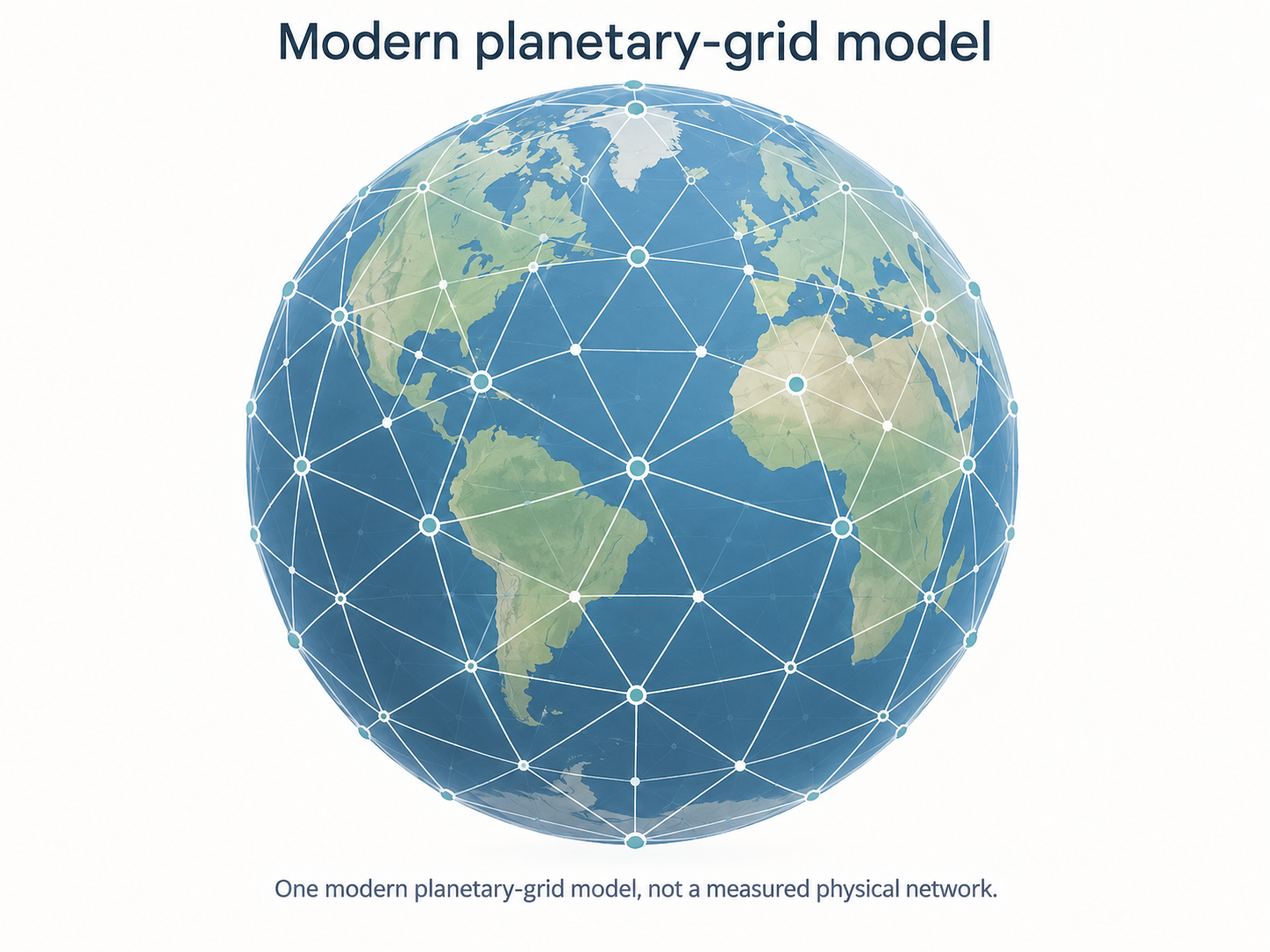
The resulting map is visually striking. A geometric network is projected across the globe, with particular points presented as significant planetary nodes.
The model has since become enormously influential in New Age and Earth Mysteries circles.
But the map is not a scientific map of a measured energy field. It is a theoretical geometric construction. That does not make it uninteresting. It changes the question we should ask.
Instead of:
"Where is the proven Earth grid?"
we can ask:
"How was this grid constructed, what points were chosen, and does the pattern remain meaningful when tested against alternatives?"
The statistical problem with global grids
The bigger the map, the bigger the problem of selection.
There are tens of thousands of ancient monuments, religious sites, mountains, cities, islands, archaeological sites and culturally significant locations around the world.
If a researcher is free to choose which places count as significant, there is a very large pool of potential points.
Add multiple geometric shapes, adjustable line widths and different map projections and striking alignments become increasingly easy to produce.
This is the global version of the same problem found in local ley-line hunting. A pattern can be visually impressive without demonstrating causation. This does not prove that every pattern is meaningless.
It means that a serious investigation has to ask:
- Were the locations chosen before the geometry was drawn?
- Are the criteria for including sites consistent?
- How precisely do the sites fit?
- How many equally important sites fall outside the grid?
- Would a different geometric model work just as well?
- Does the result survive changes in map projection?
- Is there independent historical evidence connecting the sites?
Without those questions, almost any sufficiently rich landscape can be made to look designed.
Earth chakras
One of the most popular modern extensions of the grid idea is the concept of Earth chakras. Within this spiritual framework, the planet is imagined as having energetic centres analogous to the chakras of the human body.
Different maps assign different places to these centres.
Frequently named locations include:
- Mount Shasta
- Lake Titicaca
- Glastonbury and Shaftesbury
- Uluru
- Mount Fuji
- Mount Kailash
- the Great Pyramid or other Egyptian sacred sites
There is no universally agreed map. Different writers assign different places and functions. The Earth-chakra system is therefore best understood as a modern spiritual model, not as an ancient universal map that has been recovered intact.
For practitioners, however, the model can provide a symbolic way of relating the human body to the planet.
That idea has a long history in religious and esoteric thought: the microcosm reflecting the macrocosm. What changes is the modern attempt to assign specific terrestrial locations to a chakra system.
Are vortexes part of the grid?
Often, yes, at least within modern Earth-energy belief.
A vortex is generally described as a place where energy concentrates, spins or behaves differently. Sedona is perhaps the best-known modern example.
Visitors frequently report sensations of heightened awareness, calm, emotion, tingling or altered perception at particular sites. Those experiences are real as experiences. Their cause is less clear.
Expectation can affect perception. Landscape can affect mood. Altitude, weather, exertion, social suggestion, acoustics and cultural meaning can all shape what someone feels.
The fact that an experience has psychological components does not make it worthless. It simply means the experience alone cannot establish the existence of an external energetic mechanism.
Sacred Illusion will explore vortexes separately because they deserve more than being folded casually into every ley-line theory.
What about dowsing?
Dowsing is often used by Earth-grid practitioners to locate claimed lines or nodes.
A dowser may walk across a landscape holding rods or a pendulum and note where the tool appears to respond.
Within spiritual practice, that response may be interpreted as contact with a subtle field.
Controlled testing has not established dowsing as a reliable detector of ley lines or hidden Earth-energy structures.
The movement of dowsing rods can be explained by the ideomotor effect, where small unconscious muscular movements influence the tool.
That still leaves room for personal experimentation. The useful discipline is to distinguish the observation from the explanation.
- Observation: the rods crossed here repeatedly.
- Interpretation: this location is a planetary energy node.
Those are different statements.
The temptation to use science as proof
Earth-grid writing often borrows scientific language.
Magnetism. Frequency. Resonance. Electromagnetic fields. Quantum physics. Solar storms. Crystalline structures. DNA. Some of those words describe real scientific phenomena. But their presence in a sentence does not make the wider metaphysical claim scientific.
For example, geomagnetic activity genuinely changes during solar storms. Scientists measure those variations continuously. That does not establish that solar activity is "activating crystalline codes" within a planetary consciousness grid.
The two statements belong to completely different evidential categories. Sacred Illusion will happily explore unusual ideas. But the more extraordinary the claim, the more important it becomes to identify where observation ends and interpretation begins.
Could ancient builders have known something we have forgotten?
This is perhaps the strongest version of the mystery.
Ancient cultures unquestionably possessed sophisticated knowledge. They observed astronomical cycles. They engineered monuments. They understood local geology, seasons, water and terrain. They created ceremonial landscapes. They oriented structures towards celestial events. They travelled enormous distances. And they repeatedly treated certain places as sacred.
But there is a danger in assuming that anything we do not immediately understand must prove the existence of a lost global technology or energy network. Ancient knowledge was sophisticated in culturally specific ways.
The more interesting task is to discover what those people actually knew rather than forcing every site into one modern theory. Sometimes the explanation may be more extraordinary than the myth. Sometimes it may be more ordinary.
Both are worth finding out.
The Earth grid and consciousness
This is where the subject moves from geography into metaphysics.
Some modern writers propose that consciousness interacts with the planetary grid. Sacred sites are imagined as interface points. Meditation at nodes is thought to amplify intention. Group ritual is sometimes described as influencing the wider field.
Synchronicities, dreams or personal transformation may then be interpreted as responses from that system. There is no established scientific evidence that human intention travels through a planetary ley-line network or that sacred sites amplify manifestation.
But these ideas are psychologically and spiritually significant to many practitioners. They also raise fascinating philosophical questions.
Does place influence consciousness? Almost certainly.
Architecture does. Landscape does. Memory does. Culture does. Expectation does. Ritual does.
Whether something additional is happening at particular sacred places remains much harder to establish.
That is precisely why first-hand fieldwork matters.
A Sacred Illusion way to investigate the grid
Rather than asking someone else to tell you whether the grid exists, treat it as a hypothesis. Choose a proposed node or alignment.
Then investigate four layers.
1. Place
What is physically present? Landscape, geology, water, altitude, sightlines, buildings, roads, electrical infrastructure.
2. History
What do archaeological records, maps and historical sources tell us? When did the site become significant? Who used it? What changed?
3. Tradition
What claims have become attached to the place? Ley lines? Vortexes? Healing? Pilgrimage? Apparitions? Sacred geometry?
4. Experience
What do you actually notice? Record it before deciding what it means. Then return if possible. Compare. Use control locations. Ask other people independently. The aim is not to destroy the mystery. It is to make the mystery harder-earned.
So, is there an Earth energy grid?
There are several different answers.
Does the Earth contain invisible physical fields?
Yes. Its magnetic field and other geophysical phenomena are real and measurable.
Do ancient cultures organise landscapes around sacred places, routes and alignments?
Yes.
Do some significant places form striking geographical or astronomical patterns?
Yes.
Did twentieth-century researchers create geometric planetary-grid models?
Yes. Becker and Hagens are a notable example.
Has science demonstrated that sacred sites are connected by a single hidden network carrying spiritual energy?
No. And yet the idea refuses to disappear.
Perhaps because underneath the grand theory lies a simpler observation:
Human beings have always treated some places as different.
We build there. We return there. We bury our dead there. We tell stories there. We pray there. We notice patterns there. The Earth-grid theory asks whether those places are connected by something deeper.
That question remains open.
Continue exploring
What Are Ley Lines? History, Evidence and the Mystery of the Old Straight Track
Start with the origins of ley-line theory and how Alfred Watkins' landscape idea became part of modern Earth Mysteries.
How to Find Ley Lines Near You: Maps, Methods and Fieldwork
Take the theory into the landscape with maps, archaeological records and practical observation.
How to Recognise an Energy Node
Next, we will examine what people mean by nodes and how to investigate one without assuming the explanation in advance.
What Is an Energy Vortex?
Explore the idea of concentrated or spiralling energy at sacred places and what might explain the experiences people report.
Ultimate Guide to Earth Gridwork
For the practitioner side, explore how modern spiritual traditions work symbolically and experientially with Earth-grid ideas.
Frequently asked questions
What is the Earth energy grid?
The Earth energy grid is a modern umbrella term for theories proposing that significant places are connected through ley lines, nodes, vortexes or geometric patterns. There is no single agreed grid model and no scientifically verified global network of subtle energy.
Is the Earth energy grid scientifically proven?
No. The Earth has measurable magnetic and geophysical fields, but science has not demonstrated that sacred sites are linked by an invisible spiritual-energy network.
What is a planetary grid?
A planetary grid is a geometric model projected across the Earth's surface. Some modern researchers have proposed that important sacred or anomalous locations cluster around the grid's lines or intersections.
What is the Becker-Hagens grid?
William Becker and Bethe Hagens developed a well-known planetary grid model in the early 1980s. It combines geometric forms with locations they regarded as significant. Their own work described it as a synthesis of earlier ideas rather than a scientifically measured physical grid.
What is an Earth energy node?
Within Earth-grid traditions, a node is a place where two or more proposed energetic lines intersect. Practitioners often regard these places as unusually powerful or spiritually significant.
Are ley lines and the Earth grid the same thing?
Not exactly. Ley lines are proposed alignments between significant sites. Earth-grid theories extend that idea into larger regional or planetary systems containing lines, nodes, vortexes and geometric structures.
Are Earth's magnetic field and ley lines connected?
No established scientific evidence shows that ley lines correspond to Earth's magnetic field. Local magnetic anomalies can occur because of geology, infrastructure and other physical causes.
Can sacred sites sit on real magnetic anomalies?
Yes, they can, just as any location can. The presence of a magnetic anomaly does not demonstrate that the site is part of a spiritual energy grid. It must be investigated separately.
Why do people believe in Earth chakras?
Earth chakras are a modern spiritual framework that treats particular locations as energetic centres of the planet, analogous to chakras in the human body. Different traditions and writers use different maps, so there is no universally agreed system.